
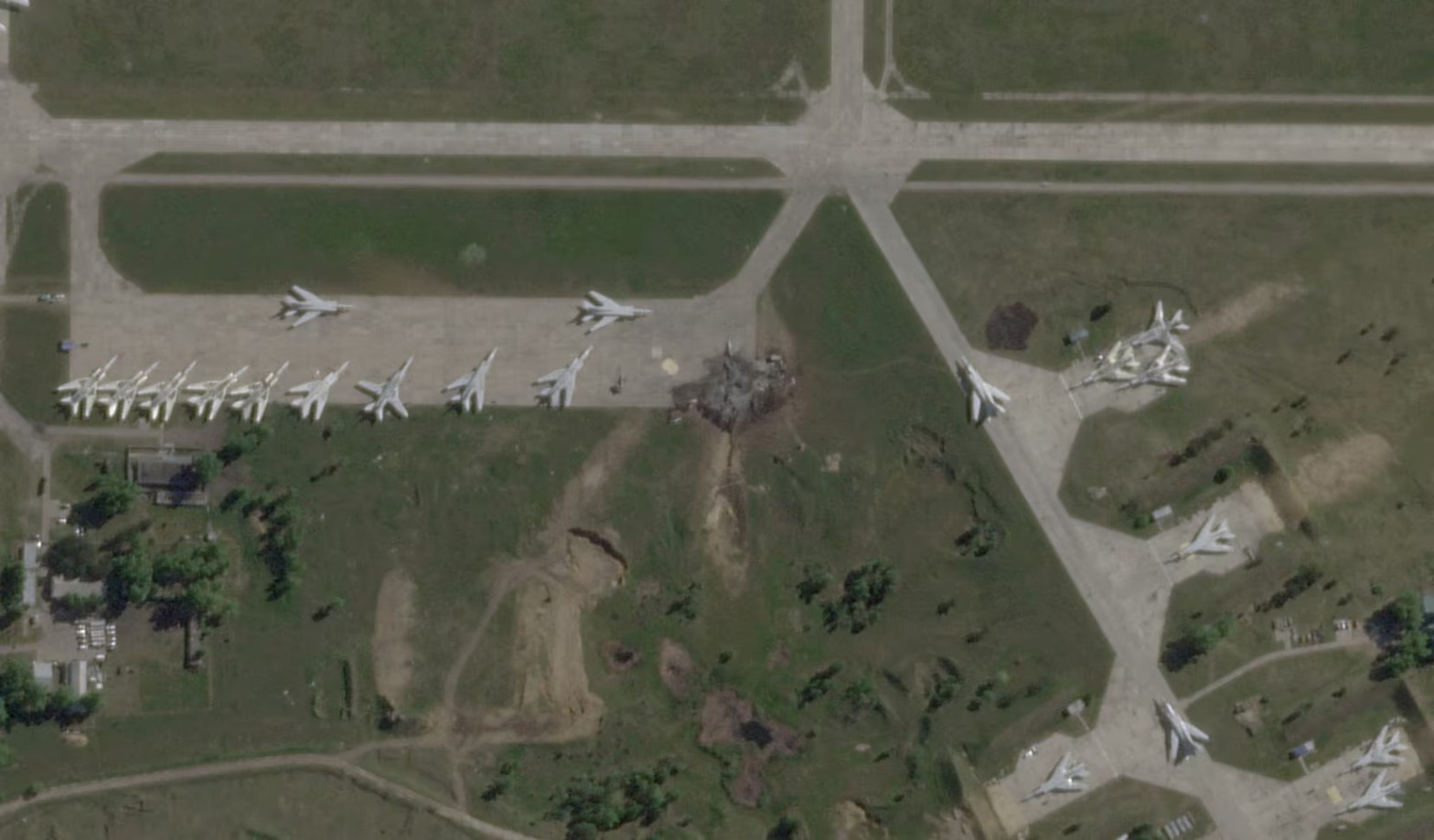
Ukraine achieved its longest-range attack into Russia on Sunday, 01 June, hitting targets on four strategic military bases nearly 4,000 kilometres away from Ukrainian territory, and hitting around 40 Russian warplanes. Thirteen of these were reportedly destroyed, and others damaged. Ukrainian President Zelensky claimed that 117 drones were used in the so-called “Spider’s Web” operation by the Security Service of Ukraine (SSU). The strike had been nearly 18 months in the planning. Russia acknowledged the Ukrainian attacks and termed them an “act of terror.” Zelensky congratulated SSU head Vasyl Maliuk on the “absolutely brilliant result” of the operation. “Interestingly, the ‘office’ of our operation on Russian territory was located right next to the regional office of FSB, the powerful state security service,” Zelensky said. “All the people involved in the operation had been safely moved out of Russia before the strikes,” he added.
The attacks took place as negotiators were heading to Istanbul for a second round of peace talks on Monday. An audacious drone attack sent a subtle message to the opposing side, and also to the West, which is already suffering from “war-fatigue.” This very daring operation is likely to further constrain relations and negatively impact peace talks. Meanwhile, a massive drone and missile attack was launched in response. Let us look at the targets and the drone attack modalities.
Complex Logistics Planning
The whole operation can be described as an “extremely complex logistic” plan. The SSU first transported the first-person view (FPV) drones to Russian territory in mobile wooden crates. Once on site, the drones were hidden under the roofs of these cabins, which had been placed on cargo vehicles. The genius of this entire operation was not the technology but the organizational and logistical part, multiplied by total local sloppiness in terms of ensuring elementary security measures.
Drone Attack Modalities
On the afternoon of 1 June 2025, the SSU launched a clandestine attack codenamed “Spider’s Web” on multiple Russian military airfields, targeting strategic bombers. Undoubtedly an “audacious and sophisticated” operation. The strike, which was 18 months in the making, successfully targeted 41 Russian bombers. The drones were hidden in wooden mobile cabins atop trucks. The cabins had remotely operated roofs. Trucks were brought near the airbases. At the right moment, the roofs were remotely opened, and the drones took off to strike the Russian bombers. Each of the 117 drones launched had its own controlling pilot. The targets were Russian strategic nuclear-capable bombers Tu-95 and Tu-22M3, as well as A-50 early warning warplanes. The attack destroyed or severely damaged dozens of aircraft deep inside Russian territory. Screenshots from footage released purportedly showed drone attacks on Russian warplanes. Video footage from several military airfields showed destroyed aircraft and planes engulfed in flames, though the full extent of the damage is still being assessed. Ukraine has estimated that 34 percent of Russia’s strategic bombers were damaged, costing a $7 billion loss to Russian strategic aviation, a claim that most consider highly exaggerated.
The government confirmed that in the Murmansk and Irkutsk regions, several aircraft reportedly caught fire after drones were launched from nearby areas. The blazes were extinguished, and there were no casualties. The Defence Ministry stated that drones had attacked airfields in five regions, stretching across five time zones. The attack on Belaya air base in Irkutsk was especially significant — it marked the first time any location in Siberia had come under attack. The Olenya base in Murmansk is one of the key strategic airfields with high-value nuclear-capable aircraft.
The operation was reportedly authorised and carried out at the highest levels. Some military analysts have likened Ukraine’s elaborate drone operation to a covert Israeli strike in September 2024, when Israel remotely detonated beepers and walkie-talkies it had earlier distributed to Hezbollah operatives in Lebanon, and killed at least nine people and wounded some 2,800, after the devices exploded nearly simultaneously across multiple sites. Other somewhat equivalent operations were Israel’s 1976 “Entebbe Raid” to rescue hostages 2,500 miles away; US Navy SEAL’s 2011 “Operation Neptune Spear” to kill Osama bin Laden in Abbottabad; and 2007 Israeli “Operation Orchard” stealth bombing of a Syrian nuclear facility.
Such an elaborate operation, mostly by the Ukrainians, would have had involvement of local Russians. Some of the participants in the terrorist attacks have been detained Russian sources said.
Russian Strategic Bombers
The Tupolev Tu-22M is a supersonic, variable-sweep wing, long-range strategic and maritime strike bomber developed in the 1960s. Just before the Ukraine conflict, there were 66 aircraft in service. Combat range is 2,500 km with a typical 10,000 kg weapons load. It can carry four Kh-47M2 Kinzhal nuclear-capable hypersonic air-launched ballistic missiles, many of which have been fired on targets in Ukraine. The Tupolev Tu-160 is also a supersonic, variable-sweep wing, heavy strategic bomber. It is the largest and heaviest Mach 2-plus supersonic military aircraft ever built. The first upgraded variant, Tu-160M, joined service in December 2014. In addition to 16 old, 50 new aircraft were to be built. The aircraft has a combat range of 2,000 km at Mach 1.5, and 7,300 km at subsonic speeds. It can carry a maximum of 45,000 kg ordnance, including 12 conventional or nuclear cruise missiles.
Attacked Airbases
The Russian Aerospace Forces’ Belaya airbase is in Irkutsk oblast (Siberia). This was the farthest target, nearly 4,900 kilometres east of Kiev. It is controlled by Long-Range Aviation. It has significant ramp space and 38 bomber revetments. It houses the Tu-22M3 bomber. There are a few transport aircraft. The base was especially important in projecting power against China following the Sino-Soviet split of the late 1960s. Not too far from the airbase is the Irkutsk Aviation Plant, which has produced over 7,000 aircraft, including the Su-27, Su-30, and Yak-130. It is also involved in the production of the MC-21 airliner.
Olenya airbase, also part of the Russian Aerospace Forces, is located in Olenegorsk, Murmansk Oblast. It is in the north-west part of the country, very close to northern Finland. It is also a major Russian Navy reconnaissance base, located on the Kola Peninsula, 92 km south of Murmansk. It is a key facility for intercontinental flights across the North Atlantic basin. The airbase operates Tupolev Tu-22M3 aircraft. Interestingly, the Tu-95V aircraft carrying the Tsar Bomba, the most powerful nuclear weapon ever detonated, took off from the airbase on 30 October 1961. The first test launch of the Kh-47M2 Kinzhal “Dagger,” a nuclear-capable air-launched ballistic missile, fired from a MiG-31K, in the Arctic, took place in mid-November 2019 from the airbase. In July 2024, Ukraine made an unconfirmed claim that they attacked the base with a drone and hit a Tu-22M3 bomber.
Dyagilevo airbase, operated by the Russian Aerospace Forces, is in Ryazan Oblast. It serves as a training centre for the strategic bomber force. It is very close to Belarus and not far from Ukraine. It has a Flight Refueller Aircraft (FRA) regiment with the Ilyushin Il-78/78M and the Instructor Red Banner Heavy Bomber Aviation Regiment as part of the Center for Combat Employment. A number of Tu-16, Tu-22, and M-4 aircraft are mothballed here. It is a training base for the Tu-134, Tu-95MS, and An-26. Air tankers operating Il-78 and Il-78M are stationed here. On 5 December 2022, the base was attacked by drones, which damaged a Tu-22M3 bomber and destroyed a fuel truck.
Ivanovo Severny airbase, northeast of Moscow, is controlled by Military Transport Aviation. It is home to the IL-76 aircraft and also to the Airborne Early Warning and Control (AEW&C) Aviation Regiment. It also has the combat training/development centre for military transport aviation, and uses the A-50 and A-50U AEW&C aircraft.
Not the First Long Distance Attack
Despite the great success of Ukrainian attacks, the world needs to temper expectations of the strategic outcomes. Russia has been under these sorts of attacks for some time, and Moscow’s resolve to achieve its war goals has not been affected. Ukraine has been undertaking a long-range strike campaign against targets inside Russia. They have hit targets in capital Moscow. It has done this to degrade Russia’s war-making capacity by attacking factories and oil refineries. Ukrainian drone attacks on Russia’s Ryazan refinery, southeast of Moscow, in March and May 2024, knocked out 3.3 million metric tons, or 4 percent, of the country’s total oil refining capacity. In June 2024, Ukraine claimed a successful drone strike on a Sukhoi Su-57 fifth-generation aircraft at the Akhtubinsk airfield, which is 589 kilometres from the front lines in Ukraine.
Russian Response to Drone Strikes
Ukraine’s most damaging drone strike of the war was escalatory in nature. Russia struck Ukraine with vengeance after the Ukrainian drone attack. The Ukrainian authorities said 472 drones and seven ballistic and cruise missiles were involved in a wave of attacks. Ukraine claimed it to be one of the largest single Russian drone attacks so far. Ukraine said it “neutralised” 385 aerial drones/projectiles. The land forces reported that 12 of its military personnel were killed and more than 60 injured in a missile strike on a training centre. Ukraine accused Russia of undermining the next round of peace talks.
What were Counter Drone Options?
Such a massive drone attack so deep was not anticipated, though there had been deep drone attacks in the past. There clearly was significant local support for this operation that had been building silently for 18 months. Ukrainians speak fluent Russian and merge with the local population. Clearly, it was an intelligence failure. If it can happen in a country that is run autocratically with a powerful Federal Security Service (FSB), the successor of the KGB, then it can happen in other lesser security-conscious countries even more easily.
The drones were flying in from just outside the airbases—very little flying time. FPV control was carried out using the mobile networks. Each drone was using Ardupilot hardware and software solution. A webcam is connected to the PC, which transmits the image and sends back commands to control the drone. If there had been some means to know, and had there been time, the mobile Internet could have been turned off.
Airfields with such strategic assets should have had anti-drone boundary security. This should have included electro-optical and IR cameras, anti-drone snipers, signal jammers, and anti-drone directed energy systems. The aircraft themselves could have been secured by foldable large nets.
To Summarise
The Spider Web operation represents a new normal for Ukraine’s asymmetric warfare strategy, combining long-term covert planning, insider logistics, and high-precision drone warfare to deliver one of the most impactful strikes of the conflict. It indeed was a “black day” for the military and security establishment, as they made “serious intelligence errors.” The strike has been a tactical and strategic success with a high degree of symbolism. Ukraine’s ability to strike strategic infrastructure deep inside hostile territory, using low-cost and high-level intelligence tactics, brings in a new dynamics to warfare.
Will these attacks force dispersal of Russia’s strategic assets? Will they now be moved more frequently across different airfields to reduce vulnerability? Will Russia now invest in creating hardened infrastructure to secure them? It remains to be seen whether anti-drone defences will be deployed across all major airbases, or if this was an isolated wake-up call. The success of the Spider Web operation has triggered serious introspection within the Russian military-security establishment.
The full import of the Ukrainian drone strikes on Russia’s military capabilities is too early to assess at this stage. The losses will reduce the number of cruise missile-carrying airborne platforms. These Russian supersonic/hypersonic air-launched cruise missiles (ALCMs) are harder to intercept. These strikes have greatly enhanced the Ukrainian military’s and civilian population’s morale and “will” to continue defending the country—morale that was fast depleting since US President Trump decided to slow military aid and support. For the peace talks, Ukraine has sent the signal that they are not negotiating from a position of weakness.
The aim of the attack was to put political pressure on Russian President Vladimir Putin to negotiate a war termination agreement favourable to Ukraine. If peace talks do not move forward, Russia could substantially increase aerial assaults to redeem its military honour. In 2012, Putin declared that “Nuclear weapons remain the most important guarantee of Russia’s sovereignty and territorial integrity and play a key role in maintaining the regional balance and stability.” Russia’s nuclear arsenal would also come into play in the event of “actions by an adversary affecting elements of critical importance, the disablement of which would disrupt response actions by nuclear forces.” In 2024, Putin ordered a revision of Russia’s nuclear doctrine to account for the complex geopolitical realities emerging from the ongoing Special Military Operation (SMO) in Ukraine, where the conflict has transformed into a proxy war between the collective West (NATO and the US) and Russia. Operation Spider Web has been an assault on critical Russian military infrastructure, directly linked to Russia’s strategic nuclear deterrence. Imagine an attack on B-2 bombers stationed at Whiteman Air Force Base in Missouri—a similar blow to US strategic assets. Many believe this Ukrainian operation could not have occurred without the tacit approval of Ukraine’s European partners, particularly the UK, France, and Germany, all of whom were in direct consultation with President Zelensky in the days preceding the attack. Some even speculate that the United States was also aware. There is growing concern that such developments might push the world toward a catastrophic situation.
Lessons for India – Whole of Nation Approach
In the four-day “Op Sindoor”, India had learnt lessons and the importance of drones and Loitering Munitions (LM) as offensive weapons, and also the need for counter-drone systems and strategy. Cheap FPV drones cost as little as $1,000. Hitting aircraft costing nearly $100 million or more is a very adverse ratio, but a new reality. These strikes and many earlier ones in the Ukraine conflict have great lessons for India. The impact of drones on future warfare has been re-emphasised. The composition of future militaries would require a balance between exquisite weapon platforms and large numbers of cheaper capabilities.
Military stations in densely populated cities are vulnerable to ground attacks. One would recall the attack by Tehrik-i-Taliban Pakistan (TTP) and Al Qaeda, which took place on 22 May 2011, at PNS Mehran, the headquarters of the Pakistan Navy’s Naval Air Arm and the most populous Pakistani military installation, located near the PAF’s Faisal Air Force Base of Karachi. Fifteen attackers killed 18 military personnel and wounded 16 in a sophisticated terrorist attack and also destroyed two American-built P-3C Orion surveillance aircraft. Similarly, there were failed attacks at IAF’s Pathankot airfield and also a drone attack against Jammu airfield.
The military bases, in war zones and deeper home, are now even more vulnerable. Some of the larger strategic assets such as AEW&C, Flight Refueller Aircraft (FRA), and Cargo aircraft cannot be parked under hardened shelters. Placed in the open, they will be vulnerable. While aircraft strikes and even cruise missiles can be intercepted, small drones in large numbers, launched from across the airfield boundary wall, would have different dynamics. Airfield security would have to be tightened. These scarce and expensive assets must be dispersed more often. Security around all airbases and military installations has to be further tightened.
The Russian intelligence agencies and internal security apparatus could not track these drone-laden trucks for so long. Security is now everyone’s business. India is a multi-cultural country with a huge population. Most military installations and airfields have civilian population and structures close to the boundary walls. The local police, the highway and traffic police, Intelligence Bureau (IB), military police have all to be in great coordination. General public awareness has also to go up.
Anti-drone measures have evolved and need to be put in place at all locations to defend high-value targets. These could be used to hit not just military targets but also political centres of power, large political rallies, and religious congregations. Time to get into a huddle and do some out-of-the-box thinking and get our “anti-drone” act right.
Note: The article was originally written by the Author for First Post on June 7th, 2025, it has since been updated.
Header Picture Credit: Reuters
Twitter: @AirPowerAsia
 Air Power Asia