
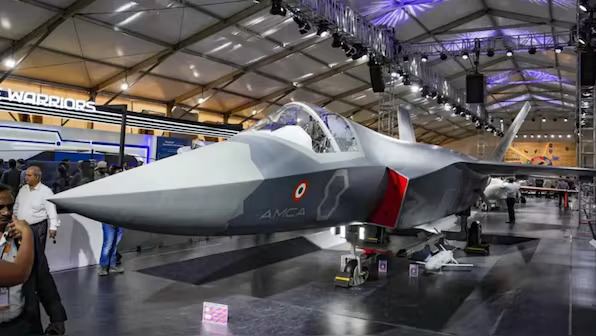
The AMCA (Advanced Medium Combat Aircraft) program in India is considered urgent due to the country’s declining fighter squadron strength, the modernization of rival air forces, and the need to maintain a technological edge in air combat. The program aims to replace aging aircraft and introduce a fifth-generation fighter, addressing both operational and strategic requirements. The Indian Air Force (IAF) is down to 29 fighter squadrons vis-à-vis the sanctioned strength of 42, and several more are scheduled for retirement in the coming years. IAF was forced to stretch the MiG-21 aircraft fleet, and the last of these squadrons will wind down mid-September 2025.
China has inducted fifth-generation J-20 fighters in large numbers and is already flight-testing two sixth-generation fighters. Pakistan has been upgrading its air force with advanced fighter jets and aerial weapons, and is seeking stealth fifth-generation fighter aircraft from both China and Turkey. This is creating an imbalance in the region.n.
The F-35 and Su-57
The American F-35 Lightning II stealth fighter has not been on formal offer to India; in fact, the USA had denied the F-35 to its NATO ally Turkey since, like India, they had acquired the Russian S-400 AD system. President Trump’s unpredictable tariff policies have been targeting India, among many others. Historically, the USA has often jettisoned global partners when its own interests were no longer in congruence. As per a Bloomberg report, India had notified the United States that it will not acquire the F-35 stealth fighter jets. The F-35 was reportedly proposed as part of a broader US plan to increase military sales to India.
The F-35 is priced close to $100 million per unit and is quite expensive to maintain. The F-35 will have compatibility issues with India’s Russian-origin equipment, such as Il-78 refuelling aircraft. Additionally, the US is unlikely to meet India’s requirements for co-production or technology transfer, which are central to the “Make in India” initiative. In contrast, Russia has offered to co-produce its Su-57 stealth fighter in India, aligning with these goals. Su-57 is much cheaper at nearly $60–65 million. But total numbers built are still very few (42), and earlier India had walked away from its predecessor, the joint fifth-generation fighter aircraft (FGFA). But then, the Su-57 is the only serious foreign offer as on date.
AMCA’s early success is a strategic imperative for India, enhancing its air combat capabilities and reducing reliance on foreign platforms. The AMCA is meant to provide a technological advantage over adversaries and enable India to compete in modern air warfare. The program aims to reduce reliance on foreign technology and boost indigenous aerospace capabilities. Meeting the projected induction timeline of the AMCA is crucial to address the operational gaps and maintain a credible deterrent. In essence, the AMCA is not just a fighter jet project; it’s a national security priority that requires swift and decisive action to maintain India’s aerial dominance and strategic posture.
AMCA Status
The single-seat, twin-engine, fifth-generation stealth, multirole AMCA is being designed by the Aeronautical Development Agency (ADA), an aircraft design agency under the Ministry of Defence (MoD). The AMCA is intended to perform a multitude of missions including air supremacy, ground strike, Suppression of Enemy Air Defences (SEAD) and electronic warfare (EW) missions. It is intended to supplant the Sukhoi Su-30MKI air superiority fighter, which forms the backbone of the IAF fighter fleet. The AMCA design is optimized for low radar cross section and super-cruise capability.
As of July 2025, the prototype development phase is underway after the completion of the feasibility study, preliminary design stage, and detailed design phase. The AMCA programme, originally launched in 2010 as a 20-tonne class fighter, is now a 25-tonne class fighter. The design work was completed in 2023, and approval for the ₹15,000 crore (US$1.8 billion) project for prototype development was received from CCS in March 2024. A total of 5 prototypes are to be built. The first three prototypes will carry out developmental flight trials, whereas the next two will focus on weapon trials. The prototype will be rolled out at an interval of 8–9 months.
The initial plan was to form a Special Purpose Vehicle (SPV) consisting of ADA, Hindustan Aeronautics Limited (HAL), and a private company for the development and production of AMCA. At the Aero India 2025, a full-scale engineering model of the AMCA was publicly demonstrated for the first time. As revealed during the event, ADA had laid out a 10-year development roadmap from the phase that began in April 2024. The prototype rollout is planned by late 2026 or early 2027, followed by the first flight in 2028, certification by 2032, and induction in 2034. Each prototype will cost ₹1,000 crore (US$120 million).
Proposal for Industry Partnership Model
It has been reported that the government is yet to decide the production partner for the aircraft, as ADA has proposed handing over the responsibility to private sector companies rather than HAL, in view of the company’s “not-so-great delivery track record.” Multiple meetings have been held, and HAL has pushed for an additional assembly line dedicated to the AMCA if required. Meanwhile, the government has shifted to an “industry partnership model” instead of the initial plans for an SPV. ADA’s push for changing the production partner is aimed at avoiding further delays, following setbacks from development funding issues and the lack of clearance from the US government for licensed production of engines. The private sector partner would be responsible for development, production, and lifetime maintenance of the jet.
The MoD formed a panel to examine increasing the role of private sector companies in the development of the AMCA. A top-level committee has evaluated a “clear-cut strategy and production-cum-business model” to accelerate the development of the AMCA. The committee was tasked with devising a plan to “shrink timelines” to get the AMCA from the drawing board to the air, as well as to advance the development of the high-thrust indigenous engine. On 27 May 2025, the MoD cleared the “Advanced Medium Combat Aircraft (AMCA) Programme Execution Model.” Under this model, the ADA will release an Expression of Interest (EOI) to develop the AMCA through industry partnership. Both private and public sector companies can bid either as independent entities or as consortia/joint ventures to secure the contract. As of now, the prototype rollout is expected by 2028–29, the first flight by 2029, service introduction by 2034, and series production by 2035. HAL is reportedly set to evaluate responses from 24 companies in order to select a partner firm for the formation of a consortium. This consortium, structured under the Public-Private Partnership (PPP) model, will subsequently bid to become the designated AMCA development consortium.
On 18 June 2025, the EOI was released by ADA to shortlist Indian companies for prototype development, flight testing, and certification of the AMCA. The document calls for “reputed” Indian companies that comply with Indian laws and have experience in the Aerospace and Defence Sector. The bidder must establish dedicated facilities for the series production of the aircraft. The bidder must complete the development, prototyping, flight testing, and certification of the AMCA within eight years of signing the contract. The deadline for responding to the EOI is 16 August, with a pre-EOI meeting scheduled before that date.
Engine development
Initially, ADA had planned to issue a Request for Proposal (RfP) to six Original Equipment Manufacturers (OEMs) for the co-development of an afterburning low-bypass turbofan in the 110 kN thrust class. As per a Government statement in the Rajya Sabha during the Winter Session 2021, there was a proposal to jointly develop the engine for the AMCA with the help of a foreign partner, using know-how from the Kaveri engine development programme. On 15 July 2023, India and France agreed to collaborate on the joint development of a combat aircraft engine, which would power the Mark-2 variant of the AMCA, as part of the Horizon 2047 document for the India–France strategic partnership.
On 18 November 2023, Dr. Samir V. Kamat, Chairman of the DRDO, announced that the United States had provided the necessary permits, enabling GE Aerospace and HAL to jointly produce the General Electric F414 engine in India for the HAL Tejas Mark 2 and for the first two squadrons of the AMCA.
As of September 2024, foreign firms offering joint venture development include the US-origin General Electric, UK-origin Rolls-Royce, and French-origin Safran. The latter two had also offered 100% intellectual property (IP) rights for the engine design. Safran and Rolls-Royce have received clearance from their respective countries for engine development. In October 2024, Safran and HAL signed an MoU to develop industrial cooperation in forging parts manufacturing for commercial engines. At its Bangalore facility, HAL would supply engine parts of the CFM International LEAP to Safran Aircraft Engines.
On 18 February 2025, it was reported that while France was in the advanced stages of talks with India, Rolls-Royce Holdings was also in discussions with India for the engine co-development programme for the AMCA. They offered “to co-develop and co-design, allowing India to own the IP in India, for India, for use in current as well as future programmes.”
By 18 July, the MoD officially recommended a strategic partnership with France to co-develop a next-generation engine with a thrust of 120 kN (27,000 lbf). The recommendation was forwarded to the Government after a consultative process, including feedback from stakeholders and a technical committee that examined all aspects of fighter jet engine manufacturing. This strategic project is valued at ₹61,000 crore (US$7.2 billion). Safran had earlier suggested a roadmap that would be synchronised with the developmental timeline of the AMCA. As per estimates, India will require around 250 of these engines over the next decade.
Government Support’s Private Sector
The Indian government is actively promoting private sector involvement through various initiatives and policies. A new model for the AMCA program allows private firms to bid alongside HAL, either independently or in collaboration with other Indian or foreign partners. Increased private sector participation aligns with government goals to foster indigenous manufacturing and achieve self-reliance under the “Make in India” and “Atmanirbhar Bharat” initiatives in defence production.
The AMCA program is categorized as a Make-I project under the Defence Acquisition Procedure (DAP) 2020. This offers government funding for Research & Development (R&D) and incentives such as research grants, tax concessions, and preferential procurement terms to private companies. Innovations for Defence Excellence (iDEX) initiatives provide grants and support to start-ups and MSMEs for developing innovative defence technologies, creating a vibrant ecosystem for private sector involvement. Companies can also leverage the Production-Linked Incentive (PLI) scheme and simplified FDI norms. Programs such as the Defence Industrial Corridors and the DRDO Technology Development Fund encourage participation from smaller firms.
Private Sector and AMCA
For long, military aircraft development and production in India have been the preserve of the Defence Research and Development Organisation (DRDO) and the Defence Public Sector Undertaking (DPSU), Hindustan Aeronautics Limited (HAL). The recent contract for the Indian Air Force’s (IAF) CASA C-295W broke that trend, with the contract awarded to the private sector firm Tata Advanced Systems Limited (TASL).
Hindustan Aeronautics Limited (HAL) has a substantial captive order book from the Indian Armed Forces, which includes the Light Combat Aircraft (LCA) Mk1 and Mk2 variants, a variety of helicopters, trainers, aero-engines, and aircraft overhauls. Defence Research and Development Organisation (DRDO) Chief Mr. Kamat recently announced that the Aeronautical Development Agency (ADA) will select the Advanced Medium Combat Aircraft (AMCA) production partner by the end of the year. The move seeks to leverage private sector efficiency to avoid the delays that have plagued past defence projects. Private firms can participate in designing and engineering various components and subsystems of the AMCA — from structural elements like the fuselage and wings to specialized parts like composite panels. Companies with expertise in avionics, propulsion, stealth features, advanced materials, and electronic warfare can contribute to integrating the complex systems within the AMCA.
Private companies can provide crucial support throughout the aircraft’s lifecycle, including Maintenance, Repair, and Overhaul (MRO) services, as well as the supply of spare parts. The private sector can also contribute to skill development and technological advancement. Their participation in the AMCA program will foster the growth of advanced manufacturing capabilities, high-precision machining, avionics, embedded software, and other critical technologies within the industry.
Consortium Approach
Companies like TASL, Larsen & Toubro (L&T), Vem Technologies, and Alpha Tocol Engineering Services are already involved in manufacturing various components and assemblies for HAL projects and are well-positioned to play a significant role in AMCA development. Other players such as Mahindra Defence, Bharat Forge, and Adani Defence are also major contributors to defence production, expanding into aerospace manufacturing, and are likely to contribute to the AMCA supply chains. Even IT giants like Infosys, TCS, and Cyient have cleared technical evaluations for designing the AMCA stealth fighter airframe and sub-systems, highlighting the broadening scope of private sector involvement.
Private companies are known for their agility and efficiency, which can help accelerate the design, development, and production phases of the AMCA program. Increased private sector involvement fosters the growth of indigenous capabilities, reducing India’s dependence on foreign technology and boosting domestic aerospace expertise. Competition among private players can drive down costs and encourage innovation, resulting in a more robust and advanced AMCA. The AMCA project, with its substantial investment and long-term scope, is also expected to generate numerous job opportunities across various skill levels and contribute to the growth of India’s defence and aerospace industrial ecosystem.
A good approach would be to form a consortium of private companies. Such an approach is being followed in most aircraft-building programs around the world. The F-22 Raptor was a joint program between Lockheed Martin and Boeing. The Global Combat Air Program (GCAP) is a joint initiative between UK, Japan, and Italy-based companies. The Future Combat Air System (FCAS) program includes Dassault Aviation, Airbus, Thales, Indra Sistemas, and EUMET, among others.
Large corporates like TASL or L&T could serve as the prime contractor and main integrator. Others with individual strengths could act as partners. Companies specializing in stealth technologies can focus on manufacturing radar-absorbing composites, designing stealth airframe parts, and engineering internal weapon systems—crucial for maintaining a low radar cross-section and low electromagnetic signatures. Private players can contribute by building AI-powered avionics, sensor fusion systems, advanced electronic warfare (EW) solutions, net-centric capabilities, electronics, and sensor suites. Firms can also develop engines, components, and technologies that enable supersonic flight without afterburners and support thrust-vectoring systems for improved agility. With propulsion systems initially using GE F414 engines, private industry can participate in the co-production and supply of key engine components.
Private companies can work on developing smart weapons. Firms in the aerospace supply chain can contribute precision components, machined parts, and provide quality testing and certification services. The production of advanced alloys is another significant area for private sector participation. Bharat Forge has notable expertise in forgings. Private companies can also engage in supplying parts, sub-assemblies, and specialized materials. In the LCA project, over 500 Indian companies, including MSMEs, are involved—indicating a broad and deep ecosystem of Tier-2 and Tier-3 suppliers.
This collaborative approach, combined with the dynamism and innovation of private firms, is expected to accelerate the development and production of India’s ambitious fifth-generation stealth fighter jet, contributing significantly to national security and self-reliance. It is time to take decisive action and get going, India.
Note: The article was originally written by the Author for First Post on August 6th, 2025, it has since been updated.
Header Picture Credit: Press Trust Of India
Twitter: @AirPowerAsia
 Air Power Asia