
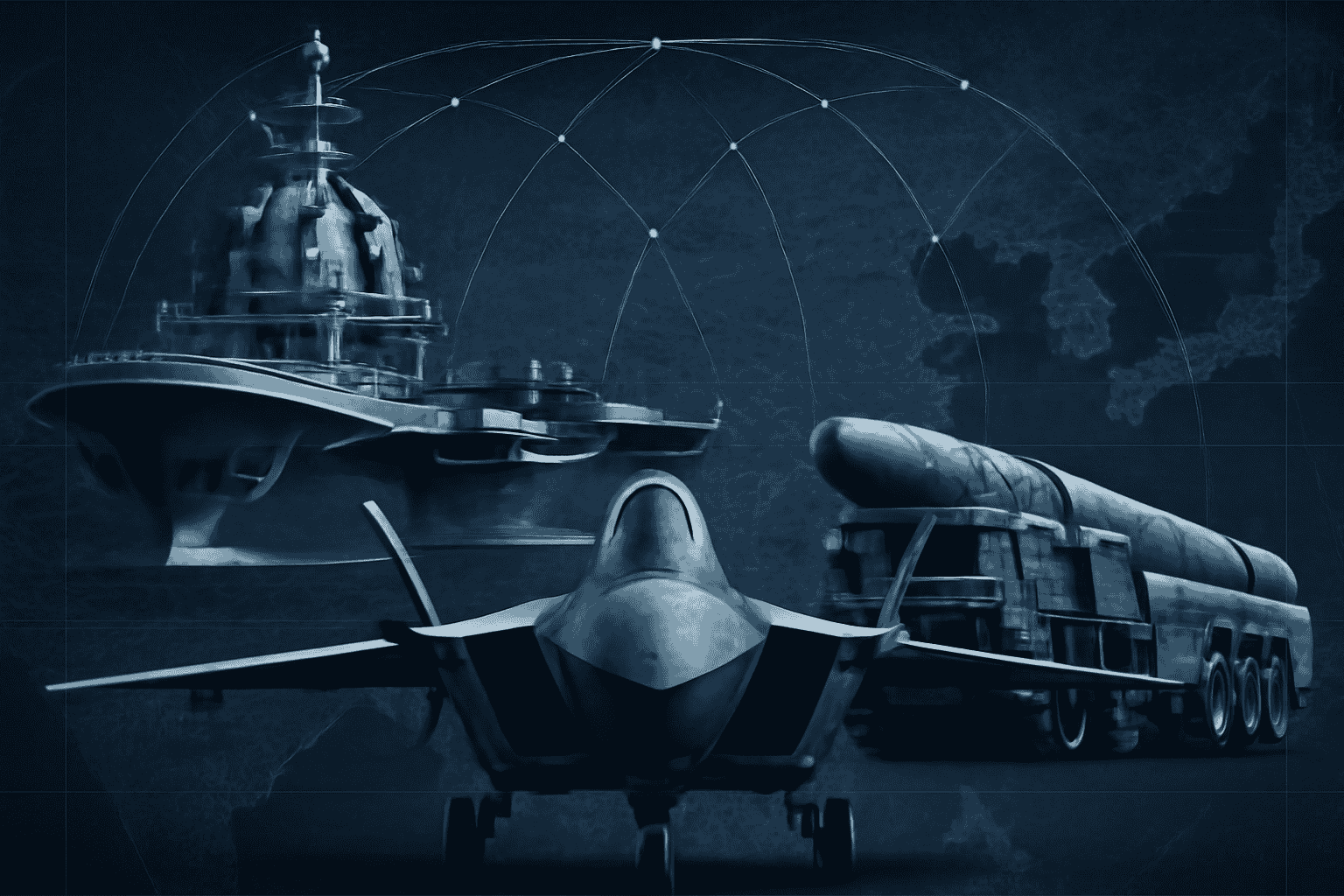
As China seeks to achieve “national rejuvenation” by its centenary in 2049, Chinese Communist Party (CCP) leaders view a modern, capable, and “world-class” military as essential to achieving its revisionist aims (changing the current status quo) and overcoming what Beijing sees as an increasingly turbulent international environment. This is the guiding principle charting China’s national, economic, and military strategy. It is thus important to understand the People’s Liberation Army’s (PLA) strategic thinking, current capabilities, and activities as well as its future modernization goals.
China continues its efforts to transform the PLA into an increasingly capable instrument of national power. The PLA is adopting more coercive actions in the Indo-Pacific region, and elsewhere, while accelerating its development of capabilities and concepts to strengthen China’s ability to “fight and win wars” against a “stronger enemy,” counter an intervention by a third party in a conflict along China’s periphery, and project power globally.
Understanding China’s Strategy
China’s longstanding national strategy determinedly pursues political, social, economic, technological, and military development to increase China’s national power and revise the international order in support of China’s system of governance and national interests. China’s stated foreign policy seeks to reshape the international order into what it calls a “community of common destiny.” Chinese leaders claim their power to shape world events continues to grow, presenting “new strategic opportunities” to create an environment favorable for China’s interests.
China acknowledges that internal and external challenges have complicated its economic recovery and growth post‑Covid. It is trying to recover its long-term growth trajectory. China’s ongoing military modernization objectives are commensurate with and part of its broader national development aspirations to invest heavily in technological self-sufficiency and concentrate on advanced manufacturing. China’s stated defence policy remains oriented toward advancing its sovereignty, security, and development interests while emphasizing a greater global role for itself. Beijing has demonstrated an increasing willingness to use military coercion and inducements to achieve these aims. But the senior military leadership is mired in corruption, and Xi Jinping is pushing through an unending purge. It includes the sacking of two Defence Ministers while the third is under investigation. Similarly, many loyal generals had to be shown the door.
PLACapabilities
The PLA is in a serious process of modernization of its capabilities and improving its proficiencies across all warfare domains to become a joint force capable of the full range of land, air, and maritime as well as nuclear, space, counter-space, electronic warfare, and cyberspace operations. Despite its progress, the force still has significant deficiencies, including in commander proficiency, long-distance logistics, and urban warfare. The PLA continued to adjust its military structures, field modern indigenous systems, build readiness, and strengthen its competency to conduct joint operations. While it is pulling way ahead of neighbours India, Japan, and South Korea, it has some distance to cover to reach the capabilities of the USA.
PLA Ground Force (PLAGF)
The PLAGF, with one million active personnel, continues its decades-long effort to modernize equipment and focus on combined arms and joint training. The PLAGF is undergoing significant reform, experimentation, modernization, and restructuring to deal with potential threats and enhance its capabilities. Divisions are downsized into combined arms brigades, which are reorganized into high-readiness army groups.
While the size of the PLAGF has been reduced over the past few decades, technology-intensive elements such as special operations forces (SOF), army aviation (helicopters), surface-to-air missiles (SAMs), and electronic warfare units have all been significantly expanded. The latest operational doctrine of the PLAGF highlights the importance of information technology, electronic and information warfare, and long-range precision strikes. The older generation command, control, and communications systems are being replaced by integrated battlefield information networks featuring local/wide-area networks, satellite communications, unmanned aerial vehicle (UAV)-based surveillance and reconnaissance systems, and mobile command and control centers for network-centric warfare capability. The PLAGF has 4,700 main battle tanks and 1,250 light tanks, and a huge force of self-propelled artillery.
It has been demonstrating long-range joint fires capabilities during exercises. The Joint Sword‑2024 was a military exercise organized by the Eastern Theatre Command (ETC) to train and test the land, sea, air, and rocket forces of the theatre of operations in the vicinity of Taiwan. The weapons and equipment, including fifth‑generation Chengdu J‑20, Shenyang J‑16, Type 052C destroyer, Type 071 amphibious transport dock, Dongfeng series missiles, and box-type long‑range rockets were exercised.
PLA Navy (PLAN)
Numerically, PLAN is the largest navy in the world. It has 384,000 active personnel, and over 370 combatant ships (including 79 submarines), and 600 aircraft. It is the second-largest navy in the world by total displacement tonnage, at 2 million tons, behind only the United States Navy (USN). China is projected to have 475 battle force ships by 2035 while the USN will have 305 to 317. This would put the United States at a numerical and operational disadvantage, especially in the West Pacific. China’s shipbuilding capacity is also many times more than the USA.
The PLAN has grown ability to perform missions beyond the First Island Chain (FIC) and is already working towards dominating the 2nd Island Chain. Three aircraft carriers are at sea, and three much larger ones are planned in the coming decade. The PLAN’s combat units are deployed among three theatre command fleets, namely the North Sea, East Sea and South Sea Fleet, which serve the Northern, Eastern and Southern Theatre Command, respectively. China’s closeness with Pakistan, Bangladesh, and ports in Hambantota, Gwadar, and Djibouti, among others, make it easier for PLAN to operate in the Indian Ocean. Their forays are also increasing, to the detriment of India.
PLA Air Force (PLAAF) and Aviation Industry
The PLAAF has 403,000 active personnel, and controls most of the PLA’s air assets, including tactical aircraft, large airlifters, and strategic bombers. PLAAF operates a fleet of nearly 4,000 aircraft, of which around 2,566 are combat aircraft (fighter, attack, and bombers). PLAAF includes ground-based air defence assets, including national early‑warning radars, and controls the Airborne Corps. PLAAF is backed by a very modern aircraft industry.
The Aviation Industry Corporation of China (AVIC) is the state-owned publicly traded aerospace and defence conglomerate. In 2024, AVIC was ranked second among the world’s top defense companies. It has over 100 subsidiaries, 27 listed companies, and 500,000 employees across the globe. It had a total revenue of $119 billion, including non‑defence services. China’s hypersonic missile technologies have greatly advanced during the past 20 years. Many Chinese missile programs are comparable to other international top‑tier producers.
The PLAAF made substantial progress in transitioning to more modern airpower with the acquisition and development of advanced aircraft like the Sukhoi Su‑27 variants and their domestic models, and indigenous J‑10 fighters. China has two fifth‑generation fighters, the J‑20 and the J‑35. Over 300 J‑20s have been built and PLAAF plans to have 1,000 by 2030 and 1,500 by 2035. On December 26, 2024, China carried out the test flights of its two sixth‑generation J‑36 and J‑XX fighter jets.
The strategic orientation of the PLAAF continued to evolve with a focus on expanding its operational capabilities, including the development of long‑range stealth bombers (H‑20) and enhancing joint operational capacity with other branches of the Chinese military. China is modernizing and indigenizing its aircraft and unmanned aerial systems rapidly, matching U.S. standards. The PLA recently transferred significant portions of PLAN shore‑based, fixed‑wing combat aviation units, facilities, air defence, and radar units to the PLAAF. This will enable better command and control over China’s integrated air defence system.
PLARocketForce(PLARF)
The PLARF is the 4th branch of PLA. It controls China’s strategic and tactical missile arsenal of land‑based ballistic, hypersonic, and cruise missiles, both nuclear and conventional. The PLARF is under the direct command of the CMC. It has approximately 300,000 personnel and six ballistic missile “Bases” (units at roughly corps level), plus three support Bases in charge of storage, engineering, and training, respectively. The six operational Bases are independently deployed in the five Theatres throughout China, and each controls a number of brigades.
China has the largest land‑based missile arsenal in the world. According to U.S. Department of Defense (DoD) estimates, this includes 400 ground‑launched cruise missiles, 900 conventionally armed short‑range ballistic missiles, 1,300 conventional medium‑range ballistic missiles, 500 conventional intermediate‑range ballistic missiles, as well as 400 intercontinental ballistic missiles (ICBM). Many of these are extremely accurate, which would allow them to destroy targets even without nuclear warheads.
The PLARF is advancing its long‑term modernization plans to enhance its “strategic deterrence” capabilities. China is developing new ICBMs that will significantly improve its nuclear‑capable missile forces and will require increased nuclear warhead production. China may also be exploring development of conventionally armed intercontinental‑range missile systems. If developed and fielded, such capabilities would enable China to threaten conventional strikes against targets in the continental United States. China can already make conventional strikes anywhere in India.
Nuclear Capabilities
The PLA seeks a larger and more diverse nuclear force, comprised of systems ranging from low‑yield precision strike missiles to ICBMs with multi‑megaton yields to provide it multiple options on the escalation ladder. Beijing continued its rapid nuclear expansion. In 2025, Federation of American Scientists estimated the Chinese nuclear stockpile at around 600 warheads, while the Pentagon estimates that China will have around 1,000 warheads by 2030 and 1,500 by 2035, much of which will be deployed at higher readiness levels.
The Former Strategic Support Force (SSF)
The SSF was meant to support PLA’s ability to fight what China terms “informationized conflicts” and enhance the PLA’s power projection capabilities in space and cyberspace. In April 2024, Beijing dissolved the SSF, and positioned its subordinate forces, the Aerospace Force (ASF) and the Cyberspace Force (CSF), directly under the CMC. Beijing also established a new Information Support Force (ISF), under the CMC, to coordinate the management of the military’s networks and communications systems. The updated PLA organizational structure now features four Theatre‑grade services, the PLAGF, PLAN, PLAAF, and PLARF, and four deputy‑Theatre‑grade forces or service arms, the ASF, CSF, ISF, and the Joint Logistic Support Force (JLSF).
The Joint Logistic Support Force
The JLSF is the rear echelon and logistics arm of the PLA. It was established in September 2016, and was recognized as an arm of the PLA in April 2024. It is structured around a central “Logistics Base” in Wuhan, a major transport hub. Five joint logistics support centers are assigned to each of the five Theatre Commands. The JLSF is working on improving joint strategic and campaign‑level logistic efficiencies through training and integrating civilian products and services. The JLSF supports multimodal transportation methods to facilitate the movement of PLA forces and equipment.
PLA Reserves, Paramilitary, and Militia Forces
Interoperability and integration between the PLA, its reserve components, and China’s paramilitary forces continue to grow in scale and sophistication, including the coordination between the PLAN, the China Coast Guard (CCG), and the China Maritime Militia (CMM). China primarily relies on its CCG and CMM for maritime coercion while selectively using the PLAN to provide over‑watch to deter rival claimants and quickly respond with force, if necessary. The People’s Armed Police (PAP) is an additional paramilitary component of China’s armed forces. Its primary missions include internal security, maritime security, and augmentation to the PLA during conflict.
Special Operations Forces (SOF)
The special operations forces of the PLA are units that conduct direct action and reconnaissance, including in enemy rear areas, to prepare the advance of friendly forces. They also perform counter‑terrorism operations, although that task is formally assigned to PAP. Each Theatre Command controls its own SOF units. Most ground SOF are organized like conventional light infantry units. The PLA SOF consisted of 15 PLAGF brigades, one PLAN Marine Corps brigade, one PLAAF Airborne Corps brigade, and a PLARF Reconnaissance Regiment.
Chinese SOF units lack real‑world combat experience. SOF do not have a national‑level special operations command to oversee all SOF activities. Despite an emphasis on joint training, Theatre commanders have no authority over PAP units, making it difficult to incorporate PAP and SOF into PLA training exercises.
Advancements in Informatized and Intelligentized Military
China’s military strategy is to integrate technology into warfare. It involves using artificial intelligence (AI), big data, and other technologies. Informatization involves integrating networks, information systems, and data into military operations. These include command and control, intelligence, surveillance, and reconnaissance (ISR), and cyber operations. Intelligentization involves incorporating emerging technologies such as AI, quantum, virtual and augmented reality, cloud computing, autonomous systems, and the Internet of Things (IoT). It includes the concept of “hybrid intelligence,” which blends human and machine intelligence. China envisions a “Metaverse War,” and is emphasizing improving the PLA’s human resources to meet the requirements of modern warfare.
The PLA considers information operations (IO) important for achieving information superiority early in a conflict, which it considers a critical requirement for the success of any military campaign, and is being exercised regularly. China has significant persistent cyber‑enabled espionage and attack capability. It can be a threat to an adversary’s military and critical infrastructure systems. Also, China has the second‑largest number of military satellites in the world, after the United States. It has demonstrated the ability to shoot down a satellite in orbit.
Theatre Commands
China continues to refine the establishment of the Theatre Commands. The Eastern Theatre Command (ETC) is oriented toward Taiwan and the East China Sea and would likely oversee a Taiwan campaign. The ETC continues to execute exercises aimed at pressurizing Taiwan. The Southern Theatre Command (STC) is oriented toward the South China Sea (SCS) and Southeast Asia border security. It responds to U.S. freedom of navigation operations in the SCS and can assume command, as needed, over all CCG and CMM ships enforcing China’s claimed sovereignty. STC units conduct multiple live‑fire drills and amphibious training events near China’s occupied features in the SCS, including the deployment of howitzers and counter‑battery radars at the China‑Myanmar border.
The Western Theatre Command (WTC) is oriented toward India and counterterrorism missions along China’s Central Asia borders. Its geographic coverage area is more than the size of India. The WTC focuses on Xinjiang and Tibet Autonomous Regions, where the CCP perceives a high threat of what it defines as the three evils of “separatism, terrorism, and extremism.” WTC continues to blow hot and cold in both Ladakh and Arunachal Pradesh of India. The Northern Theatre Command (NTC) is oriented toward the Korean Peninsula and Russian border security, and the Central Theatre Command (CTC) mission is the defence of Beijing while providing support to other Theatre commands.
Evolving PLA Capabilities for Power Projection
The PLA remains focused on developing capabilities to provide options for China to dissuade, deter, or, if ordered, defeat third‑party intervention in the Indo‑Pacific region and globally. The PLA has undertaken important structural reforms and introduced new military doctrine to strengthen joint operations and is testing joint capabilities in and beyond the FIC. It has primarily emphasized power projection capabilities in the maritime domain, and improvements in air and naval systems enable the PLA to operate farther from the Chinese mainland for longer.
PLA Preparations across Himalayas
The PLA has enhanced its capabilities in the Himalayas by improving infrastructure, building airbases, and developing new weapons. Advanced infrastructure includes an integrated road and rail network. PLA military camps close to the border areas help their forces acclimatize to the high‑altitude conditions. The PLA has extended power to border outposts in the Himalayas, which helps troops stay warm and safe in the winter. They have micro‑pressure chambers and improved air supply that help soldiers recover after patrols or strenuous activities. They have built a bridge across the Pangong Tso lake in Ladakh, which helps troops and tanks mobilize faster. The PLA has built new airbases in Tingri and Shannan‑Lhunze, and has strengthened existing airbases like Lhasa‑Gonggar and Shigatse. PLA has improved weapon stocking. They have armed UAVs that can penetrate Indian airspace, perform ISR operations, and obtain coordinates for missile targets. All these capabilities are of particular concern to India.
To Summarise
Global think‑tank analyses indicate that Beijing spends 40 percent to 90 percent more than it formally announces in its defence budget, which equates to approximately $330 billion to $450 billion in total defence spending for 2024.
China’s main concentration remains towards annexing Taiwan. It also means challenging US military in the Western Pacific. China continues to engage with many groups that oppose USA, such as Iranian proxies, Hezbollah in Lebanon, the Houthis in Yemen, or Iran‑backed militia groups in Iraq. China has been trying to engage with Afghanistan through Pakistan to discuss stability, regional peace, counterterrorism, and security for Chinese nationals, institutions, and projects in the region—but to not much avail.
In recent years, China has employed a more coercive approach to deal with disputes over maritime features, rights to potentially rich offshore oil and gas deposits, and border areas, including India. Its desire for a bi‑polar world and uni‑polar Asia makes it turn towards India, mostly to try to put it in place, and prevent it from being a challenge to its hegemony. The approach across Himalayas and in SCS remains coercive. Tensions with India along the Line of Actual Control (LAC) sparked a standoff between China and Indian forces and skirmishes in mid‑2020 in the Galwan Valley. In late 2022, PLA and Indian forces engaged in an unarmed clash near Tawang along the Eastern Sector of the LAC separating Tibet and the Indian state of Arunachal Pradesh. China also continues to arm‑twist Bhutan for territorial gains.
China continues to build overseas military bases and logistics facilities to allow the PLA to project and sustain military power at greater distances. China is the largest contributor of peacekeepers among the five UN Security Council permanent members, having deployed about 50,000 personnel over the last 31 years. China uses international outreach to garner the assistance of partner governments. Of late China has increased bilateral and multilateral exercises to normalize its overseas presence and deepen defense ties. These include the “Shaheen” air exercises with Pakistan, “Falcon Strike” air exercise with Thailand, “Maritime Security Belt” naval exercise with Russia and Iran (2019), and “Blue Sword” with Saudi Arabia. Beijing first participated in Russia’s VOSTOK capstone exercise in 2018.
China remains the fourth‑largest arms supplier in the world and sells nearly every category of conventional military equipment, including unmanned aerial vehicles, man‑portable air‑defence systems (MANPADS), submarines, naval surface vessels, surface‑to‑air missile systems, and fighter aircraft to customers worldwide. China’s share of international arms exports was 5.9 percent between 2020 and 2024.
PLA remains mired in corruption and many senior leaders had to be removed. This has demoralized the forces and caused confusion in the command structure. This is bound to affect PLA’s progress toward stated 2027 modernization goals. It is also affecting combat readiness. The political work system and the political training features within it have been central parts of the PLA since its founding as the party army of the CCP. Any military that has to owe allegiance first to a political party and only thereafter to a nation can never be a real combatant force.
Nevertheless, China is growing significantly in military strength. India needs to be conscious of the growing capability gap and needs to build its conventional military strength and find game‑changing combat solutions.
Note: The article was originally written by the Author for First Post on May 3rd , 2025, it has since been updated.
Header Picture Credit: Author
Twitter: @AirPowerAsia
 Air Power Asia