A cut in the Red Sea cable on September 08, disrupted internet services across India, Pakistan, and the Middle East. The outage also affected the UAE, where networks like Etisalat and Du slowed down. It shows how much of the global internet relies on undersea cables. The problem came from two major cables: the SMW4 (South East Asia-Middle East-Western Europe 4) cable, run by Tata Communications, and the IMEWE (India-Middle East-Western Europe) cable, managed by a consortium led by Alcatel-Lucent.
The Red Sea has long been considered a maritime shipping choke point but it is also an internet and telecommunications bottleneck, with around 90 percent of communications between Europe and Asia, as well as 17 percent of global internet traffic, passing through cables under the narrow Bab al-Mandab Strait. Yemen’s Houthi rebels have attacked over 100 ships since late 2023 and sunk four. The US and allies have retaliated.
Subsea cables can be damaged by ship anchors or targeted attacks. Repairs can take weeks, as a specialised ship and crew must locate and fix the damaged section. Undersea cables form a core part of the internet’s infrastructure, alongside satellites and land-based cables. Internet providers usually have multiple access points and can reroute traffic if one cable fails, though this may slow down connectivity.
Cable laying
Submarine cables are laid on the seabed between land-based stations to carry telecommunication signals across stretches of ocean and sea using special cable layer ships. The first submarine communications cables were laid beginning in the 1850s. Modern cables are typically about 25 mm (1 in) in diameter and weigh around 1.4 tonnes per kilometre. Larger and heavier cables are used for shallow-water sections near shore.
Britain dominated initial cable laying, and the first cable reaching to India from Aden, Yemen, was laid by the British in 1870. In the 1980s, fibre-optic cables were developed. The first transatlantic telephone cable to use optical fibre, TAT-8, became operational in 1988. Modern optical fibre repeaters use a solid-state optical amplifier. The total amount of power sent into the cable is often up to 16.5 kW. The fibres are arranged in a self-healing ring to increase their redundancy. The submarine sections follow different paths on the ocean floor. Switching and all-by-sea routing commonly increases the distance and thus the round trip latency.
Laying and maintaining these cables is highly specialised. Private companies and international consortiums handle it, rather than governments. In India, major players include Tata Communications, Reliance Jio, Bharti Airtel, Sify Technologies, and BSNL. Globally, companies like SubCom, Alcatel Submarine Networks, and TE SubCom design and lay these cables using special ships that avoid sensitive areas and deep-sea hazards. Tata Communications’ Global Network (TGN) is the only wholly owned fibre network circling the planet. Big global firms such as Amazon, Google, Meta, and Microsoft dominate the scene, owning or leasing around half of all undersea bandwidth. Such heavy dependence adds to vulnerability.
Global Subsea Cables
As of early 2025, there are about 650 active and planned subsea cables worldwide, stretching over 1.4 million km connecting literally every country and providing connectivity for both internet and telecommunications across different regions.
Each cable has an average lifespan of 25 years. 107 new cables costing $13.8 billion were laid between 2016 and 2020. Investments of $18 billion were projected from 2021 to 2025. Undersea cables are expected to remain the primary conduit for most of the world’s internet traffic for the foreseeable future. On these cables rides data for billions of online financial transactions around the globe.
The submarine cable could be damaged through deliberate cyber or physical attacks, or accidentally by man-made or natural events. Natural events like undersea volcanic eruptions and tsunamis have caused cable cuts. Implications are strategic. There is an increasing challenge to identify if damage to undersea cables is intentional or an accident.
However, combining undersea cables with satellite technology offers added resilience and protection against potential cable disruptions. Undersea cables are already being treated as critical infrastructure. There is thus a need to understand protective measures.
Strategic Role of Cables
Subsea cables may carry sensitive government communications, and are used to support overseas military operations. They also facilitate more than $10 trillion of financial transactions daily. Nations often covertly tap into the data flowing through them for national security and economic espionage purposes.
Some Recent Cable Attacks
Over the past three years, there have been major sabotage attacks on European submarine critical infrastructure in the Baltic Sea. In September 2022, the Nord Stream 2 gas pipeline was blown up. In October 2022, multiple fibre cables were cut in Marseille – a central hub for subsea cables, located in the Mediterranean, with the Atlantic to the west and links to Asia to the east – in a targeted attack.
In October 2023 and November 2024, two Chinese-flagged vessels damaged vital submarine data cables as well as a gas pipeline in the Baltic Sea and near Taiwan. Several major cables, including the Asia-Africa-Europe 1 (AAE-1), TGN Atlantic, Europe India Gateway, and the Seacom system were cut in the Red Sea, causing outages in February 2024, which the Houthis blamed as a reaction to US and British military strikes against them. As a result, four of the 15 severed submarine cables in the Red Sea, an estimated 25 percent of traffic flowing between Asia and Europe was affected.
On Christmas Day 2024, the “Estlink 2” submarine power cable between Finland and Estonia broke. Two ships were passing overhead at the time of the incident. Finnish police suspect the “Eagle S,” a vessel en route from Russia to Egypt, was involved. It is believed the cable broke due to an anchor the ship was dragging along the seabed.
Vulnerability and National Security
Submarine cables are exposed to a variety of potential threats. Many of these threats are accidental, such as by fishing trawlers, ship anchors, earthquakes, turbidity currents, and even shark bites. Several vulnerabilities of submarine communication cables make them attractive targets for organized crime and military action. The remoteness of these cables in international waters poses significant challenges for continuous monitoring and increases their attractiveness as targets of physical tampering, data theft, and service disruptions.
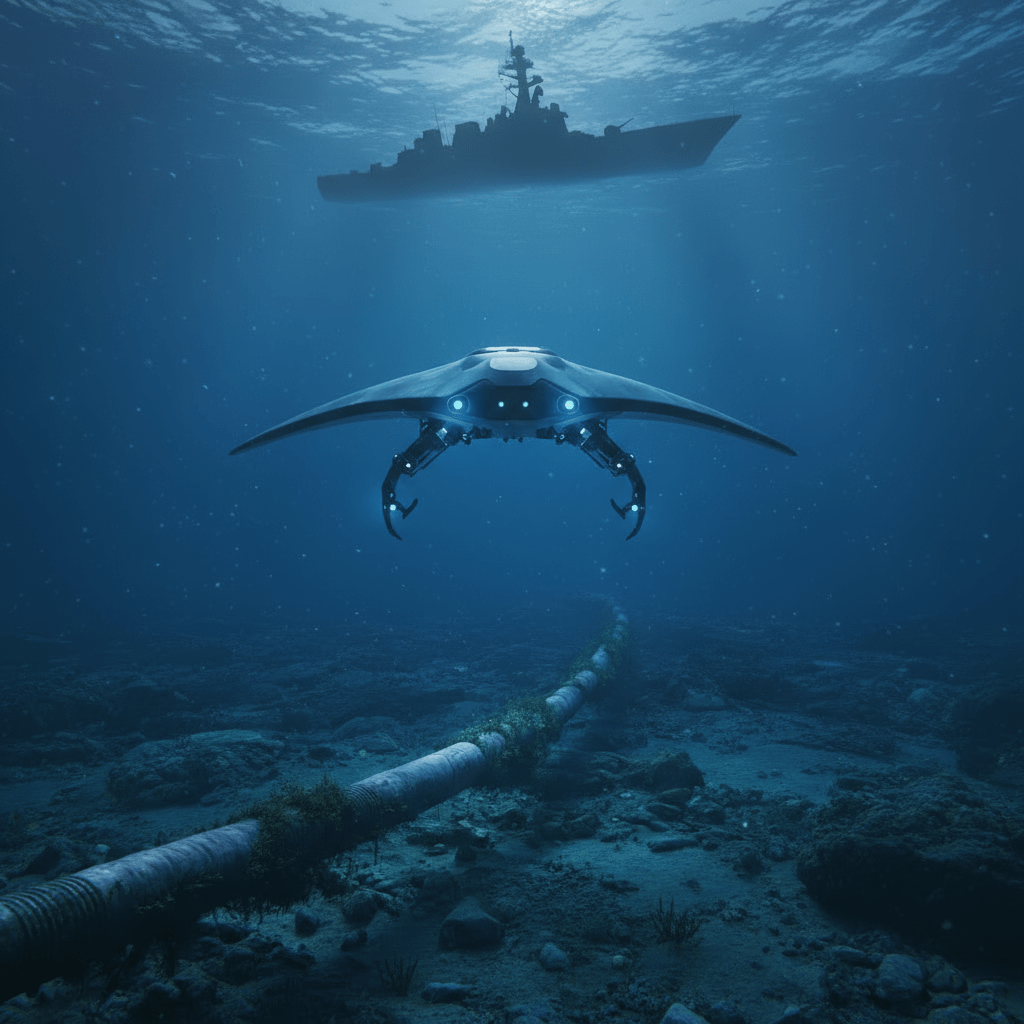
The cables’ vulnerability is further compounded by technological advancements, such as the development of Unmanned Underwater Vehicles (UUVs), which enable covert cable damage while avoiding detection. However, even low-tech attacks can impact the cable’s security significantly, as demonstrated in 2013, when three divers were arrested for severing the main cable linking Egypt with Europe, drastically lowering Egypt’s internet speed.
Transmitting massive amounts of sensitive data every day, they are essential for both state operations and private enterprises. Disruptions to these cables can lead to communication blackouts and, thus, extensive economic losses.
Interruption of military data on the cable network during intense operations could have direct consequences for the military. An example of state dominance in the global cable infrastructure is China’s ‘Digital Silk Road’ strategy funding the expansion of Chinese cable networks. The Chinese company HMN Technologies holds up to 10 percent of the global market share. Chinese investments in critical cable infrastructure are approximately 25 percent of global submarine cables. The US is trying to counter by supporting alternative projects. Most countries are working on a minimum of three or four different routes to ensure there is no blackout of transmission.
Cable Protection and Repairs
The newer cables are fibre-optic data pipelines. The fibres themselves are made of wafer-thin glass, but, to keep them safe from common threats, they are encased in a pipe comprising polycarbonate, aluminium, steel wires, and polyethylene.
Accidental cable faults can occur. Most incidents highlight that onshore landing stations remain the most vulnerable point in a cable system to damage or attack, and fortunately, these can be repaired more easily. However, when a deep-sea submerged part of a cable is cut or damaged, repairing could take several weeks, and this could be a costly exercise both for repair and disruption impact.
Location of the cut has to be identified. A specialist vessel has to go and repair the fault. Unfortunately, there are only around 60 repair vessels globally. Rough seas can delay the operation.
Cyber Security Issues and Countermeasures
Increasingly, sophisticated cyber-attacks threaten the data traffic on the cables, with incentives ranging from financial gain, espionage, or extortion by either state actors or non-state actors. Further, hybrid warfare tactics can interfere with or even weaponise the data transferred by the cables. However, attributing an incident to a specific actor or motivation of such actor can be challenging, specifically in cyberspace.
Cyber-security strategies for submarine cables, such as encryption, access controls, and continuous monitoring, primarily focus on preventing unauthorized data access but do not adequately address the physical protection of cables in vulnerable, remote, high-sea areas. Physical security remains important.
Typically, cables are buried in waters with a depth of less than 2,000 meters. Increasingly, they are also being buried in the deeper seabed to protect against high-seas fishing and bottom trawling. Embedding is also advantageous against physical attacks from organized crime. Other technical solutions are advanced protective casings and monitoring them with UUVs.
Legal Support System
The International Cable Protection Committee (ICPC), which represents key submarine stakeholders, plays a vital role in promoting cooperation and information sharing among stakeholders. As of 2025, a tense US-China relationship complicates this task, especially in the South China Sea where there are territorial disputes. China has increasing control and influence over global cable networks because it financially supports many cable projects and exerts diplomatic pressure.
Submarine cables are internationally regulated within the framework of the United Nations Convention on the Law of the Sea (UNCLOS), but there are implementation challenges. Some scholars argue that UNCLOS should be updated to protect cables extensively, including cooperative monitoring and enforcement protocols.
Given the increased involvement of organizations like NATO, others recommend clarifying the roles of military and non-military actors in cable security and enhanced multi-level governance models.
Multilateral Efforts
The rising great power competition remains an impediment for global cooperation. In May 2023, the Quad announced a new initiative for undersea cable protection in the Indo-Pacific, called the “Quad Partnership for Cable Connectivity and Resilience.”
In June 2024, Dmitry Medvedev, former Russian president and one of Vladimir Putin’s closest allies, argued that Russia has a right to attack subsea cable systems, citing his belief that the West was responsible for sabotaging the Nord Stream undersea gas pipeline in 2022. “If we proceed from the proven complicity of Western countries in blowing up the Nord Streams, then we have no constraints, even moral, left to prevent us from destroying the ocean-floor cable communications of our enemies,” he wrote.
NATO announced Operation “Baltic Sentry” in the Baltic Sea to deter attacks on critical undersea infrastructure. It follows a declaration of solidarity between nations at the Baltic Sea NATO Allies Summit in Helsinki on 14 January 2024.
India’s Under Sea Cable Network
India has about 17 international cables landing at 14 stations in Mumbai, Chennai, Cochin, Tuticorin, and Trivandrum. Tata Communications owns five cable landing stations, three in Mumbai, and one each in Chennai and Cochin. Global Cloud Xchange (formerly Reliance Globalcom) operates the Versova station in Mumbai for the FALCON cable and the Trivandrum station for the WARF cable, which connects the Maldives and Sri Lanka to India. Reliance Jio has the BBG station in Chennai and the AAE-1 station at Versova, Mumbai, and is constructing new stations for its IAX and IEX cables. Bharti Airtel owns three stations: two in Chennai and one in Mumbai, and will serve as the landing party for the 2Africa/EMIC-1 and SEA-ME-WE 6 cables. Sify Technologies operates the Mumbai station for the MENA and GBI submarine cable systems. BSNL owns its first international cable to Sri Lanka (BLCS) and the Tuticorin station, has completed the Chennai-Andaman & Nicobar Islands (CANI) cable system, and built additional stations in the region. It is also expected to own the newly approved Digha station in West Bengal. Vodafone operates a station in Mumbai. Lightstorm acts as the landing partner for Cinturion’s TEAS cable and is building a carrier-neutral, open Cable Landing Station (CLS). IOX plans to construct a new station in Puducherry for its IOX cable, expanding India’s subsea connectivity further.
CANI connects Port Blair along with seven other Islands of Andaman & Nicobar, and the Kochi-Lakshadweep Island (KLI) cable system for a direct communication link through a dedicated submarine optical fibre cable between Kochi and 11 Islands of Lakshadweep.
As of early 2025, India’s network had a cumulative capacity of 180 terabits per second (tbps), with 132 tbps actively in use, according to the Telecom Regulatory Authority of India (TRAI).
India’s digital infrastructure is on the verge of a revolutionary transformation, with three significant undersea cable projects expected and increasing internet capacity fourfold. These projects, 45,000 km long 2Africa Pearls, connect 33 countries across Africa, Asia, and Europe and are to be operational by Q4 2025. It has investments from major players like Bharti Airtel and Meta (formerly Facebook).
India-Asia-Express (IAX), and India-Europe-Express (IEX) will ensure faster and more reliable digital connectivity. Reliance Jio is leading these projects with funding from a consortium including Facebook and Google. The IAX (16,000 km) and IEX (9,775 km) cables have 200 tbps of capacity each. The IAX cable will connect Mumbai to key hubs in Southeast Asia. The IEX cable will link India with Europe via the Persian Gulf.
Blue-Raman connects Italy, Greece, Israel, Jordan, Saudi Arabia, Oman, and India; this cable bypasses the Egyptian chokepoint. It has a capacity of over 200 Tbps and is funded by a consortium led by Google. MIST cable will link Mumbai and Cochin in India to Myanmar, Thailand, Malaysia, and Singapore. It has a capacity of 218 Tbps and became operational in 2024. SEA-ME-WE 6 is an upgrade to the link from Singapore to Marseille, spanning 19,200 km with a capacity of 126 Tbps. It is scheduled to be operational in 2025 and involves a consortium of telecommunications companies.
The boost in internet capacity will greatly improve the quality of services, especially for high-demand applications such as 5G video streaming, Internet of Things (IoT) devices, AI-based services, and cloud computing.
Way Ahead India
The West was implicated in the tapping of cables for surveillance purposes after documents leaked by whistle-blower Edward Snowden showed leading telecoms firms had given Britain’s GCHQ spy agency access to undersea cables. Experts say that Russia too was monitoring undersea cable systems closely.
India has a huge cable network and capacity and speed will increase significantly. Repairs can be expensive and time-consuming. India has to doubly secure its cables and also build multiple redundancies. India must enhance the fault detection and repair facilities. Other than rogue elements, India must closely monitor Chinese and Pakistani maritime activities. China is showing much greater interest in India’s neighbourhood. Both Gulf of Aden and Gulf of Oman are important choke points. The heavy dependence on the Red Sea and its high vulnerability have to be factored.
India must also be conscious that a lot of global telecom hardware has origins in China. The situation is not going to change in a hurry. Alternative sourcing and local production must be encouraged. TRAI has recommended that all Indian telecom companies operating undersea cables must demonstrate ownership of the portion of cables located in Indian waters. TRAI has also proposed that a government committee explore financial viability models for commissioning Indian-flagged ships for the repair and maintenance of undersea cables. Undersea cables are a very important strategic asset. India needs to be conscious. We need to build and protect.
Note: The article was originally written by the Author for First Post on September 11th , 2025, it has since been updated.
Header Picture Credit: Author
Twitter: @AirPowerAsia
 Air Power Asia