
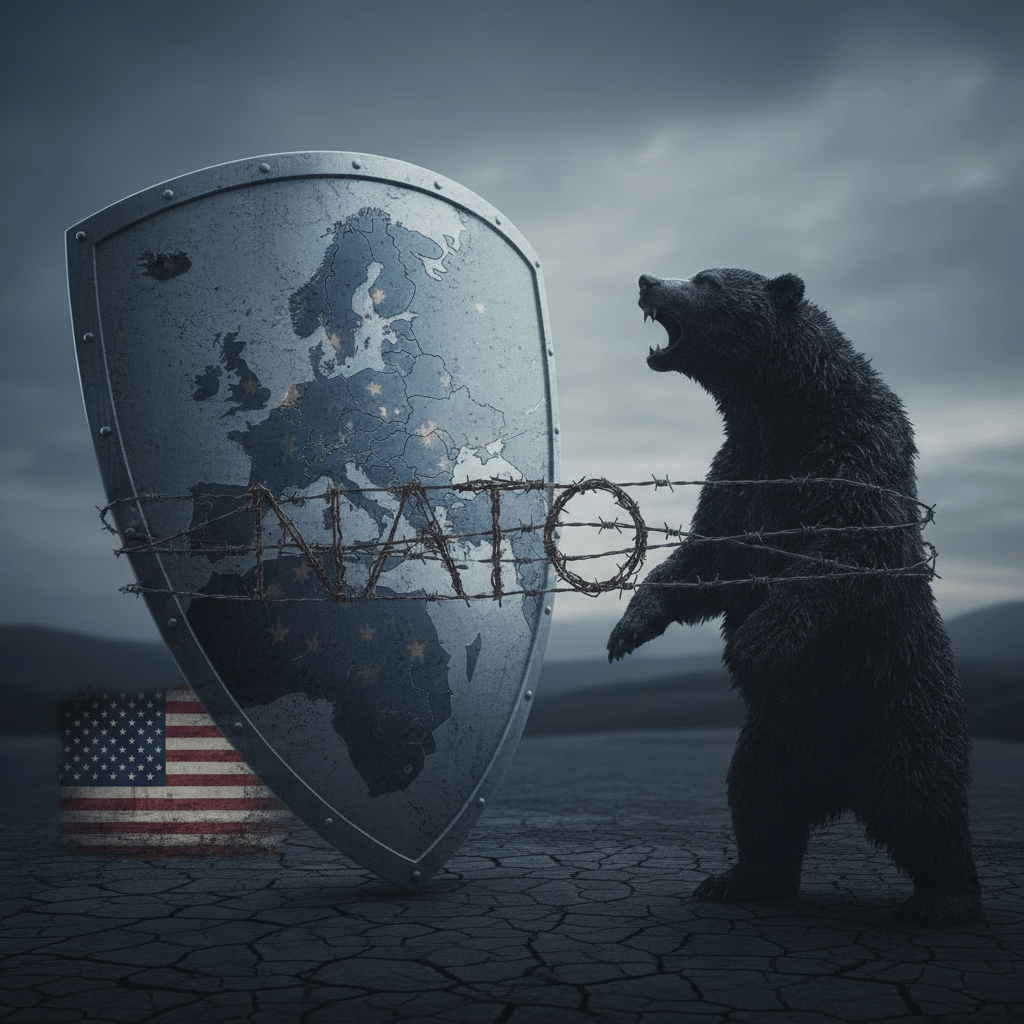
The world is gradually becoming multipolar. US President Donald Trump’s peace plan for Ukraine has yet to be made public, but it is already quite clear that he expects Europe to play a far bigger role in the continent’s future security and contain Russia. In fact, he doesn’t even consider Russia as an adversary and would rather deal with it for a win-win solution. He has called for European NATO members to increase defence spending to five percent of GDP. Trump has engaged Putin and hinted the US may not defend European allies, causing alarm about NATO’s future.
North Atlantic Treaty Organization (NATO) was formed in 1949. It was a collective security system where its independent member states agreed to defend each other against attacks by third parties. During the Cold War, NATO operated as a check on the threat posed by the Soviet Union. The Warsaw Pact, a military and political alliance between the Soviet Union and seven Eastern European countries, was created in 1955 to counter NATO. In 1991, the Soviet Union imploded. The Warsaw Pact was dismantled. There was no raison d’être for NATO to carry on. But NATO not only continued, it in fact started expanding towards Russia.
NATO’s Defence Spend
NATO today has thirty-two members, mostly in Europe and two in North America. NATO has annual budgets and programmes worth around $4.8 billion. In 2023–2024, the United States and Germany were the biggest contributors with 16.2 percent each. UK contributes around 11 percent, Italy 8.5, and Spain 5.8, and others lesser percentages. In addition, each country’s defence budget builds defence capability which in turn contributes to overall strength.
In mid-2024, the head of NATO, Mark Rutte, had said that NATO members will have to spend “considerably more than 3 percent of GDP on defence.” Under the previous target, the members of the military alliance pledged to spend at least 2 percent of GDP on defence per year by 2024. 23 of the 32 members have reportedly achieved it. Presently, Poland leads with 4.1 percent of GDP, Estonia and USA spend 3.4 percent. The UK spends 2.3 percent. The average for NATO members is around 2.0 percent. The US has called for NATO allies to spend 5 percent of GDP on defence. NATO members also pledged that at least 20 percent of their defence expenditure would go on acquiring and developing military equipment.
Ukraine Conflict Was West Driven
After US withdrawal from Afghanistan, it was expected that USA would concentrate its energies and assets in the Indo-Pacific, where China is the main competitor, challenger, and reason for possible confrontation. But the US Military Industrial Complex, which has huge political influence, would always like to see USA at war. The Russian demand to keep Ukraine outside NATO was a legitimate one. Crimea was very crucial for Russian Security. As long as there was a friendly regime in Ukraine, Russia’s Black Sea naval fleet could operate safely from Sevastopol. The three years of conflict have destroyed most of the crucial infrastructure in Ukraine. A very large number of young people have died. Many have fled the country. Ukraine has lost over 20 percent of its territory.
Now as Trump begins to negotiate after three years of conflict, Ukraine is not going to get back the territory, nor will it be allowed to join NATO.
Funding Support for Ukraine Conflict
Till end December 2024, over the past 3 years of war, donor countries have provided a continuous flow of support to Ukraine, with a value of about $80 billion per year. The U.S. reached almost $120 billion, while EU institutions had allocated less than half of that at $52 billion. Individual contributions by European nations in billions of dollars were Germany (18), UK (15.4), Denmark (8.4), Netherlands (7.7), Sweden (5.7), and France (5.1) billion. Canada, a NATO member, contributed $8.7 billion. Non-EU and non-NATO member Japan contributed $11 billion.
Can Europe still count on the US?
The US has long been the anchoring power in Europe. European leaders have been left stunned by the open rapprochement between Trump and Putin. The Ukrainian President has been given a dressing down in the White House in the presence of media. The big three in Europe — Germany, France, and UK — will have to take calls. More countries in Europe are embracing right-wing nationalism, with their own nation-first approach.
USA is making a clear point of asking the Europeans to get out of the welfare state culture and spend much larger sums on their defence. My assessment is that notwithstanding the initial rhetoric, USA will come in support of European democracies against autocratic regimes, but will expect them to pay for it.
Military power of European Union (EU) and UK & Russia
The European Union (EU) is a political and economic union of countries with a total area of 4,233,255 sq. km and a population of 447 million. Most of the members are in NATO. Russia has an area of 17,098,242 sq. km, and a population of 146 million. The table below is based on EU sources.
| Attribute | EU | Russia |
| Military Budget | $300.8 billion | $86.4 billion |
| Active personnel | 1,298,969 | 1,000,000 |
| Reserve personnel | 1,750,132 | 2,000,000 |
| Tanks | 4,377 | 12,267 |
| Armoured fighting vehicles | 30,510 | 24,172 |
| Total artillery | 6,416 | 18,266 |
| Self-propelled artillery | 1,965 | 6,443 |
| Rocket artillery | 778 | 4,331 |
| Total aircraft | 5,392 | 4,418 |
| Fighters/Multirole/Attack Aircraft | 1,473 | 1,411 |
| Helicopters | 2,330 | 1,665 |
| Total Naval Vessels | 1,385 | 653 |
| Aircraft Carriers incl UK | 3 | 1 |
| Destroyers | 17 | 14 |
| Frigates | 78 | 11 |
| Corvettes | 23 | 80 |
| Submarines | 59 incl UK | 66 |
| Nuclear Weapons | 519 (UK & France) Europe has many US Nuclear Weapons | 5,889 |
US Military Assets in Europe
Number of US troops in Europe has ranged between approximately 75,000 and 105,000 military personnel, primarily from the Air Force, Army, and Navy. Germany currently hosts by far the largest number of US forces in Europe, followed by Italy and the UK. However, the biggest single overseas deployment of US personnel is in Japan, where the US maintains more than 50,000 troops. USA has 35,000 troops in Germany, 24,000 in South Korea, 12,000 in Italy, and 10,000 in the UK. US forces also have a significant presence in the Middle East and the Gulf, although exact figures are not always disclosed and some deployments are only temporary.
More than forty U.S. military bases span the European continent, from north-western Greenland to Turkey’s border with Russia. Their main bases and installations are in Germany, Italy, Poland, and the United Kingdom. USA is believed to house roughly one hundred B16 gravity bombs, which are smaller, tactical nuclear weapons, in Belgium, Italy, the Netherlands, Germany, and Turkey.
USA’s Third Air Force (3 AF) is headquartered at Ramstein Air Base, Germany. The Third Air Force had ten wings totalling over 32,000 personnel. In 2025, the US Air Force had aircraft deployed from Lakenheath, England to Poland, and used European tanker support to patrol the NATO-Russian border. The US Air Force has deployed bombers to Europe for Bomber Task Force (BTF) deployments. The US may also use space assets and unmanned aircraft to support the European force. In February 2025, B-52H Stratofortress aircraft operated in Europe. USAF combat aircraft assets include F-15E Strike Eagle, F-35A Lightning II, F-16s, KC-135R Stratotankers, HH-60G Pave Hawk, C-130J Super Hercules, MQ-9 Reaper, among others.
Russia’s War Experience and Surge Production Capability
Russian military and defence industry is considerably larger, more experienced, and better equipped than before the Ukraine conflict began in 2022. Russian defence production has been rapidly ramped up. In 2024 alone, Russia produced and refurbished an estimated 1,550 tanks, 5,700 armoured vehicles, and 450 artillery pieces of all types. There is a 220 percent increase in tank production, 150 percent in armoured vehicles and artillery, and 435 percent in long-range loitering munitions. Russia has made substantial advances in drones, after previously relying on Iran. They have deployed over 1,800 long-range Lancet loitering munitions. They have had invaluable battlefield experience unmatched by any other European military.
Defending Europe without the US
Europe needs to be able to defend itself against Russia, with or without the United States. There are estimates that Europe could need 300,000 more troops and an annual defence spending hike of at least $260 billion in the short term to deter Russia. Assessments by NATO, Germany, Poland, Denmark, and the Baltic states put Russia as ready to attack more European states within three to ten years.
As Trump and Putin evolve a peace deal, Europe remains sceptical. Till it happens, Europe’s priority will be to defend Ukraine, which it considers a bulwark against Russia. But for long, Ukraine and the EU have relied on some critical US strategic enablers, including intelligence and satellite communications. These are difficult to replace in the short term, but there are substitutes if necessary.
Since February 2022, US military support to Ukraine has amounted to $70 billion, while Europe, including the United Kingdom, sent $65 billion. To replace the US, the EU would have to double its military support, which would amount to only around 0.12 percent of its GDP. But Europe cannot manage without the US military-industrial base.
Currently, the presence of nearly 100,000 US troops in Europe is a big deterrence. If the US moves out, some estimates are that if war continues and if the EU were to get more directly involved, Ukraine would need around 150,000 European troops to effectively deter Russia. But if the attack has to be deterred on any NATO country, Europe will require 300,000 additional troops (50 brigades) and many mechanised vehicles. In many countries, the youth are unwilling to join the military. Troops from such a large number of countries are not easy to harmonise into combat assets in a short period.
There are estimates that to prevent a rapid Russian breakthrough in the Baltics, Europe would require a minimum of 1,400 tanks, 2,000 infantry fighting vehicles, and 700 artillery pieces. This is more combat power than currently exists in the French, German, Italian, and British land forces combined. They will also require large quantities of munitions, considering the war could carry on for months or years. Drone production would have to match the Russians for parity.
Europe would also need to greatly increase military combat aviation assets and force multipliers including AEW&C, FRA, transport aircraft, missile and electronic warfare capability, and communication and intelligence capacities. All this will cost money and require time. The defence budgets of European countries will have to shoot up from the current 2 percent to 3.5 percent of GDP.
Effectively, since WW II, USA leads NATO forces. Who will lead after they move out? USA not only takes a leadership role but also provides strategic enablers. Will Germany take the lead role? Will France want equal importance? What will be the UK’s position when it comes to defence of Europe, even though it’s not an EU member but active in NATO?
Finally the Ground Realities and Options
Some feel that Trump is pursuing a transactional approach by using a threat to abandon for pushing Europe to take greater security responsibility and spend much more on defence. This approach would also force Europeans to buy more American military equipment. In reality, USA will stay on. Trump will also extract other concessions on trade tariffs and good deals for US companies.
Europeans may have no choice but to placate Trump by increasing defence spending and signing new contracts with American companies. Trump can then put force withdrawals on temporary hold. He could introduce bilateral deals and concessions with those who comply and leave those who don’t, high and dry. He could also play one state against the other to bring rifts and gain the upper hand. Trump is already trying to extract his pound of flesh by seeking critical mineral rights from Ukraine. Trump would do everything to ensure better sales for the American defence contractors. Of course, any disengagement from Europe would be a slow and controlled process, but Trump will get it rolling. USA would continue to provide a nuclear umbrella and deterrence.
The second possibility being talked of is that USA leaves Europeans to defend themselves, makes concessions to Putin, ends the Ukraine war, and woos Russia a little away from China. Remember, Republicans in 1971 had split international communism by creating a rift between the Soviet Union and Mao’s China. Trump can put all US military assets and might to take on China in the Indo-Pacific. He strengthens Japan and South Korea and engages more with India and ASEAN.
These scenarios are consistent with the Trump campaign promises. Many countries in Europe are seeing right-wing or nationalist resurgence. People are fed up with paying subsidies and doles to unwanted illegal emigrants in Europe. Many European leaders openly support Trump’s MAGA (Make America Great Again) approach. In fact, they want to replicate some of it in their own countries.
In all scenarios, the Europeans will have to take much greater responsibility for their security and make concessions individually or collectively. They will have to build military capabilities and industrial capacities to make up for American thinning down. Managing individual nation priorities under increased budgetary strains will be a complex process for a still partly fragmented EU. European masses would have to be prepared for this new realism. It is best to wait and watch the unfolding situation.
Note: The article was originally written by the Author for The EurAsian Times on March 2nd, 2025, it has since been updated.
Header Picture Credit: Author
Twitter: @AirPowerAsia
 Air Power Asia