
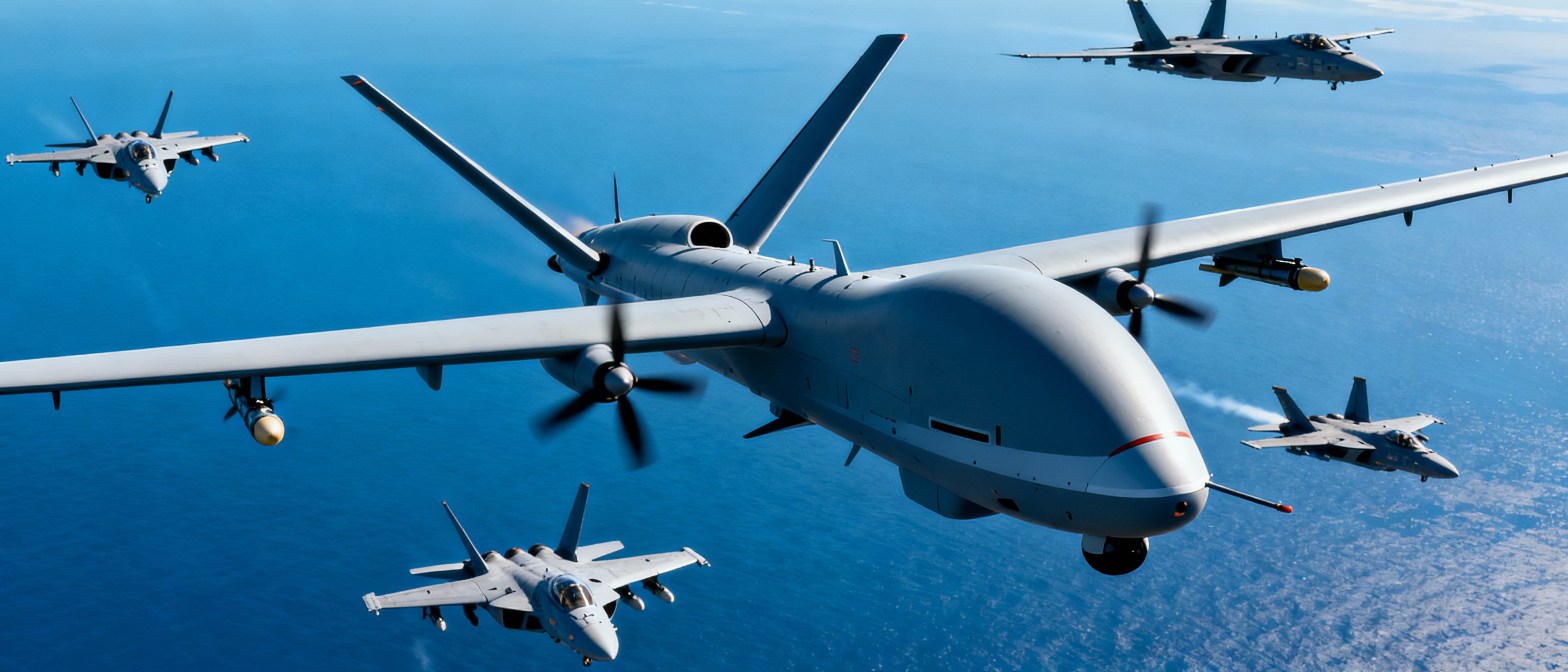
Elon Musk has suggested that fighter jets be replaced by drones. However, some say that drones would need to have the same electronics as fighter jets, which would make them expensive. Clearly, more and more tasks are being gradually shifted to drones. Unmanned aerial vehicles (UAVs) are not likely to replace fighter jets anytime soon. However, drones will fly alongside and in coordination with fighter and other combat platforms and take on specific combat and combat-support tasks. Aerial Manned Unmanned Teaming (MUM-T) is fast evolving. Strengths of an expensive manned fighter when combined with a much larger number of relatively cheaper drones could be harnessed for better situational awareness and attack missions.
Evolving Combat Aviation
Combat aviation continues to remain the most preferred means of prosecution of war. The one who controls air and space will control all operations in the air, on surface and sub-surface. Military aviation also continues to see the fastest growth of technology. While combat aircraft features such as agility (speed, manoeuvrability) remain important, they have become less consequential. Occasions for close-combat engagements are reducing. Long-range beyond-visual-range (BVR) combat requires sensors and weapons that allow ‘see first, shoot first, hit first’ ability. High exposure close air support can now be taken on by drones and unmanned platforms. Long range precision strike ability has become more important. Exposing expensive manned aircraft to mobile potent air defences will be risky. Air denial rather than air superiority will be easier to achieve. Contested dense environment would require electronic warfare and cyber warfare superiority. Information superiority and shortened decision loop will decide the victor.
Stealth, integrated sensors, and secure data-linked communications would be more important. Investments in Intelligence, Surveillance, and Reconnaissance (ISR), Directed Energy Weapons (DEW), hypersonic platforms and weapons, cyber warfare capabilities, and Artificial Intelligence (AI) would be required to outdo adversaries. Manned Unmanned Teaming will bring greater and faster effects at lower cost.
Gen-Next Fighter Aircraft
The future fighter aircraft technologies will enhance survivability in contested well-defended environment, and yet deliver arsenal for effect-based results. Integration with other aircraft will require secure, high-bandwidth, data-links, connecting sensors across platforms and terra-firma in multiple domain environment. Intelligent usable data without information overload often termed “data-to-decision” (D2D) capability will be crucial. Systems-of-systems approach would greatly enhance situational awareness, operational reach, and survivability. AI will support multiple data assessment and high speed decision making, and autonomy. Helmet-mounted or even eye-retina displays will endeavour to give the pilot and systems operator an all hemisphere picture, allowing more complete threat assessment and attack/response options.
The new aircraft will feature next-generation avionics, more efficient thrust-vectoring engines with in-built super-cruise, advanced stealth features, conformal weapon bays with extended long-range weapons with high degree of post-launch autonomy. Improved on-board power generation and capacity will support powerful electronic warfare systems and DEW. All systems will talk to each other. The aircraft will have a powerful health monitoring and diagnostics suite and self-healing options. At the design board stage itself, the airframe shaping, composite materials, emissions absorbing paints, specially designed engine inlets and exhausts, and more passive sensors and concealed emitters will support low radar cross section (RCS) over cross-section of all frequencies without trading any flight performance.
Plug-and-play interchangeable hardware will have appropriate software. 3D tools will be used for both design and manufacture processes. The sixth-generation fighters would have self-healing structures, breakthroughs in propulsion, materials, power generation and weapon technology. Modern glass cockpits greatly improve situational awareness and canopy or helmet displays allow sensor and weapon cuing.
Advantage Drones
Drones, or UAVs, are best used for “dull, dirty, or dangerous” missions in both military and non-military applications. For military, long-endurance surveillance missions, flying into contaminated areas, and operations in highly contested threat areas. Drones can be used for reconnaissance, intelligence gathering, and target acquisition. They can carry weapons for precision strikes. Drones can be used to support targeting by ground-based weapons and airborne platforms. Drones can be used to mark targets for laser weapons. They can jam enemy defences. They could be used as decoy formations. Larger UAVs will be used as aerial tankers and also for cargo delivery.
Drones are controlled remotely or operate with high level autonomy. They have become more capable and versatile over time, and are now used for a wide range of missions. Drones can be less expensive than fighter jets, and can be used in large numbers. With the absence of human on-board, drones don’t require human-support systems and don’t risk human life.
Swarm Drones
Swarm drones are becoming cheaper and more capable, and are being developed by the United States, Russia, China, India and many others. The US has plans to create thousands of autonomous drone systems to compete with China.
Low cost swarm drones can be mass produced cheaply. Some systems can launch multiple drones quickly. Some systems are designed to be compact and transportable. Some drone swarms use artificial intelligence (AI). Of course, some swarm drones may have reliability problems. Swarm drones also require significant support infrastructure. It may be expensive to equip militaries to destroy swarm drones.
Finally, the swarm drones may be part of and combine with MUM-T. XQ-58A Valkyrie drone is designed to be controlled by a parent aircraft and can operate as part of a swarm. The XQ-58A Valkyrie drone costs around $5.5 million, which includes the cost of support, launch, and test equipment. The company’s goal is to reduce the cost to $2 million per unit.
Drones and Manned Unmanned Teaming
Drones and uninhabited systems are already flying in large numbers and more action is unfolding. Dual use (optionally manned) aircraft are evolving. Autonomous UAVs are operating from aircraft carriers. Next generation UAVs will be able to take on all roles of ISR, surface strike, air defence, aerial refuelling, and air delivery.
By mid-2040’s, it is envisaged that every aerial mission could be flown unmanned. Aerial drone swarms operating in mutual coordination, flying synchronously, and performing operational tasks has been repeatedly demonstrated, including by Indian manufacturers. The swarm could overwhelm the defences by numbers. Drone counters include both “hard kill” and “soft kill” and are already evolving. These could be small arms fire, electro-optical weapons such as lasers, data-link jamming, electronic or cyber-attack, and directed energy weapons like microwave. A drone swarm may be engaged by a counter drone swarm. Manned and unmanned aircraft teaming will exploit the advantage of human in the loop with strength of numbers to take on well-defended target systems.
Advantage Teaming Collaborative Combat Aircraft (CCA)
Fighter jets have been the backbone of military strategy for decades, and are designed for air superiority and air dominance. All the future fighter aircraft programs of the world still have the aircrew on-board. Most of these are optionally manned, but more importantly have the capability to control or team up with drones. Together they build and share situational awareness across the battle-space.
The US Air Force (USAF) is developing CCAs as autonomous “wingmen” drones to pair with manned fighters. They are also working on AI-enabled fighter aircraft for over a decade. USAF’s goal is to field at least 1,000 CCAs. These CCAs will be such that they don’t require runways, which would give them more operational flexibility. USAF is also looking at CCAs that are more exquisite, carry more weapons, and have more missions.
To Summarise
The Economist titled “The last manned fighter” in an article in 2011 about the Lockheed Martin F-35 Lightning II, the most expensive defence project in history. The Lockheed Martin F-35 Lightning II fighter jet costs between $80 million and $115 million, depending on the variant. As of 2024, the F-35 Joint Strike Fighter’s expected total cost is expected to top $2 trillion over its entire life span given the U.S. military plans to fly it longer. The Lockheed Martin F-22 Raptor costs around $361 million per aircraft, making it one of the most expensive fighter jets ever built. India has acquired 31 MQ-9B Predator drones for an estimated cost of $3.9 billion. So large drones are not cheap. However, the CCA drones the USAF is developing are estimated to cost between $25 and $35 million each. This is about one-third the price of an F-35 Lightning II fighter jet.
Every CCA doesn’t have to have all kinds of systems, but one can have a mix of platforms with different capabilities, working together with a crewed aircraft. It gives you the set of capabilities that are most cost effective. Concerns still loom over how the USAF will pay for its CCA drones, as well as other advanced next-generation aircraft.
Secretary of the US Air Force, Frank Kendall had said that USAF is working to acquire what could ultimately be a fleet of multiple different types of CCA drones through iterative development cycles. “It depends upon the mix, right? What capabilities do you put on every aircraft, every CCA? What do you distribute,” he said. “I don’t regard CCAs as expendable. They’re not munitions. … we don’t send them all to die,” Kendall said. “So there needs to be enough survivability in them – the combination of how you equip them, design them, plus tactics so that you can have reasonable attrition in most areas – but they are things that you are willing to let a few of die in order to gain an advantage”. The survivable requirement requires an expensive counter measure suite. CCA should “definitely” not be “exquisite” platforms. In this context, exquisite would refer to much higher-end (and expensive) drone designs, such as stealthy, highly advanced, heavier payload, flying-wing uncrewed combat air vehicles (UCAV).
USAF is working on a new sixth-generation stealthy crewed combat jet and advanced stealth tankers. The sixth-generation combat jet and CCA programs are both part of the Air Force’s larger Next Generation Air Dominance (NGAD) initiative. A detailed review of US sixth-generation combat jet plans is set to take place under the Trump administration, which will also be in a position to make new decisions about the CCA, next-generation aerial refueling aircraft, and other efforts. These three potential new designs and platforms are all tied together, both operationally and from an affordability perspective. Troy Meink, a senior leader at the National Reconnaissance Office, is President-elect Donald Trump’s choice to serve as secretary of the Air Force, will have to drive these.
When it comes to CCAs, the USAF expects them to have a transformative impact on how it fights, as well as its day-to-day activities, including training and maintenance cycles. It will involve development of new concepts of operations and tactics, techniques, and procedures around the new drones. The plans are to initially buy between 100 and 150 Stage 1 CCAs, and multiple thousands of smaller drones across all of the program’s eventual increments. Crewed aircraft, including specially modified F-16 Vipers, will support those efforts, as well. What the Air Force learns from that experimentation could well feed into the still-ongoing refinement of the Stage 2 requirements.
Both U.S. and China are developing CCA drones featuring similar attributes or performance criteria. USA will have to have a robust manufacturing base and strong supply chain to maintain advantage.
India’s CCA are the “Abhimanyu“ and the Hindustan Aeronautics Limited (HAL) Combat Air Teaming System (CATS). These aircraft are designed to operate alongside manned fighters, such as the Tejas, Su-30 MKI, or Rafale. Abhimanyu, an unmanned aerial system (UAS), has been developed by NewSpace Research and Technologies designed to operate with the Indian Navy’s MiG-29K fighters, engineered for carrier-based take-off and landing.
CATS is an unmanned and manned combat aircraft air teaming system developed by HAL. The system will consist of a manned fighter aircraft and a set of swarming UAVs and UCAVs. The primary aim is to make multiple advanced aerial platforms including those that can act as atmospheric satellites for high altitude surveillance, perform autonomous deep penetration precision strikes from standoff distance with maximum firepower while reducing human error and the threat on life. A twin-seated HAL Tejas is likely to be the mother-ship aircraft. Various other sub components of the system are currently under development and will be jointly produced by HAL, National Aerospace Laboratories (NAL), Defence Research and Development Organisation (DRDO) and Newspace Research & Technologies. HAL is planning to complete all the project related developmental work in 2025.
MUM-T is the domain of action, and Collaborative Combat Aircraft are the future of aerial warfare. Indian Air Force (IAF), Indian government, Indian research and academic community, and Indian industry are all gearing up for the evolving action. It is still a sunrise field. Time to Act is now.
Note: The article was originally written by the Author for The EurAsian Times on March 9th, 2025, it has since been updated.
Header Picture Credit: Author
Twitter: @AirPowerAsia
 Air Power Asia