
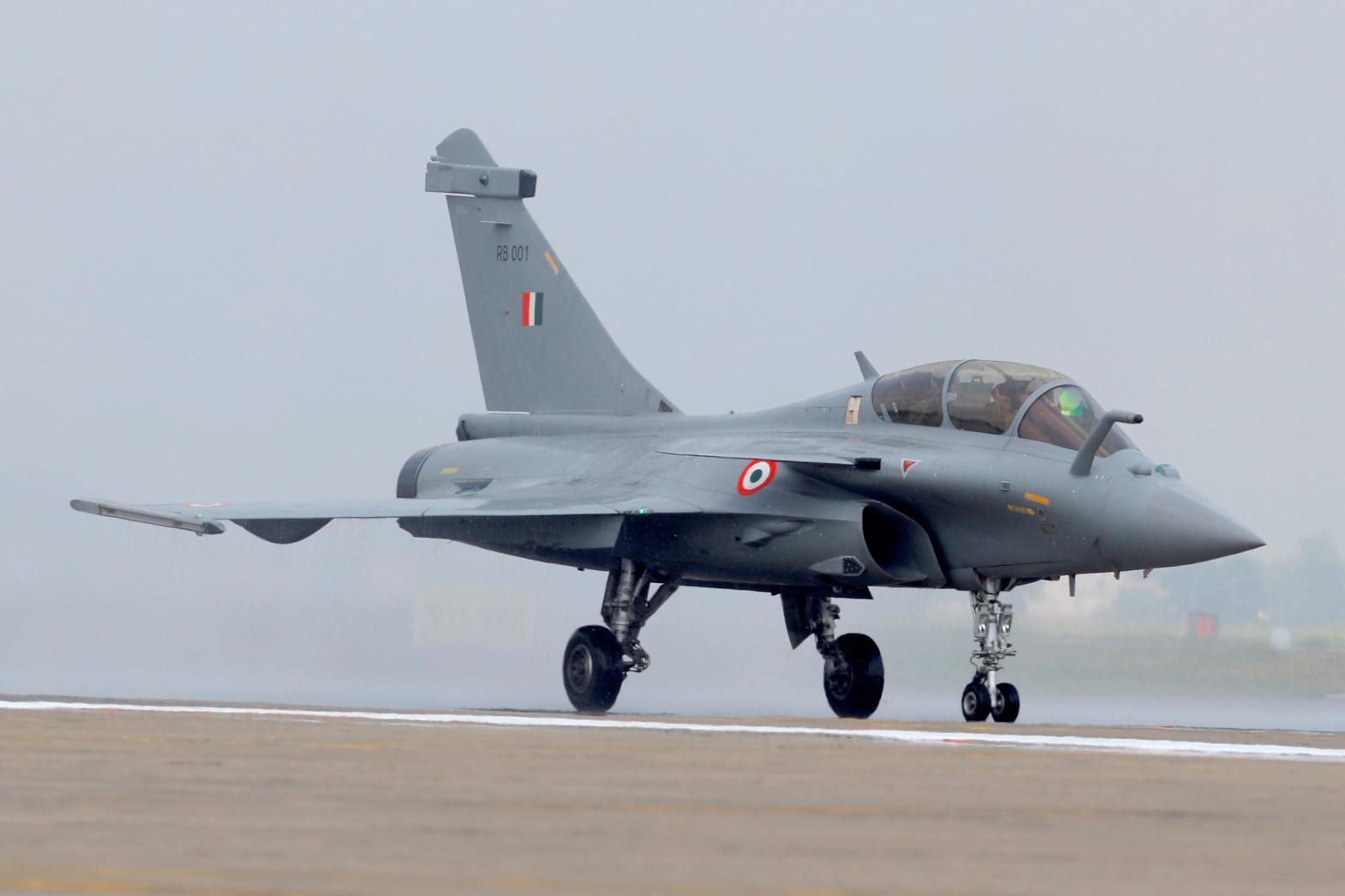
French President Emmanuel Macron and Ukrainian President Volodymyr Zelenskiy held a joint press conference at the Elysee Palace in Paris, France, on November 17, 2025, and announced that Ukraine will acquire up to 100 Dassault Rafale warplanes over the next 10 years. Kyiv seeks to bolster its defences against Russia’s invasion. Air defence systems, munitions, and drones were also included in the letter of intent, signed against a background of a Rafale jet and flags of both nations.
In October this year, Dassault hailed the production of the 300th Rafale. As of late 2025, there have been 533 firm orders for the Rafale, with France and export customers including India, Egypt, Qatar, Greece, Croatia, the UAE, Serbia, and Indonesia. Of these, 233 are still to be delivered. This does not include the 100 aircraft that Ukraine has shown intent to acquire, nor the Indian Air Force’s (IAF) proposal for 114 Rafale aircraft, which is currently under active consideration by India’s Ministry of Defence (MoD). If these two deals go through, the numbers will be even more significant.
Rafale: Current Production Rate
A year ago, the Rafale production rate was 2 aircraft a month (24/year). The same has now been increased to 3 per month (36 per year), with plans to increase to 4 per month (48 per year) to handle a growing backlog of orders. This is a significant increase from previous years and is supported by expansion at the Mérignac and new facilities in Cergy-Pontoise. Dassault already has plans to make the Rafale fuselage in India. The Indian Navy has already ordered 26 Rafales. If India were to decide to acquire 114 Rafales, a full assembly line would be set up in India.
This would give a great boost to total production. Making in India would also be cheaper. Dassault could thus source and supply India-made Rafale jets for global customers. Such a plant would also expand India’s options for future aircraft ventures with France.
Indian Proposal
India’s MoD received a proposal from the IAF to acquire 114 “Made in India” Rafale fighter jets, to be built by the French firm Dassault Aviation in collaboration with Indian aerospace firms. The proposal, expected to be worth over Rs 2 lakh crore ($22 billion), includes indigenous content of more than 60 percent.
While it is still going up and down in the labyrinth of corridors of power, it will eventually be taken up for discussion by the Defence Procurement Board, headed by the Defence Minister. If given the go-ahead, it would be the biggest defence deal ever for India.
Choosing Rafale maintains continuity and prevents adding an additional fleet that could be a logistical nightmare. IAF has already inducted 36 Rafale, and the Indian Navy has ordered 26 of them, both under government-to-government (G2G) deals. 114 more will make the fleet strength 176.
Dassault has already tied up with India’s Tata Group to make Rafale fuselages in India at the rate of 25 a year. The indigenous content in the Made-in-India Rafale fighter jets will continue to increase in stages. Dassault has already set up a Maintenance, Repair, and Overhaul firm in India. The M-88 engines will be overhauled in Hyderabad.
The IAF is already down to 29 fighter squadrons. The urgency to get back to the authorised 42.5 squadrons has been reinforced by the regional threat perception and collusive Sino-Pak anti-India engagement. The last of the overstretched MiG-21 squadron was phased out in September 2025. India is also the only operator of Jaguar strike aircraft, and they will be the next to go.
The upgraded Mirage-2000 and MiG-29 will serve for another decade. Finally, the IAF inventory should primarily comprise the Su-30 MKIs, Rafale, and indigenous LCA and AMCA fighters.
Make-In-India Rafale Fuselage
Earlier in June 2025, in a big boost to Make-in-India, Dassault and India’s Tata Advanced Systems Limited (TASL) agreed to partner to manufacture Rafale aircraft fuselage at a dedicated facility in Hyderabad.
The key structural sections of the aircraft, to be manufactured in India, include the front section, central fuselage, rear section, and lateral rear shells. The first fuselage sections are expected to roll out by FY2028, with a production capacity of up to two complete fuselages per month. Rafale fuselage will be produced in India for both domestic and global markets. This marks the first time in history that Rafale fuselages will be manufactured outside France.
Four Production Transfer Agreements (PTAs) have been signed between the companies. Eric Trappier, Chairman and CEO of Dassault Aviation, emphasised that this partnership is a “decisive step in strengthening our supply chain in India,” noting that it aligns with the company’s long-term strategy to collaborate with Indian aerospace firms like TASL.
Sukaran Singh, CEO and MD of TASL, described the partnership as a milestone in India’s aerospace journey, demonstrating both India’s manufacturing prowess and the trust international aerospace leaders place in Indian partners.
“The production of the complete Rafale fuselage in India underscores the deepening trust in Tata Advanced Systems’ capabilities and the strength of our collaboration with Dassault Aviation. It also reflects the remarkable progress India has made in establishing a modern, robust aerospace manufacturing ecosystem that can support global platforms,” Singh said. This facility will represent a significant investment in India’s aerospace infrastructure and will serve as a critical hub for high-precision manufacturing.
With over 10,000 military and civil aircraft, including 2,700 Falcon business jets, delivered in more than 90 countries, Dassault Aviation has built expertise in the design, production, sale, and support of all types of aircraft, military drones, and space systems.
Make-With-India Safran Aero-Engine
French aerospace company Safran and India’s DRDO have joined to develop India’s first jet engine with Indian intellectual property rights (IPR).
Safran will transfer 100% technology to DRDO, including that for crystal blades. The joint project between Safran and India’s Gas Turbine Research Establishment (GTRE), a DRDO lab, will develop and produce a 120 Kilo Newton (kN) engine, which will power India’s twin-engine Advanced Medium Combat Aircraft (AMCA) fighters. The announcement comes shortly after PM Modi called for indigenous development of jet engines from the ramparts of Red Fort during the recent Independence Day speech.
It is reported that Safran-GTRE will develop nine prototype engines over a 12-year period. The initial engines will be of 120 kN power and later go up to 140 kN by the end of the 12-year time period.
Single-crystal blades use superalloys and are efficient, long-lasting, and better able to withstand higher temperatures and rotational stress. The Indian private sector, with the Tata group, L&T, Adani Defence, and others, is already poised to pitch in for this national effort. This critical defence technology will have spin-offs for larger airliner and cargo aircraft engines.
Only the US, Russia, the UK, and France are capable of designing, developing, and producing aircraft engines. For a long time, China has used Russian or reverse-engineered engines to power its military aircraft.
India’s GTRE tried to develop an indigenous engine, Kaveri, but the project was not completed. India is powering its LCA Mk1 variants with the American GE F-404 engines. The LCA Mk2 will feature GE-414 engines manufactured in India. The transfer of technology (ToT) will be around 80 percent.
India considers France a more reliable partner with less capacity and less intent to arm-twist, and thus prefers it to develop an indigenous aero-engine. The engine will power future Indian fighters.
France – A Major Global Aviation Manufacturer
Major French aviation companies include Airbus, Dassault Aviation, Safran, Thales Group, and MBDA. Airbus is a major manufacturer of commercial and military aircraft, while Dassault Aviation specializes in business jets and military aircraft, including Falcon and Rafale.
Safran is a key player in aircraft engine manufacturing and other aerospace technologies, and Thales provides a wide range of aerospace and defence systems, specializing in electronics. MBDA is a European missile manufacturer. Airbus, a global aircraft manufacturer headquartered in France, is known for its commercial aircraft and helicopters.
ATR is a joint venture between Airbus and Leonardo (Italy) and is known for regional turboprop aircraft. Daher is a French company that manufactures light aircraft and business turboprops. India’s Time-Tested French Aviation Connect
India acquired 104 each of Dassault Ouragan fighters (Indian name Toofani) and Mystère IVA in the 1950s. Hindustan Aeronautics Limited (HAL), license-built versions of French Aérospatiale SA 315B Lama (designated Cheetah) and Aérospatiale Alouette III (designated Chetak) in the mid-1960s.
Indian Navy procured 14 French Bréguet Br. 1050 Alizé in 1960 for carrier operations. The French Turbomeca TM 333 2B2 engine powered the initial HAL Dhruv, later replaced by the Shakti engine, which was jointly developed by HAL and Turbomeca.
TM 333 2M2 powers HAL Cheetal and Chetan, upgraded versions of the Cheetah and Chetak, respectively.
India bought the Anglo-French SEPECAT Jaguar deep penetration strike aircraft (DPSA) in the late 1970s, although the contract was serviced by the British. IAF built and upgraded many Jaguars and continues to fly significant numbers even today. Finally, IAF bought the Mirage 2000, which was inducted in 1984. It was the first relaxed stability fly-by-wire aircraft with active controls technology to be inducted into the IAF.
It also brought a modern Air Interception (AI) radar with look-down/shoot-down capabilities, and the first BVR missile, the Super R530. Later, the all-aspect Magic 2 missile changed the dynamics of close combat.
IAF also got the first comprehensive EW suite on any aircraft, including a self-protection jammer, RWR, chaff and flare dispenser, an escort jammer, and an ELINT pod. The aircraft was later upgraded to the Mirage 2000-5 Mk 2 standards, extending its useful life for another 20–25 years. The upgrade included new avionics, a glass cockpit, and helmet-mounted displays.
The 4.5 Generation Rafale Aircraft
The twin-engine delta-wing fighter aircraft is an omni-role fighter with frontal stealth capabilities. It can simultaneously undertake air supremacy, interdiction, reconnaissance, and the airborne nuclear deterrent missions.
Rafale was inducted into the French Air Force and the French Navy for carrier-based operations in 2000. Rafale has been used in combat over Afghanistan, Libya, Mali, Iraq, Syria, and in recent Op Sindoor.
The aircraft uses digital fly-by-wire controls and has very high agility. The aircraft’s canards improve aerodynamic performance. The Rafale’s glass cockpit was designed around the principle of data fusion, prioritising the display of information to pilots. The primary flight controls are arranged in a hands-on-throttle-and-stick (HOTAS)-compatible configuration.
The Rafale also features an advanced avionics suite. The passive front-sector electro-optical system can operate at both visible and infrared wavelengths. The total value of the radar, electronic communications, and self-protection equipment is about 30 percent of the aircraft’s total cost.
The Rafale features an integrated electronic survival system, SPECTRA, that protects the aircraft against airborne and ground threats. The system incorporates a radar warning receiver, a laser warning receiver, a Missile Approach Warning (MAW) for threat detection, plus a phased-array radar jammer and a decoy dispenser for threat countering.
The AEROS all-weather, night-and-day-capable reconnaissance system used on the Rafale can transmit real-time images to ground stations. India has also acquired the Talios laser designation pod. The RBE2 AA active electronically scanned array (AESA) radar has a range of 200 km.
The 36 aircraft, valued at €7.87 billion (Rs 58,891 crore), Government-to-Government (G2G) Rafale deal included 28 single-seat and eight twin-seat aircraft. The deal included tailor-made IAF-specific enhancements, including the integration of an Israeli helmet-mounted display (HMD), radar warning receivers, and low-band jammers. It included a weapons package and a performance-based logistics agreement.
The aircraft’s 14 hard-points can carry a 9,500 kg external load. The air-to-air missiles include Matra Magic II, MBDA MICA IR or EM, and MBDA Meteor.
Meteor is an active radar-guided BVRAAM that offers multi-shot capability against long-range, manoeuvring jets, UAVs, and cruise missiles in a heavy electronic countermeasures (ECM) environment, with a range of around 180 kilometres. The no-escape zone of over 60 km is the largest among air-to-air missiles, according to the manufacturer.
India also procured SCALP air-to-ground cruise missiles. Subsequently, the HAMMER (highly agile modular munition extended range) glide bomb was bought.
The Indian Rafale is a modified version of the F3R standard. The two squadrons are located at two different airbases. Both these airbases have infrastructure and capacity for an additional squadron each.
The French have already tested the F4 variant with an upgraded radar and improved HMDS. OSF (long-range optoelectronics system) will add IRST to detect and identify airborne stealth targets at long range. It will be more effective in network-centric warfare, with more data exchange and satellite communication capacity. The F5 variant is also evolving.
Win-Win For India & France
The Indian Navy has just ordered 26 Rafale-M; the French Air and Space Force and the Navy have combined orders for 286. Other operators with confirmed orders are IAF (36), Croatia (12), Egypt (54), Qatar (36), UAE (50), Indonesia (42), and Serbia (12).
More orders are on the way. The current production rate is 36 aircraft a year. It will take nearly 10 years to meet existing orders. France desperately needs another production line.
Production in India will be for all global customers. India’s capability to produce global-class aerostructures has been proven through the cabins of the Apache AH-64, Sikorsky S-92 helicopter, and Lockheed Martin C-130J Super Hercules aircraft.
India also makes Lockheed Martin F-16 wings. India makes the entire indigenous LCA. Making the Rafale in India will work out much cheaper for France.
114 Rafale for IAF – Best Way Ahead – Take Early Decision
Traditionally, India and France have enjoyed an exceptionally warm relationship, the fruit of deep affinities and unwavering trust between the two countries since India’s independence. France is considered the most reliable Western “friend”. France has never imposed any sanctions or tried to arm-twist India. IAF regularly carries out the Garuda series of air exercises with the French Air and Space Force (FASF). IAF is already down to 29 fighter squadrons vis-à-vis the authorised 42.5. The IAF urgently needs more fighter squadrons.
LCA Mk1A has still not been inducted and seems to be facing more delays. The case for the 114 “Make-in-India” fighter has finally started moving. The Rafale is a tried-and-tested aircraft. India has already paid for one-time India-specific enhancements. We have spare capacity at existing IAF Rafale bases to take more squadrons. There is 95% commonality between the IAF and Navy Rafales.
Most recent aircraft deals have all been G2G. Rafale has already been the winner of a contest in which competing aircraft similar to it were involved. India already has a large variety of fighter fleets. Multiple fleets are a logistical nightmare. To save time, it would be prudent to acquire 114 Rafale 4.5 generation aircraft.
Initially, India would mostly make the fuselage of the airframe. As we go along, more sub-parts and components will be manufactured. If India chooses to make 114 Rafales for the IAF, the total make-in-India order numbers, including the Navy, would reach 140. India could thus insist on making the entire aircraft in India.
With France supporting India’s indigenous aero-engine, all blocks are in place. It will make better economic sense for India to acquire Rafale and the latest variant, F4, in a G2G deal, and to make in India in larger numbers to amortise costs.
Note: The article was originally written by the Author for The EurAsian Times on November 23rd, 2025, it has since been updated.
Header Picture Credit: Reuters
Twitter: @AirPowerAsia
 Air Power Asia