
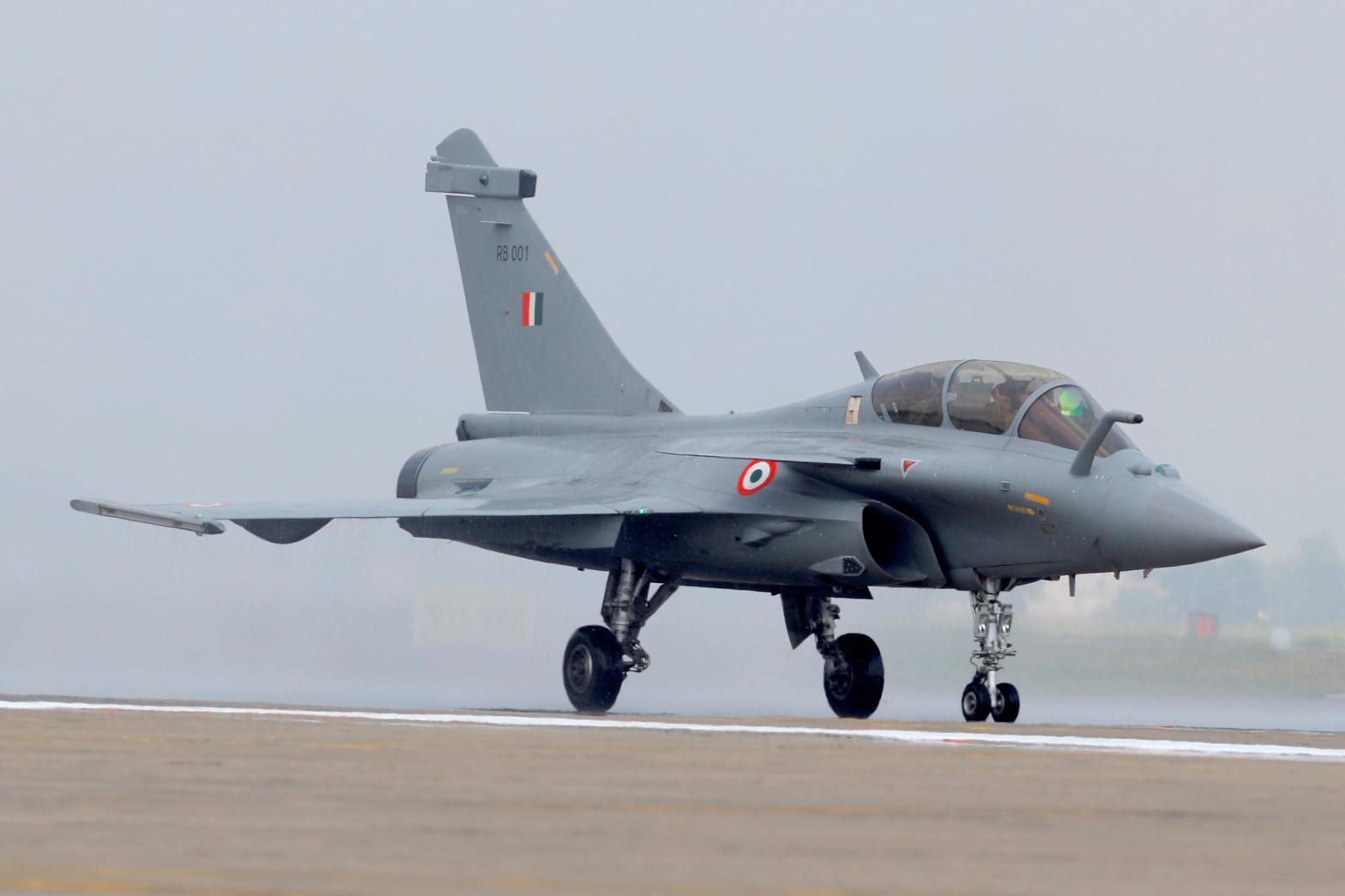
The Cabinet Committee on Security (CCS), headed by Prime Minister Narendra Modi, on Wednesday, April 9, 2025, approved a nearly ₹63,000-crore deal for the procurement of 26 Rafale-M fighter jets from France for the Indian Navy, official sources confirmed. The contract is expected to be concluded later this month. It includes 22 single-seater jets that can operate from aircraft carriers and four twin-seater trainer jets, which are not carrier-compatible. The deal includes weapons, simulator, spares, associated ancillary equipment, crew training and logistics support for the Navy. This will include India-specific add-ons such as establishing a maintenance repair and overhaul (MRO) hub, integration of India’s own Astra missile and sourcing from local suppliers. The delivery of the jets will begin three-and-a-half years after the contract is signed and is expected to be completed in about six-and-a-half years. The entire fleet is anticipated to be with the Navy by 2031.
The Indian Navy‘s Rafale-M deal will also include several upgrades to the IAF‘s Rafale fleet. Under the deal, 10 of the 36 Rafale will be upgraded to allow buddy-buddy refuelling enhancing the Air Force‘s operational range. Other improvements include ground-based equipment for operational support, software upgrades, advanced weapon systems and sensor suites as well as 40 long-range drop tanks.
The Defence Acquisition Council (DAC), chaired by Defence Minister Rajnath Singh, had accorded initial approval for the procurement of 26 Rafale-M fighters back in July, 2023. The Rafale-M purchase is one of the biggest military orders placed by the country, second only to 97 Tejas Mark1A jets for Rs 65,000 crore. Indian Air Force (IAF) had purchased 36 Rafale for Rs 59,000 crore in 2016.
These fighters will be deployed on INS Vikrant, India’s first indigenous aircraft carrier, and will complement the Navy‘s existing fleet of Russian-origin MiG-29K jets. Rafale-M is capable of carrying Scalp-EG, a 650-km-range missile. The aircraft will expand the Navy’s arc of offensive operations at sea and adding new capabilities such as long-range precision-strike missiles to hit ships and air targets. The Rafale-M jets can also be deployed to IAF bases along the northern borders to bolster the IAF fleet of 36 Rafale.
Rafale-M Aircraft
The Rafale was developed as a modern jet fighter with a very high level of agility. It has a delta-wing with active close-coupled canard, and uses digital fly-by-wire flight controls to maximize manoeuvrability. The Rafale has sufficient low speed performance to operate from STOBAR-configured aircraft carriers, and can take-off using a ski-jump with no modifications. The Rafale-M features a greatly reinforced undercarriage to cope with the additional stresses of naval landings, an arrestor hook, and “jump strut” nose-wheel, which only extends during short take-offs, including catapult launches. It also features a built-in ladder, carrier-based microwave landing system, and the new fin-tip Telemir system for syncing the inertial navigation system to external equipment. Altogether, the naval modifications of the Rafale-M increase its weight by 500 kilograms compared to other variants, the Rafale-M retains about 95 percent commonality with Air Force variants including, although unusual for carrier-based aircraft, being unable to fold its multi-spar wings to reduce storage space. The size constraints were offset by the introduction of Charles de Gaulle, France‘s first nuclear-powered carrier, which was considerably larger than previous carriers.
Although not a full-aspect stealth aircraft, the cost of which was viewed as unacceptably excessive, the Rafale was designed for a reduced radar cross-section (RCS) and infrared signature. In order to reduce the RCS, changes from the initial technology demonstrator include a reduction in the size of the tail-fin, fuselage reshaping, repositioning of the engine air inlets underneath the aircraft’s wing, and the extensive use of composite materials and serrated patterns for the construction of the trailing edges of the wings and canards. Seventy percent of the Rafale‘s surface area is composite.
Rafale M with French Navy
The French Naval Aviation (Aéronavale), the air arm of the French Navy, inducted Rafale-M in December 2000. After almost four years of training, the Rafale-M was declared operational with the French Navy in June 2004. The aircraft is fully compatible with United States Navy aircraft carriers and some French Navy pilots have qualified to fly the aircraft from US Navy flight decks. In 2002, they were first deployed to a combat zone, seven Rafale-Ms embarked aboard Charles de Gaulle of the French Navy during “Mission Héraclès”, during the French participation in “Operation Enduring Freedom”. They flew from the aircraft carrier over Afghanistan, but the F1 standard precluded air-to-ground missions and the Rafale did not see any action. In March 2002, the aircraft carrier was stationed in the Gulf of Oman, where its complement of Rafale undertook training operations. In June 2002, while Charles de Gaulle was in the Arabian Sea, Rafale conducted several patrols. In 2016, Rafale operating from Charles de Gaulle struck targets associated with the Islamic State of Iraq and the Levant (IS).
Operation Chesapeake, a test of this interoperability, was conducted in May 2018, when 12 Rafale along with nearly 350 support personnel embarked aboard USS George H.W. Bush for two weeks of carrier qualifications and exercises. On 9 January 2025, Rafale-M conducted joint anti-aircraft drills with Su-30MKI and Jaguar aircraft of the Indian Air Force. The French Carrier Strike Group (CSG) centred on the Charles de Gaulle, the carrier air wing including Rafale-M, her escort ships and fleet support ship.
IAF Rafale
The Rafale was the winner among the six aircraft competing in the Indian MRCA competition for 126 multirole fighters. 18 Rafale were to join in flyaway condition, and remaining were to be built in India by HAL. The deal stalled due to disagreements over technicalities of local production. Finally it was decided to buy 36 flyaway Rafale in a G2G deal worth €7.8 billion. Around August 2017, India had reportedly considered ordering 36 more Rafale amid tensions with China. All 36 Rafale had inducted in IAF by April 2022.
IAF Rafale have since participated in Red Flag (Alaska 2024) exercise, and exercises with Hellenic Air Force and Egyptian Air Force. IAF Rafale took part in Exercise “Tarang Shakti” in August-September 2024. After the Chinese balloon shoot down by US Air Force with an F-22 fighter, IAF Rafale shot down a comparatively smaller spy balloon (including a payload) with an air-to-air missile at an altitude of 55,000 ft.
IAF’s MRFA
The Indian Air Force (IAF) is pursuing the MRFA (Multi-Role Fighter Aircraft) program to acquire 114 advanced fighter jets, aiming to bolster its dwindling squadron strength and modernize its fleet, with a focus on both foreign acquisition and domestic manufacturing. The IAF is currently at a low of 31 fighter squadrons, and numbers could reduce further if LCA production is not hastened considerably and additional foreign aircraft are not bought. As many as eight aircraft responded to the RFI. These include the Boeing F/A-18E/F Super Hornet, Boeing F-15EX Eagle II, Lockheed Martin F-21 (a variant of F-16V with 14 India-specific customizations), Dassault Rafale, Eurofighter Typhoon, Saab JAS-39 Gripen E/F, Mikoyan MiG-35, and Sukhoi Su-35. The Acceptance of Necessity (AoN) has still to be cleared. Therefore CCS clearance has not been accorded, and Request for Proposal (RFP) have yet to be sent out. The focus has to be Made-in-India. Also the contract is supposed to be linked with transfer of a few critical aerospace technologies. The MRFA deal is considered a critical component of India’s defence strategy, particularly in light of regional security challenges.
Combine Rafale-M and IAF’s MRFA and “Make-in-India-For-The-World”
The purchase of Rafale-M with high commonality with IAF Rafale fleet was a good decision. It was better than inducting another type of aircraft that bring along with it many logistics and maintenance challenges. Combining repairs and spares with the IAF will save maintenance costs and inventory holding numbers. G2G was a good method considering the technical evaluation has already been done in great detail and it would save a lot of time. Also the Rafale will be able to operate on land along with the IAF in operational contingencies. In fact they both must train together very significantly.
The desperate need of IAF’s fighter aircraft requirement has been well flagged. The government had set up a high-level committee under Defence Secretary to suggest ways to make good IAF shortages urgently. Purchase of 114 Rafale for the IAF as part of the MRFA program could have been added to 26 Rafale-M and total numbers would have been 140. Such number is very viable for Make-in-India. Dassault factory in France has hands full with orders and the long queue for supplying existing orders. France has been open to setting up a factory in India as a Joint-Venture. Like the CASA C-295, the factory could be set up with private sector. It would be win-win for both. The factory in India could be used for “Make-in-India-for-the World”. India will benefit from global manufacturing best practises. Indian private industry will get huge orders. The MSME sector will particularly benefit.
Such a decision can be linked to aero-engine technology transfer, albeit, with some additional contract. Making Rafale in India will in no way scuttle or slow the LCA Mk1A, LCA Mk2 and AMCA projects. Though one school of thought is that India can concentrate only on LCA Mk1A and AMCA, and discontinue with LCA Mk2. The Rafale could be the 4.5 generation aircraft. It will save time, effort and costs. Whatever be the route, it is time for the “huddle” and to take hard calls, and get IAF’s fighter requirements on track.
Note: The article was originally written by the Author for The EurAsian Times on April, 13th, 2025, it has since been updated.
Header Picture Credit: Reuters
Twitter: @AirPowerAsia
 Air Power Asia