
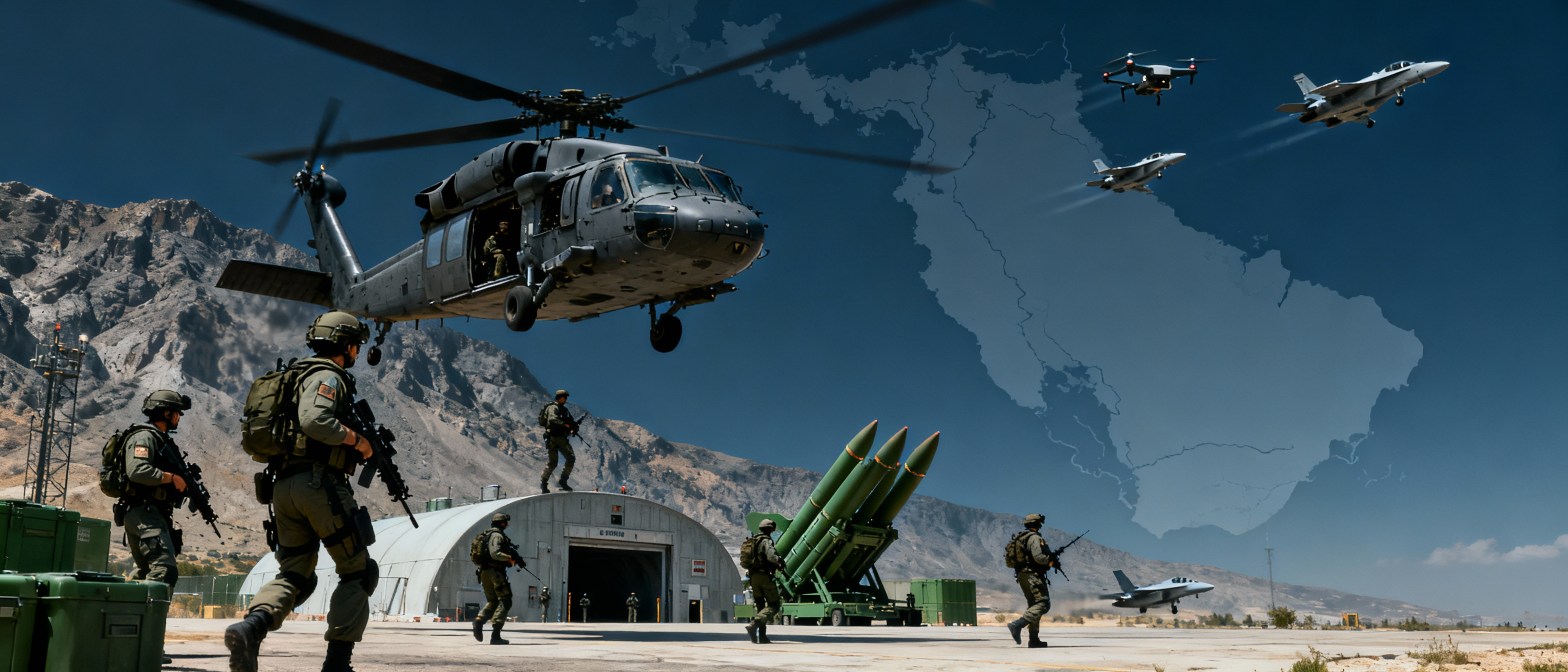
Israel Air Force has just de-classified the mission, codenamed “Operation Many Ways,” how in 3 hours 120 elite Israeli forces raided and destroyed alleged underground Iran-funded missile manufacturing facility in Syria. The mission was carried out on September 8 in 2024. Iran’s construction of the “Deep Layer” facility reportedly began in late 2017.
Earlier Israel has carried out many other, now famous air-raids such as the Entebbe counter-terrorist mission in Uganda (1976), and Operation Opera against Iraq’s Osirak nuclear reactor (1981). Israeli airstrike on Iran’s consulate in Syria in April 2024 killed 2 generals and 5 other officers. Hamas chief Haniyeh and his bodyguard were killed when an “airborne guided projectile” hit a special residence for military veterans, in which he was staying, in northern Tehran in July 2024.
There is an unending list of operations. Each operation was carried out after obtaining actionable hard intelligence. Success rates were very high. The world has a lot to learn from the planning and execution. So does India.
The Deep Layer Facility
The “Deep Layer,” facility was located in Masyaf area in western Syria, a stronghold of Syrian air defences. The site was a flagship project of Iran’s missile production program, and intended to supply precision missiles to Hezbollah in Lebanon and to the Assad regime in Syria.
The underground facility had been built because an earlier Israeli airstrike on an aboveground rocket engine manufacturing site in Jamraya, southern Syria had destroyed it. By 2021, the underground facility, buried 70 to 130 metres into a mountain, had become operational, with missile production capabilities nearing full scale.
The horseshoe-shaped structure featured three primary entrances: one for raw materials, another for completed missiles, and a third for logistics and office access. Israel estimated the facility’s annual output could be between 100 and 300 missiles, of over 300 kilometres range.
The site was intentionally located 200 km north of the Israeli border and 45 km from Syria‘s western coastline to keep away from Israeli strikes on overland weapons convoys to Hezbollah. Israel had been monitoring the facility closely. Airstrike plans had been prepared for sometime and were continuously being refined.
Operation Many Ways
The urgency began after October 2023 attacks on Israel, by Hamas in Gaza, Hezbollah in Lebanon, and other Iran-backed militias. The elite Shaldag unit, known for long-range penetration operations, and Unit 669, specialising in combat search and rescue, were selected for the mission, and trained extensively.
The operation began with 100 commandos and 20 medics boarding four CH-53 “Yasur” heavy helicopters, escorted by AH-64 attack helicopters, 21 fighter jets. Others platforms were five drones, and 14 reconnaissance planes. The formations flew over the Mediterranean to avoid Syrian radar detection.
After entering Syria the helicopters flew nap-of-the-earth (NOE) operations, flying exceptionally low to evade the country’s densest air defence zones. Aircraft launched diversionary strikes on other Syrian targets, taking attention away from the Masyaf region.
The helicopters landed near the facility’s entrances, deploying troops. Medics remained aboard helicopters prepared to evacuate or treat casualties. A surveillance drone launched by the commandos monitored the area.
Commandos secured the perimeter and then breached the heavily guarded facility. Once inside, the team planted nearly 660 pounds of explosives along the production line and its support facilities. The team then exited and detonated the explosives remotely destroying the production site. The mission was completed in less than 3 hours, and returned using the same helicopters. They reported killing approximately 30 Syrian guards and soldiers during the operation. Syrian media acknowledged 14 fatalities and 43 injuries.
Operation Entebbe
Officially codenamed Operation Thunderbolt was a 1976 Israeli counter-terrorist mission in Uganda. It was launched in response to the hijacking of Airbus A300 Air France Flight 139 with 248 passengers on 27 June 1976 between Tel Aviv and Paris. During a stopover in Athens, the aircraft was hijacked by two Popular Front for the Liberation of Palestine – External Operations (PFLP-EO) and two German RZ members, who diverted the flight to Libya and then to Uganda, where they landed at Entebbe International Airport to be joined by other terrorists. Once in Uganda, the group enjoyed support from Ugandan dictator Idi Amin.
The hijackers took the passengers hostage and demanded release of 40 Palestinian and affiliated militants imprisoned in Israel as well as the release of 13 prisoners in four other countries. Over 100 Ugandan soldiers were deployed to support the hijackers after the flight landed, and Amin had personally welcomed the terrorists at Entebbe. After moving all of the hostages to a defunct airport, the hijackers separated all Israelis and several non-Israeli Jews and moved them into a separate room. Over the next two days, 148 non-Israeli hostages were released and flown out to Paris. The 94 remaining passengers and the 12-member Air France crew were held hostage. The hijackers had threatened to kill the 106 captives if the specified prisoners were not released.
When all global diplomatic efforts failed, acting on intelligence provided by Mossad, the decision was made to have the Israeli military undertake a rescue operation. Initiating the operation at nightfall on 3 July 1976, four Israeli C-130 transport planes flew 100 commandos over 4,000 kilometres to Uganda for the rescue effort. Over the course of 90 minutes, 102 of the hostages were rescued successfully, with four having been killed.
The Israeli military suffered five wounded and one killed; Yonatan Netanyahu was Israel‘s sole fatality of the Operation, and had led special reconnaissance unit during the rescue effort. He was the older brother of Benjamin Netanyahu, who is the current Israeli prime minister. The Israeli commandos killed all of the hijackers and 45 Ugandan soldiers, and 11 Ugandan MiG-17s and MiG-21s were destroyed. Through the operation Israel received support from neighbouring Kenya.
The Israelis lacked the logistical capacity to aerially refuel four to six aircraft so far from Israeli airspace. Israel used influential Jews to arrange with Kenya to land and refuel at Nairobi airport. Mossad had built an accurate picture of the whereabouts of the hostages, the number of hijackers and Ugandan troops, from the released hostages in Paris. Israel consulted with Israeli construction firms that had built the terminal where the hostages were held. The IDF erected a partial replica of the airport terminal for training. Separate groups were created for assault and hostage rescue operation; for securing the airfield and refuelling operation; and for destroying the squadron of MiG fighter jets on the ground.
The task force flew following international routes over the Red Sea, mostly flying at a height of no more than 30 m (100 ft) to avoid radar detection by Egyptian, Sudanese, and Saudi Arabian forces. Near the south outlet of the Red Sea the C-130s turned south crossed Ethiopia, and when northeast of Nairobi, Kenya, they turned west, passing through the African Rift Valley and over Lake Victoria. Of the two Boeing 707 jets that followed the cargo planes, one with medical facilities landed and remained in Nairobi. The second circled over Entebbe Airport during the raid.
The Israeli force landed at Entebbe on 3 July at 23:00h. A black Mercedes car that looked like President Idi Amin‘s vehicle and Land Rovers that usually accompanied Amin‘s Mercedes were brought along. On landing, the assault teams drove the vehicles to the terminal building in the same fashion as Amin. The hostages were rescued.
The entire operation lasted 53 minutes, of which the assault lasted only 30 minutes. The 102 rescued hostages were flown to Israel via Nairobi.
Operation Opera against Iraqi Osirak Nuclear Reactor
Israeli Air Force conducted a surprise attack on 7 June 1981, which destroyed an unfinished Iraqi nuclear reactor located 17 kilometres southeast of Baghdad. Operation Opera, was part of Israel‘s counter-proliferation preventive strike that had been elucidated in the Begin Doctrine. It became a precedence for every future government in Israel.
In 1976, Iraq purchased an Osiris-class nuclear reactor (named Osirak) from France. It was jointly maintained, and intended for peaceful scientific research. The Israelis believed it was meant to produce nuclear weapons. On 7 June 1981, a flight of Israeli Air Force F-16A fighter aircraft, with an escort of F-15As, bombed the Osirak reactor deep inside Iraq. The airstrike reportedly killed ten Iraqi soldiers and one French civilian.
The attack was met with sharp international criticism, including in the United States, and Israel was rebuked by the United Nations Security Council and General Assembly in two separate resolutions.
By spring of 1979, Israeli PM Menachem Begin had reached the conclusion that an anticipatory attack was necessary. In April 1979, Mossad agents in France allegedly planted a bomb that destroyed the reactor’s first set of core structures while they were awaiting shipment to Iraq. On 14 June 1980, Mossad agents assassinated Yahya El Mashad, an Egyptian nuclear scientist who headed the Iraqi nuclear program, in a hotel in Paris. Mossad also reportedly bombed several of the French and Italian companies it suspected of working on the project. In July 1980, Iraq received from France a shipment of approximately 12.5 kilograms of highly enriched uranium fuel for the reactor.
Iranians had also carried out an air-attack codenamed Operation Scorch Sword, against the Osirak plant site on 30 September 1980 using two F-4 Phantom aircraft. The attack was the first on a nuclear reactor and only the third on a nuclear facility in history. The Iraqis denied any major damage, but the French and Italian technicians promptly left Iraq.
In October 1980, Mossad reported that the Osirak reactor would be fueled and operational by June 1981. Israeli cabinet finally voted 10–6 in favour of launching the attack. Israelis needed photographic intelligence about the layout of the plant. Interestingly an Iranian F-4 Phantom reconnaissance jet took pictures of the Osirak reactor for Israelis. Israeli F-4 Phantoms also ran reconnaissance missions over southern and western Iraq, and discovered a blind area of Iraqi radars, on the border with Saudi Arabia. Israel also had an advantage that Iraq was preoccupied fighting Iran.
The distance between Israeli military bases and the reactor site was over 1,600 km. The Israeli planes would have to violate Jordanian and/or Saudi airspace in a covert flight over foreign territory, making mid-air refuelling unfeasible. Israel eventually decided that a squadron of heavily fuelled and heavily armed F-16As, with F-15As providing air cover and fighter support, would perform a surgical strike without resorting to aerial refuelling.
The attack consisted of eight F-16As, each with two unguided Mark-84 2,000-pound delay-action bombs. Six F-15As provided fighter support. The operation started on 7 June 1981, at 15:55 local time. The Israeli planes took off from Etzion Airbase near Gulf of Aqaba, flying unchallenged in Jordanian and Saudi airspace. The Israeli pilots conversed in Saudi-accented Arabic while in Jordanian airspace and told Jordanian air controllers that they were a Saudi patrol that had gone off course. While flying over Saudi Arabia, they pretended to be Jordanians, using Jordanian radio signals and formations. The Israeli planes were so heavily loaded that the external fuel tanks were jettisoned over the Saudi desert.
The attack formation descended to 30 m (100 ft) over the Iraqi desert, attempting to fly below the Iraqi radar cover. Final attack was a pull-up and a 30 degree dive releasing the Mark 84 unguided gravity bombs in pairs, at 5-second intervals. At least eight of the sixteen released bombs struck the containment dome of the reactor. The attack lasted less than two minutes. The Israeli planes were still intercepted by Iraqi defenses but managed to evade the anti-aircraft fire.
Both, the UN General Assembly and the Security Council condemned and warned Israel. The Osirak facility remained in its damaged state until the 1991 Persian Gulf War, when it was completely destroyed by air strikes by the United States Air Force.
Balakot Strike
26 February 2019, the IAF conducted an early morning airstrike against a Jaish-e-Mohammed (JeM) terrorist training camp at Jaba Top near Balakot, Pakistan. Balakot had a training camp that offered both basic and advanced terrorist training on explosives and artillery. The airstrike was the first time since the Indo-Pakistani War of 1971 that attacking warplanes had crossed the Line of Control. The attack was in the aftermath of a JeM claimed terror attack against an Indian CRPF convoy that had resulted in 40 soldiers killed.
Twelve Mirage 2000 jets carrying SPICE 2000 precision-guided munitions and other weapons were involved in the operation. They were supported by four Sukhoi Su-30MKI, Netra and Phalcon airborne early warning and control aircraft, an IAI Heron UAV and two Ilyushin Il-78 aerial refuelling aircraft. There were decoy missions that flew in Rajasthan sector feigning a strike against JeM headquarters in Bahawalpur. Nearly 300 trainees and instructors were reportedly killed at Jaba Top.
The major highlights were that very high-level of secrecy was maintained despite very large number personnel involved in preparation of aircraft at many airbases. The very early morning timing of the strike, also called the “Graveyard Shift” was meant to catch all the radar controllers and air defence crew at their bio-clock low.
Lessons from Israeli Operations
Israel has had a threat to its existence from the Arab nations surrounding it who support the Palestinian cause. Thus for Israel it is a do-or-die situation. Their public mind-set, and armed forces preparations are based on the basic fear of annihilation. The psyche of political and military leadership is well tuned to defence of the nation and are ready to take calculated risk, irrespective global political reactions. Israel and its diaspora in USA has worked hard to get backing of the US government. It must be understood that Israel cannot go it alone. In the literal sense, Israel fights by itself, but its lifeline is the United States.
The success of any military operation is heavily dependent on accurate intelligence. Israeli Institute for Intelligence and Special Operations, popularly known as Mossad, is a world acclaimed intelligence agency. It has contributed significantly to the success of all Israeli military operations.
The continuous Israeli military training follows the dictum “more you sweat in peace, less you bleed in war.” Expecting war at short notice, Israel keeps high weapon stocking, and has secured supply chains.
The mission preparation is most crucial. All successful operations involved great amount of preparations including mission rehearsals and dummy strikes on full-scale models and realistic targets.
The world has lot to learn from Israel on close combat in an urban environment, as has been especially in Gaza and South Lebanon. Israel has been practicing criticality of organic lethality and rapid engagements. The ability to responsively employ precision fires in close proximity to friendly forces, and giving higher priority to air delivered fires. Israel believes in what Clausewitz taught students of strategy, war is not an end in itself. War is a means to an end, the application of organized violence to achieve geopolitical objectives.
Lastly Israel has had both intelligence and military failures and has constantly tried to learn from it and made amends. Israel has no illusions about a permanent resolution to the conflict. As has often been observed, eternal vigilance is the price of liberty. Israel believes in “Do plan for the day after”.
Note: The article was originally written by the Author for The EurAsian Times on January, 12th, 2025, it has since been updated.
Header Picture Credit: Author
Twitter: @AirPowerAsia
 Air Power Asia