
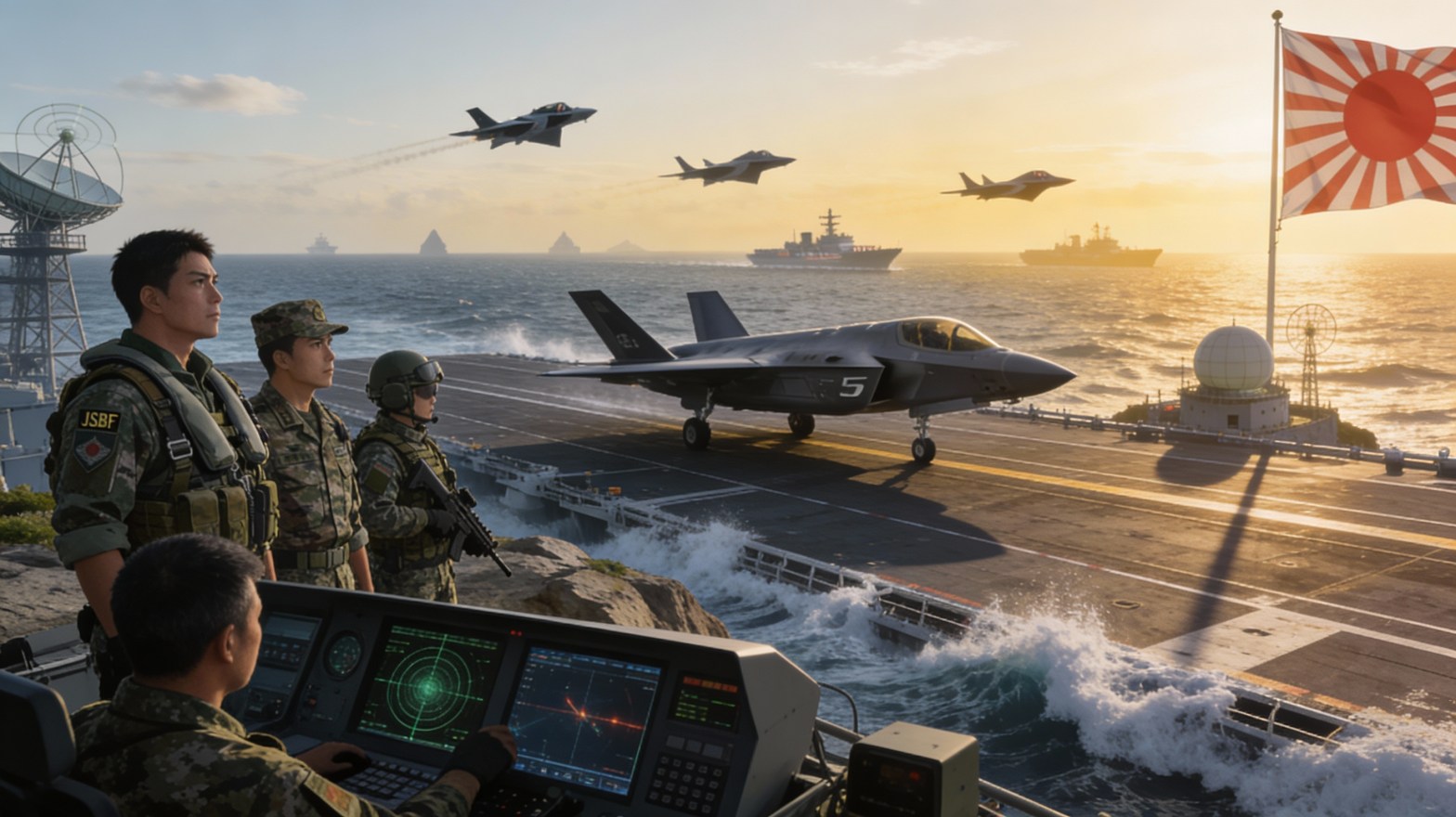
Pacific military balance is tilting in China‘s favour, says the new “Defence of Japan 2025” White Paper, a Defence Ministry annual document. Tokyo released the paper in early July with findings that the international community is facing its greatest risk of conflict since World War II. The paper pointed to Russia, China and North Korea as primary regional security threats. The report also found the US-China strategic competition has escalated, and that the military balance between China and Taiwan has been rapidly tilting in China‘s favour.
Defence of Japan 2025 White Paper
China‘s external posture, and military and other activities are a matter of serious concern for Japan, and the greatest strategic challenge, reads the document. China‘s activities in the East and South China Sea have been intensifying, especially, around Taiwan. China is building military strength, especially air, maritime, and amphibious capability in pursuit of unification of Taiwan. They could attempt a blockade of Taiwan.
The presence of Chinese warships in the Pacific has steadily increased and the frequency of their passage off south-western Japan has tripled in the past three years, including in waters between Taiwan and the neighbouring Japanese island of Yonaguni, the report said.
Russia and China‘s militaries are training together. It includes joint bomber flight operations, and coordinated naval patrols, including in the vicinity of Japan. These joint activities are intimidating show of force against Japan, says the paper. The paper also condemns Russia‘s invasion of Ukraine and the ongoing war, and calls it an attempt for unilateral changes to the status quo by force. A similar situation may occur in the East Asia region in the early future.
North Korea‘s nuclear and missile developments were also highlighted as a grave threat to Japan. North Korea is focusing on qualitative improvements in its nuclear and missile capabilities. In view of political, economic and military competition between the US and China, the importance of the US–Japan alliance, was highlighted as important for joint deterrence. Report highlights ongoing initiatives and efforts to improve the capabilities of the Japanese Self Defence Force (JSDF).
China‘s Foreign Ministry spokesperson Lin Jian criticized the white paper, saying it “adopts a wrongful perception of China, unjustifiably interferes in China’s internal affairs, and plays up the so-called China threat.” Beijing has lodged protests with Japan, Lin said, defending China‘s military activities as “legitimate and reasonable.” He urged Japan to reflect on its wartime past and “stop hyping tension in the region and China-related issues as a pretext to justify its military build-up.”
China-Japan Security Dynamics
The security dynamics between China and Japan are complex, marked by both cooperation and competition, particularly in the context of a shifting regional power balance. China‘s rise as a regional power, and its military modernization, have heightened Japan‘s security concerns. Japan, in turn, is strengthening its defence capabilities, deepening its alliance with the United States, and forging closer ties with other regional partners to counter potential threats. The Senkaku/Diaoyu Islands dispute remains a major source of friction, highlighting the lack of trust between the two nations. Japan has responded by increasing its defence spending and modernizing its military. Despite security concerns, the two countries maintain strong economic relationships. Japan‘s alliance with the United States is a cornerstone of its security policy, providing a strong deterrent against potential threats. Both China and Japan have a vested interest in maintaining peace and stability in the region, although their approaches to achieving this goal may differ.
There have been cases when Chinese warplanes briefly violated Japanese airspace off islands near Nagasaki, and an aircraft carrier’s entry into a zone just outside of Japan‘s territorial waters southwest of the Nansei island chain, which stretches from the southern coast of Kyushu to Taiwan. More recently, Chinese JH-7 fighter-bomber flew close to a Japanese YS-11EB electronic-intelligence aircraft. Japan raised a protest. Beijing in turn accused Japan of flying near Chinese airspace for spying purposes.
New National Security Strategy (NSS)
On December 16, 2022, Japan announced its new National Security Strategy (NSS) which outlined a shift towards a more proactive and robust defence posture. Article 9 of the Japanese Constitution was a clause that renounced war as a sovereign right and permitted only self-defence forces. For long, Japan had a self-imposed limit on defence budget at no more than 1 percent of the country’s GDP. The NSS which came into effect after Russia‘s conflict in Ukraine, commits to increasing Japan‘s defence budget to 2 percent of its GDP by 2027, a significant jump from the earlier limit.
It calls now for the development of capabilities to launch counter-strikes against potential adversaries and to disrupt invasions earlier and at greater distances. The strategy emphasizes the use of all instruments of national power, diplomatic, informational, military, and economic to achieve Japan‘s security objectives. Japan is prioritizing strengthening its alliance with the United States and building a network of security cooperation with other countries like the EU. The strategy also focuses on strengthening Japan‘s domestic defence industry and developing capabilities like long-range precision cruise missiles and active cyber defence.
Defence Budget 2025 and Acquisition Priorities
Decades of compulsive dependence on the United States has left Japan‘s military a underdeveloped force. Tokyo’s military posture vis-à-vis regional threats remains a work on progress. With President Donald Trump focusing on the strengthening of the US economy and security, Japan and other US allies face expectations to play a greater role for peace and stability in the region. North Korea poses “an increasingly serious and imminent threat” for Japan‘s security. Japan has accelerated its military build-up on south-western islands in recent years, preparing to deploy long-distance cruise missiles, as it worries about a conflict in Taiwan. Japan tested a short-range, surface-to-ship missile recently.
For 2025, Japan approved a record defence budget, the 13th growth year in a row. It is up 9.4 percent to a record 8.7 trillion yen ($55.1 billion). Among the priorities are new communications satellites, stand-off weapons such as ground- and sea-launched Type 12 anti-ship missiles, hyper-velocity gliding projectiles for island defence, and development of submarine-launched missiles. Funds would be required for Kongsberg‘s Joint Strike Missile for Japan‘s F-35A fighters, Tomahawk cruise missiles to arm destroyers, and extended-range Joint Air-to-Surface Stand-off Missiles (JASSM-ER) for F-15 fighters. Also on the list are two MQ-9B SeaGuardian drones and six American V-BAT drones to operate from Japanese warships. Integrated air and missile defence is a priority and so are mobile reconnaissance radars.
Japan‘s Self Defence Forces (JSDF) Renewed Approach
Since North Korea acquired ballistic missile capability in 1998, Japan has participated in the American anti-ballistic missile (ABM) defence program, through joint research and development of the Aegis Ballistic Missile Defence System, and have physically deployed three types of ABM system, air defence vehicles, sea-based Aegis and land-based PAC-3 ABM, and the upgraded version of the MIM-104 Patriot. In 2018, Japan picked Lockheed Martin Corp to build a $1.2 billion radar for two ground-based Aegis ballistic missile defence stations.
In light of tensions over the Senkaku Islands, Japan began to assemble the Amphibious Rapid Deployment Brigade in 2016, its first marine unit since World War II, designed to conduct amphibious operations and to recover any Japanese islands taken by an adversary. Japan has also initiated a program to convert its Izumo-class destroyer two-ship fleet from “helicopter carrier destroyers” to aircraft carriers with a capability to launch the F-35B – to be the first Japanese aircraft carriers since World War II. In 2014, Prime Minister Shinzo Abe‘s government lifted the long-term ban on engaging Japanese troops abroad, a prohibition dating to the end of the Second World War, in a bid to strengthen Japan‘s position.
Japan Air Self-Defence Force (JASDF)
JASDF is the air and space branch of the JSDF. Major organs of the JASDF are the Air Defence Command, Air Support Command, Air Training Command, Air Development and Test Command, and Air Materiel Command, and the Space Operation Squadron. The Air Defence Command is further divided into northern, central, and western regions, and the south-western Composite Air Division. JASDF controls surface-to-air missile units of both the JASDF and the JGSDF (Ground Force).
The nearly 50,000 strong JASDF has around 750 aircraft (320 fighters). Its main roles are aerial, space, cyber, and electronic warfare. The JASDF carries out combat air patrols around Japan, while also maintaining a network of ground and air early-warning radar systems. The service will be renamed in 2027 to the Japan Air and Space Self-Defence Force (JASSDF).
Its current fighters include Boeing F-15J/DJ, Mitsubishi F-2A/B, and F-35A/B. E-767 AWACS and E-2C/D Hawkeye are the AEW&C. Transport aircraft include the Kawasaki C-1 and C-2, Lockheed C-130H, Hawker 800, Gulfstream IV, and Boeing 777. The electronic warfare aircraft include YS-11EA/EB and EC-1 (for EW training). JASDF operates Sikorsky UH-60J, and Boeing CH-47J (LR) Chinook helicopters. The Flight Refuelling Aircraft (FRA) are KC-767, KC-46 Pegasus, and KC-130. JASDF has 22 AWACS and AEW&C aircraft, and 10 FRA. Japan also operates RQ-4 Global Hawk UAVs. Since March 2022, the Space Operations Group is operating with two squadrons.
Japan is significantly bolstering its air power, particularly with the F-35 fighter jet, to counter the growing threat from China‘s expanding air force. It is conscious of the need to take-on the Chinese H-6K bombers and J-20 stealth fighters, both within and beyond the First Island Chain (FIC). Also the growing Chinese aircraft carriers has prompted Japan to modernize its air force and strengthen its alliances with QUAD countries like the US, Australia, and India. F-35s are replacing the retired Mitsubishi F-4EJ Phantom II for countering Chinese stealth capabilities. The JASDF is also upgrading its F-15J fighter jets to maintain air superiority. The JASDF‘s F-2 fighters are slated to be replaced by a future sixth-generation stealth fighter developed under the Global Combat Air Programme (GCAP). This aircraft would be designed by a joint venture set-up in mid-2025 with manufacturing and assembly being subcontracted to Britain’s BAE Systems, Italy’s Leonardo, and Japan‘s Mitsubishi Heavy Industries. The fighter is slated to be deployed by 2035 and would be a crewed platform which would possibly be capable of directing other autonomous aircraft.
The earlier plan for JASDF to operate the STOVL F-35B from land bases. Japan approved the modification of the ships of the Izumo-class to operate STOVL aircraft like F-35s. In the last few years, the JASDF has scrambled on average nearly 700 times a year to intercept China‘s People’s Liberation Army Air Force (PLAAF) aircraft. This has resulted in heavy wear and tear on their F-15J fighter aircraft. F-35 fighter now supplement in such missions. JASDF will finally have around 100 F-35A/B.
To Summarise
Japan has to initially defend itself from the large PLA offensive capability. It is a tall order. China‘s official defence budget for 2025 is close to US$ 277 billion. The Japanese defence budgets have only started going up significantly very recently. It has already hit 1.8 percent of GDP in 2025. Once it reaches 2 percent of GDP, it may exercise further flexibility to increase to 2.5 percent or even more.
China’s first priority is reclaiming/annexing Taiwan. Will China invade Taiwan and antagonise the entire world? Even Russia is opposed to use of force against Taiwan. USA, Japan, South Korea have significant military strength. Will USA enter conflict against China in case China invades Taiwan? Will Japan enter such a conflict also remains a mute question. Notwithstanding, deterrence is important. USA will be able to provide satellite-based ISR, communications and navigation, and targeting.
United States Forces Japan constitute nearly 35,000 personnel. US Air Force (USAF) maintains several key airbases in Japan, strategically positioned to support regional security and operations. These include Yokota Air Base, Kadena Air Base, and Misawa Air Base, each playing a vital role in the US military’s presence in the Pacific. USAF operates F-16 and F-15 fighters, KC-135 tankers, E-3 AWACS, and HH-60G helicopters. Other notable bases include Misawa Air Base, which is currently undergoing a transition from F-16s to F-35s. F-22 also make long operational detachments in Japan. The US Air Force maintains a significant presence in South Korea, primarily through Seventh Air Force, which is the component of Pacific Air Forces (PACAF). With The Philippines offering many airbases to USA, the USAF presence will increase further. Guam would have to be defended at all cost.
JASDF will have to concentrate on air defence against cruise and ballistic missiles, and build capability and capacities. It would need fighter aircraft to defend against Chinese next generation fighters and bombers. It would also need to build its own offensive weapon inventories in the long term to act as deterrent. Japanese military asset commonality with NATO will help early replenishments if required. Japan‘s two Izumo-class helicopter destroyers, the JS Izumo and JS Kaga, are undergoing conversion to light aircraft carriers to accommodate and operate F-35B. At least two more would be required later. Japan is on track to become an even more significant air and space power.
Note: The article was originally written by the Author for The EurAsian Times on, July 26th, 2025, it has since been updated.
Header Picture Credit: Author
Twitter: @AirPowerAsia
 Air Power Asia