As we come to the end of the year 2025, we have seen the ongoing trend of chaos, conflict, and, at times, confusion in the geopolitical arena. The war in Ukraine continues, with a possible closure in 2026. Much to European angst, Vladimir Putin, the “Wizard of the Kremlin”, continues to stand steadfast and call the shots in his own way. Meanwhile, Trump continues to push Europeans and President Volodymyr Zelenskyy to agree to his proposed peace deal that envisages concessions to Russia.
The crisis in West Asia saw massive US and Israeli strikes on Iran. Iran has since fallen into a lull but is likely to remain a major source of interest and intrigue over the coming years. An unexpected war in Venezuela looks ever more likely. The G2 (the US and China) continue their economic war. Meanwhile, Trump continued to ravage the world through his punishing tariffs in his attempt to Make America Great Again (MAGA) by balancing trade and reducing federal debt. As the US heads towards isolationism, and with war on Europe’s doorstep, alliances look ever more fragile. The US wants Europe to shoulder a much greater part of its own security.
The Chicago-based Bulletin of the Atomic Scientists, which runs the Doomsday Clock, set it at 89 seconds to midnight in January 2025. They decided to move the clock one second closer to midnight, from the previous 90 seconds, because of climate change, nuclear threats, and biological hazards. The world is already perilously close to the precipice. A move of even a single second should be taken as an indication of increased danger and an unmistakable warning that every second of delay in reversing course increases the probability of global disaster.
The scourge of terrorism continued to visit India, as Pakistan remains the global fountainhead of terror. The Pakistan-backed Pahalgam Massacre invoked a massive response from India, hitting Pakistan hard in “Op Sindoor”. Pakistan–Afghanistan relations hit a new low, as Pashtuns made the Durand Line live with cross-border action. Bangladesh remains in a civil-war state after the ouster of Sheikh Hasina, as the interim government tries to distance itself from India and makes overtures to China and Pakistan.
The United States’ use of sanctions, technology dominance, and other tools of economic warfare has, at times, replaced military action as the weapon of choice for destabilising adversarial regimes, reflecting the US’ renewed vision of its place in the world and growing dissatisfaction with the previously self-championed ideals of globalisation. Mostly, sanctions have been found to be an ineffective tool, as seen from the growth of China, India, and Russia, among the most hit. Is the world heading for a new economic Cold War?
All of this has continued to remind the world of the criticality of geopolitics for governments, businesses, and populations alike. The year 2026 looks to be no calmer for analysts and global affairs watchers, with great power competition, conflict, and challenges to established global orders continuing to dominate the geopolitical landscape.
Major Global Events 2025
The 25th year of the third millennium and the 21st century saw an escalation of major armed conflicts, including the renewed Russian thrust into Ukraine, even as peace negotiations began between Vladimir Putin and Donald Trump. The Gaza war, including famine and a humanitarian crisis, as well as the Sudanese civil war, also continued throughout the year.
Internal crises in Armenia, Bangladesh, Ecuador, France, Georgia, Germany, Haiti, Peru, Somalia, and South Korea continued into 2025. South Korean President Yoon Suk Yeol was arrested and removed from office. The year also saw a wave of protests predominantly led by Generation Z, with some, such as those in Bangladesh, Nepal, and Madagascar, resulting in the overthrow of governments. Several brief conflicts arising from longstanding tensions emerged mid-year, including India-Pakistan in May, Iran-Israel in June, and Cambodia-Thailand in July.
In economics and business, the return of Donald Trump to the US presidency ushered in a series of tariffs levied by America on most of the world, significantly disrupting global trade, in addition to reinvigorating the China–United States trade war. The technology sector was additionally hit with the release of DeepSeek’s chatbot, a Chinese large language model that competes with ChatGPT.
Aviation and aerospace also saw accidents this year, including the crash of Air India Flight 171 in Ahmedabad, India. Several advances in space exploration were made as well, including the first crewed polar-orbit spaceflight and the first fully successful landing of a spacecraft on the Moon by a private company.
Challenges and Opportunities – India in 2025
In 2025, India’s geopolitical landscape was defined by balancing major power relations (the US, Russia, the EU, and China), navigating regional instability (Pakistan, Bangladesh, and the Maldives), pursuing key trade deals (with the US and EU), managing energy security amid global conflicts (Ukraine and West Asia), and addressing economic pressures from Western tariffs, all while enhancing strategic partnerships in areas such as technology and cyber security.
US–India dynamics included dealing with potential US tariffs, “America First” policies, renewed US–Pakistan ties, and efforts to secure a significant trade deal for better market access. India–EU relations are a deepening “Strategic Partnership” focused on trade (with FTA talks ongoing), EU–India Trade and Technology Council (TTC) cooperation, security, climate, and digital transformation, with both seeking to build resilient economies and counter China’s influence under a shared goal of global stability and growth. However, EU–India differences on Russia create policy challenges.
The EU sees India as a vital partner for supply-chain diversification, clean energy, and a rules-based Indo-Pacific, while India leverages EU technology and investment for its growth. This also meant navigating EU sanctions (including the Vadinar refinery), carbon border taxes, digital barriers, and balancing energy imports with other EU nations.
India continues a delicate balance of trade with China despite border tensions while managing energy ties and geopolitical pressures over relations with Russia. President Putin’s state visit to India on December 4-5, 2025, for the 23rd India–Russia Annual Summit further strengthened the Special and Privileged Strategic Partnership between India and Russia. Major trade agreements with the US, the UK, EFTA, Qatar, and New Zealand could boost investment.
On regional security and stability, addressing anti-India sentiment in Bangladesh and the Maldives and managing complex counter-terrorism efforts with Pakistan, including incidents such as the Pahalgam attack and Delhi bomb blasts, remained areas of concern. Increased militarisation in the Indo-Pacific region remained a key apprehension.
Strengthening energy partnerships with the US, Russia, and Middle Eastern nations, and navigating global energy market turbulence, was handled with relative resilience. Facing pressures from global protectionism, leading to efforts to diversify and secure critical mineral supply chains, remained a challenge.
India’s 8.2 per cent GDP growth in Q2 of 2025-26 was very encouraging. The year was marked by global structural shifts, increased nationalism, trade protectionism, and cyber-security threats. India balanced its interests amid global power competition, seeking strategic partnerships while maintaining strategic autonomy.
Global Geopolitical Expectations – 2026
Will Gaza finally see peace? How will the fragile ceasefire be handled? Can there be a homeland for Palestinians ruled by a moderate government and not militant Hamas? Will Iran restart full support for Hamas, Hezbollah, and the Houthis, creating an environment for military escalation in the Middle East and forcing increased Israeli targeting of Iran-aligned groups throughout the region?
Israel is likely to receive continued support from the US to pursue its objectives of occupation and displacement in Gaza, along with settlement expansion and the likely annexation of the West Bank. The US may exert little or no pressure on Israel to restrain its military activity elsewhere in the region, and Israel may feel emboldened to conduct strikes in Turkey, Egypt, or other states hosting Hamas leadership. Gulf and Islamic countries may intensify diplomatic pressure on Israel, including reviewing diplomatic and economic ties and activating regional defence commitments.
Iran may head towards acute economic and security destabilisation. Iran’s internal and regional security will continue to destabilise due to domestic unrest, proxy weakening, the possibility of further Israeli offensives, and potential US supervision on its border with Azerbaijan and Armenia through management of the Zangezur Corridor, leading to possible military escalation. This could generate political pressure for moderation of ideological divisions.
Turkey is tending towards political and security destabilisation, with the controversial arrests of over 100 politicians affiliated with the opposition Republican People’s Party (CHP) under investigation for corruption and tender rigging. President Erdoğan’s anti-terrorism initiative targeting the Kurdistan Workers’ Party (PKK) has had consequences. A substantial increase in defence sector exports may gradually lift the lira from its record low.
Russian missile and drone strikes against Ukraine will continue as Russia makes incremental territorial gains in eastern Ukraine. Russia has identified securing all of Donbas as a key goal. Will Europe and Ukraine give in to American pressure and accept the Ukraine deal? What kind of security guarantees can exist for Ukraine and other frontline states? Who will position a peacekeeping or monitoring force — the UN, China, India, or the African Union?
If the war does not stop, Russia may continue to gain territory and increase its bargaining power. The USA is unlikely to inject further funds, and Europe cannot shoulder the burden alone. There is a moderate to high probability that the US will increase economic pressure through secondary tariffs and sanctions if Russia continues to avoid taking concrete measures towards a peace deal.
The Indo-Pacific will see diplomatic de-escalation as the US and China make further progress towards a trade agreement that lowers tariffs. There will be modest trade enhancements as the White House’s tariffs and technology restrictions rebalance and settle into a new normal, while AI-driven increases in power consumption and climate-related threats raise the risk of energy disruption.
The US has signed agreements with most trading partners in the region, with the notable exception of India. The US and India will likely attempt to reach a diplomatic settlement involving tariff removal through behind-the-scenes efforts by both sides for a more favourable trade agreement.
The US and China continue to negotiate a trade agreement, as export restrictions on technology and rare earth elements are eased. China will continue to display strong diplomatic clout, negotiating a rapprochement with India, whose ties with the US deteriorated due to continued purchases of Russian oil. China deepened diplomatic relations with Russia and other partners through agreements on energy cooperation and technology sharing.
In the South China Sea, showdowns between China and the Philippines are likely to continue. Other escalatory events could include increased joint Russian-Chinese military drills in the Pacific. China and North Korea may deepen cooperation on trade, potentially exacerbating threats perceived by the US.
Donald Trump signalled an even harder edge towards Caracas, declaring that Venezuelan President Nicolás Maduro’s “days are numbered” and refusing to rule out the use of American ground troops. The USA has carried out a string of lethal strikes on alleged drug-smuggling boats in the Caribbean and eastern Pacific, and Trump has hinted that a land operation could come “very soon”. Despite vast natural resources, Venezuela’s economy remains fragile. With the US expanding its military operations, Washington clearly seeks to install a friendly regime.
Pakistan in 2026
Pakistan has begun to see some pseudo-economic stabilisation due to increased diplomatic ties with the US over sanctions negotiations and energy development, as well as continued relations with China through the China-Pakistan Economic Corridor. However, political destabilisation persists due to contested election results and political violence against protesters and supporters of the Pakistan Tehreek-e-Insaf party, alongside security destabilisation stemming from tensions with India over insurgency and terrorism.
Baloch separatist and Islamist militant activities have the potential to spill over into other provinces due to increased resource extraction from the region by the government alongside the United States. Continued political repression, confinement based on false accusations of inciting violence, contested election outcomes, and splintered support for the government are likely to continue.
President Asif Ali Zardari has approved Asim Munir for the newly created position of Chief of Defence Forces (CDF), while he also remains Chief of the Army Staff, solidifying the military’s disturbing dominance over Pakistan’s civilian government. This move, granting Munir command over all three services for five years, confirms that the army has once again outmanoeuvred political leadership, effectively subordinating the civilian government.
Technology ‘26
Artificial intelligence (AI) will remain a key priority for China and the United States. The US’ AI Action Plan emphasises the construction of critical infrastructure to support AI development. The year 2026 will see contracts for developing data centres, electricity grids, hardened infrastructure, and cyber security.
China’s new plan covering 2026-2030 will unfold and boost domestic technology capabilities. China has renewed export licences for rare earths vital to AI and technology development, and if trade negotiations with the US progress satisfactorily, these licences are likely to extend into 2026, though they remain a key point of leverage. The US will continue diversification efforts for critical mineral extraction and refinement.
The Trump administration has struck a revenue-sharing agreement with Nvidia for Chinese sales, indicating a strong probability of continued concessions. The year 2026 will likely see extensions of technology flows from the US to China. China will continue working towards domestic technology manufacturing capabilities, including in semiconductors, amid the ongoing threat of US export restrictions.
Data centres are expected to see a continuous rise in power consumption due to the growing use of digital technologies. Demand for fossil fuels to power AI data centres and EV charging stations will continue to expand.
In the energy and climate transition, solar and wind generation may surpass coal-fired electricity. Reactor restarts in Japan and new nuclear plants in China and India could increase global nuclear power capacity for low-emissions electricity. Global investment in renewable energy, particularly solar photovoltaic and wind, is expected to accelerate further.
India’s technology growth plan focuses on strategic self-reliance (Atmanirbhar Bharat), leveraging Digital Public Infrastructure (UPI and Aadhaar), and major investments in frontier areas such as AI, semiconductors, and advanced manufacturing, aiming for a $35 trillion economy by 2047. This includes robust R&D, private-sector participation, and building global leadership in AI (IndiaAI Mission) and chips (Semicon India Programme).
Technology giants Amazon ($35 billion) and Microsoft ($17.5 billion) plan major investments in India by 2030 to advance AI-driven digitisation, export growth, and job creation. Google’s major investment centres on a $15 billion AI hub in Visakhapatnam, Andhra Pradesh.
Geopolitical Expectations – India in 2026
Expectations for India in 2026 point towards continued strong economic growth, solid market performance driven by domestic demand and policy support, and significant anticipation surrounding Union Budget 2026, with a focus on tax fairness, support for sunrise sectors, and consumer-facing reforms in healthcare and insurance.
India’s GDP is projected to grow between 6.5 and 7.4 per cent in 2026, reaching approximately $4.1 to $4.6 trillion in nominal terms, driven by strong domestic demand and robust liquidity. Focus areas include digital infrastructure, manufacturing incentives, and managing global economic uncertainties.
Sector incentives should include GST refund fixes and manufacturing incentives, particularly in electronics and EVs. Continued emphasis on digital access and services is expected, alongside debates on policies such as genetically modified crops to boost yields. Overall, 2026 is anticipated to be a year of sustained growth, strategic policy interventions, and increasing global economic prominence for India.
While the China–US relationship is widely regarded as the defining geopolitical issue of the 21st century, relations between China and India arguably hold greater long-term significance for Asia and the global order. Together, the two nations account for nearly 40 per cent of the world’s population. China is the world’s second-largest economy, with India currently fourth and soon to be the third-largest. Yet China–India relations remain complex.
Tensions over a long-standing and unresolved territorial dispute play a significant role, but beyond that lies a broader geopolitical rivalry. Both view themselves as civilisational states, and their rising prominence is creating new areas of competition. The West increasingly sees India only as a counterweight to China, with limited interest in India’s success beyond that framework.
Indian Military in 2026
The Ministry of Defence has several vision documents, most notably the Technology Perspective and Capability Roadmap (TPCR), outlining a 15-year plan for defence modernisation, and the broader Indian Armed Forces Vision 2047, aligned with the national “Viksit Bharat – 2047” initiative. The TPCR guides both public and private defence industries on R&D priorities, identifying over 200 weapon systems and technologies.
These include nuclear propulsion for naval vessels, hypersonic missiles, AI, stealth, unmanned systems, and space-based warfare capabilities, aimed at transforming the armed forces into a technologically advanced, combat-ready force capable of multi-domain integrated operations. The document strongly supports “Make in India”, encouraging domestic design, development, and MSME participation.
The year 2025 was declared the “Year of Reforms” in the Ministry of Defence, emphasising jointness and integration across services. The Armed Forces Vision 2047 aims to create a modern, agile, adaptive, technology-enabled, and self-reliant force capable of deterring and winning wars across the spectrum of operations, in synergy with all services.
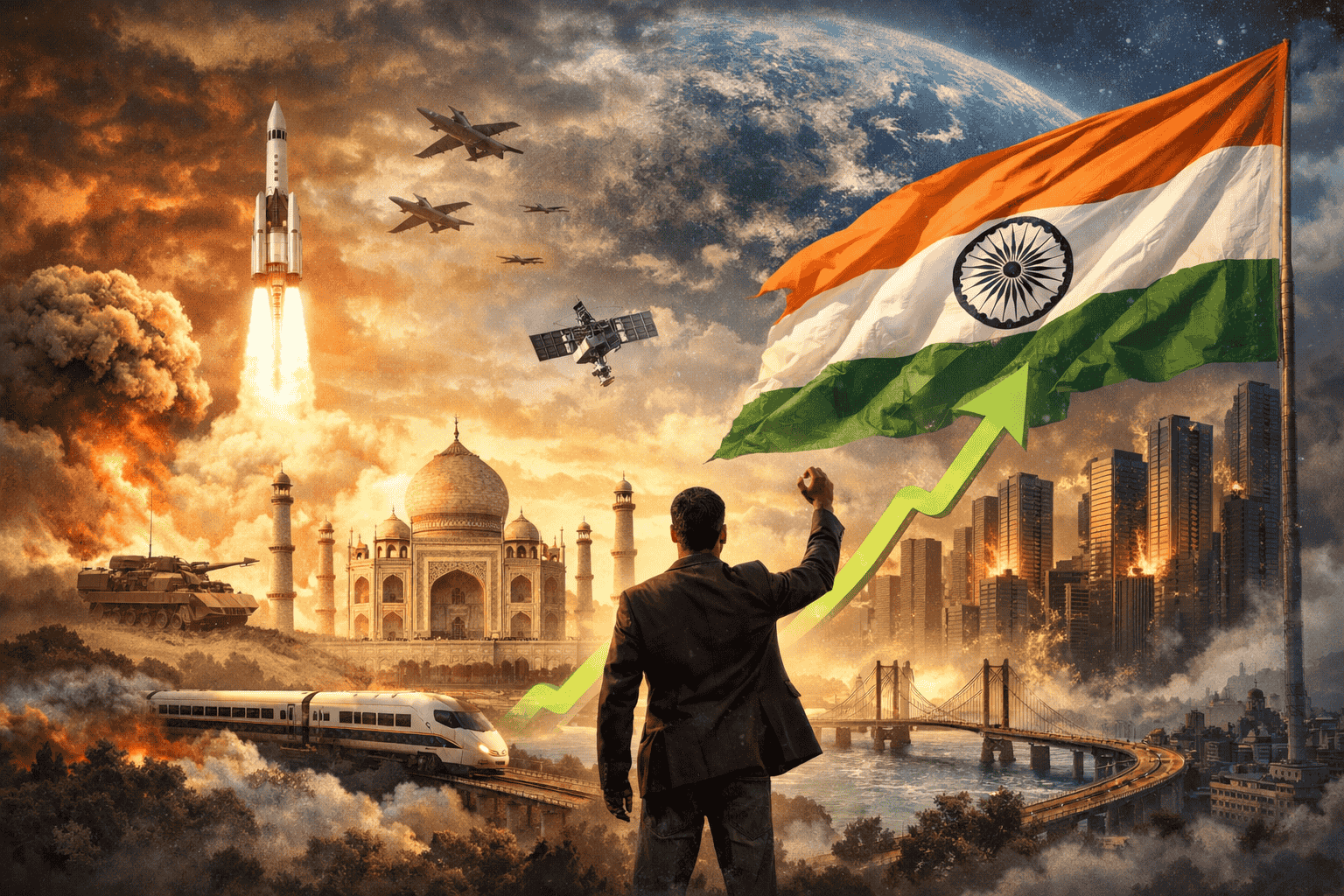
India will continue to rise as a major economic and strategic power.
Note: The article was originally written by the Author The First Post on, December, 21st, 2025, it has since been updated.
Header Picture Credit: Author
Twitter: @AirPowerAsia
 Air Power Asia