
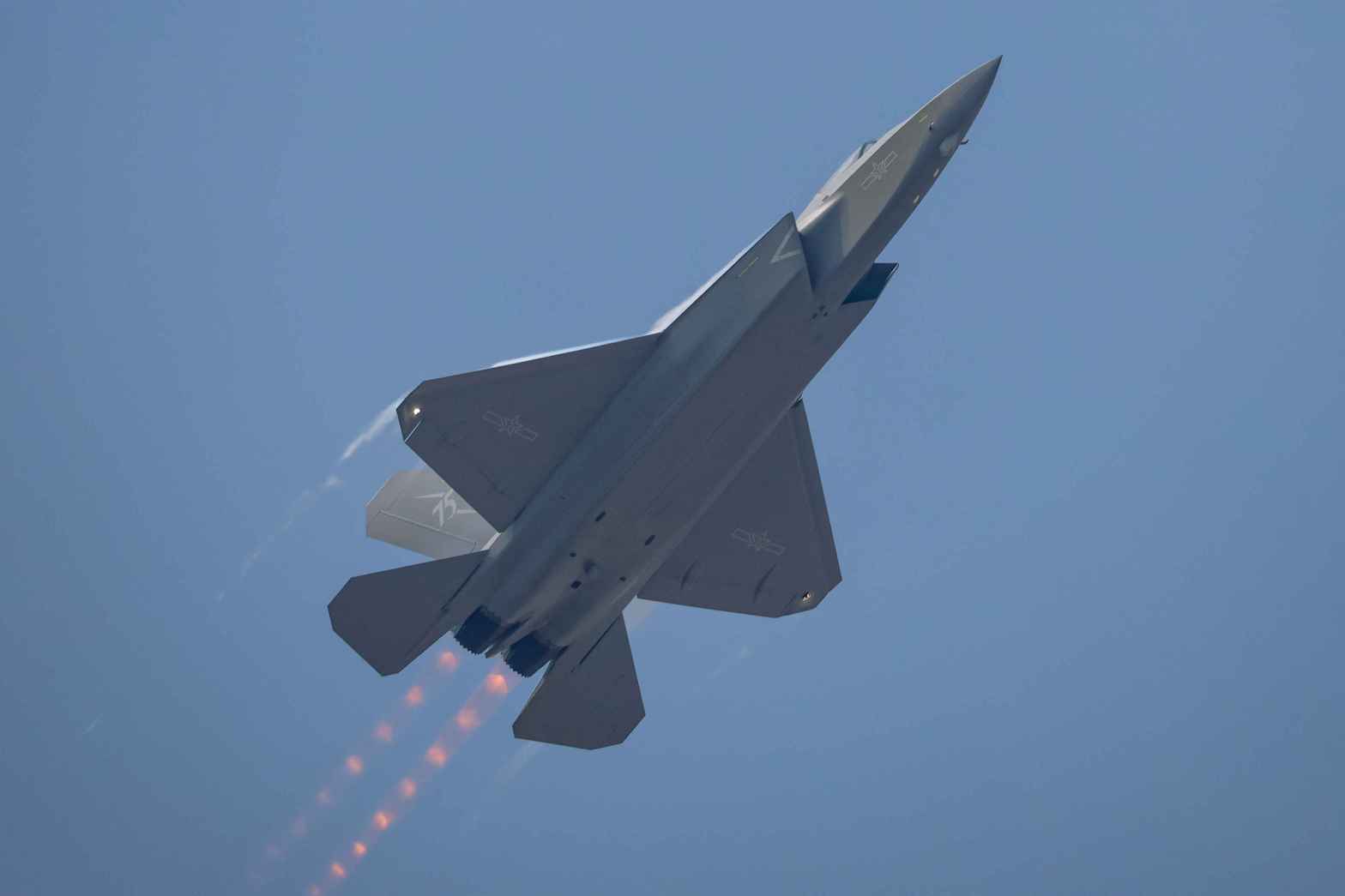
Midst of Op Sindoor, Pakistan once again announced that it will start acquiring around 40 Chinese fifth-generation fighter J-35A, as early as August 2025. Pakistan’s Foreign Minister and Deputy Prime Minister Ishaq Dar reportedly finalized the logistics and financing details of the J-35 fighter jet deal during his visit to China immediately after Op Sindoor. Can China fast-track the production and deliveries of an aircraft which has just begun production remains a moot point. The earlier spoken timelines for such deliveries were 2029. Is it the Pakistani military’s rhetoric to appease the sentiments of a public that has felt demoralised after India struck military and terror targets across the length and depth of the country? Meanwhile, the timelines of induction of India’s home-grown fifth-generation Advanced Medium Combat Aircraft (AMCA) are around 2035. How will an economically impoverished Pakistan, which is surviving on IMF doles for its basic survival, pay for such expensive aircraft is being questioned. Will it be a gift by China, so as to keep India threatened from multiple fronts? Or, as some say, it may be at a 50 percent discount as a reward for showcasing Chinese aircraft (J-10CE and JF-17) and aerial missile (PL-15) in what they tout as good light during Op Sindoor. Such a supply will alter the air dominance dynamics in the sub-continent. This has generated a hot debate for India’s immediate options.
Meanwhile, there is a discussion among the Indian strategic community about the need for an interim fifth-generation fighter for the Indian Air Force (IAF). China, India’s major adversary, already has around 300 J-20 fifth-generation fighters, and numbers are growing around 60 a year. China has also unveiled two sixth-generation fighter jets, Chengdu J-36 and Shenyang J-50, on December 26, 2024, in Chengdu, representing their next evolutionary leap based on two decades of R&D. The only other matured fifth-generation fighters flying in reasonable numbers are the American Lockheed F-35 and Russian Su-57. Time to look at what is a fifth-generation fighter, why India needs one, and the complexities of choices between the two. Also, do we add more 4.5 generation aircraft and join some international consortium for a sixth-generation aircraft?
What is a Fifth Generation Fighter?
The fifth generation was ushered in by the Lockheed Martin/Boeing F-22 Raptor in late 2005. These aircraft are designed from the start to operate in a network-centric combat environment, and to feature extremely low, all-aspect, multi-spectral signatures employing advanced materials and shaping techniques. They have multifunction AESA radars with high-bandwidth and low-probability of own intercept. IRST and other sensors are fused in for Situational Awareness (SA) and to constantly track all targets of interest around the aircraft’s 360-degree bubble. Avionics suites rely on extensive use of very high-speed integrated circuit (VHSIC) technology and high-speed data buses. Integration of all these elements is claimed to provide fifth-generation fighters with a “first-look, first-shot, first-kill capability”. In addition to its high resistance to ECM, they can function as a “mini-AWACS”. Integrated electronic warfare system, integrated communications, navigation, and identification (CNI), centralized “vehicle health monitoring”, fibre-optic data transmission, and stealth are important features.
Manoeuvre performance is enhanced by thrust-vectoring, which also helps reduce take-off and landing distances. Super-cruise is inbuilt. Layout and internal structures minimize RCS over a broad bandwidth of frequencies. To maintain low signature, primary weapons are carried in internal weapon bays. Stealth technology has now advanced to where it can be employed without a trade-off with aerodynamics performance. Signature-reduction techniques include special shaping approaches, thermoplastic materials, extensive structural use of advanced composites, conformal sensors, heat-resistant coatings, low-observable wire meshes to cover intake and cooling vents, heat-ablating tiles on the exhaust troughs, and coating internal and external metal areas with radar-absorbent materials and paints.
These aircraft are very expensive. F-22 costs around $227 million. Lockheed Martin F-35 Lightning II fighters will cost, on average, $95 million, depending on the variant, despite large production scale. Other fifth-generation fighter development projects include Russia’s Sukhoi Su-57. India is also developing the Advanced Medium Combat Aircraft (AMCA). China’s J-20 is flying since January 2011, and combat units started inducting in early 2018. Today, they have nearly 300 aircraft. The Shenyang J-31 (now designated J-35) first flew in October 2012. The program has received government funding and is being sought after by both the PLA Air Force (PLAAF) and PLA Naval Aviation (PLANAF). Pakistan is trying to be its first export customer.
Sixth Generation Technologies
Advanced digital capabilities including high-capacity networking, AI, data fusion, cyber warfare, and battlefield command, control and communications (C3) capabilities. Increased speed and range. Advanced stealth airframes and avionics. More modular design with primary aircraft components able to be swapped within hours to optimize for the mission requirements and easing the introduction of future upgrades. Software Architecture with separation of flight-critical operations from other functionality. Use of advanced GaN transistors in AESA radar.
Increased battlefield survivability in the highly contested, anti-access/area denial (A2/AD) environment, and ground support/attack enhanced and adapted to the future threat environment. An initial focus on air superiority roles has moved away from close-in dogfighting, which is becoming less common, and instead broadened to embrace ground support, cyber warfare and even space warfare capabilities, with very long range air-to-air missiles (VLRAAM) capability remaining important. The flexibility to undertake manned and unmanned missions is also sought, along with the ability to integrate with more numerous fleets of satellite drones and ground sensors in a high-traffic networked environment to deliver full “data-to-decision” (D2D) capability.
6th generation fighters will mostly have single-seat cockpits. The basic flying and procedures training will be done mostly on simulators. Some will be optionally manned that will perform AI-supported missions. Manned fighters will control “Loyal Wingman” or swarm of drones for both offensive and defensive tasks. The aircraft will have the ability to act as an airborne network node. It will be capable of receiving and relaying data to multiple platforms such as other aircraft, ground vehicles or satellites. It will also process data on-board and will be able to dynamically generate new target lists or update mission parameters on the fly.
Increased-range sensors and standoff weapons that can take both aerial and surface targets. Greater electrical power generation to enable equipping directed energy weapons (DEW) such as a laser close-in-weapon-systems (CIWS). Virtual cockpit and helmet-mounted display allowing the pilot 360-degree vision and doing away with many cockpit displays. Use Adaptive Versatile Engine Technology. The sixth-generation strike capability with a system of systems including communications, space capabilities, standoff, and stand-in options.
Chinese sixth-generation aircraft, Chengdu J-36, tri-jet tailless double-delta winged aircraft, and Shenyang J-50 featuring a cranked arrow configuration with sharply swept lambda wings have already flown.
US Sixth Generation Boeing F-47
On September 14, 2020, USA had revealed that they had secretly designed, built, and flown at least one prototype of its Next Generation Air Dominance (NGAD) fighter. On 21 March 2025, President Trump announced that its centrepiece aircraft would be called the F-47, and that the engineering and manufacturing development contract, worth more than $20 billion, would be awarded to Boeing. The Boeing F-47, air superiority sixth-generation fighter, will succeed F-22 in the United States Air Force (USAF). The service aims to field it by decade’s end. USAF intends to buy “185-plus” F-47s, which will have a combat radius of more than 1,000 nautical miles and a top speed faster than Mach 2. Being able to pierce deeply into the enemy’s A2/AD bubble will be the absolutely essential feature. There will be a premium on range and overall endurance.
Russian Fifth-Generation Aircraft
Russia Sukhoi Su-57 ‘Felon’ evolved from the Indo-Russia Fifth Generation Fighter Aircraft (FGFA), contract for which was signed in October 2007. The FGFA itself had evolved from Russia’s the PAK FA. By 2014, however, the Indian Air Force (IAF) began voicing concerns over performance, cost, and work-share. India found that the aircraft does not meet its requirements and eventually left the partnership in 2018. Sukhoi continued to develop and promote the Su-57 for prospective export customers. The export variant, designated Su-57E, was officially unveiled at the MAKS-2019 air show on 28 August 2019. Su-57 has been showcased at many air shows including in China and India.
The first operational unit was formed in 2021. It is supposed to be a multi-role aircraft with significant air-to-air and ground attack capability. The aircraft were first reportedly used in the Syrian campaign in 2018. Russia has claimed that Su-57 saw significant combat in Ukraine. Around 42 Su-57 have been produced till date. Russia has already ordered nearly 30 more. Numbers will increase as they go ahead.
The single-engine Sukhoi Su-75 “Checkmate”, also designated as the Light Tactical Aircraft (LTA), is a single-engine, stealth fighter aircraft under development with planned induction around 2027. It’s designed for both export and Russian Aerospace Forces, with a focus on being a cost-effective, yet advanced, combat aircraft. The Su-75 is intended to compete with other fifth-generation fighters like the F-35 and China’s Shenyang J-35. The aircraft is designed with AI integration for enhanced capabilities. The Su-75 aims to be significantly cheaper than other fifth-generation fighters. The maiden flight occurring in 2024. Russia is actively seeking export markets for the Su-75, with India being a potential target. The Su-75‘s design incorporates technology transfer, which could potentially make it a “nearly Indian” fighter.
Other Fifth Generation Aircraft
The KAI KF-21 “Boramae” is a South Korean-led fighter aircraft development program to produce an advanced multirole fighter for the South Korean and Indonesian air forces. The airframe uses stealth technology but carries weapons externally, and features such as internal bays will be introduced later with KF-21EX program. First flight took place on 19 July 2022, and six prototypes have been built till date. Service introduction is planned in 2026. Turkey’s Turkish Aerospace Industries (TAI) “Kaan”, under development with sub-contractor BAE Systems, made its maiden flight on 21 February 2024. Only one aircraft has been built presently, and service induction is planned in 2030.
Other Sixth Generation Fighter Programs
The Global Combat Air Programme (GCAP) is a multinational initiative led by the United Kingdom, Japan, and Italy to jointly develop a sixth-generation stealth fighter. In December 2023, the three governments signed a treaty to develop a common fighter jet, merging their previously separate sixth-generation projects such as the United Kingdom-led Tempest developed with Italy, and the Japanese Mitsubishi F-X. Under the current timeline, the program expects to begin the formal development phase from 2025, with a demonstrator aircraft to fly in 2027, and production aircraft to begin entering service from 2035. India is being wooed to join the GCAP.
The Future Combat Air System (FCAS) is a European combat system of systems under development by Dassault Aviation, Airbus and Indra Sistemas. The FCAS will consist of a Next-Generation Weapon System (NGWS) as well as other air assets for the future operational battle-space. The NGWS‘s components will be remote carrier vehicles (swarming drones) as well as a New Generation Fighter (NGF), a planned sixth-generation jet. It will replace France’s Rafale and Germany and Spain’s Typhoons. A test flight of a demonstrator is expected around 2027 and entry into service around 2040.
India’s AMCA
India’s fifth-generation fighter AMCA will be a stealth, multirole, single-seat, twin-engine, air superiority fighter with ground-strike, Suppression of Enemy Air Defences (SEAD) and Electronic Warfare (EW) missions. Designed by Aeronautical Development Agency (ADA), it will be built by a public-private joint venture between ADA, Hindustan Aeronautics Limited (HAL), and an Indian private company. The initial development cost is estimated to be around ₹15,000 crore (approx. $2 billion). In March 2024, the project received approval from India’s Cabinet Committee on Security (CCS) for the prototype development and mass production expected to begin by 2035.
The development of AMCA will take place in two phases, AMCA Mk-1 and AMCA Mk-2 which would majorly differ in the indigenous content and futuristic features. Mk-2 will focus more on stealth, EW, and futuristic pilot-AI interface. The AMCA Mk-2 will have DEWs and thrust-vectored engines with serrated nose pattern. Mk-2 will also incorporate sixth generation technologies. The aircraft will one day replace the Sukhoi Su-30MKI.
The AMCA design is optimised for low radar cross section and super-cruise capability. AMCA successfully completed its systems-level critical design review (CDR) in 2022. Metal cutting has already begun. DRDO expects to roll out the first prototype by 2027 and the first flight in 2029. The first three prototypes will carry out developmental flight trials, whereas the next two will focus on weapon trials. The prototypes will be rolled out at an interval of 8-9 months. Mass production of the aircraft is planned to start by 2035. The IAF plan to procure at least 125 AMCA in Mark-1 and Mark-2 configurations. The Mark 2 of AMCA is expected to have a more powerful engine, sixth-generation features and technologies to stay relevant in the coming decades.
General Fighter Aircraft Technology Status India
Most parts of the airframe are being made in India. Some systems like aero-engine are still imported. There are some other avionics and airborne radar that are being made through joint ventures with friendly foreign companies. The weapons are mostly being made in India. BrahMos is an Indo-Russian joint venture. Sixth generation technologies are on drawing boards. It can be seen that India is finally coming of age in its fighter aircraft manufacturing eco-system. But LCA Mk1A induction is running behind schedule by 15 months already, and not necessarily for aero-engine alone. IAF may be forced to accept the MK1A with concessions.
Indigenous aircraft are intended to provide the bulk of the manned tactical airpower of the IAF and the Indian Navy over the coming decades. The Ministry of Defence (MoD) had set up a high-level committee to address shortages in the IAF. It was to understand the shortages of fighter jets, weapons, and other equipment and suggest solutions, including accelerating indigenous production and selectively inviting foreign collaborations, amid growing security challenges from China, Pakistan, and Bangladesh. The report has been submitted but details are not in the public domain.
Does India Need an Interim 5th Generation Fighter?
India is one of the most threatened nations with two very significantly powerful nuclear-armed adversaries as its neighbours. With both of them, there are serious boundary disputes and India has fought wars. China plans to increase its J-20 production to 100 a year and targets to have 1,000 by 2030 when AMCA will be making its first flight. It will have 1,500 by 2035 when India will optimistically induct the AMCA.
Pakistan is already talking to China to induct the J-35A by later 2025. Also, around 200 Pakistani technicians and engineers are working with TAI on the Turkish 5th generation aircraft. A country with a failing economy seems will have a fifth-generation aircraft earlier than the country that is already the fourth largest economy.
There is a school of thought that India may be forced to acquire an interim imported fifth-generation aircraft. The choices are few. President Trump announced that they are willing to offer the F-35, but no formal dialogue seems to have begun. One can recall that they had earlier refused their NATO ally Turkey, because like India, they had acquired the S-400 air defence system from Russia. S-400 reportedly has sensors that will be able to record F-35 electronic signature. Also, USA prefers India to first buy a 4th generation aircraft in the MRFA competition before the F-35 can even be considered. Clearly, it is a complex geo-politics at play. Indians are also wary about the much greater ability of USA to arm-twist and even leave a friend in the lurch if its own interests are at variance. USA may also want India to distance itself from Russia. But India can still use some back-channel consultations to get USA to sell around two squadrons of F-35.
The second option is to re-join, or acquire, two squadrons of the Su-57 aircraft. The aircraft is fast maturing. Russia has offered to set up production in India and transfer technology. Has seen combat action in Syria and Ukraine. Production is still slow but increasing. But Russia is fighting a war. Their industry is geared up more towards that. Because of Western sanctions, there are issues related to payment. The balance of payments had become more adverse due to India’s higher oil imports. The same may not be the case as global oil prices have dropped considerably. The Su-75 is the other choice, but it is still some distance away. Lastly, IAF already has 60 percent of its fleet of Russian origin and therefore cannot increase that basket any more.
Way Ahead India – AMCA Must Succeed
As China’s air combat capabilities grow, regional powers such as Japan, South Korea, and India will have to invest more in their advanced fighter aircraft to maintain a credible deterrent against Chinese aggression. China is not only pulling ahead in aviation technology and capability, but the gap with India is fast becoming unbridgeable in the near future. China will have greater capability to penetrate Indian airspace without being detected.
With the F-35 still not on offer, and Russia having lesser capacity to arm-twist, the Su-57 is the only clear offer. GCAP is another program that is likely to succeed. But all three partners are very close allies of USA, and may switch either to Boeing F-47, if on offer, or will be heavily influenced by the US technology. If, in the long run, India must maintain the AMCA program, then all India needs is an interim fighter, then Su-57 may be the better choice.
Undoubtedly, the “Atmanirbharta” campaign will drive indigenisation. For India to be part of the big league, the AMCA must succeed. The aircraft needs to be developed concurrently with LCA Mk2 and must have a dedicated separate team. A “whole of nation” vision and approach will be required. The private partner must be inducted quickly. A specially selected CEO may be designated. He should be allowed to form a team. Spelling out clear end-states, timelines, and regular path-line reviews would be important. Adequate funds must be made available. Buy technologies if required. Increase spend on R&D.
The air operations in Op Sindoor and in Ukraine have indicated that in a peer group combat, crossing into adversary territory would be denied to either side. It may be worthwhile to quickly build a large inventory of 4.5 generation fighters like LCA Mk2 and Rafale, and get long range Air-to-surface missile (BrahMos II) and longer-range AAMs like Astra III or Russian R-37m. India must not take any knee-jerk decision. All the same, the time to act is now, lest it is too late.
Note: The article was originally written by the Author for The EurAsian Times on, May 27th, 2025, it has since been updated.
Header Picture Credit: Reuters
Twitter: @AirPowerAsia
 Air Power Asia