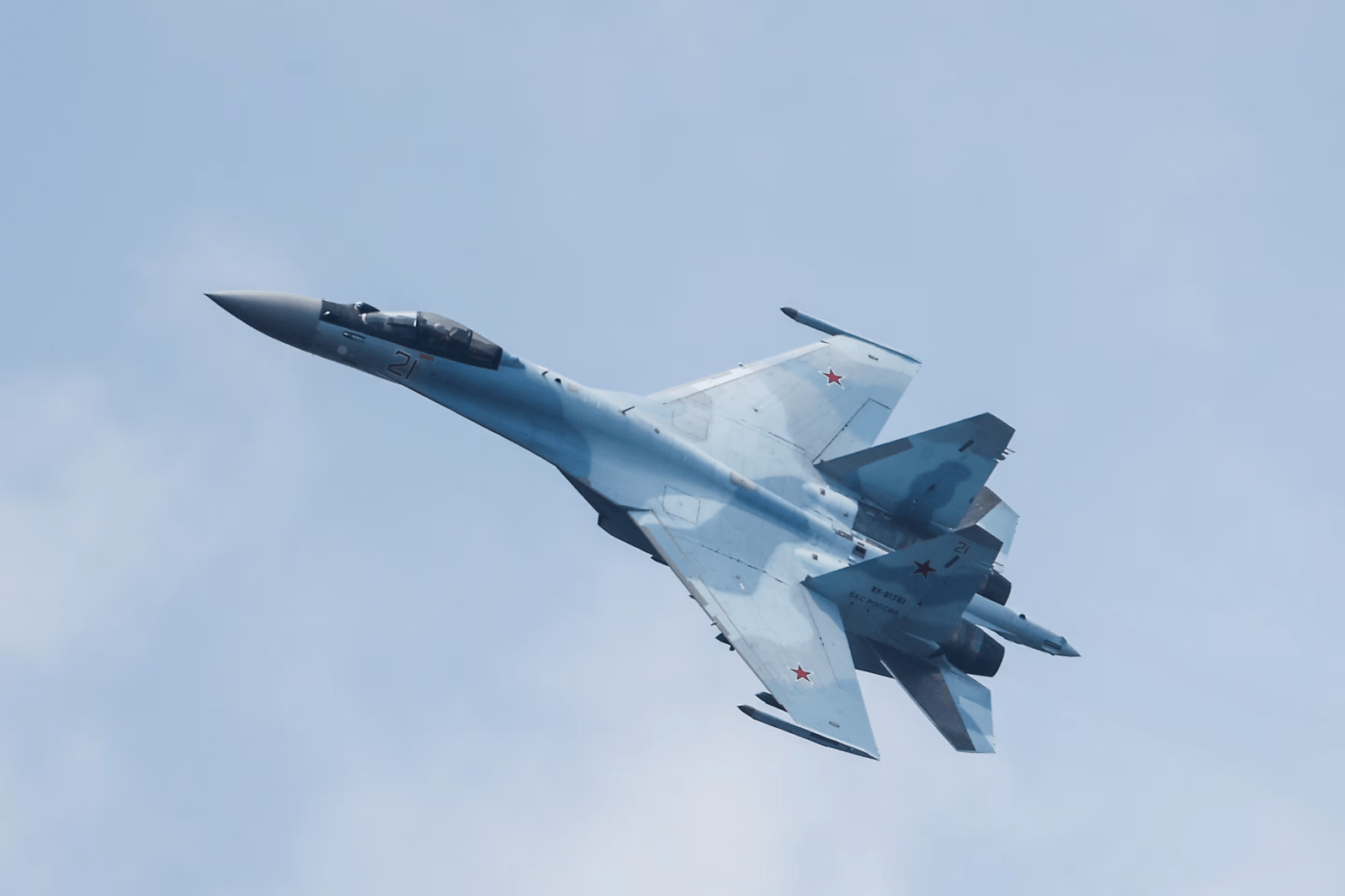
Iran has purchased Russian-made Sukhoi Su-35 fighter jets, amid Western concerns about Iran and Russia’s growing military cooperation. Ali Shadmani, the deputy coordinator of the Khatam-ol-Anbia Central Headquarters, who was quoted by media, did not clarify how many jets were purchased or whether they had already been delivered to Iran. “Whenever necessary, we make military purchases to strengthen our air, land, and naval forces. The production of military equipment has also accelerated,” Shadmani added. He also warned, referring to Iran‘s arch-rival in the region, Israel.
In November 2023, Iran‘s Tasnim news agency had said Tehran had finalised arrangements to buy Russian fighter jets. In early January 2025, Iran and Russia signed a comprehensive strategic partnership which did not mention arms transfers but said the two will develop their “military-technical cooperation.” The deal reinforced ties between the two countries just as they are both facing mounting geopolitical pressures.
While Russia‘s regional standing has been strained due to the war in Ukraine, Iran has been grappling with Western sanctions and the weakening of several regional allies amid conflict with Israel in West Asia. But more importantly, it was the collapse of Bashar al-Assad’s regime in Syria in early December that proved to be the key impetus for the strengthening of ties between Tehran and Moscow.
Iran‘s air force has only a few dozen strike aircraft that include Russian jets as well as ageing U.S. F-14 aircraft acquired before the 1979 Islamic Revolution. The new jets are meant to bolster Tehran’s military capabilities. It is time to understand the Israel–Iran air power dynamics after the Su-35 purchase.
Sukhoi Su-35
The Sukhoi Su-35 Super Flanker has basically evolved from the Su-27M air-defence fighter that first flew in June 1988, 36 years ago. Sukhoi refined the aircraft’s capability during development of India’s Su-30MKI. Su-35 is a single-seat, twin-engine, highly manoeuvrable, 4.5 generation air superiority fighter.
Awaiting the Sukhoi Su-57 fifth-generation aircraft that was still under development, in 2003, Sukhoi embarked on a second “deep” modernization of the Su-27 to serve as an interim export aircraft, awaiting the development of the Sukhoi PAK FA (Su-57) program. The aircraft’s ability to maintain a high angle of attack while flying at close to zero airspeed has traditionally attracted considerable media and public attention.
The Su-35 incorporated technologies from the PAK FA program and has a redesigned cockpit and weapons-control system, and features thrust-vectoring engines that obviated the need for the canards. The type made its first flight in February 2008. Although it was designed for export, the Russian Air Force became the launch customer in 2009, with the production version designated Su-35S. China‘s People’s Liberation Army Air Force (PLAAF) also acquired it. The Islamic Republic of Iran Air Force is the next in line. Total built till date is around 150.
The Su-35 employs the N035 Irbis-E “Snow Leopard” passive electronically scanned array (PESA) radar, which is a further development of the N011M radar that had been evaluated on Su-27M test-beds and constitutes the core of the Su-35‘s weapons-control system. It is capable of detecting an aerial target up to 400 km away, and can track thirty airborne targets and engage eight of them simultaneously. In addition, the multi-function radar is capable of providing high-resolution images of the ground using synthetic aperture mode. The aircraft is equipped with an OLS-35 optoelectronic targeting system ahead of the cockpit to provide other forms of tracking, including infra-red search and track. The Su-35 is equipped with the L175M Khibiny-M electronic countermeasure system.
Radar-absorbent materials have been applied to the engine inlets and front stages of the engine compressor to halve the Su-35‘s frontal radar cross-section and minimise the detection range of enemy radars. The multi-role Su-35 can deploy air-to-air missiles of up to 300-kilometre range, and can carry the heavy Oniks anti-ship cruise missile, as well as a multitude of air-to-ground weaponry.
The Su-35 is powered by a pair of Saturn AL-41F1S turbofan engines, a highly upgraded variant of the AL-31F. The AL-41F1S is closely related to the Su-57‘s Saturn AL-41F1, having 137.3 kN thrust with afterburner. The engines are equipped with thrust-vectoring nozzles, which have their rotational axes canted at an angle; the nozzles operate in one plane for pitch, but the canting allows the aircraft to produce both roll and yaw by vectoring each engine nozzle differently; this configuration was first implemented on the Su-30MKI and is also used on the Su-57. The engine gives the Su-35 the limited ability to sustain supersonic speed above Mach 1.1 without the use of afterburners (super-cruise).
The max take-off weight is 34,500 kg. Combat range is 1,600 km. The 12 hard-points (10 on wing and fuselage stations and two on 2 wingtip rails) can carry 8,000 kg ordnance. Various combinations could be up to 12 × R-77M/P/T/-1 AAMs, or 6 × Kh-29L/TE air-to-surface missiles, or 6 × Kh-31A/AD anti-shipping missiles, among others.
Su-35 in Operations in Syria
The Su-35S attained full operational capability (FOC) in late 2018. The aircraft compliments the Su-30M2, Su-30SM and the heavier Su-34 strike aircraft in Russian Air Force. In July 2020, the Russian Knights aerobatic team received eight new Su-35Ss as an addition to its previously acquired Su-30SM aircraft. The 185th Combat Training and Combat Application Center, also known as an aggressor squadron of the Russian Aerospace Forces, has received three Su-35S in September 2022.
In January 2016, Russia made the first combat deployment of the Su-35S when it sent four aircraft to Syria. The combat deployment to Syria helped refine aircraft avionics. Su-35s in Syria carried unguided bombs. Russian Su-35Ss, operating from the Khmeimim Air Base, intercepted Turkish Air Force F-16s on many occasions and forced them to leave the Syrian airspace. Russian Su-35Ss also intercepted several Israeli aircraft over southern Syria and prevented them from carrying out airstrikes.
Su-35 in Ukraine
Su-35S fighters were used for air superiority missions during the Ukraine war. At least seven air-to-air victories were reported over Ukrainian fighters, and one over a Ukrainian Naval Aviation Mil Mi-14.
On 3 April 2022, the first Russian Su-35S was shot down by Ukrainian forces, with the pilot ejecting and being captured. There have been claims and counter claims of Su-35-related successes from both sides.
Sales to China amid IPR Concerns
China had reportedly first shown interest in the Su-35 in 2006. Sales discussions were protracted due to intellectual property rights concerns. China had reverse engineered the Su-27SK and Su-33 to create the J-11B and J-15, respectively. Chinese industry was reportedly interested in the AL-41F1S engine and Irbis-E radar.
PLAAF received the first four aircraft in December 2016. With the J-20‘s commissioning, Russia understood that the Su-35 would “lose its value to the Chinese and it would be the last (combat) aircraft China imports.” Also in 2018, the U.S. imposed sanctions on China‘s Equipment Development Department and its director, for engaging in “significant transactions” with Rosoboronexport, specifically Su-35s and S-400 SAMs.
Sale to Iran
Following the Russian purchase of Iranian suicide drones during the invasion in Ukraine, the Islamic Republic of Iran Air Force (IRIAF) began considering the procurement of the Su-35 in exchange for further delivery of ammunition, drones and ballistic missiles. The training of Iranian pilots reportedly began in early 2022 and the aircraft were to be delivered in 2023. The deal was to be for 24 Su-35s originally built for Egypt. Also, Iran has ordered from Russia air defence and missile systems as well as helicopters. Iran has also received deliveries of the Yak-130 advanced jet trainer. Finally, an order for 24 Su-35s was reported in April 2024. Iran received two Su-35E in November 2024 out of an order of 50 total aircraft. Further deliveries will be on to replace Iran‘s F-14 fleet.
Potential Su-35 Customers
The United Arab Emirates evaluated the Su-27M, but later acquired the Mirage 2000. In February 2017, the country was to sign a preliminary agreement for the Su-35 purchase. Su-35 is competing with 7 other aircraft for India’s 114 MRFA. Unconfirmed reports indicate that in December 2019, Algeria has reportedly signed a contract for 14 aircraft as part of a large military deal that also includes purchase of Su-34 and Su-57 fighters.
In July 2019, Russia offered the Su-35 to Turkey after it was removed from the F-35 programme by the United States due to the purchase of the S-400 missile system. Russia was also ready to cooperate with Turkey on the export and local production of the Su-57. There are others like Egypt, Vietnam, Kazakhstan, North Korea, Venezuela, Sudan and Pakistan who have shown interest.
Israeli Air Force
The Israeli Air Force (IAF) is responsible for air and space operations. It has around 34,000 active personnel, 55,000 reserve personnel, and 608 aircraft. The IAF began seeing action early. Major operations included the 1956 Suez Crisis, the 1967 Six-Day War, and the Yom Kippur War of 1973. 172 Egyptian aircraft were shot down in air-to-air combat, for a loss of between 5 and 21 for the Israelis, on all fronts.
Most of Israel‘s military aircraft have been obtained from the United States. Among these are the A-4 Skyhawk, F-4 Phantom II, F-15 Eagle, F-16 Fighting Falcon and F-35 Lightning II, the C-130 Special Operations aircraft, and the Apache Longbow (designated AH-64DI). The IAF has also operated domestically produced IAI Nesher, and IAI Kfir.
In June 1981, eight IAF F-16s escorted by six F-15s carried out Operation Opera to destroy the Iraqi nuclear facilities at Osiraq. In June 1982, the IAF carried out Operation Mole Cricket 19, crippling Syrian air defences in Lebanon. In October 1985, in response to a PLO terrorist attack which murdered three Israeli civilians in Cyprus, the Israeli air force carried out Operation Wooden Leg, bombing the PLO Headquarters in Tunis. In 1991, the IAF carried out Operation Solomon which brought Ethiopian Jews to Israel. In 1993 and 1996, the IAF participated in Operation Accountability and Operation Grapes of Wrath, respectively. It has taken part in many operations since, including the 2006 Lebanon War, Operation Cast Lead, Operation Pillar of Cloud, Operation Protective Edge, Operation Guardian of the Walls and Operation Swords of Iron.
In September 2007, the Israeli Air Force successfully bombed an alleged Syrian nuclear reactor in Operation Orchard. In May 2021, Israeli artillery and air force carried out 1,500 strikes on Gaza during Operation Guardian of the Walls. Starting in October 2023, the Israeli Air Force fulfilled a main role in the war against Hamas. IAF has played a major role in the Syrian Civil War. IAF has hit many targets in a retaliatory strike on Iran in late 2024.
IAF Combat Status
IAF has state-of-the-art aircraft. They have a great inventory of UAVs and loiter munitions. Israel has some of the best home-grown air defence systems like the Iron Dome, and David’s Sling. IAF is backed by a strong domestic arms industry. IAF exercises regularly with some of the best air forces of the world. IAF has a huge continuous combat exposure and experience. Its current aircraft inventory includes 66 F-15I with 25 F-15EX on order, 174 F-16s and 38 F-35 Lightening II. IAF has 4 AEW&C and 22 flight tankers. Clearly, IAF has the capability to take on multiple air forces of the region simultaneously, and also non-state actors like Hamas, Hezbollah and Houthis.
Islamic Republic of Iran Air Force
The Islamic Republic of Iran Air Force (IRIAF) is the aviation branch of the Islamic Republic of Iran Army. The IRIAF was heavily involved in the Iran–Iraq War, carrying out major operations and the first attack on a nuclear reactor in history, as part of Operation Scorch Sword. As many as seven IRIAF pilots claimed more than six kills, mostly achieved in the F-14 Tomcat. Today, IRIAF has 37,000 personnel and around 340 aircraft.
Due to strained relations with the West, Iran had to procure new equipment from Brazil, the Soviet Union and China. Due to the continuous spare parts shortages faced by the air force, a decision was made in the late 1980s to develop a local aerospace industry to support the air force. In 2002, Iran, with the co-operation of Ukraine, successfully started the manufacture of the Iran-140, a license-built version of the Antonov An-140 transport aircraft. Simultaneously, Iran began construction of two domestically produced fighters, upgraded using technology from the F-14 Tomcat and the F-5 Tiger II. The fighters have been named the Azarakhsh and the Shafaq. Since then, the country has also become self-sufficient in the manufacture of helicopters.
The country claims that it is capable of producing the U.S. AH-1 Cobra gunship. Additionally, Iran also produces Bell Helicopter Bell 212 and Bell 206 helicopters in serial production. These are known respectively as the Shabaviz 2-75 and the Shabaviz 206.
Iranian fighter/attack aircraft include 14xF-14A, 24xMiG-29A/UB, 12xMirage F1 variants, 17xF-7M, 64xF-4D/E, 21xSu-24MK, 35xF-5E/F, 2xSu-35S (48 more on order), 22xHESA light jet variants. They fly CH-47, Bell 212, Bell 206 helicopters. They have Kaman 22, Kaman-12, and Mohajer-6 indigenous UAVs. The transport fleet includes C-130, IL-76, F27, Boeing 747, Boeing 707, Falcon 20, Falcon 50, and HESA Simourgh. They have six tanker aircraft. The IRIAF air fleet is aging; some aircraft are more than 40 years old.
Since the Russian invasion of Ukraine in February 2022, Iran and Russia have formed closer relations, with Iran supplying Russia with loitering munitions such as the HESA Shahed 136. Russia has offered fighter aircraft in return.
IRIAF Combat Experience
There were over 300 air-to-air engagements between 1980 and 1988 during the Iran-Iraq War. Despite limitations and sanctions, the IRIAF achieved a successful kill rate in air-to-air combat against Iraqi jets, to the point that in air-to-air engagements, Iran‘s kill ratio was roughly 5:1. The F-14 Tomcat was particularly successful.
From mid-1987, the IRIAF found itself confronted also with U.S. Navy fighters over the Persian Gulf. It stretched available IRIAF assets to the limit, and exhausted its capacity. Yet no air force has exploited the F-14 as well as IRIAF. The IRIAF developed proven tactics and skillful battle-tested pilots, thus becoming one of the most experienced air arms in the region.
During the 1991 Persian Gulf War, numerous Iraqi pilots flew Iraqi Air Force aircraft to Iran to avoid destruction by coalition forces. The Iranians impounded these aircraft and never returned them, putting them in service in the IRIAF and claiming them as reparations for the Iran–Iraq War. The aircraft included several Mirage F1s, MiG-23s, MiG-29s, Su-20s, Su-22Ms, Su-24s, Su-25s and a number of Il-76s, including the secret, one-off AEW&C Il-76 prototype. In late 2014, Iran returned 130 military aircraft to Iraq.
To Summarise
Clearly, Iran has few friends. Russia, China, North Korea are open to supporting it. China will also not push too much because of economic engagement with the West. USA and many Western countries continue to back Israel against Iran. Also, many West Asian countries do not like Iran and would like it to get embarrassed. U.S. sanctions also mean lesser international support. Iran does have a successful ballistic missile and kamikaze drone program. But it does not have a significant aircraft industry. Many of Iranian aircraft are old and surviving on grey market spares. They are overdue for retirement.
Israel also has the backing of its own and Western defence technologies. Israel also gets significant defence aid from USA. Induction of few Su-35 will certainly add strength to IRIAF, but they will be no match to the Israeli air power. Iran will continue to depend on ballistic missiles, drones and its proxies Hamas, Hezbollah and Houthis to hurt Israel. Iran will also try to surreptitiously acquire a nuclear weapon and then use it as a political blackmail tool.
Note: The article was originally written by the Author for The EurAsian Times on, February 4th, 2025, it has since been updated.
Header Picture Credit: Reuters
Twitter: @AirPowerAsia
 Air Power Asia