
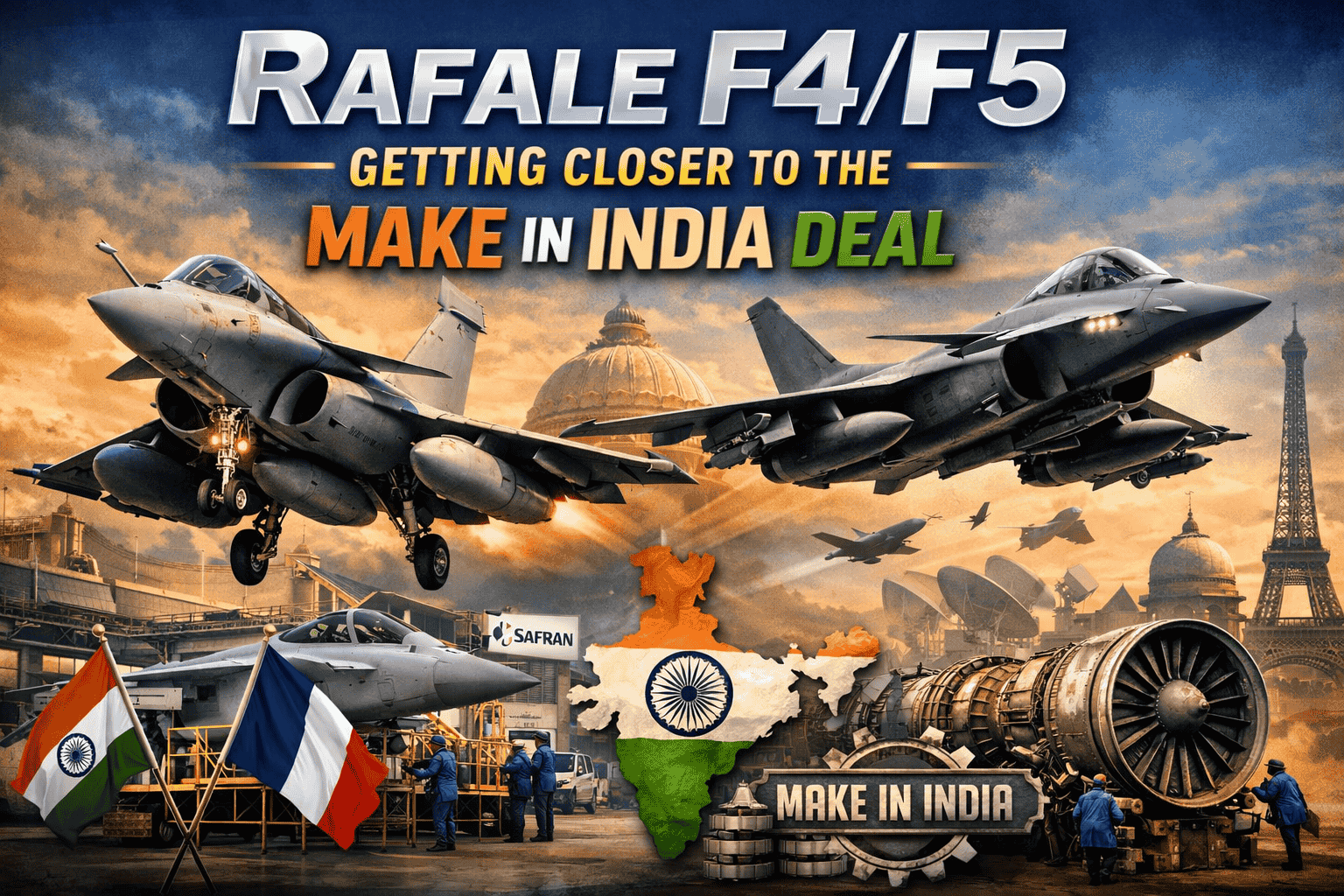
A suspected leak from France’s Ministry of the Armed Forces a few days back suggests that India intends to procure 90 Rafale F4 multirole fighter aircraft, with an additional option for 24 next-generation Rafale F5 variants for the Indian Air Force (IAF). The IAF had also reportedly moved a case for possible purchase of 114 Rafale to hasten the process of Multi-Role Fighter Aircraft (MRFA) induction. Rafale has been tried and tested in various exercises and more recently on “Op Sindoor.” As of late 2025, the IAF fields only 29 fighter aircraft squadrons against an authorised strength of 42.5, a gap aggravated by delays in indigenous programs. The IAF thus needs additional fighter aircraft. Meanwhile, the United States has cleared a $686-million upgrade package for Pakistani F-16 fighter jets that will also extend the life of the Pakistani F-16 fleet till 2040. China already has nearly 400 J-20 fifth-generation fighters. Pakistan is already operating J-10C fighters armed with PL-15 long-range beyond-visual-range (LR-BVR) missiles. The Pakistan Air Force (PAF) has sought to acquire the Chinese J-35 fifth-generation aircraft. With China and Pakistan working in collusion, and by adding and modernising their fighter fleets, regional military balances are undergoing significant transformation.
Rafale, if chosen, would retain continuity and avoid adding another fleet. A government-to-government (G2G) deal could be signed quickly as the price identification already exists. Discussions with French officials in India also indicate that something is cooking, albeit slowly. 114 when added to 26 of the Indian Navy would make a viable figure for Make in India and to set up a full assembly line. There is already a project to make Rafale fuselage in India. France’s Safran is establishing a dedicated facility in Hyderabad, India, for the maintenance, repair, and overhaul (MRO) of the M88 engines used in the Rafale fighter jets. India’s future fighter fleet will not only be a military asset but a central pillar of countries’ operational capabilities and national strategy.
Notwithstanding the strong undercurrents, New Delhi continues to emphasise that the proposal remains subject to formal Acceptance of Necessity (AoN) by the Ministry of Defence and clearance by the Cabinet Committee on Security (CCS). Now that the “Cat has been released among the pigeons,” it is important to understand the options and dynamics. Also, is there any geopolitical messaging.
Rafale F3R
The Rafale is considered a 4.5-generation fighter. It has forward hemisphere stealth and super-cruise capability. IAF Rafale aircraft are highly customised with some India-specific modifications. Essentially, they are of F3-plus standard. India initially acquired the 36 Rafale F3R variants through a €7.87 billion deal (approximately $8.5 billion) signed in 2016. It was a G2G (government-to-government) contract prioritising speed and political assurance. The platform combined air superiority, deep-strike, nuclear delivery, and electronic warfare roles. The aircraft had significant India-specific enhancements, and the deal included infrastructure for two full operational airbases. During Op Sindoor, Rafale’s survivability and the integration of long-range stand-off munitions, electronic attack, and real-time data fusion were demonstrated and appreciated.
The Rafale F3R is an advanced, omnirole fighter jet featuring the Meteor long-range missile, MICA missile, TALIOS laser designator pod, enhanced Safran AASM Hammer smart bombs (GPS/IR guided), and the automatic Ground Collision Avoidance System (AGCAS). It has improved air-to-air, air-to-ground, and reconnaissance capabilities, making it a potent platform.
It has the Thales TALIOS (Targeting Laser System) pod for high-resolution imaging and target tracking (visible & infrared), improved Human-Machine Interface (HMI), and the powerful SPECTRA electronic warfare suite. India-Specific Enhancements included Israeli helmet-mounted displays, integration of Spice-1000 glide bombs, advanced jammers, cold-start capability for high-altitude bases (like Leh), Indian satellite communications, and integration with indigenous weapons like Astra missiles, among others. The F3R standard became operational around 2019. It serves as a bridge to the next-generation Rafale F4 standard, which adds advanced connectivity and further capabilities.
In April 2025, an additional inter-governmental agreement for 26 Rafale-Marine aircraft for the Indian Navy was signed in a deal worth ₹63,887 crore (approximately $7.6 billion). The Rafale-M has 95 percent commonality with IAF fighters, and thus a very high degree of interoperability.
Rafale F4
Development of the F4 standard began in 2019. The standard improved on-board processing, external connectivity, and upgrades of the Thales SPECTRA self-defence system. The radar and sensor upgrades facilitate the detection of airborne stealth targets at long range. With improved communications equipment, it is also more effective in network-centric warfare. Flight tests began in 2021, and the first F4-standard aircraft was delivered in 2023. French Air and Space Force (FASF) aircraft are being upgraded to this standard. UAE is the first foreign customer of F4.
The qualification of the F4.1 standard was announced in March 2023. The F4.2 standard was expected by 2025. They will spend $1.51 billion to upgrade the Rafale to F4 standard between 2024 and 2026. The Rafale is planned to be the FASF’s primary combat aircraft until at least 2040.
F4 will give enhanced survivability and sensor-fusion-based dominance in highly contested environments. The aircraft will be able to integrate Indian systems and weapons such as the Astra Mk-2 BVR AAM.
The proposal envisages a firm order for 90 Rafale F4 aircraft with deliveries beginning around 2029. The Rafale F4 continues to see planned upgrades till 2035, thus extending both capability and relevance.
Super Rafale F5 – Cutting Edge Capabilities
Until the Dassault-led tri-nation Future Combat Air System (FCAS) sixth-generation fighter becomes operational, France will need a top-end fighter for both aerial and nuclear deterrence. Unlike Germany, one of the partners in the FCAS program, the French have not acquired the American F-35. The F5 version will be developed under the French government’s military planning program 2024–2030. It is the Plan ‘B’ in view of FCAS delays. Dassault and its partners are already working on the F5 standard, which will be ready by around 2030. The upgrade will be incremental. F5 will share some features with the next-generation European aircraft. The F5 standard will have new sensors, armaments, and faster and more secure ability to communicate and collaborate.
The aircraft will have a much better electronic warfare suite, with advanced capability for Suppression or Destruction of Enemy Defences (SEAD/DEAD), using the latest jamming systems and anti-radiation weapons. It will be a further evolution of the existing SPECTRA EW and jamming system that combines radar jamming, ECCM, infrared and radar decoys, and will also create a “defensive bubble” around the aircraft. There is a proposal to have on-board and air-released systems for saturation of the electromagnetic spectrum to deny combat access to the adversary. These will be applied simultaneously in coordination with surface forces under multi-domain conditions. F5 will also introduce fibre-optic cabling. All this will greatly improve penetration in contested environments. The F5 is envisioned to bridge fifth- and sixth-generation capabilities.
The Rafale F5 will also act as a sensor-truck with data fusion and processing abilities that allow it a tactical flying command post role, a role that is evolving in the United States’ Next Generation Air Dominance (NGAD) program. Futuristic surface-attack and anti-ship missiles are being developed, and so are long-range air-to-air weapons. The F5 will also be modified to carry the Anglo-French Future Cruise Missile (FCM) and Future Anti-Ship Missile (FASM). Thales RBE2 XG radar is planned for F5. It will have a new mission computer with considerably enhanced processing capacity. The T-REX engine will deliver nearly 20 percent greater thrust than the current M88-2.
The “Super Rafale” will also be modified to carry hypersonic, nuclear-capable guided missiles known as “ASN4G,” which will replace the nuclear-guided ASMPA missile as France’s deterrence capability. Dassault calls it an Air Combat System within a system, rather than just a fighter jet, like the current Rafale F4 variant.
F5 deliveries initially were planned to start in 2029, but discussions are underway to deliver them starting in 2027. The F5 standard will give combat proficiency while waiting for the Next Generation Weapon System within the FCAS program.
Specialised munitions and drones will be developed for various kinetic and non-kinetic roles. These will give it greater long-range strike and combat capability. It is planned to integrate a loyal unmanned wingman on the lines being evolved in the European nEUROn combat drone program.
France will reportedly invest the equivalent of $6.75 billion into the Rafale aircraft program between 2023 and 2026 and has earmarked an additional $5.87 billion after 2026. France continues to see a market for Rafale F5 for those unable to acquire the F-35 for geopolitical reasons.
The Rafale is distinct from other European fighters because it is almost entirely built by one country, with Dassault (airframe), Thales (avionics and EW), and Safran (aero-engine) covering all the major systems. Rafale also has a carrier-based maritime variant. French officials had reportedly also considered equipping the Rafale to launch small satellites.
The likely India deal envisages 24 Rafale F5 with deliveries from around 2030. The F4 aircraft may also be upgraded later. Rafale would become a cornerstone of India’s operational credibility and deterrence.
Make in India Aero-Engine with France
French aerospace company Safran and India’s DRDO have joined to develop India’s first jet engine with Indian intellectual property rights (IPR). Safran will transfer 100 percent technology to DRDO, including that for crystal blades. The joint project between Safran and India’s Gas Turbine Research Establishment (GTRE), a DRDO lab, will develop and produce a 120 kilo-Newton (kN) engine which will power India’s Advanced Medium Combat Aircraft (AMCA). Later engine variants will have up to 140 kN. India considers France a more reliable partner with less capacity and intent to arm-twist, and thus prefers it as a partner not only with Rafale but also the aero-engine.
Geopolitical Messaging and Balancing
As the United States bends back towards China for trade and technology, and clears Pakistan for more liberal defence equipment sourcing, New Delhi is also resorting to geopolitical signalling. When the Trump administration started isolating India for excessive tariff pressures, India not only closed in towards China and Russia, it also made overtures to the European Union (EU) and European partners like France and Germany. As the United States was trying to push its 4.5-generation fighters, India seems to be pushing ahead with Rafale. It has also signalled its intent to negotiate with Russia for the Su-57 fifth-generation fighter.
There is meanwhile a strong likelihood of the IAF acquiring additional C-130s for its medium transport aircraft (MTA) requirements. C-130J Super Hercules empennages (tail sections) are made in India by Tata Lockheed Martin Aerostructures Limited (TLMAL) in Hyderabad, with the joint venture serving as the single global source for these critical components for all new C-130J aircraft worldwide. India is too big and populous a country, and a large and fastest-growing economy and major military power, to be ignored or taken lightly. Clearly, India is trying to balance military assets from Russia, the United States, and Europe as it pushes its own indigenous platforms.
Rafale Current Production Rate
In October this year, Dassault hailed production of the 300th Rafale. As of late 2025, there have been 533 firm orders for the Rafale, with France and export customers including India, Egypt, Qatar, Greece, Croatia, the UAE, Serbia, and Indonesia. Of these, 233 are still to be delivered. This does not include the 100 aircraft that Ukraine has shown intent for, and the likely Indian order for 114 Rafale that is still under processing. If these two deals go through, the numbers will be even more significant.
Till a year back, the Rafale production rate was 2 aircraft a month (24 a year). The same has now been increased to 3 per month (36 per year), with a plan to increase to 4 per month (48 a year) to handle a growing backlog of orders. This is a significant increase from previous years and is supported by expansion at the Mérignac factory and new facilities in Cergy-Pontoise. Dassault already has plans to make Rafale fuselage in India. With an increased Indian order, a full assembly line can be created in India. This would give a great boost to total production. Making in India would also be cheaper. Dassault could thus source and supply India-made Rafale jets for global customers. Such a plant would also increase India–France options for future aircraft.
Rafale Life Cycle Costs
Rafale had come out a winner in the MMRCA competition results announced in 2012 by the UPA government for two reasons. Firstly, it met the technical requirements, and secondly, it had a lower life-cycle cost than the other shortlisted aircraft, the Eurofighter Typhoon. Since India operates both Western and Russian aircraft, it is a known and well-analysed fact that while the initial cost on Russian platforms is nearly two-thirds of the Western platforms, the life-cycle costs of many Russian platforms overtake at a later stage. Such a comparison exercise was done by the IAF between Mirage-2000 and MiG-29, which were acquired more or less at the same time. The reason is a shorter period for mandatory component replacements, longer repair cycles requiring larger inventories, and fewer hours between overhauls, among others. Also, historically, Russian fleets have seen lower serviceability percentages in the IAF than their Western counterparts.
Viable Make-in-India Numbers
It is a universal fact that for setting up local production, sufficient numbers are required to amortise costs. The cost of setting up factory infrastructure, creating rigs and jigs, testing facilities, training and employing manpower means the viable number could be not less than 120–130 aircraft. It can be recalled that during discussions between Dassault and the Indian government in 2012–14, one issue was that HAL was insisting on nearly double the man-hours required for making the Rafale. This meant that the cost of Make in India was going up considerably. Dassault would rather partner with a private company where it could exercise control over quality assurance and manning requirements. French industry representatives indicate that for the Rafale Make in India to go through, the full order of 114 + 26 should be in place first.
To Summarise
The French government is conscious that an order for 114 Rafale indicates trust and a strong partnership between France and India. The feeling in the corridors of power is that the AoN is expected by early 2026. President Emmanuel Macron of France will attend the AI Impact Summit, to be held in India on 19–20 February 2026. He will take the opportunity to launch, alongside Prime Minister Narendra Modi, the India–France Year of Innovation 2026. If the deal goes through, India would become the largest Rafale operator outside France with over 175 aircraft. It will mean a huge boost to the French aircraft industry’s global image.
Some backroom discussions are likely ongoing over costing, delivery schedules, offsets, and Make in India details. A lot would need to be negotiated: intellectual property rights (IPR), access to source code, and limits and independence for Indian modifications. Will the Rafale F4/F5 be sufficient to counter Pakistan acquiring two squadrons of Chinese J-35A fifth-generation fighters?
India’s capability to make global-class aerostructures has been proven with cabins of the Apache AH-64, Sikorsky S-92 helicopter, and Lockheed Martin C-130J Super Hercules aircraft. India also makes Lockheed Martin F-16 wings. India makes the entire indigenous LCA. Making the Rafale in India will work out much cheaper for France.
Made in India F4 and F5 will be a learning help for India’s AMCA program, which too will be imbibing sixth-generation technologies. India will insist on achieving over 60 percent indigenous content at the earliest. The same will be possible as the fuselage and many sub-systems and components will be made in India. Dassault Aviation already has a partnership with Tata Advanced Systems Limited to manufacture Rafale fuselage sections in Hyderabad, with a targeted production of up to 24 airframes annually. The proposed Maintenance, Repair, and Overhaul (MRO) facility in India would substantially reduce lifecycle costs, improve tarmac availability, and secure operations from supply chain complexities.
The urgency to get the IAF back to the authorised 42.5 squadrons has been reinforced by the regional threat perception and collusive Sino-Pak anti-India engagement. India needs to reduce the number of fighter aircraft fleets. Finally, the IAF inventory should primarily be comprised of the upgraded Su-30 MKIs, Rafale, and indigenous LCA and AMCA fighters.
Traditionally, India and France have enjoyed an exceptionally warm relationship, which is the fruit of deep affinities and unwavering trust between the two countries since India’s independence. France is considered the most reliable Western “friend.” France has never imposed any sanctions or tried to arm-twist India. The IAF regularly carries out the Garuda series of air exercises with the French Air and Space Force (FASF).
It will make better operational and economic sense for India to acquire the latest variants, F4 and F5, in a G2G deal and Make in India. A lot of time has been lost. Time to act is now, lest we get “OBE” (overtaken by events) in our neighbourhood.
Note: The article was originally written by the Author for The EurAsian Times on, December 14th , 2025, it has since been updated.
Header Picture Credit: Author
Twitter: @AirPowerAsia
 Air Power Asia