
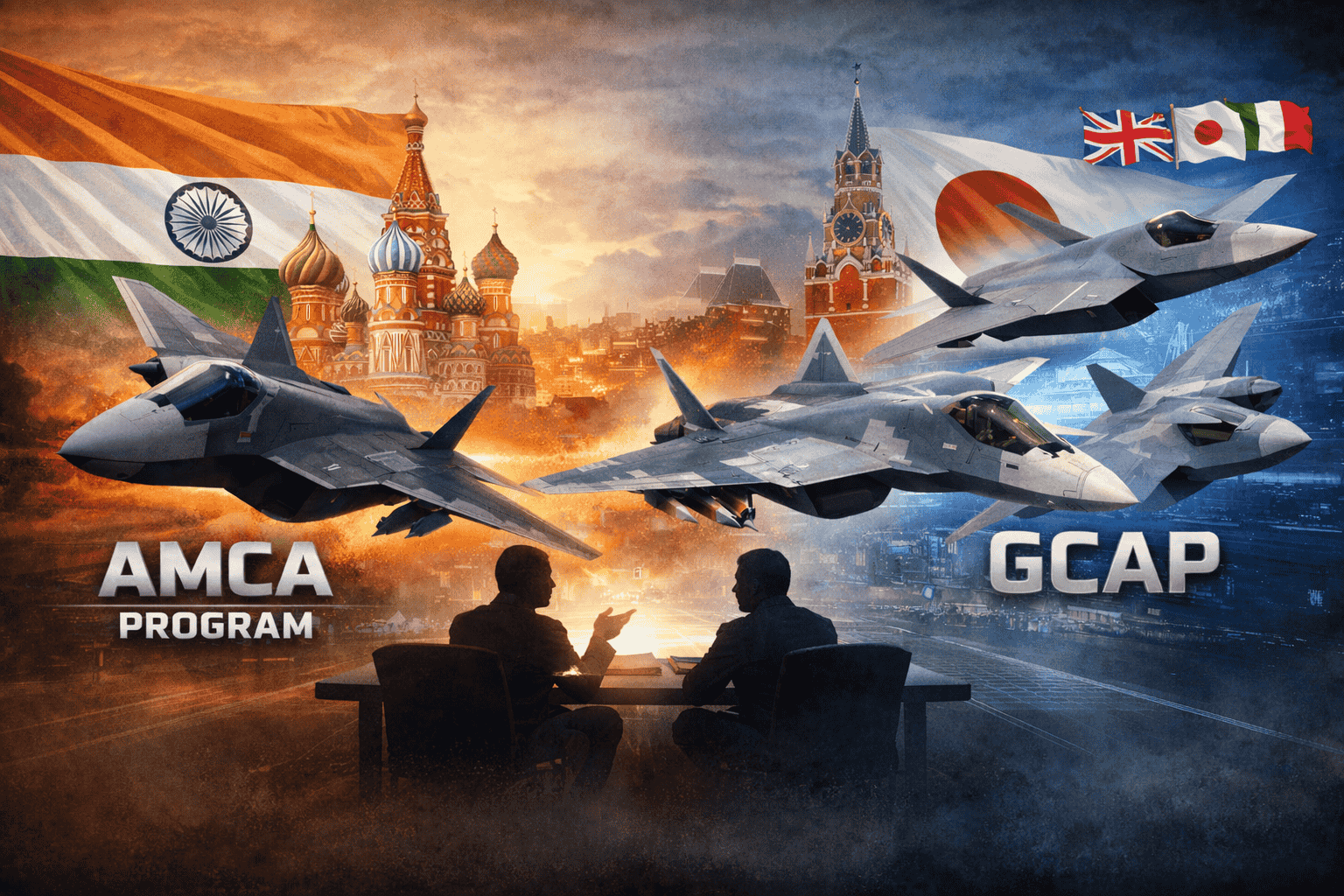
Russia’s Su-57 “Felon” fifth-generation stealth fighter once again enthralled spectators at the recent Dubai Airshow. As India prepares to host President Putin, defence cooperation has moved to the centre. Expectations around Putin’s visit are high. Su-57 collaboration and five additional S-400 systems are expected to be the starred points of discussion. It could mean the beginning of a new era of co-development rather than a traditional buyer–seller arrangement. Moscow has made its most significant military proposal to India in years by offering full licensed production of the Su-57 in India, along with unrestricted transfer of technology, a level of access no defence partner has ever offered India till date. While India needs technological help for its own fifth-generation Advanced Medium Combat Aircraft (AMCA) program, it will not enter into any deal that scuttles or even slows the AMCA.
The American F-35 has flown in the last two Indian airshows, but no offer has yet been made. The tri-nation sixth-generation Global Combat Air Program (GCAP) partners have made overtures to India to join the program, but India has been quietly watching from the sidelines.
China has inducted fifth-generation J-20 fighters in large numbers and is already flight-testing the J-35 and two sixth-generation fighters. Pakistan has been upgrading its air force with advanced fighter jets and aerial weapons and is seeking stealth fifth-generation fighter aircraft from both China and Turkey. This could create an imbalance in the region.
There remain technological uncertainties with India’s AMCA, which will, at best, induct into the Indian Air Force (IAF) around 2038. Considering the regional threat assessment, India may be forced to take a call on the Su-57 and GCAP. Under these circumstances, what are the choices with India?
AMCA Status
The AMCA’s success is considered urgent due to the country’s declining fighter squadron strength, the modernisation of rival air forces, and the need to maintain a technological edge in air combat. The program aims to replace aging aircraft and introduce a fifth-generation fighter, addressing both operational and strategic requirements. The IAF is down to 29 fighter squadrons vis-à-vis the sanctioned strength of 42.5, and several more are scheduled for retirement in the coming years. The IAF plans to induct a total of 120 AMCA. This includes 40 AMCA Mk 1 (partially stealth) and 80 AMCA Mk 2 variants.
The single-seat, twin-engine, fifth-generation stealth multirole AMCA is being designed by the Aeronautical Development Agency (ADA). The AMCA is intended to perform a multitude of missions including air supremacy, ground strike, Suppression of Enemy Air Defences (SEAD), and electronic warfare (EW) missions. It is intended to supplant the Sukhoi Su-30MKI, which forms the backbone of the IAF fighter fleet. The AMCA design is optimised for low radar cross section and super-cruise capability.
As on date, the prototype development phase is underway after the completion of the feasibility study, preliminary design stage, and detailed design phase. The program, originally launched in 2010 as a 20-tonne class fighter, is now a 25-tonne class fighter. The design work was completed in 2023, and approval for the ₹15,000 crore (US$1.8 billion) project for prototype development was received from the Cabinet Committee on Security (CCS) in March 2024. A total of five prototypes are to be built. The first three prototypes will carry out developmental flight trials, whereas the next two will focus on weapon trials. The prototypes are planned to roll out at an interval of 8–9 months. At Aero India 2025, a full-scale engineering model of the AMCA was publicly demonstrated for the first time. Each prototype will cost ₹1,000 crore (US$120 million).
On 22 August 2025, the Indian Defence Minister Rajnath Singh announced and confirmed that the engine for AMCA will be co-developed with Safran over a period of 10 years. The development will be part of the Horizon 2047 document under the strategic partnership of India and France. A total of nine prototype engines will be developed over a span of 12 years. While the initial maximum thrust of the engines will be 120 kN, the same will be gradually scaled up to 140 kN. The prototypes will be produced in India under Indian Intellectual Property Rights (IPR), with Safran transferring 100 percent technology to its Indian counterpart, GTRE. The technologies include key components like single-crystal blade technology, which is necessary for efficient and high-endurance operations in high-stress and high-heat conditions. The engines will be manufactured through the Development cum Production Partner (DcPP) program.
Proposal for AMCA Industry Partnership Model
The government is yet to decide the production partner for the aircraft. ADA had proposed handing over the responsibility to private sector companies instead of HAL for faster execution, as HAL already has overloaded order books. The government has shifted to an “industry partnership model” instead of the initial plans for a Special Purpose Vehicle (SPV). The private sector partner would be responsible for development, production, and lifetime maintenance of the jet and the aero-engine.
On 27 May 2025, the Ministry of Defence (MoD) cleared the “Advanced Medium Combat Aircraft (AMCA) Programme Execution Model.” Both private and public sector companies can bid either as an independent entity or as consortia / joint ventures to get the contract. As of now, the official position is that the prototype rollout will be by 2028–29, first flight by 2029, service introduction by 2034, and series production by 2035. The consortium, structured under the public–private partnership (PPP) model, will subsequently bid to become the designated AMCA development consortium. The bidder has to establish dedicated facilities for series production of the aircraft and complete the development, prototyping, flight testing, and certification of the AMCA within eight years of signing the contract.
The Su-57 Offer
Russia is proposing an initial supply of Su-57E fighters produced in Russia, followed by manufacturing in India with increased indigenous content. This would mean far beyond assembly from imported kits. Russia is willing to open the entire fifth-generation ecosystem, which includes engines, sensors, stealth materials, avionics, and other classified systems. Russia is also prepared to provide technological learning in areas such as fifth-generation engines, optics, AESA radar, artificial intelligence, low-signature technologies, and advanced air weapons. The reported base price of the aircraft is as little as US$45 million. The Su-57 is being termed the “mother of all offers” with complete technology transfer and co-production in India. All this is based on statements made by Russian officials at the Dubai Airshow. Hard facts will emerge when professionals sit across the table and when pen is put to paper. However, total numbers built are still very few (42). Earlier, India had walked away from its predecessor, the Fifth Generation Fighter Aircraft (FGFA) program. That said, the Su-57 is the only serious foreign offer as on date.
Current 5th and 6th Generation Fighters
The bulk of fighters flying with air forces across the world are 4th and 4.5-generation fighters. Nearly 1,750 fifth-generation fighters are in operational service. These include the American F-22 and F-35, the Russian Su-57, and the Chinese J-20 and J-35. Turkey’s TAI TF-X Kaan and South Korea’s KF-21EX Boramae are also under flight testing. Russia’s Sukhoi Su-75 Checkmate, India’s AMCA, and Saab’s Flygsystem 2020 are programs to develop a fifth-generation fighter. Many have begun imbibing sixth-generation technologies in the form of upgrades.
China already has two sixth-generation aircraft, the Chengdu J-36 and the Shenyang J-50, under flight testing, and the USA has the Boeing F-47. Many countries require fewer aircraft and cannot afford funding such programs on their own and are therefore forming consortiums. GCAP and the French-led Future Combat Air System (FCAS) are sixth-generation programs.
Sixth-Generation Technologies
Sixth-generation technologies are still evolving and represent the leading edge, and are therefore expensive. They include advanced digital capabilities such as high-capacity networking, AI, data fusion, cyber warfare, Data-to-Decision (D2D), and command, control and communications (C3). They also feature increased speed and range, advanced stealth airframes and avionics, and more modular designs, allowing aircraft components to be swapped within hours to optimise mission requirements and ease future upgrades. Software architecture separates flight-critical operations from other functionality. The use of advanced GaN transistors in AESA radar is envisaged. These platforms employ 5th and 6th generation communications, the Internet of Things (IoT), and a system-of-systems approach with extensive data sharing between platforms.
There is increased battlefield survivability in highly contested anti-access/area denial (A2/AD) environments. An initial focus on air superiority roles has moved away from close-in dogfighting, which is becoming less common, and broadened to embrace ground support, cyber warfare, and even space warfare capabilities, with very long-range air-to-air missiles (VLRAAM) remaining important. Flexibility to undertake manned and unmanned missions, along with integration with fleets of satellite drones and ground sensors, is also sought.
Sixth-generation fighters will mostly have single-seat cockpits. Basic flying and procedures training will be conducted mainly on simulators. Some platforms will be optionally manned and perform AI-supported missions. Manned fighters will control “Loyal Wingman” drones or swarms for both offensive and defensive tasks. The aircraft will act as an airborne network node, capable of receiving, relaying, and processing data from air, ground, and space-based platforms, dynamically updating mission parameters in real time.
They will feature increased-range sensors and standoff weapons, greater electrical power generation to enable directed energy weapons (DEW) such as laser close-in weapon systems (CIWS), virtual cockpits, and helmet-mounted displays providing 360-degree vision. Adaptive Versatile Engine Technology will be employed. Sixth-generation strike capability will rely on a system-of-systems integrating communications, space assets, and stand-off / stand-in options.
Global Combat Air Program (GCAP)
The GCAP is a multinational initiative led by the United Kingdom, Japan, and Italy to jointly develop a sixth-generation stealth fighter, announced on 9 December 2022. This was cemented with a treaty signed in December 2023 in Japan. The program merges the BAE Systems Tempest and Mitsubishi F-X projects. The collaborative headquarters and industrial hub will be based in the UK, with Japan providing the first CEO and Italy the first leader of the business entity.
The formal development phase has just begun. A prototype flight demonstrator is expected around 2027, with service induction around 2035. The program aims to replace the Eurofighter Typhoon in the Royal Air Force (RAF) and Italian Air Force, and the Mitsubishi F-2 in the Japan Air Self-Defence Force (JASDF). The aircraft is also expected to be available for export.
The program is envisaged as an equal partnership. In the UK, BAE Systems will act as prime contractor, Rolls-Royce will handle engines, Leonardo UK electronics, and MBDA UK weapons. In Japan, Mitsubishi Heavy Industries will be prime contractor, with IHI Corporation for engines and Mitsubishi Electric for electronics. In Italy, Leonardo S.p.A. will be prime contractor, with Avio Aero on engines and MBDA IT on missiles. Production is expected to begin around 2030, with first deployment by 2035. Possible Swedish, Saudi Arabian, and German participation has been explored, and India is being actively courted.
An attempt to include Sweden did not progress due to differing concepts and Stockholm’s focus on JAS-39 Gripen upgrades. Japan opposed Saudi participation due to technology security concerns, while Saudi Arabia sought greater industrial participation. Germany, having procured the F-35A, is negotiating for a greater role. Despite differences, GCAP is transitioning from the concept and assessment phase to full development and design by the end of 2025.
Future Combat Air System (FCAS)
The FCAS is a European system-of-systems under development by Dassault Aviation, Airbus, and Indra Sistemas. It will consist of a Next-Generation Weapon System (NGWS) and supporting air assets. The sixth-generation fighter will act as a controller for swarm drones and is expected to replace Rafale and Eurofighter fleets. A demonstrator flight is expected around 2027, with swarming trials in 2028–29, and service entry around 2040.
The aircraft will be carrier-capable, operating from the French Navy’s future aircraft carrier. Airbus, Indra, and Dassault have been designated national coordinators, with Safran Aircraft Engines as the prime engine contractor and MTU Aero Engines as the main partner. Persistent work-share and IP disputes between Dassault and Airbus continue to delay progress.
Dynamics and Options for India
Multi-nation programs repeatedly witness frictions and delays, as seen in both GCAP and FCAS. Joining either may not be ideal for India. While the Russian Su-57 Make-in-India offer appears attractive due to cost and technology transfer, actual technical details will only emerge during serious negotiations. Russia urgently needs a partner, and airshow announcements often carry more rhetoric than substance.
Manufacturing the Su-57 in India would require massive investment and risk impacting the AMCA. India also needs funding for 114 MRFA, where the Rafale remains the most suitable option due to continuity and operational success. Dassault has announced MRO facilities for M-88 engines in India, and a large Rafale order could justify a full production line in India.
Given inevitable AMCA timeline slippages, India will need an interim fifth-generation fighter. The most balanced option would be the outright purchase of 2–3 squadrons of Su-57, without licensed production, along with long-range weapons.
AMCA Success – Strategic Imperative
AMCA’s early success is a strategic imperative for India. It will enhance air combat capability, reduce foreign dependence, and strengthen indigenous aerospace ecosystems. India remains a work in progress in aero-engines, AESA radars, EW systems, AI, advanced avionics, and MUM-T “Loyal Wingman” technologies. Greater investment in sixth-generation technologies is essential.
India must urgently finalise a private-sector lead integrator and form a robust industrial consortium. Meeting AMCA induction timelines is critical to maintaining credible deterrence. The AMCA is not merely a fighter project—it is a national security priority that demands PMO-level monitoring. Time to get going was yesterday. India must get its act right now.
Note: The article was originally written by the Author for The Eurasian Times on, November 30th, 2025, it has since been updated.
Header Picture Credit: Author
Twitter: @AirPowerAsia
 Air Power Asia