
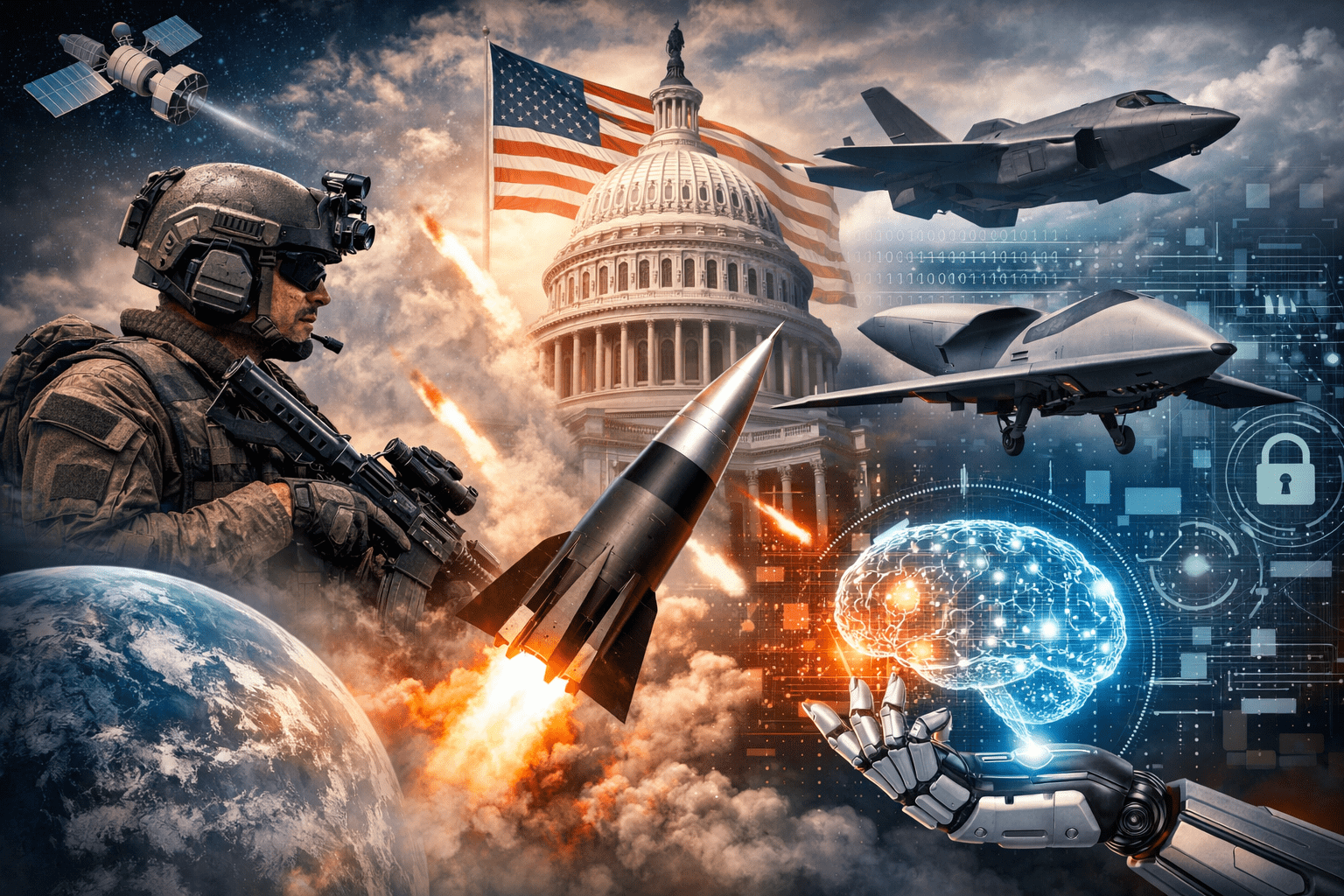
The FY2026 National Defense Authorization Act (NDAA) was signed into law by President Donald Trump on December 18, 2025, after it was passed with wide margins by the US House of Representatives and US Senate. The passage marked the 65th consecutive time the NDAA received approval, making it one of the most enduring pieces of bipartisan legislation in US history. The law authorizes $900.6 billion for the US Department of War (DOW), nuclear security programs at the U.S. Department of Energy (DOE), and related national security activities, roughly $8 billion above the presidential budget request. The NDAA procurement plan includes $26 billion for shipbuilding, $38 billion for aircraft, $4 billion for ground vehicles, and $25 billion for munitions, among others.
The NDAA emphasizes maintaining US technology superiority through significant investments in key emerging technologies, acquisition reforms for speed, and supply-chain security. It directs resources toward technologies critical for future military operations and for achieving “decision superiority” over adversaries.
The DOW is focused on the rapid integration of artificial intelligence (AI) into operations to achieve efficiency and decision superiority in the form of Applied Artificial Intelligence (AAI). The goal is for AI systems to act as reliable “teammates” in planning and execution, with a strong emphasis on accountability and traceability. The Act provides over $2.6 billion for hypersonic programs, recognizing their importance in modern warfare.
Significant investment is allocated for space-based systems, including missile-warning satellites, missile-tracking satellites, and next-generation intelligence collection. Advanced technologies include the deployment of nuclear reactors in orbit and on the Moon to ensure US space dominance. The legislation targets resources for unmanned aerial systems (UAS), uncrewed maritime platforms, and counter-UAS technologies.
The NDAA addresses the need for data-driven logistics management tools to handle potentially disrupted supply lines in future conflicts. Provisions are included to secure US biotechnology supply chains against foreign adversaries and to strengthen the recruitment and retention of a skilled cyber workforce through new hiring authorities. The budget includes investments for developing quantum computing capabilities that advance US technical superiority.
To ensure these technologies are fielded quickly, the NDAA encourages several changes. The Act highlights speed and urgency and is designed to ensure warfighters receive urgently needed capabilities, embracing an “acceleration imperative” that requires faster development and deployment cycles. The Administration is signaling openness to new suppliers and investment models, including private capital, to build a more resilient and innovative defence industrial base.
The overall aim of the FY2026 NDAA regarding technology is to leverage innovation into tactical advantages on the battlefield, thereby maintaining America’s military superiority.
Transforming the Warfighting Acquisition System
The NDAA reforms focus on accelerating requirements, centralizing program management, and embedding sustainment planning to avoid costly readiness gaps and overruns. The NDAA revises acquisition rules to prioritize “best value” instead of “lowest overall cost” and emphasizes price competition.
It requires the defence acquisition system to expeditiously provide the Armed Forces the capabilities needed to operate in the most cost-effective manner possible. The NDAA fortifies the defence industrial base by deepening allied integration, expanding funding and hiring authorities for critical supply chains, and streamlining cyber-security and technology transfer. It directs the DOW to harmonize cyber-security rules for the defence industrial base by June 01, 2026. A key provision requires the DOW to build a digital inventory of weapon-system technical data to prevent sustainment gaps.
It creates a U.S.–Israel Defense Industrial Base Working Group to study deeper integration and potential inclusion of Israel in the national technology and industrial base, with protections for sensitive information.
It directs the Secretary of War to produce a technology framework to revise transfer and foreign disclosure policies for artificial intelligence (AI), counter-unmanned aircraft systems (c-UAS), missile defence, and other topics. It emphasizes the need for contractors to maintain or invest in surge capacity and steps to address them.
Major Weapon Systems Including Hypersonic
The bill advances missile defence by enforcing the Golden Dome policy, “The Iron Dome for America.” It requires that every major weapon system have a designated product support manager responsible for sustainment, planning, and readiness outcomes to achieve availability targets.
The Bill sets the policy to deploy and maintain a “next-generation missile defence shield” that is capable of defending against complex ballistic, hypersonic, and cruise-missile threats. It bars the Pentagon from outsourcing missile intercept capabilities to private or subscription-based models. The Secretary of War must develop and operate a missile defence system with kinetic missile compatibilities that is “owned and operated” by the Armed Forces. It authorizes US funding for Israeli missile defence programs, including up to $60 million for Iron Dome, $40 million for David’s Sling, and $100 million for the Arrow 3 interceptor, with requirements for co-production in America.
There is significant authorization for funding dedicated to research, development, testing, and evaluation (RDT&E) to advance hypersonic weapons, focusing on new materials, prototyping, and expanded test infrastructure to accelerate fielding and readiness. It directs the DOW to evaluate additional airspace and range options to expand testing and training for hypersonic and long-range weapons, including safety, infrastructure, and launch requirements. It grants multiyear procurement authority for low-cost hypersonic strike systems, ensuring stable production and long-term investment in R&D to accelerate development and deployment.
Advanced and Additive Manufacturing and Critical Materials Processing
The Act requires demonstration and prototyping programs to incorporate advanced manufacturing facilities that can rapidly produce parts closer to where they are needed and quickly convert commercial manufacturing into defence production. It directs the DOW to establish a working group on the advanced manufacturing workforce within 180 days to combat shortages in industrial base career fields. It launches a pilot program to test advanced manufacturing construction technologies, including 3D printing, on specific military installations. It requires that the strategic plan for advanced manufacturing be updated periodically.
It establishes a “Stockpile Manager” and strengthens the DOW’s ability to acquire and store critical materials. It expands the “Strategic Materials Recovery and Reuse Program” for shortfall materials, including recycling and recovery of critical minerals. This provision promotes reuse of materials from defence systems to support long-term strategic supply security and reduce reliance on foreign sources.
Supply Chains
The Act strengthens the DOW’s supply-chain resilience by prioritizing production of critical readiness items, particularly those with long lead times or high prices. It also aims to speed up the qualification process for secondary suppliers to reduce over-reliance on a single source in each military department and to fast-track alternate supplier approvals. The DOW is to come up with a strategy on how it will eliminate its reliance on optical glass for computer displays manufactured by certain nations, including China, by 2030. Plans include establishing a voluntary online registry of suppliers compliant with US sourcing laws, granting them procurement preference as trusted US suppliers. The Act adds molybdenum, gallium, and germanium to the list of restricted strategic materials that cannot be sourced from adversary nations, including China. It allows exceptions for recycled material processed in the US or allied countries.
Air Power
The NDAA boosts Air Force procurement spending, authorizing $28.1 billion, an $800 million increase. It authorizes a C-40 Clipper, a military version of the Boeing 737-700, for executive airlift. It clears a new LC-130 “Skibird” cargo aircraft, as well as F-35A spare parts, and more Joint Strike Missiles and Joint Air-to-Surface Standoff Missiles (JASSM). Research and development spending is being increased to nearly $54 billion (nearly two-thirds of India’s total defence budget). The biggest increase adds $1.2 billion to the Sentinel intercontinental ballistic missile and $647 million to keep the E-7 Wedgetail airborne early warning and control aircraft. The Air Force plans to buy up to 26 E-7s to gradually replace its aging E-3 AWACS aircraft. The E-7 will have the airborne battle management and targeting mission accomplished with a combination of space-based systems and a few extra Navy E-2D Hawkeyes. Air Force operations and maintenance programs get a substantial increase for “campaigning and exercises,” with much of that focused on the Pacific.
Air Force aircraft divestment plans did not resonate with lawmakers, who ordered the Air Force to refrain from retiring 102 A-10 close air support jets and 21 F-15E fighters. The NDAA also extends prohibitions on retiring RQ-4 drones, B-1 bombers, and Air National Guard C-130 transports.
Drones and Counter-Drones
The Act advances US defences against emerging unmanned threats by expanding training and testing infrastructure and establishing task forces and partnerships to strengthen c-UAS resilience across the armed services. At the same time, the Act enhances protections for critical facilities and integrates drones and counter-drone measures into public safety and homeland security frameworks. It requires the Secretary of the Navy to investigate and adopt advanced technologies that improve Navy surface ship maintenance and prioritize drone-based inspection for uncrewed structural surveys.
A task force will be formed to manage c-UAS efforts. The task force will also be responsible for integrating c-UAS solutions at the DOW and coordinating interagency efforts for developing, testing, evaluating, and procuring counter-small unmanned aerial systems (sUAS). It establishes a working group to analyze the sUAS supplier base and recommend investments. sUAS components include battery systems. It authorizes the development of an additional range complex to train, test, and experiment with UAS and c-UAS capabilities.
It establishes a pilot program to accelerate the protection of critical DOW facilities and assets from threats posed by UAS. It extends and amends the existing US–Israel defence cooperation program to address unmanned systems threats across all warfighting domains. It directs the DOW to implement measures to protect critical facilities and assets from UAS threats and authorizes c-UAS measures to mitigate unmanned aircraft threats. It amends the Homeland Security Act of 2002 to include drone protection measures for critical infrastructure and public safety. Protection of nuclear facilities and CIA installations from unmanned aircraft is covered.
Munitions
The NDAA authorizes more than $25 billion to rebuild the US munitions arsenal and directs the US Army to expand robotic automation in manufacturing for safety, efficiency, and workforce training. The Act strengthens planning by requiring reporting on missile defence systems and assessing critical stockpiles for simultaneous conflicts. Finally, the Act grants multiyear procurement authority for key missile systems, allowing the Armed Forces to enter long-term contracts for missiles and interceptors such as Patriot PAC-3, THAAD, Tomahawk, JASSM, LRASM, SM-3, AMRAAM, and others so that the services can prepare for investment. It requires the DOW to include adversary operational plans and allied demand in munitions planning and align production levels with future defence programs. It mandates regular reports on munitions response projects, detailing contracts, delays, and challenges. It directs the Army to expand robotic automation in munitions manufacturing to boost safety and secure factory integration.
Shipbuilding and Maritime
More than $26 billion is allocated for naval shipbuilding, including Columbia-class submarines, Virginia-class submarines, DDG-51 destroyers, the Ford-class aircraft carrier, one anti-submarine warfare auxiliary ship, and two Ship-to-Shore Connector landing craft. The bill strengthens the maritime industrial base by accelerating automated shipbuilding, expanding hiring and workforce authorities, and making adjustments in procurement. It requires the Navy to develop a strategy within 180 days to strengthen the maritime industrial base and address shipbuilding cost and schedule challenges. It creates a three-year pilot program using automated shipbuilding technologies to cut construction time and ease workforce strain. It establishes a pilot program within the DOW to create governance and oversight mechanisms for small uncrewed maritime systems. It requires the US Coast Guard to develop, within 180 days, a plan to expand joint training with the Taiwan Coast Guard Administration.
Space
The Act strengthens the US Space Force by refining leadership structures, expanding training roles, and requiring oversight before proposed new commands are created. The Act also accelerates satellite development through streamlined acquisition and ensures next-generation systems include key payloads. It extends the Space Development Agency’s authority to use the streamlined middle-tier acquisition process for the Proliferated Warfighter Space Architecture, allowing rapid prototyping and fielding of satellite tranches.
US space funding involves significant allocations to NASA (National Aeronautics and Space Administration) for exploration (Artemis, Mars) and science, alongside a growing defence budget for the Space Force to secure space superiority. NASA focuses on human spaceflight, science, and aeronautics, but faces major proposed cuts in the FY2026 budget request, threatening science missions and workforce. The Space Force received a major R&D boost, increasing from $3.9 billion to $4.4 billion, and expanded funding for satellite protection, situational awareness, and space control. Private investment fuels companies like SpaceX and Varda, focusing on launch, satellites, and in-space services. Growing competition, particularly with China, is driving investments in advanced space capabilities for national security and economic dominance.
To Summarise Technology Complexities
Chinese and Russian advances in technology over the last decade have caused anxiety among the US Administration and strategic thinkers, who worry about challenges to US military and technological superiority. Russia and China are considered ahead of the US primarily in hypersonic missiles, with operational systems like Kinzhal, Zircon, and DF-17, and in counter-space / anti-satellite (ASAT) capabilities, alongside advanced drone swarms and increasing integration of AI in military doctrine. China also leads in the scale of ground-launched conventional missiles, while Russia excels in advanced air defence systems (S-400/S-500) and nuclear deterrence. China has an edge in critical mineral processing and semiconductor manufacturing.
Technology changes the character of war. However, when new technology arrives on the battlefield, another technology soon counters it. Revolutionary developments like artificial intelligence have the potential to change the nature of war because non-human intelligence may not only assist human decision-making but even replace it in some cases. The ability to appraise and react faster and better than an opponent offers an unparalleled advantage in warfare. The theory of victory focuses on leadership decision-making, and this idea undergirds current US and Western military doctrines. Likewise, the Chinese military’s emphasis on informatisation relies on similar assumptions.
Today, advanced technologies like uncrewed vehicles, electronic warfare, cyber, hypersonic weapons, and AI-enabled systems have come to fruition. Cyber and artificial intelligence reside primarily outside the physical domains. Airpower can now do more than ever before, and there is a need to review doctrines accordingly.
Space power is expanding across all instruments of national power. However, there is no universal consensus on how to apply space power. Whether space should be weaponized, and where the astronomical end of the sphere of space power lies, remains debated. Weaponisation is nearing reality. Whether space capabilities should be brown-water (supporting terrestrial warfare) or blue-water, functioning more independently, is still evolving. The United States, China, and Russia will drive space weaponisation. India and others will follow.
Artificial intelligence has the potential to be one of the most revolutionary technologies to change war’s nature. Related fields like nanotechnology and quantum computing will impact warfare, particularly information warfare and air-force applications. Machine-based super-intelligence can solve many of humanity’s weaknesses, but it must be tightly controlled to prevent unpredictable and dangerous outcomes. AI may be the first military technology in history capable of self-proliferation and potentially turning against its creators.
Hypersonic weapons can be both conventional and nuclear. How emerging technologies affect crisis bargaining, deterrence, and conflict dynamics is evolving. Hypersonic technology may affect potential dispute dyads such as United States/Taiwan–China. The implications of incorporating hypersonic technologies among major powers are becoming increasingly significant.
Despite the term “uncrewed aircraft,” drones still require extensive support, with personnel involved at all levels—whether flying the aircraft remotely, refueling them on the ground, or providing security for airfields. Will expensive manned platforms be rendered redundant by ballistic, cruise, and hypersonic missiles? Unlikely. A missile-centric airpower model offers flexible, versatile, and cost-effective means to launch long-range missiles. Small, low-cost UAS are proliferating with endurance, payload, and intelligence that rival manned aviation, often outperforming surface-to-air defences. However, counters are already emerging, reducing effectiveness.
Space-based assets are under siege as anti-satellite weapons and space-based swarms target satellite constellations. The focus is on gaining or maintaining space advantage. Smaller nations like North Korea can launch ballistic missiles releasing micro-projectiles that indiscriminately destroy satellite constellations in orbit.
The TPCR 2025, a 15-year plan, details the Indian Armed Forces’ long-term modernization goals, guides industry in technology development, and promotes self-reliance. It strongly emphasizes indigenization and includes cyber operations, information dominance, electronic warfare, hypersonic, stealth, space warfare, AI, IT, big data, robotics, and UAS that will shape future operations. India has much to learn from the NDAA’s focus on faster decision-making and reduced development and production cycles.
The world is on the verge of an enormous transformation in warfare. A first-mover nation can seize technological advantage and launch a pre-emptive strike to achieve rapid victory. The US acknowledges existing gaps and is investing heavily in hypersonic research, autonomous systems, and strengthening its defence industrial base to keep pace with rapid advancements by Russia and China.
Note: The article was originally written by the Author for The Eurasian Times on, December 28th, 2025, it has since been updated.
Header Picture Credit: Author
Twitter: @AirPowerAsia
 Air Power Asia