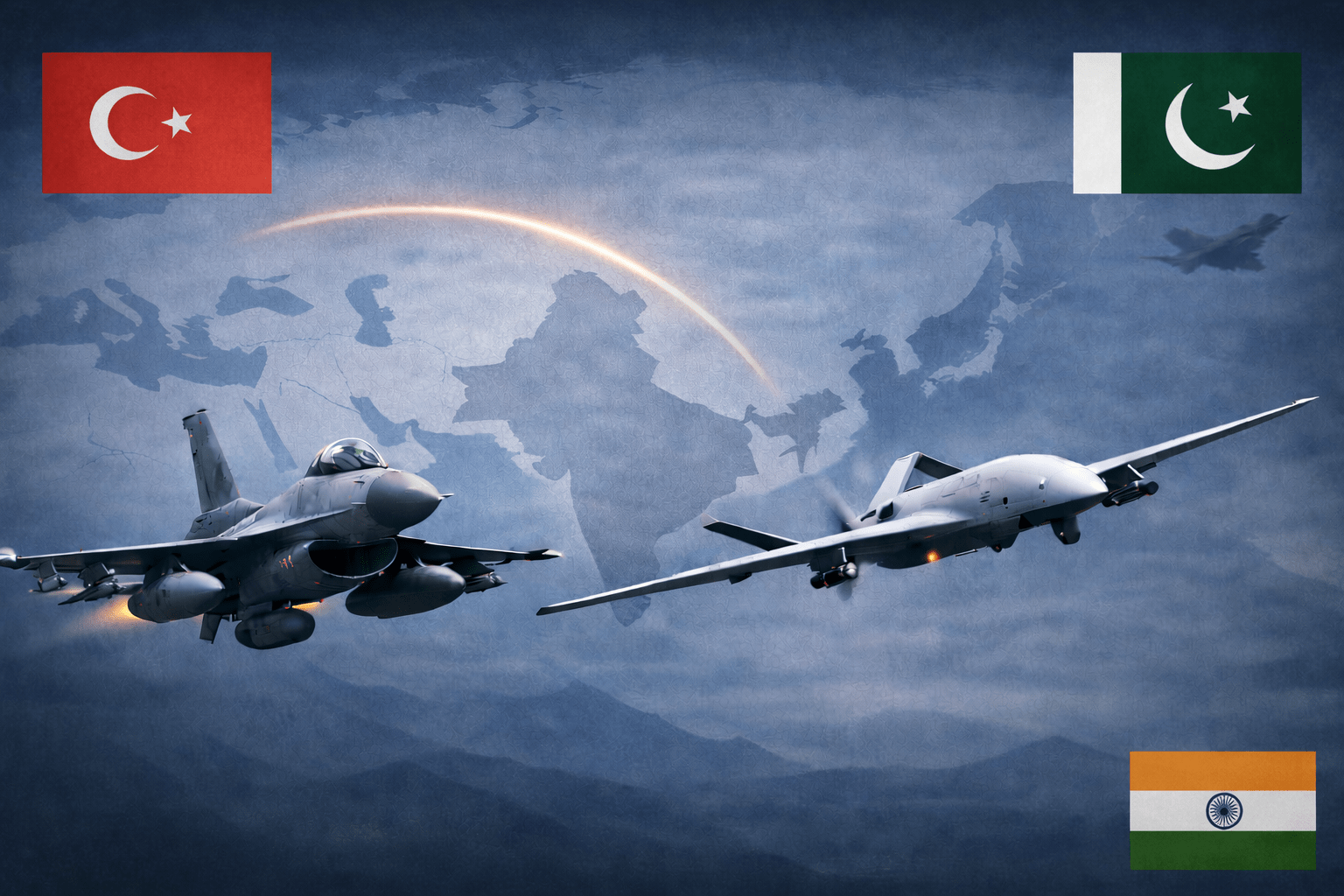
Turkey’s support to Pakistan during Op Sindoor is well known and was flagged by India during the recent Shanghai Cooperation Organisation (SCO) meeting in Tianjin, China, in early September. Turkey has provided Pakistan with defence hardware, including uninhabited aerial systems (UAS) and drones. Pakistani engineers and technicians have been working at Turkish Aerospace Industries (TAI), including on the fifth-generation aircraft KAAN. There is a religious angle to Pak-Turkish relations, with both backing hard-line Islam. Both have large militaries, and are among the strongest in the Islamic world.
More recently, there are reports that Turkey appears to have obstructed the delivery of the Indian Army’s second and final batch of six AH-64E Apache helicopters. Ordered in 2020 and en route to India, the cargo plane was abruptly turned back, further delaying an already troubled schedule. The An-124 was stuck in England for a week before returning to the United States because Turkey refused to grant airspace clearance for the cargo aircraft. It is time to look at Pak-Turkish military and strategic relations and their implications for India.
Pakistan–Turkey Political and Economic Relations
Turkey and Pakistan have a strong, long-standing relationship built on historical, religious, and geopolitical ties, characterised by significant cooperation in defence, trade, and diplomacy. Key aspects include defence partnerships with arms sales and joint exercises, political and economic cooperation, and mutual support on regional issues like Kashmir. Both countries share a similar vision and ideology, contributing to the strengthening of their alliance in recent years. Both countries are important members of the Organisation of Islamic Cooperation (OIC).
Pakistan’s founder Muhammad Ali Jinnah expressed admiration for Turkey’s founding leader Mustafa Kemal Atatürk and also a desire to develop Pakistan on the Turkish model of modernism. Similar ideas were expressed by former President of Pakistan Pervez Musharraf, who grew up in Turkey and received extensive military training there. On 26 October 2009, Recep Tayyip Erdoğan was awarded the Nishan-e-Pakistan and became the fourth world leader to address the Pakistani Parliament.
Both Turkey’s and Pakistan’s populations practise the Hanafi school of Sunni Islam. Turkey supports Pakistan’s position of holding a plebiscite under the United Nations to decide Kashmir’s future, a stance reaffirmed by President Erdoğan in a joint address to the Pakistani Parliament, attended by Pakistan’s military high command, and provides diplomatic support. Turkey supports Pakistan’s membership of the Nuclear Suppliers Group (NSG). Turkey has also reportedly opposed India’s inclusion in the NSG and previously supported Pakistan in the Financial Action Task Force (FATF).
Frequent high-level meetings between leaders of both countries reinforce the close relationship. A shared Islamic identity, strengthened by historical ties to the Ottoman Empire and ideological alignment with political Islam, underpins their relationship. The two countries have signed preferential trade agreements aimed at increasing trade volume. Turkish companies have made significant investments in Pakistan, including in the energy and consumer goods sectors. Collaboration extends to infrastructure, with projects such as solar energy plants. Turkey has also supported Pakistan in the healthcare sector, including the establishment of hospitals and medical centres.
Pakistanis enjoy the gracious attitude of ordinary Turks and are often termed Kardeş (brother). Plans to facilitate dual nationality for citizens of both countries have been mooted. Trade volume rose by nearly 30 percent year-on-year in 2024 to reach $1.4 billion. A Preferential Trade Agreement (PTA) was signed in August 2022, and negotiations are underway for a Turkey–Pakistan Free Trade Agreement.
Illegal Pakistani Migrants
The issue of Pakistani migrants entering Turkey illegally with ambitions of reaching Europe for better living conditions has brought friction. However, not all succeed and many end up stranded in Turkey. This has caused concern among Turkish authorities, who have tightened borders with neighbouring European countries. Some illegal migrants are alleged to have been involved in crime, generating negative sentiment towards Pakistanis among Turkish residents. It is estimated that 5,000–6,000 Pakistanis reside illegally in Turkey, though numbers fluctuate. Numerous Afghans using fake Pakistani passports, and some criminals evading prosecution in Pakistan, also reportedly live illegally in Turkey and commit crimes.
Pakistan–Turkey Military Relations
Both nations were part of Cold War-era alliances such as the Central Treaty Organization (CENTO) and the Regional Cooperation for Development (RCD). Today, Turkey is Pakistan’s second-largest arms supplier after China. Recent purchases include Bayraktar TB2 drones and Kemankes cruise missiles, and Turkey supplies anti-tank weapons to Pakistan. Pakistan has supported Turkey in conflicts such as Cyprus. In 2020, both the Iranian and Turkish governments were reported to be recruiting Pakistani mercenaries for conflicts in Syria.
The two nations conduct frequent joint military exercises and intelligence-sharing, enhancing Pakistan’s operational preparedness against India. Turkish and Pakistani troops held joint counter-terror exercises with Uzbek forces in Uzbekistan in April 2019. Over 1,500 Pakistani military officers have received training in Turkey since 2000. There are indications of a trilateral military alignment between Turkey, Pakistan, and Azerbaijan. Both countries have drawn closer militarily due to regional instability and strained relations with the United States in recent years.
Military Aviation Engagement
Turkey helped upgrade F-16 fighter jets for the Pakistan Air Force (PAF), manufactured engines and spare parts, and provided training to PAF officers. Turkey continues to purchase minor aerial weapons and components from Pakistan. The PAF and Turkish Air Force signed a deal to purchase 52 Pakistani-made MFI-17 Super Mushshak turboprop trainers. Pakistan assisted in pilot training and helped restore Turkish Armed Forces aviation capability following shortages after the 2016 attempted coup. Pakistanis are closely monitoring and working with Turkey on the TAI TF KAAN fighter jet.
India successfully repelled a significant Pakistani drone attack on its western border during Op Sindoor. Over 300 drones, suspected to be Turkish-made Asisguard Songar models, targeted military and civilian sites. Pakistan is jointly developing other UAVs with Turkey. ASELSAN supplied advanced targeting pods for JF-17 jets, while HAVELSAN delivered an electronic warfare training range.
Platforms for Pakistan Navy
In July 2018, the Pakistan Navy signed a contract for four MILGEM-class corvettes from Turkey, the largest single Turkish military export deal, worth $1.5 billion. Admiral Zafar Mahmood Abbasi and President Erdoğan cut the first metal plate for the first MILGEM Ada-class corvette on 29 September 2019. The naval tanker PNS Moawin was designed by STM. Turkey is conducting mid-life upgrades on Agosta 90B submarines, and the navies of both countries have participated in drills in the Mediterranean Sea and Arabian Sea.
India–Turkey Relations
India–Turkey relations are complex, marked by economic engagement and periodic political tensions, primarily due to Turkey’s support for Pakistan and its stance on Kashmir. Trade ties exist, but recent events—such as the use of Turkish drones and condemnation of Indian military operations—have created strains. Military interaction has been limited to low-profile passage exercises (PASSEX) between the Indian Navy and Turkish Navy.
Trade aspirations once targeted $20 billion, but in 2024–25, bilateral trade stood at approximately $8.71 billion, with India enjoying a surplus. India exported $5.72 billion worth of goods, including engineering, chemical, and electronic products, and imported $2.99 billion from Turkey, mainly mineral fuels, pearls, and nuclear reactor parts. Following Turkey’s support for Pakistan after Op Sindoor, there were calls for a boycott of Turkish goods. India’s Bureau of Civil Aviation Security (BCAS) suspended Çelebi’s security clearance on 15 May, citing safety concerns. As of mid-2025, India had not imposed a complete trade ban, but trade with Turkey and Azerbaijan faces uncertainty. India supports Armenia, Greece, and Cyprus in response.
Implications and Options for India
Despite India’s humanitarian assistance after Turkey’s 2023 earthquake, the Turkey–Pakistan axis remains strong. India has sought geopolitical counter-balances, aligning with Cyprus, supporting Armenia militarily against Turkey-backed Azerbaijan, and deepening Indo-Pacific partnerships with the United States, sidelining Pakistan.
Turkey dismissed reports alleging involvement in radicalisation in India as baseless after Delhi blast suspects were found to have visited Turkey.
Turkey’s aspirations to act as a bridge between Asia and Europe are challenged by projects like the India–Middle East–Europe Economic Corridor (IMEC), which bypasses Turkey. President Erdoğan criticises IMEC, favouring Turkey-led initiatives such as the Iraq Development Road (IDR), linking Grand Faw Port in Basrah to Europe via Turkey.
There is a belief that Turkish government-sponsored cargo planes carried military supplies to Pakistan during Op Sindoor, signalling a prioritisation of Islamic solidarity over trade with one of the world’s fastest-growing economies. Questions arise on whether religion outweighs nation-building.
Both Turkey and Pakistan appear to be seeking alternatives to lost Cold War relevance within the Western security architecture. Relations with the United States have fluctuated. Despite being a NATO member, Turkey faced CAATSA sanctions for acquiring Russian S-400 air defence systems, losing access to the F-35 program. Nevertheless, US strategic interests lie increasingly with India, particularly within QUAD and Indo-Pacific strategies.
Turkey’s support for Pakistan’s Kashmir position and arms supplies remain the two principal challenges in India–Turkey relations, which have reached a low point in recent years. Turkey also supported Bangladesh and Maldives during periods of strained relations with India. India agreed to support Armenia with the Akash air defence system and has strengthened ties with Turkey’s regional rivals, including Greece, Cyprus, Iran, the UAE, and Israel.
While the Islamic world cannot afford a failed Pakistan, should Turkey’s relations with Pakistan come at the cost of ties with India? There are lessons from Saudi Arabia and the UAE. President Erdoğan’s repeated references to Kashmir, even during bilateral visits to India, are unacceptable. Turkey’s actions during and after Op Sindoor have antagonised 1.4 billion Indians, requiring conscious efforts to repair ties.
At $4.2 trillion, India is the world’s fourth-largest economy, compared to Turkey’s $1.5 trillion and Pakistan’s $410 billion. In the Global Military Power Index, India, Turkey, and Pakistan rank 4th, 9th, and 12th respectively. The Turkey–Pakistan partnership is not earth-shaking but adds strategic nuisance in India’s neighbourhood. India does not require knee-jerk reactions. A calibrated response, focused on strengthening defence capabilities, alliances, and economic growth, remains essential.
Note: The article was originally written by the Author for The Eurasian Times on, November 16th, 2025, it has since been updated.
Header Picture Credit: Author
Twitter: @AirPowerAsia
 Air Power Asia