
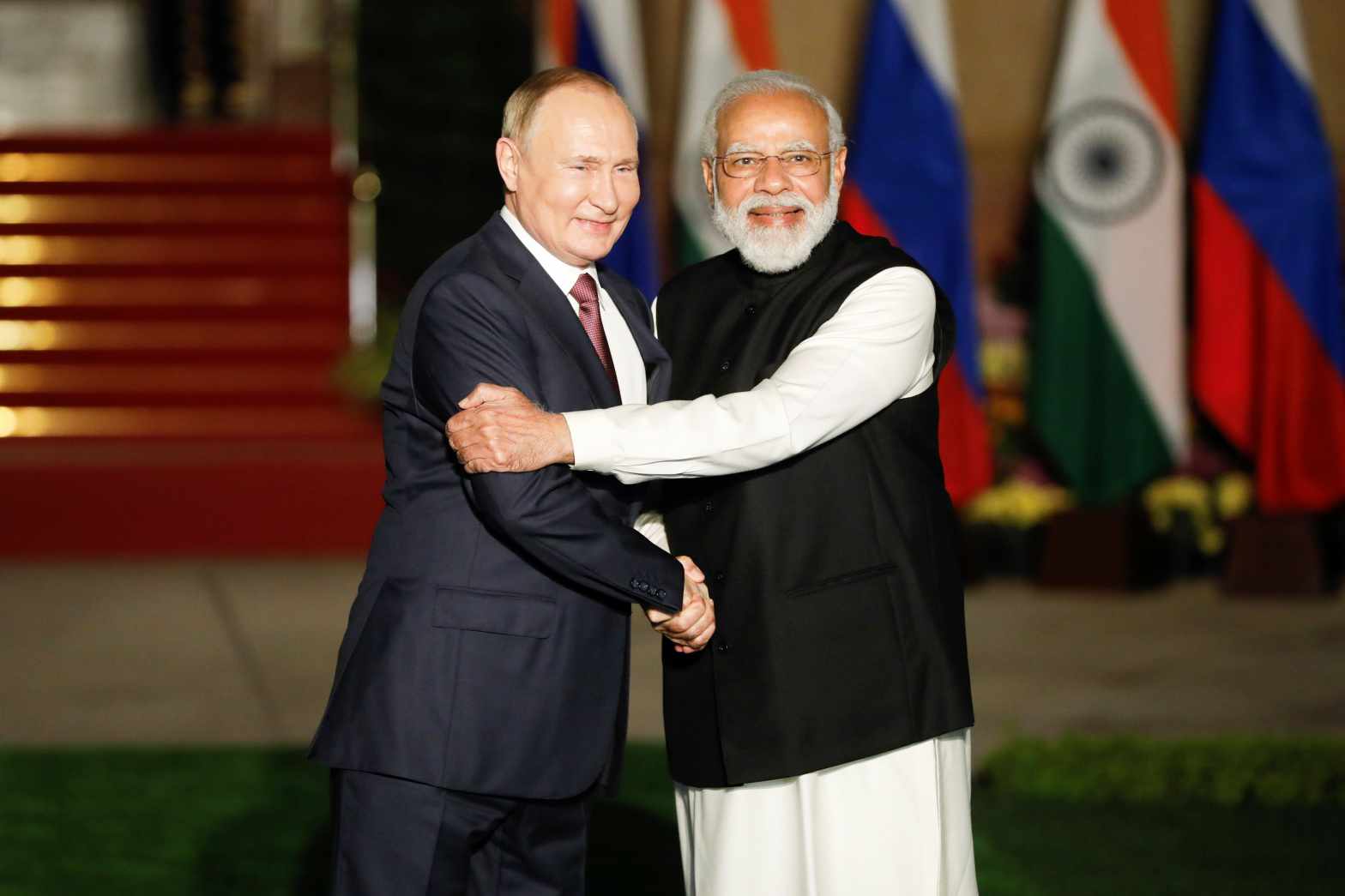
Russian President Vladimir Putin is all set to visit India on December 05, 2025 for a bilateral summit. The visit is very significant as it will reaffirm and strengthen the “special and privileged strategic partnership” amid a challenging global geopolitics and increasing Western pressure on India. This visit, the 23rd annual summit, will be Putin’s first to India since the Ukraine conflict began in February 2022, underscoring its importance.
Amidst President Donald Trump’s aggressive policies and rhetoric, India has maintained cool composure and handled tariff negotiations with great maturity, and “little give and more take.” Despite threat of sanctions on Indian entities, the Modi government kept reaffirming and strengthening its longstanding strategic ties with Russia. India’s patient approach paid dividends. Trump had to partially backtrack on pharmaceuticals, H-1B visa among some others, reinforcing India’s resolve to pursue strategic autonomy and potentially strengthen its alignment with Russia.
Meanwhile, Putin could convince Trump in Alaska to propose almost everything that Russia wanted in his 28-point Ukraine peace plan. Europe and Ukraine have shown serious reservations. Russia has objections on some still frozen financial assets. If the plan goes through, then it would be a clear win for Putin.
As India prepares to host Putin, defence cooperation has moved to the centre of an increasingly intense diplomatic week. The visit is expected to see major announcements across the defence sector. The diplomatic groundwork has already been under way between Indian External Affairs Minister Dr S. Jaishankar and Russian Foreign Minister Sergey Lavrov. In New Delhi, Nikolai Patrushev, one of Putin’s closest advisers, met PM Modi to coordinate positions ahead of the summit, while Jaishankar called on Putin in Moscow.
Expectations around Putin’s visit are high. Beyond Su-57 collaboration, pending S-400 deliveries and additional systems contract, discussions on possible S-500 cooperation, expansion of joint production of Su-30MKI aircraft and T-90 tanks, and upgrades to the BrahMos missile programme will be discussed. It could mean beginning of a new era of co-development rather than a traditional buyer-seller arrangement.
Indo-Russian Relations Stand Firm
In the last four years, India withstood American pressure to distance itself from Russia. Indo-Russian friendship stands on firm footing. The general perception that India is inching towards the Western fold is not backed by full ground reality, and that India clearly believes in strategic autonomy. India remained officially neutral on the Ukraine conflict, but was visibly inclined towards Russia. Despite US threat of Countering America’s Adversaries Through Sanctions Act (CAATSA), India did go ahead with the S-400 deal with Russia. Despite Western sanctions and tacit pressures, India stepped up petroleum purchases from Russia and continued Rupee-based trade.
President Putin has made nine visits to India, three during PM Modi’s tenure (2016, 2018 and 2021). This December will be his 10th. Interestingly, Putin has made 22 visits to China. PM Modi has made seven visits to Russia, in contrast to ten to the USA since he became PM in 2014. Few US visits were to the United Nations. There is a decades-old annual India–Russia summit format. Putin–Modi friendly chemistry has been visible in their body language.
India–Soviet cooperation began in the 1950s with steel plants, large infrastructure including dams, nuclear plants, cooperation in space, but the most enduring has been the defence equipment purchases by India. At the peak, Indian armed forces had nearly 80 percent defence hardware of Soviet/Russian origin, and the figure still remains at 60 percent. India did look towards the West for sourcing some high-end military hardware, and also to balance the basket.
In August 1971, as an insurance against possible US or China threat to support Pakistan in the Indo–Pak war, the Soviet Union signed a Treaty of Friendship and Cooperation with India. This has since become India–Russia Strategic Partnership, and includes summit and 2+2 dialogue levels. India and Russia also work closely at BRICS, SCO, and RIC among other forums.
Both wanted to take the relationship to next level. “The bond between the people of Russia & India is very strong. Our nations have stood by each other through thick and thin,” PM Modi had said during his last visit to Russia.
Military aviation remains the biggest Indo-Russian “Bear Hug” with most significant hardware transfers.
The Aviation Connection Begins
In the mid-1950s, Indian Air Force (IAF) received Ilyushin IL-14 turbo-prop medium cargo aircraft. Mi-4 helicopters were inducted starting early 1960s and became part of the military folklore after the ‘Meghna’ river crossing operation in the 1971 war. Around the same time, 10-ton payload class An-12 transport aircraft were inducted. These were used in the 1962 war for airlifting army reinforcements. In the 1971 war, they were also used for heavy bombing.
The MiG and Sukhoi Fighters Dominate IAF
In 1962, Soviets agreed to transfer technology to co-produce the MiG-21 aircraft in India, something they had earlier denied to China. Nearly 11,500 MiG-21s were built around the world. India inducted or built more than 1,200. Soviets helped India set up licence production of MiG-21 in early 1960s. Three new divisions of Hindustan Aeronautics Limited (HAL) were created at Nasik (aircraft), Koraput (engines) and Hyderabad (avionics). These factories were to later build, overhaul and upgrade all types of Russian aircraft.
In mid-1960s, IAF also inducted swept-wing high-speed Sukhoi Su-7B strike aircraft. The swing-wing MiG-23 aircraft and its air defence variant, MiG-23MF, joined the IAF in early 1980s. A more advanced strike variant of the MiG-23, the MiG-27, was inducted in 1986, and these were assembled in India and later upgraded.
Soviets developed MiG-29s and Su-27s in 1970s to counter the American F-16 and F-15 aircraft. The highly manoeuvrable MiG-29, with a modern airborne radar and a host of advanced air-to-air missiles, joined the IAF in mid-1980s. Upgraded variants of these will continue to fly for at least a decade.
125 MiG-21 Bis (Bison) aircraft were upgraded jointly with Russia starting late 1990s. The MiG-21 Bison fleet retired in September 2025.
Nearly 45 percent of IAF’s fighter fleet currently is made up of the air superiority fighter Sukhoi Su-30MKI. Jointly developed with Russia, in early 2000, it is under licence production by HAL. Nearly 272 were inducted and these will soon see a major upgrade.
Russia has pitched in two aircraft for India’s 114 aircraft MRFA project that has still to unfold fully. The MiG-35 was earlier a part of the 126 aircraft MMRCA, and has been evaluated. The Su-35 is the second aircraft. The aircraft is part of the Su-27/30 family. China has bought 24 Su-35s.
The Transport & Rotary Wing Fleet
Specially made for IAF, An-32 medium transport aircraft started inducting in 1984. Of the 125 bought, nearly 100 aircraft are still operating, and have been upgraded. IAF also acquired the 40-ton-plus payload multi-purpose four-engine strategic airlifter IL-76. IAF continues to operate the IL-76MD (freighter), IL-78MKI (Air Refueller) and the ‘A-50’ with Israeli Phalcon radar as AWACS. IL-76s, along with An-32, are the work-horse of IAF and logistically sustain the Indian Army in the Northern Himalayas and for inter-theatre air transportation.
Mid-sized utility and assault helicopters Mi-8s joined IAF in the early 1980s. Capable of carrying up to 24 troops, they were also used for VVIP communication duties. Subsequently, more advanced versions Mi-17, Mi-17-1V and Mi-17V-5s followed. Significant numbers of Mi-17s are also being acquired by Home Ministry for BSF. IAF also acquired heavy-lift Mi-26 helicopters, three of which are still operating. The first dedicated attack helicopters of IAF, Mi-25/35, were acquired in 1983.
Missiles and Maritime Assets
India also got its first set of missiles from the Soviets. K-13 was the first-generation air-to-air missile that came with MiG-21s. R-73, R-27 and R-77 RVV-AE were among those that followed. Similarly, SA-2 (Dvina) was India’s first Surface-to-Air Missile. SA-3 Pechora and SAM-8 joined the armed forces later. The state-of-the-art jointly developed Indo-Russian BrahMos cruise missile is already inducted in the Indian armed forces in large numbers. IAF has also inducted the formidable S-400 air defence system. Three units have been delivered and remaining two systems will induct by 2026.
By early 1980s, the Indian Naval air-arm was dominated by many types of Russian maritime fixed and rotary wing aircraft. These included Ilyushin IL-38, Tupolev Tu-142M, and many Kamov Ka-25, Ka-28 and Ka-31 helicopters. Aircraft carrier INS Vikramaditya (ex-Russian Gorshkov) is an important element of the long Russian aviation connection with the Indian Navy. The Navy also inducted aircraft carrier-capable MiG-29Ks.
Fifth Generation Fighter Aircraft
In 2007, Russia and India signed a contract between Sukhoi and HAL to jointly develop a derivative of the evolving Su-57, called the Fifth Generation Fighter Aircraft (FGFA). In 2010, both agreed on a preliminary design contract where each country was to invest $6 billion. The development of the FGFA was expected to take 8–10 years. By 2014, there were issues related to performance, cost, and work-share. India eventually left the partnership in 2018. Russia pursued the program, and today has the much successful Su-57 “Felon” impressing spectators and professionals around the world. Russia’s single-engine and smaller Su-75 “Checkmate” also looks attractive but is still under development.
Su-57 Offer
At the Dubai Airshow, Moscow has made what officials describe as its most significant military proposal to India in years, one that could potentially reshape the future of Indian air power. Moscow announced offer of full licensed production of the Su-57 “Felon” fifth-generation stealth fighter in India, along with unrestricted transfer of technology, the level of access no Western defence partner has ever offered India. Russia is proposing an initial supply of Su-57E fighters produced in Russia, followed by manufacturing in India with increased indigenous content. This would mean far beyond assembly from imported kits. Russia is willing to open the entire fifth-generation ecosystem, which includes engines, sensors, stealth materials, avionics and other classified systems. Russia is also prepared to provide technological learning in areas such as fifth-generation engines, optics, AESA radar, artificial intelligence, low-signature technologies and advanced air weapons, many of which have been denied by the West. The reported base price of the aircraft is unbelievably as little as $45 million. Su-57 is being termed as the “mother of all offers” with complete technology transfer and co-production in India.
Indo-Russian MTA Project
The United Aircraft Corporation (UAC) of Russia, and HAL of India began a joint venture in 2009, to build a Medium Transport Aircraft (MTA). Each side pitched in US$300 million in the project. The aircraft was intended to replace the IAF’s Antonov An-32 transport aircraft. India would acquire 45 aircraft and Russia 105. Both governments agreed to produce the aircraft for their respective armed forces and for friendly third-party countries, and to develop a civilian variant of the MTA in the form of a 100-seater passenger airplane, for which HAL will be the lead partner and principal integrator.
The 20-ton payload twin-engine aircraft was a smaller Il-76 look-alike platform with expected range of 2,500 kilometres. In January 2016, it was announced that due to technical reasons, India’s HAL would no longer be involved in the project and that Russia was proceeding with the project alone. The aircraft designated as Ilyushin Il-276 is now being developed by UAC. In February 2023, on the sidelines of Aero India 2023, a Russian delegation from Rostec held talks with Indian officials on the possibility of joint development of the Il-276. However, India would prefer the aircraft to come with a European engine instead of a Russian engine, which is unlikely to be possible for Russia to propose. As Russia continues to push the case for the Il-276, the other contenders for India’s Make-in-India MTA are the Airbus A400M, Lockheed Martin C-130, and Embraer C-390.
Russia Proposes SJ-100 Airliner
India’s HAL has signed a Memorandum of Understanding (MoU) with Russia’s UAC for the manufacture of the Sukhoi Superjet 100 (SJ-100) in India. The agreement was signed recently in Moscow, paving the way for the first joint production of civilian aircraft in the history of the two countries, which have cooperated for decades in defence manufacturing. Under the new agreement, HAL will have the right to produce the Sukhoi Superjet for domestic customers in India. Domestic airlines will need to be brought on board to ensure commercial viability. It is hoped – and perhaps expected – that sanctions on Russia and high tariffs on India will gradually ease over time. While international certifications such as FAA and EASA approvals may not be critical initially, they will become important if flying on international routes.
Likely Focus Areas during Putin Visit
S-400 deliveries of remaining two systems will be discussed. Putin is likely to assure early delivery. A contract will be signed for additional S-400 missiles that have already been cleared by New Delhi. India will push for five additional S-400 units and the same may be announced. India may also show interest for S-500 air defence system. There may be a statement on further accelerating and expanding the BrahMos missile programme. India may also seek the R-37M long-range air-to-air missile to be integrated on Su-30MKI.
Russia may seek joint upgrade of Su-30MKI. Recently, India ordered 12 additional Sukhoi Su-30MKI worth $1.5 billion. India also placed order for 240 Lyulka-Saturn AL-31FP aero-engines worth $3.05 billion. Though both orders are with HAL, they will require major supplies from Russia. The engines are being built from the raw material stage with technology transfer from Russia, and some spares, forgings and castings are expected to be imported. There have been reports that negotiations are on between India and Russia for exporting Indian-produced, Russia-supported Su-30MKIs to global customers.
Discussion on Make-in-India Russian Su-57 may be the flagship subject on the table. The timing of the offer is significant. IAF head, Air Chief Marshal A.P. Singh, had stated that the Indian Air Force needs to induct 35 to 40 fighter aircraft every year for the next two decades to close squadron gaps. He has linked this requirement to India’s long-term manufacturing goals under Roadmap 2047. While India is progressing with its own AMCA fifth-generation aircraft programme, that will take some time and an interim option perhaps needs to be exercised. If not Make-in-India, Russia may push for outright purchase of 2 to 4 squadrons of the fifth-generation fighter.
Russia could also make the offer of the Tu-160M strategic bomber. Russia would want India to revisit the Joint Venture to make the Ka-226T Light Utility Helicopter (LUH) in India.
Russia would also expect a more formal Indian position on the SJ-100 regional jet. There will be discussions on the Kudankulam Nuclear Power Plant. Only two of the six units are operational, and there have been significant cost and time overruns. There will be discussions on Russian support for India’s forthcoming first human space flight, the Gaganyaan Mission.
“Chakra III”, the third nuclear-powered attack submarine that India is leasing from Russia, will surely be discussed as the timelines have currently slipped to 2028. Russia will push to partner in India’s AIP submarine programme and offer to jointly design and develop conventional submarines with advanced technology access, as part of Project P-75I.
Recently, two frigates, INS Tushil and INS Tamala, were built by Russia at the Yantar Shipyard, while the remaining two are being constructed at Goa Shipyard Limited (GSL) in India through technology transfer. Russia is reportedly expanding its shipbuilding cooperation with India, with two Indian shipyards being considered for construction of four non-nuclear icebreakers. Russian shipbuilding officials have offered New Delhi their nuclear-powered aircraft carrier design for the Indian Navy, according to reports.
GSL is also to construct 24 river-sea class cargo ships for Russian clients in the Caspian Sea by 2027. Cooperation with India in shipbuilding has its benefits for Russia as the unit cost per vessel is projected to be half of what it would cost Russian shipbuilders.
The Indo-Russia Rifles Private Limited (IRRPL) joint venture has been established and it has started production of AK-203 rifles in India under the “Make in India” initiative. The rate of production needs to go up and the same will be discussed.
India and Russia have recently signed the Reciprocal Exchange of Logistics Agreement (RELOS) to facilitate military cooperation, allowing both nations’ armed forces to use each other’s bases and facilities for logistical support. There could be a mention.
Indian military’s hardware umbilical cord, including spares and repairs, with Russia will continue for decades to come. India will seek simpler procedures and faster deliveries.
India and Russia are trying to push the International North–South Transport Corridor, the Chennai–Vladivostok Maritime Corridor, and the Polar Route. This should form part of the final joint declaration.
As the Russian Ambassador to India, Nikolay Kudashev, said recently, “Sky is limit for expansion of Russia–India Partnership.”
Note: The article was originally written by the Author for Russia Today on, December 3rd, 2025, it has since been updated.
Header Picture Credit: Reuters
Twitter: @AirPowerAsia
 Air Power Asia