
The Adani Group is reportedly in talks with the Uttar Pradesh government on a public-private partnership to build Small Modular Reactors (SMRs) as India opens its nuclear energy sector to private investment. It plans to build eight Small Modular Reactors (SMRs) with a capacity of 200 megawatts (MW) each at yet-to-be-identified sites in the state. A potential deal would give the Adani conglomerate a total of 1.6 GW of nuclear capacity with SMRs and could place the private firm at the forefront of India’s nuclear development.
India’s nuclear sector is opening to private players, with major firms like Reliance Industries, Tata Power, Adani Power, Hindalco, JSW Energy, and Jindal Steel & Power expressing interest in developing SMRs under the Bharat SMR initiative, following recent legislative changes enabling private investment in nuclear power for the first time, aiming to boost capacity and innovation.
SMR technology is an ideal solution for India’s diverse and remote energy needs. India has an ambitious target to increase its nuclear energy capacity to 100 GW by 2047, a goal that relies on both large-capacity reactors and the faster deployment of SMRs. Earlier this year, a panel set up by India’s power ministry said in a report that for India to meet the 100 GW target by 2047, up from just 8.8 GW now, would require as much as 19.28 trillion Indian rupees, or $214 billion at current exchange rates, of cumulative capital. The Modi government plans to immediately spend as much as $2.23 billion (200 billion Indian rupees) on research and development of SMRs.
India has earlier been talking to the United States, Russia, and France regarding SMR technology cooperation. Indian government agencies alone will never be able to reach the nuclear power targets. India now wants to tap the private sector, which has abundant capital and inherent efficiency in timely construction and innovation adaptation. A public-private partnership with the Adani Group would give the conglomerate an early-mover status in India’s new nuclear power industry.
Imagine if a steel mill in Jharkhand, a data centre in Bengaluru, and an industrial park in Gujarat were all powered by backyard nuclear plants of their own? It is important to understand the SMR operational potential.
Small Nuclear Power Reactors
The International Atomic Energy Agency (IAEA) defines “small” with a power capacity of up to 300 MW(e) per unit, which is about one-third of the generating capacity of traditional nuclear power reactors. “Modular” makes it possible for systems and components to be factory-assembled and transported as a unit to a location for installation. “Reactors” harness nuclear fission to generate heat to produce energy. 700 MWe are termed as “medium”. Small portable nuclear power reactors are required both for military and civilian use in remote locations. There are also very small units which are about 15 MWe, especially for remote communities. While small reactors require special technologies, they are less cost intensive, especially for transmission. Initial experience came from nuclear-powered submarines. Greater demand for SMRs would also mean economy of scale.
Four types of small reactors that are evolving include light water reactors, fast neutron reactors, graphite-moderated high temperature reactors, and a few types of molten salt reactors. In the end, what matters is the smaller size, low technology risk, inherent safety, and longer unrefuelled operations. Smaller reactors also require much less real estate. Another advantage of small reactors is the much smaller safety zone radius around them. They use low-enriched uranium (LEU) and require much less cooling water. They also produce lower radioactivity. Lower investment and siting cost make them more attractive even for captive corporate use.
Decommissioning of such plants is much simpler. Yes, certification and licensing have issues. These reactors will also be well suited for very small countries or island nations. Arctic regions are also contenders for SMRs.
SMRs can be fabricated at a plant and then moved to the installation site. This saves time and on-site activity. Also, the overall cost is much lower because of standardization and production scale. Modularity and commonality in design also hasten licensing. Additional modules can be added if power requirement needs to be scaled up. The reverse could be true in case of a scale-down of demand. Smaller reactors also reduce safety concerns, and containment in case of accident is easier.
SMRs also have a more variety of cooling options. In case of SMRs, the thermal energy can be used directly, without conversion like heating water. Most SMRs can run without much supervision. Many SMRs have higher fuel burn up, reducing the quantity of waste. The initial setting up cost of the SMR manufacturing plants are fairly high, and therefore for reducing the amortized cost, there may be need to produce around 50 or more SMRs.
Nuclear proliferation risk remains a concern for SMRs. Significantly reduced staffing reduces physical protection and therefore increases security concerns.
Countries Working on SMR
In the United States, Westinghouse, Babcock & Wilcox, Holtec, and NuScale Power are some of the major players. China has some of the most advanced SMRs. China is also developing small district level heating reactors of 100 to 200 MWt capacities to replace coal based heating plants in northern parts. India’s 220 MWe pressurized heavy water reactors (PHWRs) are also SMRs. The Nuclear Power Corporation of India (NPCIL) is offering both 220 MWe and 540 MWe versions internationally. The Chinese 300–325 MWe PWR at Chashma in Pakistan (called CNP-300) is an SMR. The United Kingdom, Canada, Japan, South Korea, Denmark, South Africa, and Russia are also players.
Early Small Nuclear Reactors for Submarines
The design, development and production of nuclear marine propulsion plants started in the United States in the 1940s. The United States and the Soviet Union have had nuclear powered submarines since the early 1950s. The nuclear submarine is powered by a small nuclear reactor. Nuclear propulsion being independent of air, frees the nuclear submarines from having to surface frequently, as required by the diesel-electric powered submarines. The much more efficient power generation allows higher speeds. The submarine may not be refuelled for entire operational life of typically around 25 years. Marine-type reactors differ from land-based commercial electric power reactors in several respects.
Nuclear Powered Ships and Vessels
Only the United States and France built nuclear aircraft carriers. The Soviet Union had heavy nuclear-powered guided missile cruisers. The United States Navy (USN) also built similar cruisers, but all were retired before the year 2000. Russia has nuclear-powered and nuclear-armed unmanned underwater vehicles. In the 1960s the United States built a few experimental nuclear-powered civil merchant ships, but did not pursue as they were too small and uneconomical to operate. The 1988-built Russian vessel Sevmorput is one of only four nuclear-powered merchant ships ever built. After refurbishment in 2016, currently it is the only one in service in the world and operating in the Arctic’s Northern Sea Route (NSR). The Soviet Union, and now Russia, have been using nuclear powered icebreaker ships since late 1950s. A few are still in service, and more are being built.
The high cost of nuclear technology and maintenance means that very few military powers can afford nuclear submarines or ships. The only six countries with nuclear submarines are the United States, Russia, China, the United Kingdom, France, and India. In 2020, the Pentagon issued contracts for mobile, small nuclear reactors that will provide nuclear power for American forces at home and abroad.
Mini Nuclear Plants for Military
For long the U.S. Army has been using mobile and static small reactors to power remote air and missile defence radar stations in Alaska, Greenland, and Antarctica, and for providing electricity and heating. Mini Nuclear Power Plants (MNPP) would be portable and operate unrefuelled for 10–20 years. Mobile SMRs would be ideal for rapid response scenarios. These would also be handy during humanitarian assistance and disaster relief (HADR) operations. The smaller ones could generate below 10 MWe for at least three years without refuelling, and be transportable by C-17 aircraft.
The US Department of Defense (DoD)’s Project Pele is on track for full power outdoor testing of a prototype mobile reactor and electricity production at the Idaho National Laboratory (INL). The aim is for field deliveries by 2028.
During the Soviet Union, Pamir-630D truck-mounted small air-cooled 0.6 MWe nuclear reactors were built. These were discontinued later. Russia now has small transportable 2.5 MWe nuclear reactors. Russia is also developing small mobile nuclear power plants for the military in the Arctic air transportable by IL-76 aircraft and Mi-26 helicopters.
Civil Applications for SMRs
SMRs are very suitable for remote areas, off-grid industrial sites, or supplementing existing grids, unlike large conventional reactors. They are becoming much safer. Many designs use natural forces for shutdown and cooling, reducing reliance on external power. They are scalable and can be added incrementally as energy demand grows. They provide electricity, process heat for industry, and desalinate water. They support industrial decarbonisation and help balance variable renewable energy sources.
Over 80 SMR designs are in development globally, with some already operational or nearing operation. Countries like India are heavily investing, planning significant deployments by the 2030s to meet clean energy goals.
Way Ahead India
Clearly, while environmental concerns are driving switch from fossil fuel power generation to much cleaner alternative energy for civil use, the military and space need much smaller, lighter, and long lasting power sources for better mobility and remote operations. India has a well-established nuclear energy program. India has the third largest armed forces and very active borders spanning some of the highest mountains and remote jungles. Like other major powers, Indian armed forces require small nuclear power plants for use on the move. India’s nuclear submarine program is still evolving, and India has still to begin developing a nuclear powered aircraft carrier. Whether India will be part of the American Artemis program, or also the Russo-Chinese joint space habitat project, will evolve.
India’s future with SMRs looks promising, driven by a major government push (₹20,000 crore budget allocation for 2025–26) to develop indigenous designs, aiming for five operational SMRs by 2033 to meet clean energy goals and industrial needs. SMRs offer flexibility for remote grids and heavy industry, potentially replacing coal and boosting energy independence, though success hinges on regulatory frameworks, private investment, and scaling production.
The Nuclear Energy Mission (2025–26 Budget) has significant funding for SMR R&D. Focus is on indigenous designs such as BARC’s Bharat SMRs for 200 MW and 55 MW units, targeting commercial deployment. SMRs provide reliable, low-carbon power, crucial for India’s 100 GW nuclear target by 2047 and net-zero commitments.
Opening the nuclear sector to private players and start-ups, alongside potential reforms to the Atomic Energy Act, to accelerate innovation is on the cards. They will provide process heat for energy-intensive industries. SMRs will deliver strategic advantages in the form of dispatchable power.
India must put in place clear regulatory frameworks and licensing for SMRs. Larger numbers will support achieving cost competitiveness against large reactors and coal. Building a robust indigenous supply chain and manufacturing capabilities is important. Addressing safety concerns and building public trust and acceptability will be required.
India is strategically pivoting towards SMRs as a key pillar for a diversified, resilient, and decarbonized energy future, leveraging strong government backing, growing industrial demand, and evolving policy to overcome traditional nuclear project hurdles. The technological potential is huge and promising, and it is time for India to get going.
Note: The article was originally written by the Author for The Eurasian Times on, January 6th, 2026, it has since been updated.
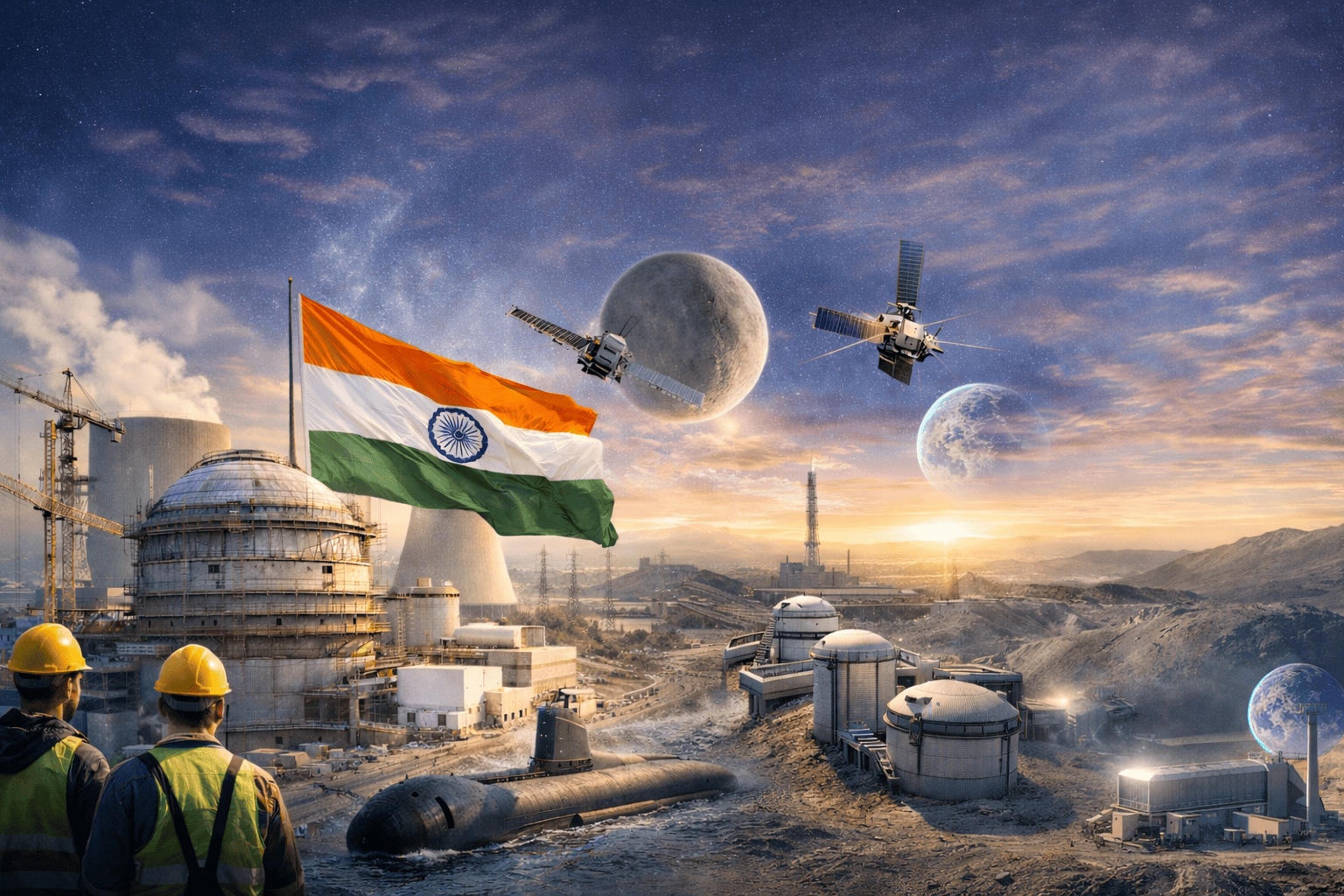
Header Picture Credit: Representative Image Generated using AI
Twitter: @AirPowerAsia
 Air Power Asia