
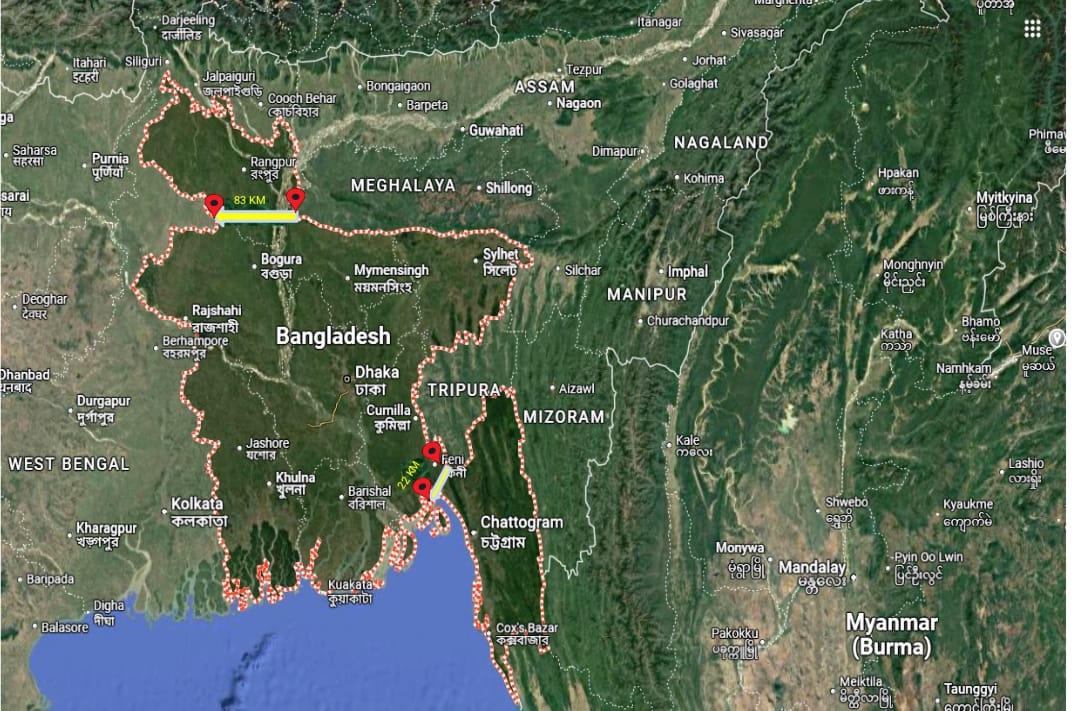
Bangladeshi National Citizen Party’s leader Hasnat Abdullah has rhetorically threatened to cut off India’s north-eastern states by cutting off India’s Chicken’s Neck, i.e. the Siliguri Corridor, while downplaying India’s contribution in the 1971 Bangladesh Liberation War. The Siliguri Corridor is the narrow land strip linking India’s northeast to the mainland. For decades, the Siliguri Corridor was treated as a geographical vulnerability to be appropriately managed by India. A controversial but amateur “Greater Bangladesh” map circulating on social media implies Bangladesh cutting off India’s north-east and annexing it. Assam Chief Minister Himanta Biswa Sarma has flagged concerns over shifting demographic trends in the state, claiming that the share of Bangladesh-origin Muslim residents could reach 40 percent very soon. Bangladesh migrant labour continues to cross over to India (Assam and West Bengal) with support and connivance of militant groups and even local politicians for vote-bank reasons.
Bangladesh Prime Minister Sheikh Hasina was ousted by Islamist radicals on August 05, 2024, and the USA-aligned Muhammad Yunus, the Chief Adviser, was asked to form the interim government. To assuage the anti-India hardliners, the interim government started making overtures to Pakistan, and there were high-level visits of Pakistani military and government leaders.
Growing anti-India sentiment, prolonged political instability in Bangladesh, and the erosion of assumptions that once kept India’s eastern flank relatively stable are now visible. The strategic community in India has started debating about possible vulnerabilities. The Chicken’s Neck is one such politico-geographical feature.
There are similar pieces of very vulnerable strips of Bangladeshi territory that can easily be cut off by the mighty Indian Armed Forces. Though dismissed in Bangladesh as fringe online propaganda, these vulnerabilities on either side need to be understood along with the implications and the security calculus.
Siliguri Corridor – India’s Chicken’s Neck
The Siliguri Corridor, often dubbed the “Chicken’s Neck”, is a stretch of land around the city of Siliguri in West Bengal. It is the sole terrestrial connection between India’s mainland and its eight north-eastern states, serving as a logistical lifeline for nearly 50 million people and crucial military movements. Bordered by Nepal, Bhutan, and Bangladesh, it lies close to Tibet’s Chumbi Valley to its northeast. The city of Siliguri is the central transfer point connecting Bhutan, Nepal, Bangladesh, Sikkim, Darjeeling, Northeast India, and mainland India.
The Partition of India in 1947 led to the creation of East Pakistan (now Bangladesh). The Kingdom of Sikkim formerly lay on the northern side of the corridor, until its union with India in 1975 via a publicly held referendum. From Sikkim, India consolidated its control of the Chumbi Valley, along with Bhutan. The dimensions of the corridor are around 170 by 60 km, with the narrowest section being 20–22 km, an area of approximately 10,200 sq. km.
Bangladeshis also refer to another Chicken’s Neck, the “Tripura Corridor.” It would require nearly 95 kilometres of Bangladeshi military thrust to cut it off from India.
Vulnerability Mitigation for Connectivity
The vulnerability for India stems from the fact that if this corridor is cut off by Bangladesh or other countries inimical to India, it would cut off India’s north-east from the mainland. It is important for India to have a friendly government in Bangladesh. After East Pakistan became an independent country (Bangladesh) with the support of India, there have been both friendly and not-so-friendly governments.
To mitigate the vulnerability, India has undertaken several initiatives, including enhancing security deployment as well as undertaking infrastructure development. To ensure seamless connectivity and military mobilization, India has prioritized developing high-capacity infrastructure in and around the corridor, notably under the Bharatmala Pariyojana projects.
As part of the corridor enhancement, major broad-gauge railway lines and highways have been upgraded to increase freight capacity and reduce transit time. Alternative connectivity solutions to reduce reliance on the single-access corridor include the proposed Hili–Mahendraganj Corridor and the Kaladan Multimodal Transit Corridor through Myanmar.
Consideration of subterranean infrastructure (tunnels) within the corridor to enhance security and reduce exposure to external threats has been under consideration. The projects include the construction of many border roads and the upgrade of Advanced Landing Grounds (ALGs). North-eastern India connectivity and Look-East transnational connectivity projects, including through BIMSTEC and BBIN, aim to create multiple alternatives to the Siliguri Corridor, including through Bangladesh and the sea.
As of 2024, to reduce dependence on the Siliguri Corridor, India is planning to build railway lines through Jogbani in Bihar, which would enter Biratnagar in Nepal and then connect with New Mal Junction in West Bengal. India was also developing railway lines through Bangladesh, which include constructing new railway tracks and the gauge conversion of existing railway tracks, in order to reduce dependence on the Siliguri Corridor.
As of now, there is no free-trade agreement between Bangladesh and India. The Tetulia Corridor, an alternative to the Siliguri Corridor, is proposed under Article VIII of the India–Bangladesh Trade Agreement 1980, which states that “The two governments agree to make mutually beneficial arrangements for the use of their waterways, railways, and roadways for commerce between the two countries and for passage of goods between two places in one country through the territory of the other.” However, the opening of the Tetulia Corridor, a proposed strategic passage through Bangladesh that would connect Chopra (North Dinajpur) to Maynaguri (Jalpaiguri) in West Bengal, is still being discussed politically.
Vulnerability Mitigation through Security
The threat of a possible Chinese advance is still considered by Indian planners. A Chinese military advance of less than 130 km would cut off Bhutan, part of West Bengal, and all of North-East India. The threat of such a situation first arose during the China–India War of 1962. The security threat to this corridor was heightened again during the 1967 Nathu La and Cho La clashes and the 2017 Doklam incident. The Indian security establishment has catered for such eventualities. The Siliguri Corridor is the Indian Army’s strongest defensive line.
The corridor had in the past also faced threats from militant groups known to have used the corridor, including the United Liberation Front of Assam (ULFA) and the National Socialist Council of Nagaland (NSCN). India has several forces stationed on the borders. The Indian Army and Indo-Tibetan Border Police (ITBP) man the border with China; Sashastra Seema Bal (SSB) is deployed along the border with Nepal and Bhutan; and the Border Security Force (BSF) along the border with Bangladesh. The strip is also patrolled by the Indian Army, the Assam Rifles, and state police forces, including the West Bengal Police.
The corridor and the surrounding region are secured by multiple military formations, primarily the Indian Army’s Trishakti Corps (33 Corps), which guards the corridor and Sikkim. In a significant move to reinforce the eastern frontier, late in 2025, India established three new military garrisons: the Lachit Borphukan station near Dhubri in Assam, and forward bases at Kishanganj (Bihar) and Chopra (West Bengal), to boost surveillance, readiness, and coordination with the BSF.
Advanced air assets are already stationed in the area, including a Rafale squadron (at Hashimara), air defence systems such as the S-400, and the offensive capability of the BrahMos missile regiment, among many others.
India has already fenced nearly 80 percent of the 4,100 km India–Bangladesh border. The remaining 900 km is unfenced due to difficult terrain (rivers, marshlands, steep areas) and land acquisition issues. There are disputes with Bangladesh over implementation, smart technology, and its impact on locals, despite joint efforts for security.
Bangladesh’s Chicken’s Necks
Bangladesh too has two Chicken’s Necks along its border with India. Cutting off these two would mean nearly 34.2 percent (50,715 sq. km) of Bangladesh’s total territory. These stretches are narrower and more vulnerable than India’s Siliguri Corridor or Tripura Corridor. The threatened stretches contribute nearly 40 percent to the Bangladesh economy, and 80 percent of Bangladesh’s total export–import trade through Chittagong Port.
In response to rhetoric from certain Bangladeshi political figures and hardliners highlighting India’s “Chicken’s Neck” vulnerability, Indian leaders have pointed out the much more vulnerable Bangladeshi corridors. The corridors are the North Bangladesh Corridor (Rangpur Division) and the Chittagong Corridor, a slender strip around 28 kilometres at its narrowest, connecting the port city of Chittagong, the economic capital, with the political capital Dhaka. This diplomatic and strategic counter-narrative serves as a warning that any hostile action aimed at the Siliguri Corridor could result in severe repercussions for Bangladesh’s territorial integrity and economic connectivity.
The Rangpur Chicken’s Neck is contiguous to India’s Siliguri Corridor. The Indian Army would have to cover just 80 km to isolate a huge parcel of land from the rest of Bangladesh. This 16,185 sq. km area constitutes 10.9 percent of Bangladesh’s total area. The area contributes significantly to the Bangladesh economy, especially rice, jute, agriculture, food security, and transport. This area is surrounded by India on three and a half sides, almost 320–330 degrees.
The Chittagong Chicken’s Neck, the south-eastern part of Bangladesh’s Chittagong Division, is contiguous to Northeast India and requires just 28 km of ground offensive to cut off 34,530 sq. km ( 23.3 percent of Bangladesh). Cutting off the Port of Chittagong cuts off 80 percent of foreign trade. The remaining 20 percent of trade to Nepal and Bhutan is through India. This area also contributes significantly to Bangladesh’s tourism. The Feni River and its several tributaries, which run along the narrowest section, completely isolate it from the rest of Bangladesh at multiple places, making it more vulnerable. A World Bank assessment makes it imperative for Bangladesh to remain in close collaboration with India. The area is largely surrounded by India. The tract is insurgency-ridden and includes many Rohingya Muslim refugees who are waging a separatist insurgency against Myanmar.
Sizeable Indian Military in the East
India has the world’s second-largest and fourth most powerful military. The Indian Army Eastern Command (EC), headquartered at Kolkata, is responsible for India’s north-eastern borders with China and Bangladesh, covering states like West Bengal, Sikkim, Assam, and the Arunachal Pradesh frontier. It comprises several Corps (IV Corps in Tezpur, XXXIII Corps in Siliguri, III Corps in Dimapur, XVII Corps in Panagarh) and Divisions. It not only secures the eastern border, handles counter-insurgency, and supports local populations. India recently established three new military garrisons in the region. Pakistan’s Lt. Gen. A. A. K. Niazi had presented the Instrument of Surrender to Lt. Gen. J. S. Aurora, the head of the EC, on 16 December 1971, in Dhaka.
The Indian Air Force’s (IAF) Eastern Air Command (EAC) has its headquarters at Shillong, in Meghalaya, and its responsibility covers 11 states. It has many full-scale airbases. The main fighters are Su-30MKI and Dassault Rafale. There are large numbers of transport aircraft and helicopters. The IAF has many Advanced Landing Grounds (ALGs), which have been recently modernised. Complete air superiority, the Meghna River heli-crossing, and the Tangail Airdrop were highlights of the 1971 war.
The Indian Navy‘s Eastern Naval Command (ENC) is headquartered in Visakhapatnam, Andhra Pradesh (Vizag), and is responsible for securing India’s eastern seaboard and operations in the Bay of Bengal and parts of the Indian Ocean. The ENC has many battleships, a submarine base, and an aircraft carrier. The Indian Navy can blockade Bangladesh if contingency demands. India also has the Andaman and Nicobar Command at Port Blair, crucial for securing India’s maritime interests in the strategic Indian Ocean Region (IOR).
Bangladesh Military
Bangladesh Armed Forces have 204,000 active military personnel vis-à-vis India’s 1.42 million. The country has a history of military coups. On 15 August 1975, Sheikh Mujibur Rahman was assassinated by a few military officers. Major General Ziaur Rahman took promotion to Lieutenant General and appointed himself as the Chief of Army Staff and Deputy Chief Martial Law Administrator. Later, in 1977, under a public referendum of a yes–no vote, he took the helm as President. On 30 May 1981, President Ziaur Rahman was assassinated in the Chattogram Circuit House in a military coup. Less than a year later, the then Chief of Army Staff Lt. Gen. Hussain Muhammad Ershad, on March 24, 1982, took power in a silent coup at dawn, suspended the Constitution, imposed Martial Law, and remained in power through farce elections and corruption till December 06, 1990.
Standoffs have occasionally occurred at the Bangladesh–Myanmar border, mainly when Myanmar attempted to force Rohingyas into Bangladesh.
Bangladesh’s armed forces primarily source military equipment from China and Russia. China is the largest supplier of tanks, missiles, and vehicles, while more recently Bangladesh has increasingly begun sourcing from Western/NATO countries like Turkey, Italy, France, the UK, the US, and Serbia. Bangladesh is showing strong interest in Chinese-made J-10C and JF-17 Thunder fighter jets.
The Bangladesh Army will soon be divided into three corps—Central, Eastern, and Western. The Air Force is being divided into two separate commands: Southern and Northern. A riverine brigade is being formed. The Air Force currently has only 8 MiG-29 and 36 Chinese F-7 fighters.
Wider Regional Lens – China & Pakistan
India is conscious of China’s expanding economic footprint, infrastructure investments, and political outreach in Bangladesh. The Bangladesh military is significantly made up of Chinese hardware. China has built a submarine base for Bangladesh. A Chinese threat, with the connivance of Bangladesh, could put significant pressure on the Siliguri Corridor. India has thus strengthened its military presence in the area to increase deterrence.
Pakistan always tries to go fishing in muddy waters. Pakistan is in a political and economic mess. It has still to recover from the drubbing it got during “Op Sindoor.” It is still busy balancing great friend China and once great friend USA. The Indian military is too strong for Pakistan. At best, Pakistan will support a government that can be less friendly to India and may promote or support hardliners. There is no three-nation connivance with a nuclear power.
To Summarise
India’s concerns have deepened since Bangladesh’s 2024 political upheaval, which unsettled a long period of relatively cooperative ties. The rise of radical nationalists, attacks against Hindu minorities, and increasingly open hostility toward Indian interests have raised tentacles in New Delhi’s security establishment. Chief Minister Sarma has been repeatedly cautioning that the evolving situation poses serious risks for India, particularly the north-eastern states, which he described as highly vulnerable due to geography and demographic pressures.
Notwithstanding the corruption and other criminal charges, during her 15-year tenure, Hasina helped dismantle anti-India insurgent networks, curbed militancy, and advanced connectivity projects, including allowing India access to the Bay of Bengal, while bolstering security along the 4,000-kilometre border. Hasina’s ongoing refuge in India has deepened the existing distrust. She faces trial in absentia for crimes against humanity linked to 2024’s deadly crackdown on anti-government protesters.
Bangladesh could see domestic unrest, information warfare, and great-power rivalry at play. As Bangladesh navigates an uncertain political transition, the Indian security establishment and intelligence community have to monitor and tacitly act to ensure no negative fallouts of the political transition. Bangladesh Nationalist Party (BNP) acting chairman Tarique Rahman, the eldest son of former Bangladeshi President Ziaur Rahman and Prime Minister Khaleda Zia, has urged people to maintain peace as he presented a vision of an inclusive society, saying the country belongs to people of all faiths, including Muslims, Hindus, Buddhists, and Christians.
The interim government in Dhaka, established after Hasina fled to India, is no longer as friendly towards New Delhi. Amid ongoing tensions with Dhaka, Bangladesh’s “newfound love” with Pakistan is of concern. New Delhi sees the rapprochement as a security threat. India’s military has reinforced its eastern frontier and created new garrisons. The Indian Air Force had staged one of its largest-ever air shows in the north-east on November 9, followed a few days later by a large-scale air force exercise across the north-east that ran until November 20. This coincided with a visit by Pakistan’s navy chief to Dhaka, and a Pakistani warship anchoring off Bangladesh for the first time since the 1971 war of independence.
History has its moments. There is no need to rush. Muhammad Yunus is obviously being controlled by external forces. Yunus had, most undiplomatically, described India’s north-eastern states as “landlocked” and called Bangladesh “the only gateway to the ocean for the region.” India’s official position has been one of calm friendliness, while tacitly reminding the Bangladesh administration of its economic and security vulnerabilities. Indian officials see minority insecurity as an indicator of deeper instability that could have cross-border ramifications. With national elections in Bangladesh due next February, India is “waiting out” the interim government, signalling it will engage only with an elected administration.
Bangladesh’s economy is significantly reliant on India for essential imports like cotton, machinery, petroleum, and power, while India serves as a major market for Bangladeshi garments and jute, creating substantial bilateral trade. India dominates exports, especially in textiles and energy, making Bangladesh dependent on India for crucial inputs and connectivity, impacting its industrial growth and daily needs, despite efforts at diversification.
Hindu bashing has to be exposed. The Indian intelligence establishment has to be on overdrive. Bangladeshi infiltration has to be stopped. The Indian military has overwhelming superiority to dominate or cut off Bangladesh from all sides. As India plays mature diplomacy, subtle signals are being sent.
Note: The article was originally written by the Author for The First Post on, January 2nd, 2026, it has since been updated.
Header Picture Credit: X/@himantabiswa
Twitter: @AirPowerAsia
 Air Power Asia
