
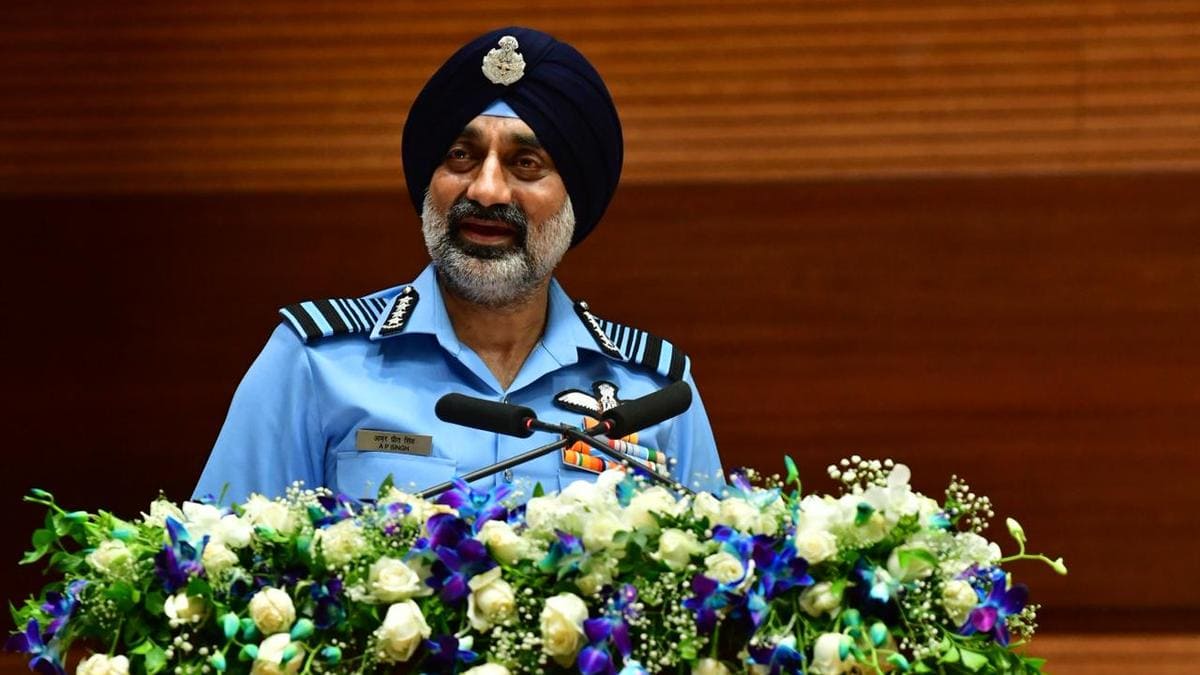
In the customary annual press interaction ahead of 93rd Air Force Day, Air Chief Marshal AP Singh dwelt at length on the very successful “Operation Sindoor”, and the capability-building plans of Indian Air Force (IAF). After retirement of the MiG-21 fleet, the IAF is down to 28 squadrons. The first LCA Mk1A has still to be handed over to IAF. At best, IAF will get 12 aircraft in this financial year to let it form a truncated squadron. The Chief of Air Staff (CAS) mentioned that he considers the entire LCA programme as a continuum. LCA Mk1 had been inducted with limited capabilities. The Mk1A will bring better radar, more weapons, EW suite, and also ease of maintenance, among others. IAF has already acquired 40 LCA Mk1 and committed to 180 Mk1A. The Mk2 will be a bigger aircraft with many more capabilities. The CAS hinted that if Mk2 were to be ready early, then some of Mk1A orders could be diverted to Mk2.
Meanwhile, the IAF has moved a strong case for acquiring 114 Made-in-India Rafale aircraft. With the naval order, it will be 140 aircraft and the overall fleet strength going up to 176. Even when LCA Mk2 is ready to induct, it will have lower capabilities than the current F3R standard Rafale. The French Air and Space Force (FASF) is already inducting F4 standard and working on F5 standard.
India’s Advanced Medium Combat Aircraft (AMCA) programme is most important in that context. For India to sit on the global defence aerospace production high table, AMCA must succeed. Su-30 MKI needs an upgrade. And buying a few squadrons of the Russian Su-57 ‘Felon’ as an interim fifth-generation aircraft is being suggested.
Rafale Proposal
India’s Ministry of Defence (MoD) has received a proposal from IAF for acquiring 114 “Made in India” Rafale fighter jets, which would be built by the French firm Dassault Aviation jointly with Indian aerospace firms. The proposal, expected to be worth over Rs 2 lakh crore ($22 billion), including indigenous content of more than 60 percent, will be taken up for discussion by the Defence Procurement Board, headed by the Defence Secretary. If given a go-ahead, it would be the biggest-ever defence deal for India. Choosing Rafale maintains continuity and prevents adding an additional fleet that could be a logistic nightmare.
IAF has already inducted 36 Rafale, and the Indian Navy has ordered 26, both under government-to-government (G2G) deals. Rafale is a 4.5-generation aircraft that performed very well against Pakistan in “Op Sindoor”, where it managed to comprehensively beat the Chinese PL-15 air-to-air missiles using its SPECTRA electronic warfare suite. The Made-in-India aircraft will have a complement of longer-range air-to-air and air-to-ground stand-off weapons and missiles beyond the existing SCALP, which was used extensively to hit both military and terrorist targets inside Pakistan.
Dassault has already tied up with India’s Tata Group to make Rafale fuselage in India at the rate of 25 a year. Rafale fuselage will be produced in India for both domestic and global markets. This marks the first time in history that Rafale fuselages will be manufactured outside France. The indigenous content in the Made-in-India Rafale fighter jets will keep going up in stages. Dassault has already set up a Maintenance, Repair and Overhaul (MRO) facility in India. The M88 engines will be overhauled in Hyderabad.
The urgency to get back to the authorised 42.5 squadrons has been reinforced by the regional threat perception and collusive Sino-Pak anti-India engagement. India is also the only operator of Jaguar strike aircraft, and they will be next to go. The upgraded Mirage-2000 and MiG-29 will serve for around 10–15 years more. Finally, the IAF inventory should primarily comprise the Su-30 MKI, Rafale, and indigenous LCA and AMCA fighters.
The 4.5 Generation Rafale Aircraft
The twin-engine delta-wing fighter aircraft is an omni-role fighter with frontal stealth capabilities. It can simultaneously undertake air supremacy, interdiction, reconnaissance, and airborne nuclear deterrent missions. Rafale has been used in combat over Afghanistan, Libya, Mali, Iraq, Syria, and in recent Op Sindoor. The aircraft uses digital fly-by-wire controls and has a very high level of agility. The aircraft’s canards improve aerodynamic performance. The Rafale’s glass cockpit was designed around the principle of data fusion that prioritises information display to pilots.
The Rafale also features an advanced avionics suite. The passive front-sector electro-optical system can operate both in visible and infrared wavelengths. It has an integrated electronic survival system “SPECTRA”, which protects the aircraft against airborne and ground threats. The system incorporates radar warning receiver, laser warning, Missile Approach Warning (MAW) for threat detection, plus a phased-array radar jammer and a decoy dispenser for threat countering. AREOS all-weather, night-and-day-capable reconnaissance system used on the Rafale has the ability to transmit information such as images in real time to ground stations. The RBE2 AA AESA radar has a range of 200 km.
The 36 aircraft, €7.87 billion (Rs 58,891 crore), Government-to-Government (G2G) Rafale deal included 28 single-seat and eight twin-seat aircraft. The deal included tailor-made IAF-specific enhancements, including integration of an Israeli helmet-mounted display (HMD), radar warning receivers, and low-band jammers. It included a weapons package and a performance-based logistics agreement.
The aircraft’s 14 hardpoints can carry 9,500 kg external load. The air-to-air missiles include Matra Magic II, MBDA MICA IR/EM, and MBDA Meteor. Meteor is an active radar-guided BVRAAM that offers multi-shot capability against long-range manoeuvring jets, UAVs, and cruise missiles in a heavy electronic countermeasures (ECM) environment, with a range of around 180 kilometres. The no-escape zone of over 60 km is the largest among air-to-air missiles, according to the manufacturer.
India also procured SCALP air-to-ground cruise missiles. Subsequently, the HAMMER (Highly Agile Modular Munition – Extended Range) glide bomb was bought. The Indian Rafale is a modified version of the F3R standard. The two squadrons are located at two different airbases. Both these airbases have infrastructure and capacity for an additional squadron each. The French have already tested the F4 variant with upgraded radar, improved HMDS, and OSF (long-range optoelectronics system), which will add IRST for detecting and identifying airborne stealth targets at long range. It will be more effective in network-centric warfare, with more data exchange and satellite communication capacity.
The F5 variant is also evolving and expected by 2030. Key features include loyal wingman capability, more powerful engines, improved stealth through conformal fuel tanks, advanced sensors, and enhanced electronic warfare (EW) capabilities. The F5 will also carry new weapons, including Smart Cruiser missiles for Suppression of Enemy Air Defences (SEAD), and will be equipped to control drone swarms.
LCA Mk1A
The LCA Mk1A will have an Active Electronically Scanned Array (AESA) radar for enhanced target detection and tracking, and capability to operate in a high ECM environment. The aircraft is equipped with advanced electronic warfare systems, including self-protection jammers and improved digital warning receivers, to increase its survivability. It can carry a wider range of weapons, including indigenous Astra beyond-visual-range (BVR) missiles, various precision-guided munitions, and smart bombs. The Mk1A design emphasises improved maintainability through modular components and better access for ground crews, reducing turnaround times. The Mk1A aircraft currently boasts 64 percent indigenous content.
In September 2025, 97 more LCA Mk1A jets were ordered, with deliveries expected to start in 2027–28, with the aim of completing all 180 aircraft by FY 2032–33. Clearly, the programme needs to be fast-tracked, with nearly 24 aircraft production a year to meet the backlog.
LCA Mk2
The LCA Mk2 is a more powerful 4.5-generation fighter aircraft to enhance IAF’s capabilities. Key upgrades include a larger airframe, a more powerful GE-414 engine, a 6.5-tonne payload capacity with 11 weapon stations, for a variety of air-to-air, air-to-surface, and precision-guided weapons. It features upgraded avionics, including the indigenous Uttam AESA radar, an infrared search and track (IRST) sensor, and advanced electronic warfare systems with improved self-defence features. The cockpit will have an evolved design with fewer switches, large touch displays, and ergonomic HOTAS (Hands-On Throttle and Stick) controls. Survivability will be enhanced by increased use of composite materials, better stealth-compatible shaping, and improved signature reduction.
The LCA Mk2 is currently in an advanced stage of development between ADA and HAL, with the airframe assembly underway. The rollout of the first aircraft is anticipated by early 2026. The first flight is expected by mid-2026. The LCA Mk2 would enter service around 2028–29.
AMCA
The AMCA is a single-seat, twin-engine, all-weather fifth-generation stealth multirole combat aircraft being developed for the IAF and Indian Navy. The aircraft is being designed by ADA. The intended missions include air supremacy, ground strike, SEAD, and electronic warfare. It will supplant the Sukhoi Su-30MKI air superiority fighter, which forms the backbone of the IAF fighter fleet. The AMCA design is optimised for low radar cross section and supercruise capability.
The design work was completed in 2023, and approval for the ₹15,000 crore (US$1.8 billion) project for prototype development was received from the CCS in March 2024. As of mid-2025, the prototype development phase is underway after completion of the feasibility study, preliminary design stage, and detailed design phase. At Aero India 2025, a full-scale engineering model of the AMCA was publicly demonstrated for the first time. The DRDO expects to roll out the first prototype of the 25-ton AMCA by early 2027. The first flight is expected in late 2028. A total of five prototypes are to be built. The first three prototypes will carry out developmental flight trials, whereas the next two will focus on weapon trials. The prototypes will be rolled out at intervals of 8–9 months. Each prototype will cost ₹1,000 crore (US$120 million). Certification is targeted by 2032 and induction in 2034. The CCS mentioned that any cost overruns during development should be reported directly to the CCS instead of the Ministry of Defence.
The government shifted to an “industry partnership model” instead of the initial plans for an SPV. These changes were made to avoid further delays following setbacks from development funding and lack of clearance from the US government for licence production of engines. The private-sector partner would be responsible for development, production, and lifetime maintenance of the jet. In March 2025, the Ministry of Defence formed a top-level committee, chaired by the Defence Secretary, to evaluate a “clear-cut strategy and production-cum-business model” to accelerate the development of AMCA.
On 27 May 2025, the Defence Ministry cleared the “AMCA Programme Execution Model”, under which ADA later released an Expression of Interest (EoI) to develop AMCA through industry partnership. Here, private or public sector companies can bid either as independent entities, as consortia, or in joint ventures for the contract. One of the criteria is the revenue-to-order book ratio, which ensures that a large share of aeronautical projects is not taken up by any single entity, to prevent monopolisation, including by HAL.
On 24 September, Larsen & Toubro (L&T) and Bharat Electronics Limited (BEL) entered into a strategic partnership, and the consortium is expected to submit its response to ADA’s EoI notice. The consortium is expected to combine L&T’s expertise in developing strategic defence and aerospace platforms and BEL’s experience in defence electronics and systems. On 26 September, Bharat Forge Limited (Kalyani Group), Data Patterns (India) Limited, and BEML Limited signed a tripartite Memorandum of Understanding (MoU) to participate in the AMCA programme. The companies will have individual stakes of 50 percent, 20 percent, and 30 percent, respectively, in the consortium. Another MoU was signed by Goodluck India Limited, BrahMos Aerospace Thiruvananthapuram Limited (BATL), and Axiscades Technologies to submit their bid for the AMCA programme. Tata Advanced Systems has independently bid for the programme. The participation of Adani Defence & Aerospace has been confirmed by its CEO, Ashish Rajvanshi. HAL has released a tender outlining its requirement to select a private-sector firm to participate in the AMCA programme jointly under a public-private partnership (PPP) model. HAL is expected to respond to the EoI with one or two partners shortly. Mahindra Group and the Adani Group are potential partners for HAL in the project.
Make-with-India Safran Aero-Engine
French aerospace company Safran and India’s DRDO have joined hands to develop India’s first jet engine with Indian intellectual property rights (IPR). Safran will transfer 100 percent technology to DRDO, including that for single-crystal blades. The joint project between Safran and Gas Turbine Research Establishment (GTRE), a DRDO lab, will develop and produce a 120 kiloNewton (kN) engine to power India’s twin-engine AMCA fighter.
It is reported that Safran–GTRE will develop nine prototype engines within a timeframe of 12 years. The initial engines will be of 120 kN thrust and later scale up to 140 kN by the end of the period. Single-crystal blades use superalloys and are efficient, long-lasting, and capable of coping with higher heat and rotational stress. This critical defence technology will have spin-offs for larger airliner and cargo aircraft engines. On 22 August 2025, Indian Defence Minister Rajnath Singh announced and confirmed that the engine for AMCA will be co-developed with Safran over a period of 10 years.
Only USA, Russia, UK, and France are capable of designing, developing, and producing aircraft engines. For long, China has used Russian or reverse-engineered engines to power its military aircraft. India’s GTRE attempted to develop the indigenous Kaveri engine, but the project did not complete. India is powering its LCA Mk1 variants with GE F404 engines. The LCA Mk2 will have made-in-India GE F414 engines. Finally, India must reduce foreign dependency.
Interim Su-57
Russia’s Sukhoi Su-57 ‘Felon’ evolved from the Indo-Russia Fifth Generation Fighter Aircraft (FGFA) programme, the contract for which was signed in October 2007. The FGFA itself had evolved from Russia’s PAK FA. By 2014, however, the IAF began voicing concerns over performance, cost, and work share. India found that the aircraft did not meet its requirements and eventually left the partnership in 2018. Sukhoi continued to develop and promote the Su-57 for export customers. The export variant, designated Su-57E, was officially unveiled at MAKS-2019 on 28 August 2019. The Su-57 has been showcased at many airshows, including in China and India.
The first Su-57 operational unit was formed in Russia in 2021. It is intended to be a multirole aircraft with significant air-to-air and ground-attack capability. Russia has claimed that the Su-57 saw combat in Ukraine. Around 42 Su-57s have been produced to date. Russia has already ordered nearly 30 more. The Su-57’s unit cost is generally estimated to be between $35 million and $50 million. However, some estimates, particularly those factoring in potential Made-in-India production, suggest a cost closer to $60–75 million. Clearly, it is much cheaper and the only one available.
Russia has offered to set up production in India and transfer technology. Also on offer is the Sukhoi S-70 Okhotnik-B stealth drone, which forms Manned–Unmanned Teaming (MUM-T) with the Su-57, and the long-range R-37M air-to-air missile.
The single-engine Sukhoi Su-75 “Checkmate”, also designated as the Light Tactical Aircraft (LTA), is a stealth fighter aircraft under development, with planned induction around 2027.
China plans to increase its J-20 production to 100 a year and targets to have 1,000 by 2030, when AMCA will be making its first flight. It will have 1,500 by 2035, when India will optimistically induct the AMCA. Pakistan is already talking to China to induct the J-35A in the next 3–4 years. Also, around 200 Pakistani technicians and engineers are working with TAI on the Turkish fifth-generation aircraft. A country with a failing economy seems to have a fifth-generation aircraft earlier than a country that is already the fourth-largest economy.
But there are issues that require surmounting. Su-57 production is still slow, though increasing. Russia is still fighting a long war, and its industry is geared more towards that. Because of Western sanctions, there are issues related to payment. The balance of payments had become more adverse due to India’s higher oil imports. The same is easing a little as global oil prices have dropped considerably. Lastly, IAF already has 60 percent of its fleet of Russian origin and therefore cannot continue to increase that basket.
Way Ahead India
The IAF fighter fleet is most affected by numbers and technology backlog. The global defence budget average is nearly 2.5 percent of GDP. For FY25 (Budget Estimates), the defence allocation was around 1.9 percent of GDP, the same as the previous year. India is the most threatened large nation. India must increase its defence expenditure share in GDP to 2.5 percent at the earliest.
Despite the highest-level push, “Atmanirbharta” (self-reliance) in defence is moving slowly and requires a more aggressive push. The country needs special technology missions for aero-engines, electronic warfare, hypersonic, cyber warfare, Artificial Intelligence, robotics, and skill development and retention. A lot more needs to be done in the number of IST and targeting satellites, and satellite navigation.
The IAF Chief has spelt out the urgency for fighter aircraft numbers repeatedly and candidly. Defence R&D has to catch up. Defence production must gradually be released from bureaucratic control. HAL must be supported to quickly scale up LCA production to 24 a year. Greater discussion is required on the Su-57 based on technology levels, production capacities, realistic timelines, and the size of the Russian basket.
Decision-making has to be quicker. IAF’s requirement of 126 MMRCA was spelt out in 2001. It is time for the government to take an early decision on 114 additional Make-in-India Rafale. The AMCA private consortium must be finalised before the end of the year. Su-30 MKI upgrades need to be pushed. There is also a need to push Astra Mk-III and BrahMos-II. Acquiring additional S-400 systems and accelerating indigenous “Kusha” air defence systems are crucial.
Note: The article was originally written by the Author for The Eurasian Times on, October 11th, 2025, it has since been updated.
Header Picture Credit: The Hindu
Twitter: @AirPowerAsia
 Air Power Asia