
Embraer, a global aerospace leader, began a bold new chapter in the world’s fastest growing aviation market India, as it inaugurated its brand-new India office at the prestigious WorldMark 4 building in Aerocity, New Delhi. This visionary move proposes to participate in India’s aerospace and defence sector by partnering with Indian industry. The ceremony saw participation of Brazil’s Vice President Geraldo Alckmin, Brazil’s Minister of Defence Jose Mucio, India’s Minister of Civil Aviation Shri KR Naidu, and the Ambassador of Brazil to India, Kenneth Nobrega. Embraer has come with a shared commitment in innovation and collaboration. At the heart of this milestone lies a profound deepening of Indo-Brazilian relations.
Embraer’s grand mission for this wholly owned Indian subsidiary is to have a strategic presence in one of the world’s most vibrant and promising aerospace markets. Embraer wants to deepen its engagement across all its major verticals, commercial aviation, defence, business jets, services and support, and urban air mobility (UAM). Embraer is conscious of India’s core driving policies of Atmanirbhar Bharat (self-reliant India) and the Make-in-India initiative, and has aligned its presence with these national goals. The company is clear about strengthening local partnerships, building indigenous capabilities, and cultivating a strong ecosystem of supply chain and engineering brilliance. Embraer wants to blend Brazilian innovation with Indian ingenuity.
India Brazil Relations
India and Brazil share a Strategic Partnership since 2006, characterized by strong bilateral ties and cooperation in international forums like BRICS, G-20, and the UN. Their relationship is built on shared democratic values, economic complementarity, and a vision for a more equitable global order. Key areas of collaboration include trade, defence, space, energy, and agriculture. The total bilateral trade volume reached $12.2 billion in the fiscal year 2024–25.
India’s main exports include pharmaceuticals and engineering products, while Brazil exports crude oil and agricultural products like soybean oil. Indian investments in Brazil are estimated to exceed $6 billion, and Brazilian investments in India are around $1 billion. The two countries hold regular Strategic Dialogues to discuss global and regional issues. An agreement for cooperation in cyber security was signed in 2020. Both countries are working to increase cooperation in the defence industry.
Embraer
Embraer S.A. is a Brazilian multinational aerospace corporation founded in 1969 by the Brazilian government as a national champion for domestic aerospace technology. The company was privatized in 1994 and began expanding to the production of larger regional airliners and smaller business jets. In 2000, Embraer became public as a limited company with its own shares publicly traded in both the United States (NYSE) and Brazil (B3). Headquartered in São Paulo, it has offices and operations in China, the Netherlands, Portugal, Singapore, the United States, and now India.
It develops and manufactures aircraft and aviation systems, and provides leasing, equipment, and technical support services. Embraer is the third largest producer of civil aircraft worldwide after Boeing and Airbus. Embraer is a leader in the executive jet market, with its Phenom series being the world’s best-selling light jet. The company also has a significant presence in military aviation, ranking among the top 100 defence contractors. In one aerospace ranking based on market capitalization, Embraer is placed 29.
While the company continues producing aircraft for the defence sector (C-390, EMB 312 Tucano, EMB 314 Super Tucano, AMX, R-99), it is best known for the ERJ and E-Jet families of narrow-body short- to medium-range airliners, and for its line of business jets. As of May 2024, Embraer has delivered more than 8,000 aircraft, including 1,800 E-Jet planes.
Indo-Brazil Aviation Relationship
Embraer’s journey in India is now nearly two decades old. In 2005, Embraer’s E-Jets first took to Indian skies. Since then, nearly 50 Embraer aircraft of 11 different types are operating in diverse roles across military, governmental, business, and commercial sectors. The Indian Air Force (IAF) and Border Security Force (BSF) have long relied on Embraer’s aircraft for critical missions.
The IAF operates a total of 11 Embraer aircraft, consisting of four Embraer ERJ-135BJ Legacy 600 VIP jets, three ERJ-145 as the ‘Netra’ Airborne Early Warning and Control (AEW&C) aircraft (there is a proposal for six more), and four 20-seater Embraer 145 aircraft used by the Air HQ Communication Squadron for unspecified roles. Embraer ERJ 135 jets, originally acquired in 2005, have a range of 7,500 km and a capacity for 14 passengers. The Border Security Force (BSF) has one Embraer-135 jet in its fleet, used for the Ministry of Home Affairs. In August 2025, the IAF contracted a Gurugram-based aviation firm to upgrade its 20-year-old, 14-seater Embraer 135BJ fleet. The planned works will include a full repaint of the aircraft, along with a comprehensive overhaul and refurbishment of both the cockpit and passenger cabin.
C-390 Millennium
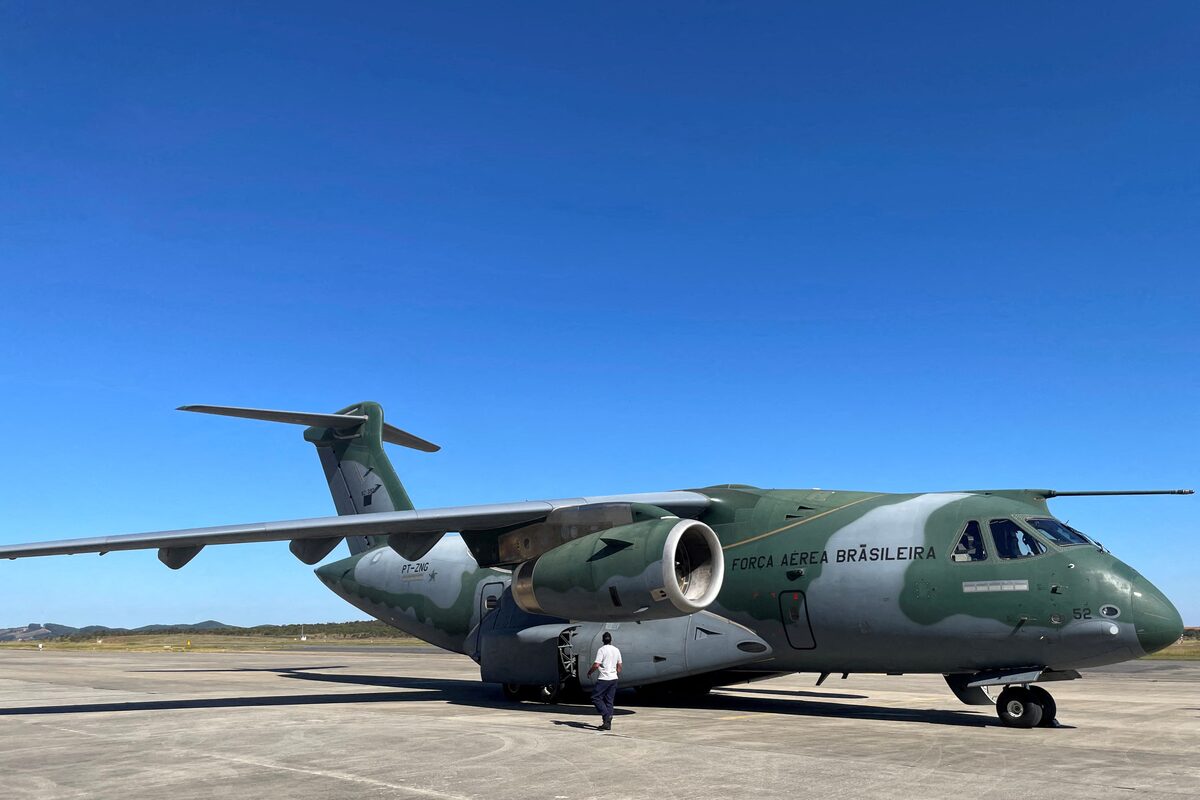
The Embraer C-390 Millennium is a medium-size, twin-engine, jet-powered military transport aircraft — the heaviest aircraft that Embraer has ever made. The project began in the mid-2000s. In April 2009, the Brazilian Government issued a $1.5 billion contract for two prototypes. Partnerships were promptly formed with various other aerospace companies on the programme, including FAdeA, ENAER, and OGMA. Major subcontractors include Aero Vodochody, BAE Systems, and Rockwell Collins.
The first of two prototypes performed its maiden flight on 3 February 2015. On 4 September 2019, the first production aircraft was delivered to the Brazilian Air Force. Its modular architecture allows rapid reconfiguration for missions like cargo and troop transport, medical evacuation, firefighting, search and rescue, humanitarian assistance, and the aircraft can also be configured for air-to-air refuelling, both as a tanker and as a receiver. It can carry payloads of up to 26 tons, such as two fully tracked M113 armored personnel carriers, one Boxer armoured vehicle, a Sikorsky H-60 helicopter, up to 80 soldiers or 66 paratroopers with full gear, and loads of up to 19 tons can be air dropped. In the first quarter of 2023, the Brazilian Air Force fleet of C-390 had accumulated more than 8,000 flight hours, having participated in aviation fairs and missions on all continents including Antarctica. Each aircraft costs around €80 million as of 2024.
C-390 is the standard model for transport, SAR, and aerial firefighting. KC-390 is the aerial refuelling variant. C-390 IVR is the anti-submarine and maritime patrol variant. Current operators: Brazil has ordered 22 aircraft (8 in service), Portugal six, and Hungary two. It has also been selected by Portugal, Hungary, the Netherlands, Austria, South Korea, Czech Republic, Sweden, Slovakia, Lithuania, and Uzbekistan. The C-390 has achieved a 93% mission capability rate and over 99% mission completion rate. This aircraft has superseded expectations and has already clocked more than 20,000 flight hours in just six years since entry into service.
IAF’s MTA Program
The IAF’s Medium Transport Aircraft (MTA) program is a long-delayed, multi-billion-dollar initiative to acquire new transport aircraft to replace its aging fleet of Antonov An-32 and Ilyushin Il-76 jets. The program will procure between 60 and 80 aircraft in the 18–30-tonne payload class, with a strong emphasis on technology transfer and domestic manufacturing under the ‘Make in India’ initiative. Key contenders include the Embraer C-390 Millennium, Lockheed Martin C-130J Super Hercules, and Airbus A400M Atlas.
Earlier, the India–Russia MTA program, a joint venture to co-develop the Il-214 aircraft, was a long-stalled project that was eventually cancelled by India around 2016 due to disagreements. While India and Russia have renewed interest in defence cooperation on a similar aircraft — now designated the Il-276 — the original project was formally terminated due to issues like design coordination and engine selection disagreements between HAL and UAC.
The proposed new fleet will fill a critical payload gap, improving the IAF’s ability to rapidly deploy troops and equipment, especially in high-altitude areas. A key goal is to build a domestic aerospace manufacturing ecosystem by encouraging technology transfer and local production through strategic partnerships with international companies. The new aircraft will also enhance the IAF’s capabilities for humanitarian assistance and disaster relief missions. Recent reports indicate the aircraft must be capable of carrying the Indian-developed Zorawar light tank, which weighs 25 tons.
Embraer C-390 Millennium is a strong contender due to its payload capacity and willingness to partner for local production. Airbus A400M Atlas is the most capable aircraft in terms of payload but is also considered the most expensive. While the IAF already operates the C-130J Super Hercules, its payload capacity precludes carrying the Zorawar light tank.
Make in India C-390 as Potential IAF MTA
Embraer has its sights on the next great opportunity, the C-390 Millennium. This multi-mission military aircraft offers operational flexibility, coupled with efficiency and advanced technology, and is a strong contender for the IAF’s MTA program. Designed for versatility, it can carry 26 tons of payload, fly faster (470 knots) and farther than other aircraft in its class, and is fully capable and certified for operations from unpaved or temporary runways — making it ideal for India’s diverse terrain, from the high-altitude Himalayan airfields to coastal and desert regions.
An MoU between Embraer Defence & Security and Mahindra Group was signed in February 2024 with the intention of working together to offer C-390 aircraft to the IAF. The businesses will investigate the possibility of making India a future C-390 regional hub. In collaboration with the Mahindra Group, Embraer suggested setting up an assembly line in September 2024. On 17 October 2025, Embraer Defence & Security and Mahindra Group signed a strategic cooperation agreement to advance the C-390 Millennium aircraft for the IAF’s MTA programme. Simultaneously, Embraer inaugurated its New Delhi national office to explore opportunities for local production, assembly, joint marketing, and MRO facilities, engaging with the Indian aerospace ecosystem.
Foreign Content in C-390
Major foreign partners contributing to the C-390’s systems include International Aero Engines (IAE) for the V2500-E5 turbofan engines, BAE Systems (UK) for the fly-by-wire primary flight control system, Aero Vodochody (Czech Republic) for the rear fuselage, OGMA (Portugal) for fuselage, rudder, and landing gear components, Fábrica Argentina de Aviones (FAdeA) for the tail cone and cargo-door structures, and Rockwell Collins (USA) for avionics, cargo handling, and the aerial delivery system.
The C-390 has a widespread European supply chain, with the EU making up 42% of its parts. Embraer has stated its intent to market the KC-390 tanker variant in the United States. For any potential American deal, the company asserts that it could source up to 70% of the aircraft’s content locally to comply with the Buy American Act. A similar arrangement would have to be worked out with India.
Other Embraer India Initiatives
Embraer’s vision aligns seamlessly with India’s regional aviation needs. Its E-Jets family, known for fuel efficiency and passenger comfort, is poised to enhance connectivity between tier-two and tier-three cities and support the Indian government’s UDAN scheme, which aims to make air travel accessible and affordable. Regional airline Star Air exemplifies this partnership. With an all-Embraer fleet comprising nine aircraft — four E175s and five E145s — Star Air plans to expand to 25 Embraer jets by 2027, significantly enhancing India’s regional connectivity infrastructure.
Beyond deploying aircraft, Embraer is actively integrating with India’s industrial ecosystem. By enhancing its supply chain base within the country, the company aims to contribute to the ‘Make in India’ initiative. This strategy reflects Embraer’s long-term commitment to supporting India’s aerospace ambitions and fostering local technological and manufacturing capabilities.
Embraer’s investments in Urban Air Mobility (UAM) showcase its commitment to shaping the skies of the future. Eve, Embraer’s UAM company, is entering the Indian market through strategic partnerships aimed at revolutionizing urban transportation. With India’s cities becoming increasingly congested, the introduction of electric vertical take-off and landing (eVTOL) solutions could redefine personal mobility, offering sustainable and futuristic commuting options.
To Summarise
At Aero India 2025, the C-390 Millennium drew strong interest from the defence community, reflecting the growing demand for multi-role platforms that enhance operational flexibility and readiness while offering great value for money. August 2025 marked Embraer’s 56th anniversary, a journey defined by engineering excellence, innovation, and resilience. Over the past two decades, Embraer has designed and brought into service more than 20 different aircraft types across defence, commercial, and business aviation. The company continues on a strong trajectory, highlighted by a record-high backlog of $31.3 billion by Q3 — a 38% increase from the previous year. The company expects to deliver 77–85 commercial jets and 145–155 executive jets for the full year.
Embraer’s focus is on sustainability and innovation. Its next-generation aircraft promise reduced emissions, aligning with global efforts to combat climate change while addressing India’s growing air travel demand. From the skies to the factory floor, Embraer’s engagement with India spans defence, commercial aviation, and industrial collaboration. With regional jets transforming connectivity and defence platforms enhancing national security, Embraer stands as India’s aircraft manufacturer of choice — weaving itself into the fabric of India’s aerospace future.
Brazil is a Global South leader like India. The two work closely together in BRICS. The C-390 is tried and tested. Embraer will be happy to transfer technology and produce in India, though finer points will emerge during formal negotiations. Unlike others, Brazil is less likely to arm-twist India and will be a more trusted partner. Embraer has partnered with India’s Mahindra Group. Their proposal includes local assembly and technology transfer. The C-390 is thus likely to be the lead contender.
Note: The article was originally written by the Author for The Eurasian Times on, October 26th, 2025, it has since been updated.
Header Picture Credit: Reuters
Twitter: @AirPowerAsia
 Air Power Asia