
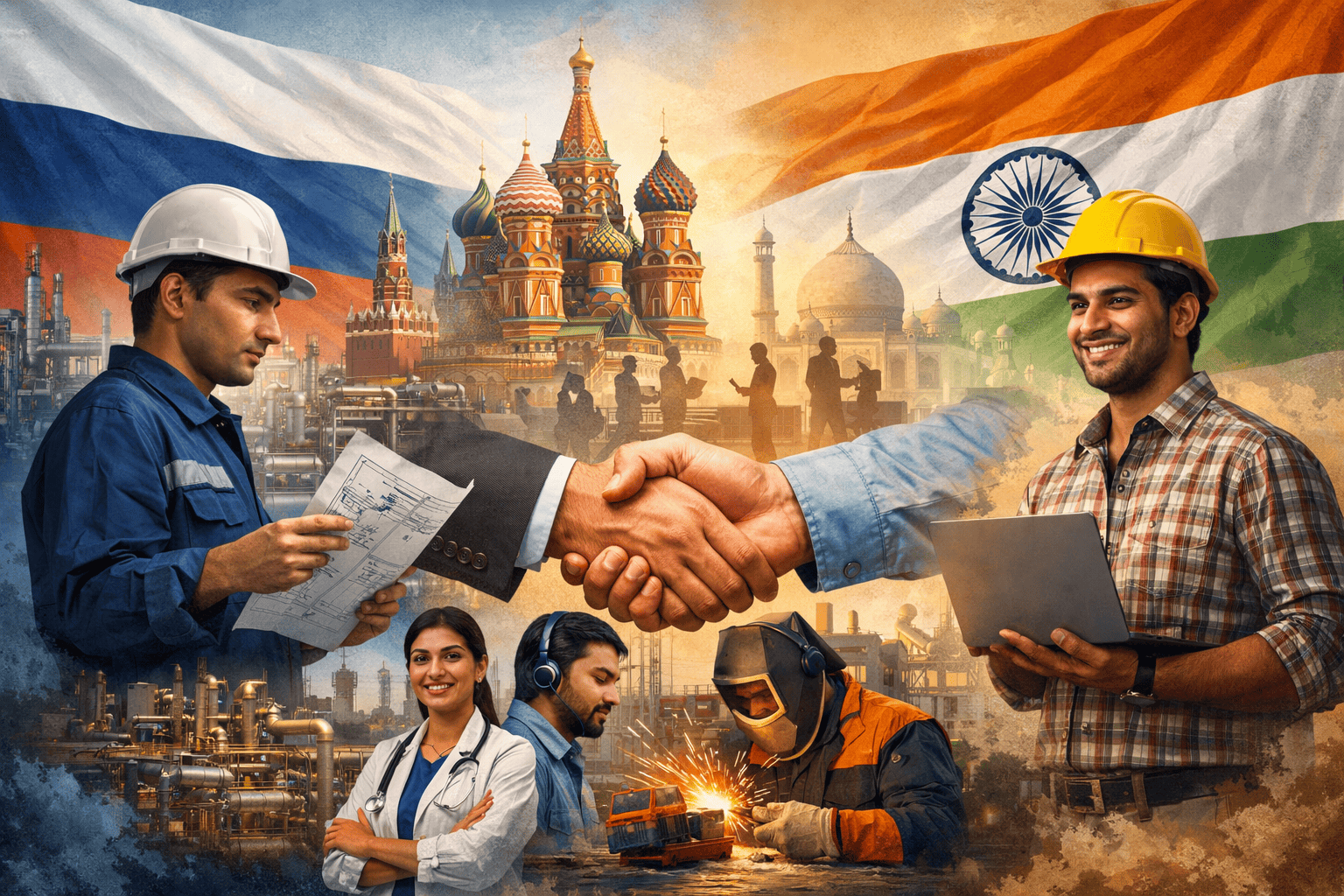
Since the war with Ukraine, Russia is grappling with a major labour shortage in its industrial hubs and plans to bring in up to one million foreign workers, including Indians. The shortfall could widen to 3.1 million workers by 2030, says Russian Labour Ministry. To address the gap, the ministry wants to increase the quota for qualified foreign workers in 2025 by 1.5 times. Russian companies in the machinery and electronics sectors are interested in hiring skilled Indian professionals to address the labour shortage. India’s Ambassador to Russia, Vinay Kumar, told Russian state news agency TASS that the demand for Indian workers was expanding beyond traditional sectors.
“At a broader level, there is manpower requirement in Russia, and India has a skilled manpower. So at present, within the framework of Russian regulations, laws and quotas, the companies are hiring Indians,” Kumar said. He pointed out that many Indians working in Russia so far have been employed in construction and textiles, but interest in hiring them for machinery and electronics roles has been steadily rising.
“As far as I know, by the end of the year, 1 million specialists from India will come to Russia, including to the Sverdlovsk region. A new Consulate General is opening in Yekaterinburg, which will deal with these issues,” Andrey Besedin, head of the Ural Chamber of Commerce and Industry, has said. “Some Russian workers are deployed in the military operation in Ukraine, and many young Russians do not go to factories,” he added. The Sverdlovsk region, in the Ural Mountains is regarded as the backbone of Russian heavy industry and its military-industrial complex.
Demographics of Russia and India
The population of the Russian Soviet Federative Socialist Republic (RSFSR) in 1950 was around 102.8 million. Russia has an estimated population of 146.0 million as of January 2025, down from 147.2 million recorded in the 2021 census. The total area of Russia is 17.1 million sq. km. It has a population density of 8.5 inhabitants per square kilometre. Overall life expectancy is 73 years. The fertility rate is 1.41 children born per woman as of 2024, in line with the European average, which is below the replacement rate of 2.1. Russia has one among the oldest populations in the world, with a median age of 41.9 years. This natural decline of the Russian population can be classified as demographic crisis. According to the United Nations, Russia’s immigrant population is the world’s third largest, numbering over 11.6 million; most of whom are from other post-Soviet states. Russia needs labour to till land, they need skilled industrial workers, and middle level managers.
India is world’s most populous country with current population of 1.46 billion equivalent to 17.78 percent of the world. India is the 7th largest country with the total land area of 3.3 million sq. km, and the population density is 473 per sq. km. The median age in India is 28.8 years.
Indians in Russia
According to India’s Ministry of External Affairs, there are approximately 62,825 Indians in Russia. The growing community is composed primarily of students (pursuing medical and technical degrees), businessmen, and a surge of labourers filling labour shortages. The diaspora is found in major cities like Moscow and is involved in various sectors including trade, IT, and manufacturing. Many Indian businessmen operate trading companies, importing goods like tea, coffee, spices, pharmaceuticals, and garments from India.
Russia is seeing a sharp increase in Indian workers, with applications for employment visas rising dramatically and projections of over 40,000 Indian nationals arriving for work in 2025 to fill jobs in construction, textiles, agriculture, manufacturing, and warehousing. The Indian community in Russia, especially in Moscow, has faced difficulties in obtaining permission to build Hindu temples, and see limited infrastructure to support their cultural and religious practices.
Indians in West Asia
There is an over 9 million large Indian diaspora in West Asia, with people residing primarily in UAE (over 3.5 million) and Saudi Arabia (around 2.5 million). They work in both skilled and unskilled roles. Skilled professionals include nurses and technicians, while many others work in blue-collar jobs. India seeks to expand economic ties and cooperation in various sectors, including healthcare, pharmaceuticals, higher education, defence, space exploration, AI, and cybersecurity, to benefit both India and West Asian nations.
The diaspora also enhances India’s soft power and cultural engagement in the region, exemplified by huge Bollywood presence and the recent BAPS Hindu Temple in Abu Dhabi. This significant population contributes billions of dollars in remittances to India’s economy annually, boosting foreign exchange reserves and household incomes in India.
Indians in USA
There are over 5.2 million Indian Americans in the USA, making them the second-largest Asian ethnic group and representing 21 percent of the total Asian population. This demographic is characterized by high educational attainment and median household incomes (over $160,000) significantly above the national average.
About two-thirds are immigrants, though the number of US-born individuals is growing. The Indian American population has grown by over 174 percent since 2000. They demonstrate high English proficiency compared to other Asian communities. Indians hold significant positions in politics, academia, and the corporate world.
Indian heads of major global corporations include tech leaders like Sundar Pichai (Alphabet/Google), Satya Nadella (Microsoft), and Arvind Krishna (IBM), along with others such as Leena Nair (Chanel), Ajay Banga (World Bank President), Rajeev Suri (Nokia), and Shantanu Narayen (Adobe). Neal Mohan (CEO of YouTube), Raj Subramaniam (CEO of FedEx), among many others. Their success highlights a growing trend of Indian-origin leaders heading major global organizations, driven by strong educational backgrounds and professional expertise.
Yet, Trump-era new US visa rules affect Indian travellers due longer waiting period, and no overseas interviews. H-1B visa, a non-immigrant visa for temporary workers, remains a blow-hot-blow-cold issue.
Indians in UK, Canada & Australia
There are over 1.8 million people of Indian ethnicity in the UK, making them the largest ethnic minority group, with a history rooted in historical and colonial ties. Rishi Sunak served as the British Prime Minister.
As of the 2021 census, at 1.86 million, Indian Canadians are the largest non-European ethnic group in the country and form the fastest growing national origin in Canada. India has been the highest source country of immigration to Canada since 2017, with yearly permanent residents increasing from 30,915 in 2012 to 85,585 in 2019, representing 25 percent of total immigration to Canada. Additionally, India also became the top source country for international students in Canada. In the 2025 Canadian federal election, a record-setting 22 Canadians of Indian origin were elected to the Canadian House of Commons. Prominent figures of Indian descent have also served in powerful cabinet roles. Anita Anand is the Foreign Minister and Maninder Sidhu is the International Trade Minister in the current Mark Carney administration.
Indian Australians are one of the largest groups with 976,000 persons declaring Indian ancestry at the 2021 census, representing 3.8 percent of the Australian population. Indians are the youngest average age (34 years), the highest educated migrant group, and the fastest growing community both in terms of absolute numbers and percentages in Australia. India has been the largest source of new permanent annual migrants to Australia since 2016. Additionally 70,000 students were studying in Australian universities and colleges.
Japan Seeks To Hire Indians
In 2025, more than 29 percent of Japan’s population is over 65 years age. Japan is currently facing a shortfall of nearly 250,000 in IT, AI, data science, etc., annually, emphasising need for overseas hires to fill expertise gaps beyond the domestic supply. Japan’s workforce is plummeting with a projected loss of over 11 million workers by 2040. This labour crisis is putting GDP & domestic production at risk unless overseas talent fills critical vacancies. Japan has been actively seeking skilled Indian workers through programs like the Specified Skilled Worker (SSW) visa across 14 sectors, which supports professionals in sectors like IT, healthcare, manufacturing, construction, agriculture, and many more, with smoother immigration. These are much more accessible than the complex and often delayed visa processes of the US, UK, or Germany, especially for Indian professionals. Indian professionals bring more to a workplace at comparatively lower costs than workers from other nationalities. Japan offers perks similar to Western countries, but with a culture similar to India.
Japan offers stable jobs with well-defined career paths, bonuses, & loyalty rewards. This benefits Indian talents looking for long-term professional security. Japan also remains one of the safest, most respectful countries for Indians living and working abroad. Bilateral agreements and MoUs between Japan and India promote structured talent exchange, encourage hiring through certified channels, and support Indian workers through placement, training, and legal protection frameworks.
Israel Needs Indian Work Force
Israel needs Indian workers, primarily to fill the significant labour shortage in its construction sector following the October 2023 conflict, which led to Palestinian construction workers being barred from the country. Under a bilateral agreement, thousands of Indian construction workers and caregivers have been recruited, with potential for more to fill vital labour gaps in Israel’s rebuilding efforts. A formal agreement between India and Israel was signed in November 2023 to facilitate temporary employment of Indian workers. Recruitment drives have focused on skilled Indian construction workers, particularly in areas like frame work, iron bending, and tiling. Indian workers also fill positions in the caregiver sector. Nearly three-time higher wages in Israel provide strong incentive for Indian workers. Thousands of Indian workers have arrived in Israel under the bilateral framework agreement, with ongoing efforts to recruit many more. National Skill Development Corporation (NSDC) in India is involved in organizing recruitment drives, aligning Indian skilling programs with global demands. The government-to-government (G2G) recruitment process helps protect workers from exploitation by middlemen.
Way Ahead For India-Russia Human Capital Arrangements
India became the largest source of skilled migrants in the 21st century. A recent FICCI-KPMG study, “Global Mobility of Indian Workforce”, has estimated that by 2030, the demand for skilled workers will exceed supply, leading to a worldwide talent shortage of over 85.2 million people. Major shortages will be in major economies like Germany, Japan, South Korea, Australia, Canada, Russia, the UK, and the US. The rate at which this shortage is growing, around 12 percent per annum, is outpacing the economic growth of many of these countries. In 25 years, that shortfall could reach 250 million. That’s a staggering gap. While several African economies also have labour surpluses, they often lack the infrastructure or governance systems to benefit from them. India is uniquely placed to help fill this gap.
The global labour market does not seem to be future-ready. The skills needed in 2030 will be quite different from what we have today. This is a challenge for the entire world. India already contributes about 700,000 workers abroad each year, particularly in technology, healthcare, transportation, and hospitality. Indian talent is generally well-regarded globally.
Russia is a huge country with under exploited potential. It needs farm labour to exploit large arable land. It needs skilled workers for exploiting natural resources. Russia needs experts and work-force in defence sector where exports are slowing. Russia has a long way to catch up with global manufacturing levels.
The weak areas of the Russian economy include significant labour shortage, higher than normal inflation (8 percent), dependence on volatile commodity exports, and a decline in productivity caused by sanctions. Russia has faced structural challenges like unfavourable demographics and weak productivity growth for some years. The economy remains vulnerable due to its over-dependence on energy exports, even with diversification efforts towards Asian markets. Russia has also lost some export markets for its defence products. A significant and growing lack of workers is a major weakness, exacerbated by military conscription and low migration policies.
Indians make a good workforce. They are disciplined, punctual, don’t get into local politics, and do not engage in criminal activities. There is thus a strong case for importing Indian labour through institutional arrangements. Both Russian entrepreneur and Indian labour interests have to be safeguarded. There are existing arrangements between India and Japan, and some others, could be a model. This arrangement could also partly neutralise the balance of payment issues. Language will be a barrier. Indian labour is a quick learner, as has been seen in other countries. English speaking supervisors would assist. It will increase India-Russia bonding. The growing opportunity is waiting to be tapped. Get going India and Russia.
Note: The article was originally written by the Author Russia Today on November, 11th 2025, it has since been updated.
Header Picture Credit: Representative Image Generated using AI
Twitter: @AirPowerAsia
 Air Power Asia