The possible Turkey-Pakistan–Saudi Arabia alliance became a major geopolitical development after reports emerged that Ankara was in advanced talks to join the Strategic Mutual Defence Agreement (SMDA) signed by Saudi Arabia and Pakistan in September 2025. This pact treats any aggression against one member as an attack on all, mirroring NATO‘s Article 5. The trilateral bloc, if materialized, would combine Saudi Arabia’s massive financial resources, Pakistan’s nuclear arsenal & large military, and Turkey’s geopolitical dominance, being NATO’s second-largest military contributor. The potential “Islamic NATO” vision stems from Washington’s fluctuating policies, concerns over Iran, and overlapping interests in South Asia, the Middle East, and Africa. If finalized, the alliance could seriously challenge and even threaten countries like India, Israel, Armenia, and Cyprus, among others.
India’s Defence Acquisition Council has just approved an $8.7 billion procurement, including 1,000 SPICE missiles from Rafael Advanced Defense Systems. India is Israel’s biggest defence customer, accounting for 34 percent of all exports between 2020 and 2024. India-Israel aerospace relations are strong, and growing strategic partnership focused on co-development and co-production of advanced defence systems, particularly drones (UAVs), missile systems (like Barak-8/MRSAM), and radars, aligning with India’s “Make in India” or “Atmanirbhar Bharat” initiatives, making Israel a top defence supplier and fostering indigenous Indian capabilities through significant technology transfers.
Among the key areas of collaboration are joint development of the Barak-8 MRSAM (Medium Range Surface-to-Air Missile) for land and naval forces, which is a major success story. India uses Israeli drones (Heron, Searcher) and is upgrading them (Project Cheetah) with Israel Aerospace Industries (IAI), involving technology transfer for indigenous production. There is collaboration on sophisticated radars (Phalcon AWACS), EL/M-2052 AESA radar for LCA and some strategic electronics, including jammers.
IAI is partnering with Hindustan Aeronautics Limited (HAL) to convert civilian aircraft into mid-air refuelers (MMTT). IAI is a major partner, setting up an Indian subsidiary (ASI) and collaborating on many projects. Bharat Electronics Ltd (BEL) formed a JV with IAI for lifecycle support of MRSAM systems.
Israel’s strong support during conflicts (e.g., Kargil War) solidified ties. A Joint Working Groups (JWG) oversee and guide deepening cooperation, aiming for a ten-year roadmap. Spice 1000 was the chosen weapon for the Balakot strikes. Israel is helping India strengthen India’s defence capabilities against aerial threats. It has clearly positioned itself as trusted defence partner for India.
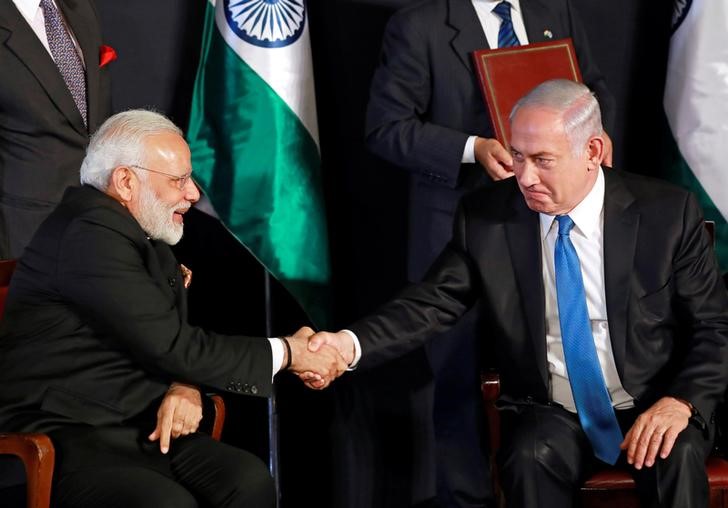
According to international surveys Israelis like Indians the most. There is a groundswell of pro-Israel opinion in India also as an all-weather friend. India established formal defence ties with Israel in 1996. Ever since, there has been no looking back. Substantial action took place in the first NDA regime, and more recently the body language between Prime Ministers Modi and Netanyahu has been extremely warm and with a desire to move forward. Israel and India are thus today poised to push further ahead. Israel is also conscious of India’s desire to become independent and push ‘Make India‘, and unlike USA and Russia who are sensitive to technology transfer, Israel is more willing to share up-end technology. While the Service HQs continue to look at immediate requirements such as additional UAVs, precision munitions, Phalcon radars for two additional AWACs, and support for India’s indigenous Ballistic Missile Defence, it is time to harness this friendship in India’s national interest.
Israel a Significant Aerospace Power
Continuous wars and heavy external threat forced Israel to have a big Military-Industrial Complex. A large number of companies in this otherwise small country that is the size of Haryana, and has a population (around 9.5-10 million) similar to Indian metropolitan Hyderabad, are into aerospace.
The Government controlled Israeli defence companies are IAI, and the Rafael Advanced Defense Systems, and private sector Elbit Systems and Taldrin Group, all producing a wide range of conventional arms and advanced defence electronics.
IAI produces aerial and astronautic systems for both military and civilian usage. It has 15,000 employees, achieved record sales of $6.1 billion in 2024, and is 31st among the world’s top 100 arms producers (HAL 44th). IAI designs, develops, produces and maintains civil aircraft, UAVs, fighter aircraft, missile, avionics, and space-based systems. Their main products include missile defence systems (Arrow, Barak, Iron Dome), UAVs/drones (Heron family), radar and electronic systems, satellites & space technology, special mission aircraft, and commercial aircraft services (conversions, components for business jets like Gulfstream). Many of these products are centred on the core needs of the Israel Defense Forces (IDF), but are also exported.
IAI UAVs that include the Heron, Panther, Bird Eye, Searcher, and Mosquito micro UAV among others were deployed in Afghanistan and also operated by India. Israel is also the only country in the world with a fully operational ground based Theatre Ballistic Missile Defence system that uses American Arrow anti-missile system. Israeli company Elta, a subsidiary of IAI, provides the Green Pine early-warning radar for the system. Elta also makes radars and airborne jammers for Indian aircraft. Tadiran (Elbit division) makes the Communication, Control, and Command centre.
Rafael Advanced Defense Systems and IAI work closely on many systems. Rafael develops and produces advanced solutions for air, land, sea, space, and cyber defence, including famous systems like air defence (Iron Dome, David’s Sling, Iron Beam Laser), active protection (Trophy), precision weapons (Spike family), and integrated command systems. Its systems are used by numerous militaries, including NATO members, and it operates through subsidiaries and global cooperation.
Iron Dome is an all-weather mobile air defence system with a range of 70 kilometres, and played a great role in Israel-Gaza conflict ‘Operation Protective Edge‘ of July 2014 and more recent “Operation Swords of Iron“. The system consists of Elta radar and Rafael’s interceptor missile, had a success rate of 90 percent against the Hamas fired rockets.
Rafael’s missiles include the Python and Derby air-to-air missiles; surface to air systems including the Spyder and the Barak anti-missile naval air defence system developed jointly with IAI. Rafael also manufactures the Litening and TopLite navigation and targeting pods, and the RecceLite real-time reconnaissance pod. Under a 2008 agreement, Rafael was awarded a contract to supply the IAF with Spyder Low-Level Quick Reaction Missile systems (LLQRM) armed with Python and Derby missiles. In March 2010, the two countries signed a huge $1.4 billion contract for the development and procurement of Barak 8 medium-range surface-to-air missiles. Rafael today partners extensively with Indian firms like Kalyani (KRAS), Astra Microwave (ARC), and L&T to localize production of high-tech defence systems, including Spike missiles, SDRs, and the Trophy APS.
Elbit Systems Ltd is the primary provider of the Israeli military’s land-based equipment and unmanned aerial vehicles with subsidiary factories around the world, and sells its products to various countries. It creates various technologies for military command, control, communications, intelligence surveillance, and reconnaissance purposes. The company produces unmanned aircraft systems (UAS), electro-optics hardware, electronic warfare, signal intelligence (SIGINT) systems, and radio and communications products. Elbit Hermes 450/900 are made in India through a joint-venture with Adani Group. Elbit Systems had 20,000 employees, with 3,200 of them based in the United States. Elbit Systems reported $6.8 billion in revenue for the full year 2024 (HAL $4 billion).
India’s Israel Connect
India’s establishment of diplomatic relations with Israel in 1992 greatly helped Israel to emerge as a global defence exporter of significance. Indian Air Force (IAF) was the first to invest in the Israeli Air Combat Instrumentation in 1996. This was followed by Dvora patrol boats for Indian Navy. Nationalist BJP led NDA government in 1998 took the relationship to a new level. Ever since India has purchased Barak Naval anti-missile defence system, Phalcon advanced airborne early warning radars for India’s IL-76 based AWACs, Heron and Searcher Unmanned Aerial Vehicles (UAVs), Night Vision Goggles, Spider quick-reaction surface-to-air missiles, smart munitions, Spice and Crystal Maze missiles, Green Pine early-warning and fire-control radars, and many other items like Laser guidance kits, Head-Up-Displays, targeting pods, PGM laser guidance kits, FLIR equipment, integrated helmets, among others. IAF also acquired the Israeli Harpy and loitering Harop killer Loitering Munitions. Israel supports India’s indigenous AD systems development including the Anti-Ballistic Missile system. Israel also supported India in space based sensors (RISAT), and intelligence.
Israeli Arms Sales
Israel is a major global arms exporter, ranking as the world’s eighth largest during the period of 2020–2024. In the period 2020–2024, states in Asia and Oceania accounted for 33% of all arms imports globally. India was the second largest importer in this period after Ukraine. Over the last decade (2014-2024), India significantly shifted its sourcing, reducing reliance on Russia (from 72% to 36%) towards Western suppliers like France, the US, and Israel. In the period 2020–2024 Israel contributed to nearly 15 percent of Indian defence imports. Israel has long been a global leader, often the top exporter, in military UAVs/drones due to early adoption, innovation, and necessity as a small nation with defence challenges, with major players like IAI and Elbit Systems dominating the market, though now facing rising competition from countries like Turkey.
Lessons from Israeli Dare-Devil Raids
Israel Air Force along with Commandos have carried out many famous air-raids such as the Entebbe counter-terrorist mission in Uganda (1976), and Operation Opera against Iraq’s Osirak nuclear reactor (1981). “Operation Many Ways” on September 8 in 2024 is when in 3 hours 120 elite Israeli forces raided and destroyed alleged underground Iran-funded “Deep Layer” missile manufacturing facility in Syria.
Israeli airstrike on Iran’s consulate in Syria in April 2024 killed 2 generals and 5 other officers. Hamas Chief Haniyeh and his bodyguard were killed when an “airborne guided projectile” hit a special residence for military veterans, in which he was staying, in northern Tehran in July 2024. There is an unending list of operations. Each operation was carried out after obtaining actionable hard intelligence. Success rates were very high. All successful operations involved great amount of preparations including mission rehearsals and dummy strikes on full-scale models and realistic targets. The world has a lot to learn from the planning and execution. So does India.
IAF’s Balakot airstrike against a Jaish-e-Mohammed (JeM) terrorist training camp at Jaba Top near Balakot, Pakistan of February 2019, and Op Sindoor had semblance of the way Israel hits its adversaries.
I2U2
I2U2 is a strategic economic partnership between India, Israel, the United Arab Emirates (UAE), and the United States, once called the “New Quad” or “Middle East Quad“. Established in 2022, it focuses on joint investments in areas like water, energy, transportation, space, health, and food security, leveraging the members’ technological strengths (Israel/US tech, India’s IT/human capital, UAE’s investment) to promote economic development, innovation, and regional stability. During “Trump-2” Administration, I2U2 has slowed down a little as America is trying to revive its economy through balancing its trade using heavy tariffs.
India and Israel have a bilateral framework agreement (Nov 2023) for Indian workers, mainly in construction, offering fair pay, lodging, medical, and social security, ensuring equal rights with Israelis under structured contracts. This government-facilitated system places Indian workers in Israel, often filling gaps left by Palestinians, providing better wages than some GCC countries, with vetting by India’s National Skill Development Corporation (NSDC). Workers enter via government channels or private recruitment, with the Indian Embassy monitoring welfare and addressing grievances like skill mismatches.
To Summarise
India and Israel have congruence on many geo-political issues. While Israel is very close to USA, it is conscious of the pro-Palestinian positions and opposition to Israel of many European countries. Israel maintains “practical” and balanced relations with both Russia and China. India hopes that the Israel-Gaza and other conflicts in the region do not continue for long. This is important for India’s uninterrupted defence supplies and defence partnership.
Israel has had a threat to its existence from the Arab nations surrounding it who support the Palestinian cause. India now has three front threat from China, Pakistan, and now less-friendly and radicalized Bangladesh.
Multiple sources, including former CIA officers and declassified intelligence reports, detail alleged plan in the 1980s Israel offered to help India destroy Pakistan’s uranium enrichment facility at Kahuta. Israel feared the development of an “Islamic bomb” and the potential proliferation of nuclear technology to hostile Middle Eastern countries like Libya.
More recently, Israel, Cyprus, and Greece have a strong, deepening trilateral strategic partnership focused on security, defence, energy (gas, electricity grid), and technology, often seen as a counterbalance to regional instability and Turkish assertiveness in the Eastern Mediterranean. Turkey and Pakistan have been working very closely. India too is concerned about this nexus. India has also been working more closely with Greece and Cyprus. India and Israel could coordinate more closely in the Mediterranean.
The success of any military operation is heavily dependent on accurate intelligence. Israeli Institute for Intelligence and Special Operations, popularly known as Mossad, is a world acclaimed intelligence agency. It has contributed significantly to the success of all Israeli military operations. India needs to have a near equivalent but more robust set up. The continuous Israeli military training follows the dictum “more you sweat in peace, less you bleed in war.” Expecting war at short notice, Israel keeps high weapon stocking, and has secured supply chains. India has begun doing the same.
The world has lot to learn from Israel on close combat in an urban environment, as has been especially in Gaza and South Lebanon. Israel has been practicing criticality of organic lethality and rapid engagements. The ability to responsively employ precision fires in close proximity to friendly forces, and giving higher priority to air delivered fires. Israel believes in what Clausewitz taught students of strategy, war is not an end in itself. War is a means to an end, the application of organized violence to achieve geopolitical objectives.
Israel has had both intelligence and military failures and has constantly tried to learn from it and made amends. Israel has no illusions about a permanent resolution to the conflict. As has often been observed, eternal vigilance is the price of liberty. Israel believes in “Do plan for the day after”.
“Iron Beam” is a 100kW class High Energy Laser Weapon System (HELWS) that is expected to become the first operational system in its class. It quickly and effectively engages and neutralizes a wide array of threats from a range of hundreds of meters to several kilometres. Engaging at the speed of light, Iron Beam has an unlimited magazine, with almost zero cost per interception, and causes minimal collateral damage. Iron Beam can be integrated with a range of platforms and can become part of any multilayer defence system. India should work with Israel on this.
Israeli SPICE glide vehicles were used for the Balakot strike. Harop LMs were extensively used in “Op Sindoor.” The Special Forces of the two countries work together and also use some similar equipment. The two work closely on cyber warfare equipment and software tools. For India, Israel remains a very reliable, ‘no-questions-asked’ defence systems supplier. Joint Ventures are today the preferred route. India is a significant market. Make in India is cheaper and also fits into India’s “Atmanirbharta” thrust.
Future India-Israel defence cooperation will focus heavily on joint development, co-production, and technology transfer in cutting-edge areas like AI, cyber, and drones, shifting from buyer-seller to strategic partnership, solidified by recent MOUs for advanced systems like hypersonic defence, enhanced UAVs (Heron upgrades), and integrated defence ecosystems, aiming for self-reliance and enhanced operational capabilities against terrorism.
Note: The article was originally written by the Author for The Eurasian Times on January, 11th 2026, it has since been updated.
Header Picture Credit: Reuters
Twitter: @AirPowerAsia
 Air Power Asia