
A British F-35B fighter jet that had made an emergency landing at Thiruvananthapuram International Airport in Kerala nearly three weeks back has been finally moved to a hangar for assessment and potential repairs. The current plan is to attempt repairs locally with a team of UK specialists. If repairs are not feasible, the aircraft will be dismantled and transported perhaps in a C-17 Globemaster. The world, and especially the Indian security establishment, watched closely the complexity of the F-35, and the need for very specialized equipment and personnel for repairs. The dismantling of an F-35 is a complex process, requiring careful logging and security coding to prevent data breaches.
In the midst of Op Sindoor, Pakistan announced that it will start acquiring around 40 Chinese fifth-generation fighter J-35As, as early as August 2025. Pakistan’s Foreign Minister and Deputy Prime Minister Ishaq Dar reportedly finalized the logistics and financing details of the J-35 fighter jet deal during his visit to China immediately after Op Sindoor. Meanwhile, the timelines of induction of India’s home-grown fifth-generation Advanced Medium Combat Aircraft (AMCA) are around 2035. Supply of J-35s to Pakistan would alter the air dominance dynamics in the subcontinent. It would put pressure on India to not only hasten its AMCA program, but also look for interim fifth-generation aircraft. This has generated a hot debate for India’s immediate options.
Likely Pakistan J-35 Deal
The J-35 deal, if finalized, would mark China‘s first export of the J-35. The deal could include additional equipment like the KJ-500 airborne early warning and control aircraft (AEW&C) and HQ-19 ballistic missile defence systems. Some reports suggest nearly 50 percent discount, valuing the package at approximately $4.6 billion. How an economically impoverished Pakistan, which is surviving on IMF doles, will pay for such expensive aircraft is being questioned. Will it be an attempt by China to keep India threatened from multiple fronts? Or, as some say, it could be a discount, as a reward for showcasing Chinese aircraft (J-10CE) and aerial missile (PL-15) in what they tout as a good light during Op Sindoor. China‘s potential export of the J-35 would be a significant milestone for its defence industry.
It does look speculative, as all defence deals require significant time for production and deliveries. Can China really fast-track the deliveries of an aircraft which has just begun production, and only around 10 have been built? The earlier spoken timelines for such deliveries was 2029. The aircraft is slated to be inducted in Chinese armed forces only in 2025. Pakistan‘s Defence Minister, Khawaja Asif, has denied the reports of the deal, calling them “media chatter.”
What is Fifth-Generation fighter and Why They Are Important
The fifth-generation aircraft were ushered in by the Lockheed Martin/Boeing F-22 Raptor in late 2005. These aircraft are designed from the start to operate in a network-centric combat environment, and feature extremely low, all-aspect, multi-spectral signatures employing advanced materials and shaping techniques. They have multifunction AESA radars with high-bandwidth and low-probability of intercept. Infrared Search and Track (IRST) and other sensors are fused in for Situational Awareness (SA) and to constantly track all targets of interest around the aircraft’s 360-degree bubble. Avionics suites rely on extensive use of very high-speed integrated circuit (VHSIC) technology and high-speed data buses. Integration of all the elements is claimed to provide a “first-look, first-shot, first-kill capability”. In addition to its high resistance to ECM, they have an integrated electronic warfare system, integrated communications, navigation, and identification (CNI), centralized “vehicle health monitoring”, and fibre-optic data-transmission.
Manoeuvre performance is enhanced by thrust-vectoring, which also helps reduce take-off and landing distances. Super-cruise is inbuilt. Radar Cross Section (RCS) is minimised over a broad bandwidth of frequencies. The primary weapons are carried in internal weapon bays. Signature-reduction techniques include special shaping approaches, thermoplastic materials, extensive structural use of advanced composites, conformal sensors, heat-resistant coatings, low-observable wire meshes to cover intake and cooling vents, heat-ablating tiles on the exhaust troughs, and coating internal and external metal areas with radar-absorbent materials and paints.
Some of these aircraft are expensive. F-22 costs around $227 million. F-35 Lightning II fighters cost on average $100 million, depending on the variant, despite large production scale. Other fifth-generation fighters flying include Russia‘s Sukhoi Su-57. China’s J-20 is flying since January 2011 and combat units started inducting in early 2018. Today, they have nearly 300 aircraft. The Shenyang J-31 (now designated J-35) first flew in October 2012. Service induction is expected in 2025.
Fifth-generation aircraft will allow aircraft to move closer to the border or penetrate into adversary territory without being seen, and thus deliver weapon loads on target and return unharmed. Similarly, they will have advantage in aerial engagements with ability to shoot-and-scoot without being seen.
Stealth Aircraft and Stand-Off Weapons
War in Ukraine and more recently the “Op Sindoor” have brought out the importance and combat use of long-range stand-off weapons. Whether it was the air-to-ground Russian Kha-series missiles such as Kh-47M2 Kinzhal (hypersonic air-launched ballistic missile), or Iskander (short-range ballistic missile), or Indo-Russian BrahMos and French SCALP-EG used by India. Similarly, the Russians used the R-37M (long-range air-to-air missile), and Pakistan used the Chinese PL-15. In these two conflicts, the adversary aircraft were forced to use stand-off weapons both for offensive and defensive purposes. Own aerial assets had to be operated at very safe distances also to avoid long-range surface-to-air missiles such as the S-400.
The stealthy fifth-generation aircraft will allow aircraft to go closer to the target and add stand-off distance to the long-range weapon. The future is in Very Long Beyond Visual Range (VL-BVR) combat and ground engagements. While anti-stealth, multi-static and VHF radars are being developed world over, including Russian Nebo-ME, Chinese JY-27V radar, India’s “Surya”, stealth aircraft remain the most desirable airborne platforms of the future. The B-2 bombers flew over Iran reportedly without being seen. Russia is developing Tupolev PAK DA and China the H-20 stealth bomber. Also, the sixth-generation fighters, Boeing F-47 and Chinese J-36 and J-50, are stealth.
Status of India’s AMCA
India’s AMCA will be a stealth, multirole, single-seat, twin-engine, air superiority fighter with ground-strike, Suppression of Enemy Air Defences (SEAD) and Electronic Warfare (EW) missions. Designed by Aeronautical Development Agency (ADA), it will be built by a public-private joint venture. The initial development cost is estimated to be around ₹15,000 crore (approx. $2 billion). In March 2024, the project received approval from India‘s Cabinet Committee on Security (CCS) for the prototype development. Mass production is expected to begin by 2035.
The development of AMCA will take place in two phases, AMCA Mk-1 and AMCA Mk-2, which would majorly differ in the indigenous content and futuristic features. Mk-2 will focus more on stealth, EW, and futuristic pilot-AI interface. The AMCA Mk-2 will have DEWs and more powerful thrust-vectored engines. Mk-2 will also incorporate sixth-generation technologies. The aircraft will one day replace the Sukhoi Su-30MKI.
AMCA successfully completed its systems-level critical design review (CDR) in 2022. At Aero India 2025, a full-scale engineering model of the AMCA was publicly demonstrated for the first time. DRDO expects to roll out the first prototype by 2027, the first flight in 2029 and certification by 2032. Five prototypes are planned. Each prototype will cost approximately Rs 1,000 crore (US$120 million). The prototypes will be rolled out at an interval of 8–9 months. Mass production of the aircraft is planned to start by 2035. The IAF plans to procure at least 125 AMCA.
It was also reported that the government is yet to decide the production partner for the aircraft since ADA has proposed to hand over the responsibility to private sector companies rather than HAL in view of the company’s “not-so-great delivery track record”. ADA‘s push for changing the production partner is to avoid any further delays following setbacks from development funding and delays in clearance from the US government for license production of engines. The private sector partner would be responsible for development, production and lifetime maintenance of the jet.
On 27 May 2025, India’s Defence Ministry cleared the AMCA “Programme Execution Model”. On 18 June 2025, ADA released an Expression of Interest (EOI) to develop AMCA through industry partnership with “reputed” Indian companies. Here, both private and public sector companies can bid either as an independent entity or as consortia or joint ventures to get the contract. The deadline for responding to the EOI is 16 August.
For the AMCA aero-engine, a few global companies were in talks with India for co-development. The requirement is “to co-develop and co-design, allowing India to own the Intellectual Property (IP).”
Russian Fifth-Generation Aircraft
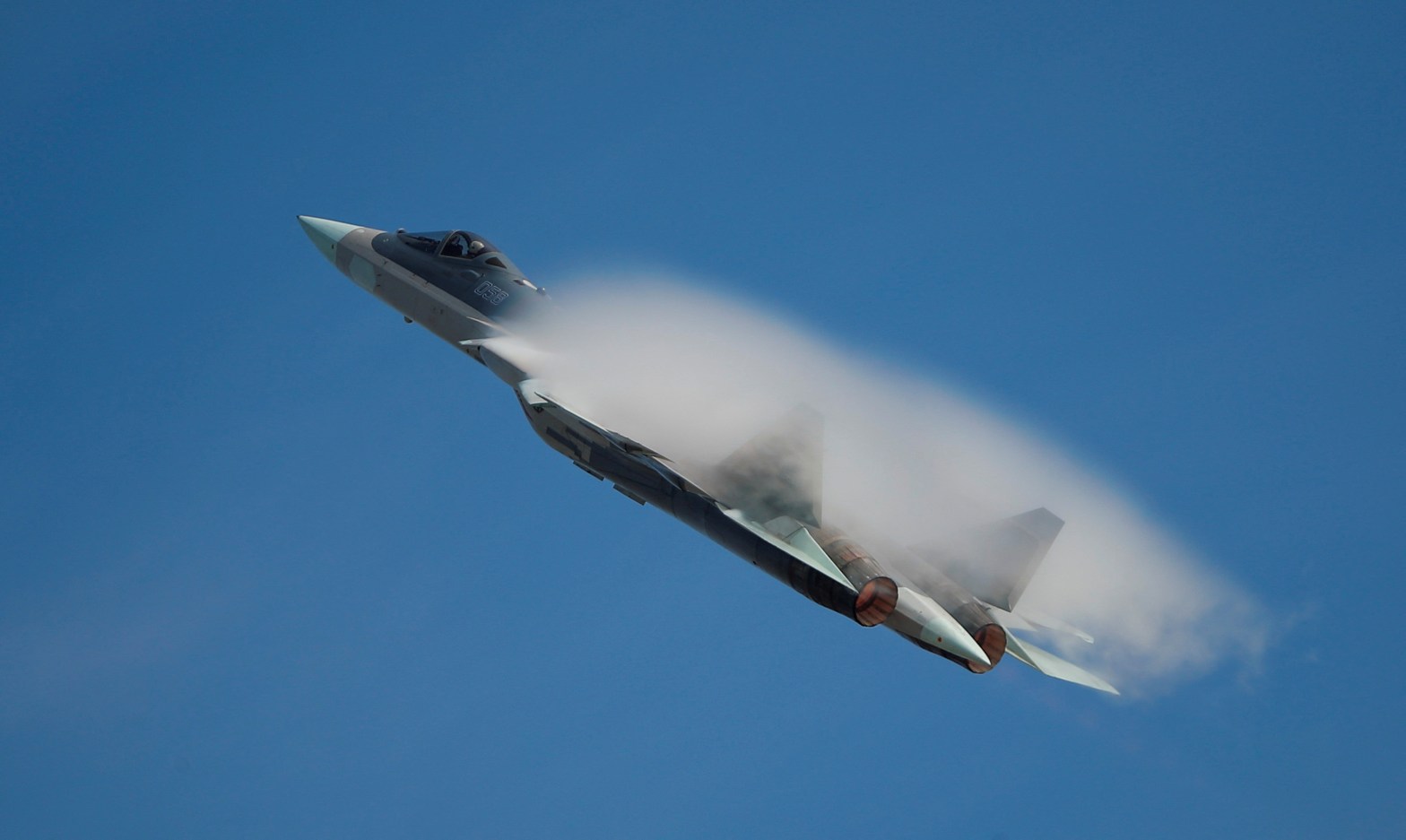
Russia’s Sukhoi Su-57 ‘Felon’ evolved from the Indo-Russia Fifth-Generation Fighter Aircraft (FGFA), the contract for which was signed in October 2007. The FGFA itself had evolved from Russia’s PAK FA. By 2014, however, the IAF began voicing concerns over performance, cost, and work-share. India found that the aircraft does not meet its requirements and eventually left the partnership in 2018. Sukhoi continued to develop and promote the Su-57 for prospective export customers. The export variant, designated Su-57E, was officially unveiled at the MAKS-2019 airshow on 28 August 2019. Su-57 has been showcased at many airshows including in China and India.
The first Su-57 operational unit was formed in Russia in 2021. It is supposed to be a multi-role aircraft with significant air-to-air and ground attack capability. The aircraft were first reportedly used in the Syrian campaign in 2018. Russia has claimed that Su-57 saw significant combat in Ukraine. Around 42 Su-57 have been produced to date. Russia has already ordered nearly 30 more. Numbers will increase as they go ahead. The Su-57‘s unit cost is generally estimated to be between $35 million and $50 million. However, some estimates, particularly those factoring in potential “Made-in-India” production, suggest a cost closer to $60–75 million. Clearly, it is much cheaper than the only other available fighter, F-35.
The single-engine Sukhoi Su-75 “Checkmate”, also designated as the Light Tactical Aircraft (LTA), is a stealth fighter aircraft under development with planned induction around 2027. It’s designed for both export and Russian Aerospace Forces, with a focus on being a cost-effective, yet advanced, combat aircraft. The Su-75 is intended to compete with fifth-generation fighters like the F-35 and China‘s Shenyang J-35. The aircraft is designed with AI integration for enhanced capabilities. The Su-75 aims to be significantly cheaper than other fifth-generation fighters. The maiden flight occurred in 2024. Russia is actively seeking export markets for the Su-75, with India being a potential target. The Su-75‘s design incorporates technology transfer, which could potentially make it a “nearly Indian” fighter.
Other Stealth Fighter Aircraft Programs
The KAI KF-21 “Boramae” is a South Korean-led fighter aircraft development program to produce an advanced multirole fighter for the South Korean and Indonesian air forces. The airframe uses stealth technology but carries weapons externally, and features such as internal bays will be introduced later with KF-21EX program. First flight took place on 19 July 2022, and six prototypes have been built to date. Service introduction is planned in 2026. Turkey’s Turkish Aerospace Industries (TAI) “Kaan”, under development with subcontractor BAE Systems, made its maiden flight on 21 February 2024. Only one aircraft has been built presently and service induction is planned in 2030.
The Global Combat Air Programme (GCAP) is a multinational initiative led by the United Kingdom, Japan, and Italy to jointly develop a sixth-generation stealth fighter that has planned service entry around 2035. The Future Combat Air System (FCAS) is a European combat system of systems under development by Dassault Aviation, Airbus and Indra Sistemas. It is meant to replace France‘s Rafale and Germany’s and Spain‘s Typhoons. Service entry will be around 2040.
General Fighter Aircraft Technology Status India
Most parts of the LCA airframe are being made in India. Some systems like aero-engine are still imported. There are some other avionics and airborne radar that are imported or being made through joint ventures with friendly foreign companies. The weapons are mostly being made in India. BrahMos is an Indo-Russian joint venture. India is making the “Astra” AAMs. Sixth-generation technologies are on drawing boards. It can be seen that India is finally coming of age in its fighter aircraft manufacturing ecosystem. But LCA Mk1A induction is running behind schedule by nearly 20 months already, and not necessarily for aero-engine alone. Indigenous aircraft are intended to provide the bulk of the manned tactical airpower of the IAF and the Indian Navy over the coming decades. It is understood the shortages of fighter jets, weapons, and other equipment can be made good by accelerating indigenous production, and selectively inviting foreign collaborations.
Does India Need an Interim 5th-Generation Fighter?
India is one of the most threatened nations with two very significantly powerful nuclear-armed adversaries as its neighbours. With both of them, there are serious boundary disputes and India has fought wars. China plans to increase its J-20 production to 100 a year and targets to have 1,000 by 2030 when AMCA will be making its first flight. It will have 1500 by 2035 when India will optimistically induct the AMCA.
Pakistan is already talking to China to induct the J-35A by later 2025. Also, around 200 Pakistani technicians and engineers are working with TAI on the Turkish 5th-generation aircraft. A country with a failing economy seems it will have a fifth-generation aircraft earlier than the country that is already the fourth largest economy.
There are increasing discussions that India may be forced to acquire an interim imported fifth-generation aircraft. The choices are few. President Trump announced that they are willing to offer the F-35, but no formal dialogue seems to have begun. One can recall that they had earlier refused their NATO ally Turkey, because, like India, they had acquired the S-400 air defence system from Russia. S-400 reportedly has sensors that will be able to record F-35 electronic signature. Also, USA prefers India to first buy a 4th-generation aircraft in the MRFA competition before the F-35 can even be considered. Clearly, it is a complex geopolitics at play. Indians are also wary about the much greater ability of USA to arm-twist and even leave a friend in the lurch if its own interests are at variance. USA may also want India to distance itself from Russia. USA’s recent moves to close up to Pakistan are also sending confusing signals.
The second, and more viable, option is to rejoin, or acquire, two squadrons of the Su-57 aircraft. The aircraft is fast-maturing. Su-57 has seen combat action in Syria and Ukraine. Russia has offered to set up production in India and transfer technology. Russia has also offered to upgrade the Su-30 MKI to Su-35 technology standard, or make Su-35S in India with full Transfer of Technology (ToT). Also on offer is the Russian stealth drone Sukhoi S-70 Okhotnik-B which forms Manned Unmanned Teaming (MUM-T) with Su-57, and the long-range R-37M AAM.
But there are issues that require surmounting. Su-57 production is still slow, though increasing. Russia is still fighting a long war. Their industry is geared up more towards that. Because of Western sanctions, there are issues related to payment. The balance of payments had become more adverse due to India’s higher oil imports. The same is easing out a little as the global oil prices have dropped considerably. The Su-75 is the other choice, but it is still some distance away. Lastly, IAF already has 60 percent of its fleet of Russian origin and therefore cannot continue to increase that basket.
Way Ahead India
As China’s air combat capabilities grow, regional powers such as Japan, South Korea, and India will have to invest more in their advanced fighter aircraft to maintain a credible deterrent against Chinese aggression. China is not only pulling ahead in aviation technology and capability, but the gap with India is fast becoming unbridgeable in the near future. China will have greater capability to penetrate Indian airspace without being detected.
F-35 is not on offer, and has its complexities. Russia has been a time-tested friend and needs India as much as India needs them. The Su-57 is the only clear offer. It will be cheaper. The existing Russian aircraft production lines will be usable to some extent. The decision may anger the Americans, but that is not new. GCAP is another program that is likely to succeed. But all three partners are very close allies of USA, and may switch either to Boeing F-47, if on offer, or will be heavily influenced by the US technology. If in the long run India must maintain the AMCA program, then all India needs is an interim fighter; then Su-57 may be the better choice.
For India to be part of the big league, the AMCA must succeed. In addition to two squadrons of Su-57, it may be worthwhile to quickly build a large inventory of 4.5-generation fighters like LCA Mk2 and Rafale, and get long-range air-to-surface missile (BrahMos II) and longer-range AAMs like Astra III or Russian R-37M. India must not take any knee-jerk decision. All the same, the time to act is now, lest it is too late.
Note: The article was originally written by the Author for Russia Today on July, 21st 2025, it has since been updated.
Header Picture Credit: Reuters
Twitter: @AirPowerAsia
 Air Power Asia