
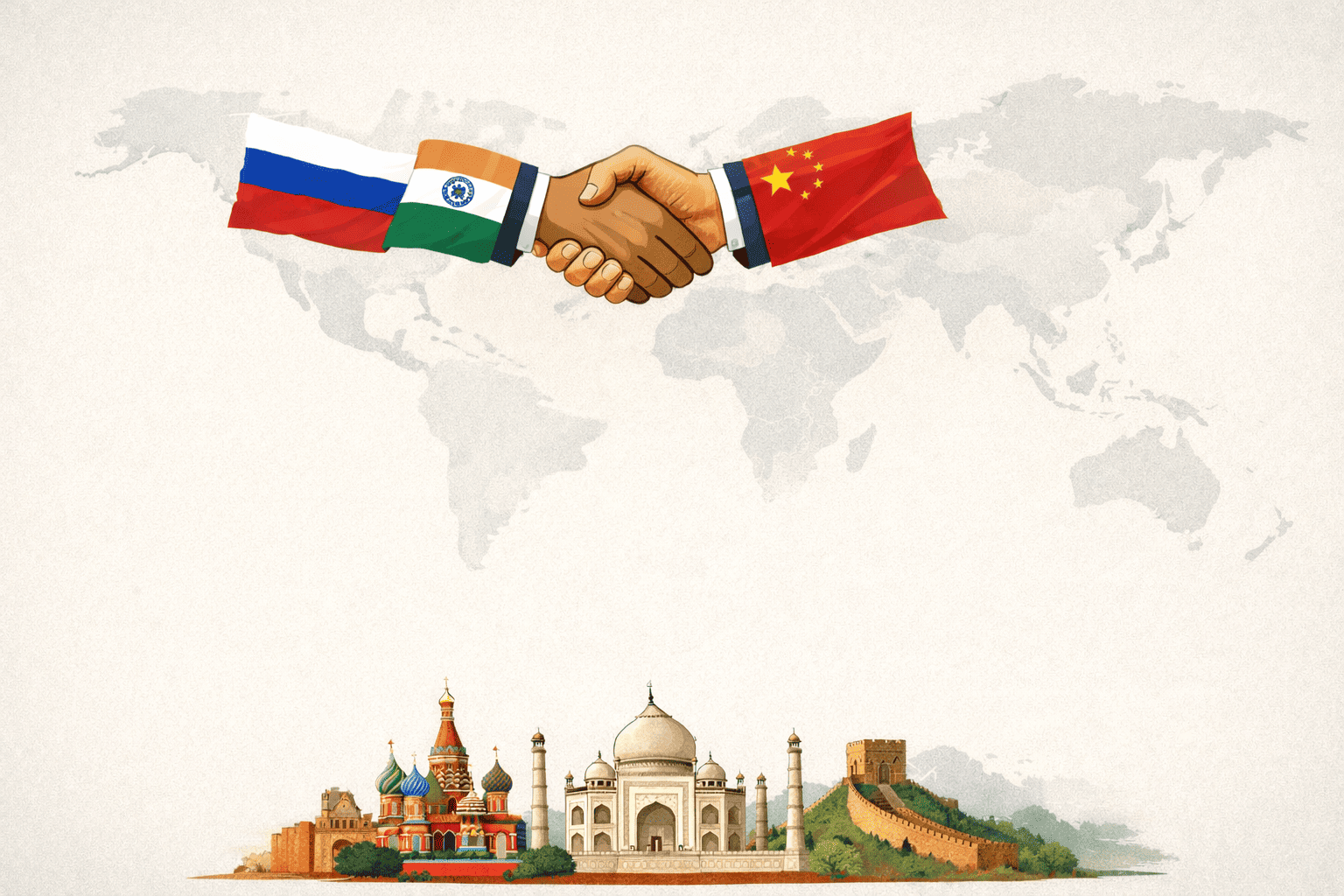
India is still amidst the aftermath of “Operation Sindoor”, in which they watched China very actively supporting its strongest ally Pakistan with hardware, intelligence and command and control, and global narrative building. China and India have continued to have military showdowns on their borders every few years. US-led NATO is most openly supporting Ukraine against Russia. Adversary of USA, China has been tacitly backing Russia. In its desire not to antagonise USA, India has chosen a neutral stand on the Ukraine–Russia conflict. Russia is not very enthused about this. China, and to some lesser extent, Russia are not happy with India becoming active in QUAD, a visibly anti-China grouping. Much to India’s chagrin, Russia continues to engage with Pakistan, which it considers as geographically important to safeguard its interests in Central Asia, but also to keep reminding India to not close up too much with USA.
With India already the fourth largest economy, and among the fastest growing, both Russia and China have interest in continuing to engage with it. If Russia can woo India away from the West, then Russia India China (RIC) can become a very significant bloc. In 2025, the combined GDP, adjusted for purchasing power parity (PPP), of China (19.6%), India (8.23%), and Russia (3.48%) amounts to 31.31 percent. The BRICS nations (Brazil, Russia, India, China, and South Africa): BRICS‘ economic influence exceeds that of the G7. In 2025, RIC accounted for 37 percent of the global population. RIC is among the top 2025 global defence spenders after USA ($895 billion), with China ($266 billion), Russia ($126 billion), and India ($77 billion). In 2025, NATO member countries spent $1.506 trillion on defence, which was 55 percent of global military expenditure. NATO is practically opposing only one country, Russia.
With this background, Russian Foreign Minister Sergey Lavrov reaffirmed on May 30, 2025, Moscow’s strong interest in reviving the Russia–India–China (RIC) trilateral dialogue, citing improved India–China border ties. Russia accuses the West of trying to support friction between India and China.
RIC Formation
RIC is an informal trilateral strategic grouping, originally conceptualized by Russia in the late 1990s to counterbalance to Western dominance. It was the brainchild of former Russian Prime Minister Yevgeny Primakov. Over the years, it facilitated over 20 ministerial-level meetings, fostering cooperation in foreign policy, economics, & security among the 3 nations. The RIC comprises three largest Eurasian countries that occupy over 19 percent of the global landmass. All 3 are nuclear powers & Russia and China are permanent members of the UN Security Council. All 3 countries are also members of BRICS, G20, & the Shanghai Cooperation Organization, etc. The group opposes unilateralism & supports the idea of a multipolar global governance model. It offers an alternative perspective on global issues, advocating for equity & reforms in global institutions. The group supports Eurasian integration through projects like the International North-South Transport Corridor (INSTC) & the Eurasian Economic Union.
For India, RIC format presents both opportunities & challenges.
As India prioritizes strategic autonomy, it must balance opportunities in RIC, avoiding being locked into any single camp, whether Western or non-Western. The grouping faced a major setback and became dormant after the 2020 Galwan Valley clashes between India & China. The ongoing border disputes and trust deficit between India & China remains a challenge. India’s growing ties with the West and its role in the Quad also complicates its simultaneous engagement with the RIC grouping. Russia‘s growing closeness with China, especially in the wake of the Ukraine conflict, might raise concerns in India about the impartiality of the RIC platform.
Moscow has been reaching out to Beijing and New Delhi to ease the situation on the border. Some level of thaw did take place when Prime Minister Modi and Chinese President Xi Jinping met on the sidelines of the 16th BRICS summit in Kazan in October 2024.
RIC Summit Osaka
There have been 18 meetings of RIC (Russia–India–China) foreign ministers. The last RIC Summit was held at Osaka on the sidelines of the G-20 Summit, June 2019. It was just the third heads of state meeting of the group in 12 years. Frequency has been rather low. The last ministerial-level RIC meeting was held online in November 2021.
At Osaka, the three leaders essentially spoke on the international situation, both the challenges on the economic side and of peace and stability. They emphasised the need to strengthen the international system led by the United Nations. The need to promote a multipolar world, a world in which there are many centres of influence and stability and also democracy in international relations. The challenges to the WTO itself as an institution and the need for reforms was discussed. All three felt that the trend of globalization, liberalization of trade, of free and open trading system must continue. They opposed the tendency towards protectionism. There was a need to ensure that the agenda of the developing countries and of the least developed countries are given some importance when the WTO reforms are discussed. Terrorism as a global scourge was discussed. To promote trilateral cooperation, more specific areas needed to be evolved.
Russia China Relations
Russia and China are two bordering large countries with global influence. Both were spearheading global communism. They had some serious differences and a border clash in the 1960s-70s, but since 1991 they have maintained very close relations. China benefits from Russia’s vast energy and natural resources, and also military hardware support. In return, China supports Russia with manufactured goods. China and Russia‘s trade reached a record high in 2024, totalling $244.8 billion, despite Western sanctions on Russia. This reflects strong economic ties between the two nations. Russia primarily exports crude oil, coal, and gas to China, while China exports manufactured goods like cars and broadcasting equipment to Russia. The close economic ties between China and Russia are seen as part of a broader strategy to challenge Western influence. In the long term, when China becomes the leading global power, how will the China–Russia relations pan out, only time will tell. If the West were to woo Russia and wean it away from China, the situation could change.
Russia India Relations
India and Russia share a long-standing, multifaceted relationship characterized by strong political, economic, and cultural ties. India and Russia share a “Special and Privileged Strategic Partnership,” characterized by strong cooperation in various fields. Both nations are cooperating in various areas like defence, nuclear energy, and space. Both countries recognize the importance of a multipolar world order. India is a major customer of Russian military equipment. They collaborate on projects like the production of T-90 tanks, Su-30 MKI aircraft, BrahMos missiles, AK-203 rifles among many other things. Bilateral trade has grown significantly, exceeding $65 billion in 2023-24. Indian companies invest in Russia‘s oil and gas, pharmaceuticals, and IT sectors, while Russian companies invest in India‘s energy, infrastructure, and manufacturing sectors. Russia has been a key partner in India‘s nuclear energy program, with the Kudankulam Nuclear Power Project being a major example. India and Russia are actively exploring new areas of cooperation, including deep-sea exploration, space technology, and the development of the Russian Far East. While bilateral trade has grown, India‘s imports from Russia significantly exceed its exports, creating a trade imbalance. Efforts are underway to address this. India has maintained a balanced approach to the Ukraine conflict, maintaining good relations with both Russia and the West. This has allowed India to benefit from increased access to Russian resources, including oil.
India China Relations
India and China share a complex relationship marked by periods of cooperation and tension, particularly regarding the unresolved border dispute. While they are both major regional powers and have significant economic ties, their relationship is also characterized by strategic rivalry and mistrust. China wants a bipolar world and unipolar Asia with its dominating influence. Russia and India want a multipolar world. India was the first non-communist nation to recognize the People’s Republic of China in 1950. The two countries signed the Panchsheel Agreement in 1954, emphasizing peaceful coexistence. But a major conflict erupted in 1962 over disputed border territories, particularly in Tibet, leading to China occupying part of Indian territory in Ladakh and elsewhere. In the 1980s, efforts were made to normalize relations through diplomatic engagement, with Prime Minister Rajiv Gandhi visiting China in 1988. In 2014, the two sides redefined their bilateral engagement as a “Closer Developmental Partnership”.
The Line of Actual Control (LAC), the border between the two countries, is not officially demarcated, leading to disagreements and occasional clashes. Recent incidents include the Doklam standoff in 2017 and the Galwan Valley clash in 2020. China is India’s largest trading partner, but India has a significant trade deficit. India and China see each other as strategic rivals, with competition for influence in South Asia and beyond.
In the recent past, the leaders of both countries have met on the sidelines of various multilateral summits. Negotiations on the border issue continue, and there have been efforts to maintain peace and tranquillity along the LAC. India and China have cooperated in various multilateral forums such as the RIC, BRICS, and the G20. The future of the relationship will depend on how they manage these competing dynamics. India–China relations remain the weak link of the RIC triangle.
Leaders Chemistry
Between 2014 and 2020, there was great personal chemistry between Russian President Putin, Indian Prime Minister Modi, and Chinese President Xi Jinping. That could have “worked wonders.” Modi and Xi had 18 bilateral one-on-one meetings in 2014-19. Then all of a sudden there was a lull due to Covid and Galwan. The two met at Kazan in October 2024 for the first bilateral meeting in five years. Xi Jinping has made three visits to India, four visits each to South Africa and Vietnam, five visits to France, Kazakhstan, and the United States, and eleven visits to Russia. Over a much longer period of Putin being in power, he has made 9 visits to India, but 20 to China. All this indicates the importance each country gives to the other.
India-US Relations Dynamics
India and the United States have a complex and evolving relationship characterized by both cooperation and areas of disagreement. The relationship is rooted in shared values, including democracy and the rule of law. With the dawn of the new century, cooperation between the two increased. This was also driven by USA’s interest in the Indo-Pacific to counter a rising China. India became a significant defence partner of USA, and acquired many military platforms. Key enabling defence agreements, including GSOMIA, LEMOA, COMCASA, and BECA, were signed. The bilateral economic relationship is growing, with increased trade and investment, but also tensions. The U.S. is a major supplier of LNG to India.
But there are many challenges. Indian analysts and public feel a level of trust deficit. While both countries have a shared interest in a free and open Indo-Pacific, they may have differing views on regional dynamics, particularly concerning China. India‘s move to Tier-1 of the U.S. Department of Commerce‘s Strategic Trade Authorization license exception was meant to facilitate defence trade and also technology transfer. But the latter has still to actually happen. While the overall trade is strong, there are trade imbalances in India’s favour. The new Trump administration has withdrawn India’s Generalized System of Preferences (GSP) and imposed tariffs on Indian goods, causing serious frictions.
USA and RIC Dynamics
USA is not very amused by Russia, India and China coming together in RIC and BRICS. USA is concerned about losing pre-eminence in the global order. They are worried about de-dollarization. USA has been trying to use the Western financial muscle for sanctions against Russia, Iran, North Korea and some others through its Countering America’s Adversaries Through Sanctions Act (CAATSA). But this has been of not much avail. In fact, Russia managed to sell much more oil and gas after the sanctions were imposed.
The other two RIC members China and India were hit by trade tariffs. Upon the second inauguration of Donald Trump in January 2025, the average effective US tariff rate was 2.5 percent. It rose to an estimated 27 percent, the highest level in over a century. After rollbacks, as of June 1, 2025, the average effective tariff rate was 15.1 percent. China, the world’s second-largest economy, the second-biggest trading partner for the US, has had tariffs up to 34 percent. In 2024, the US recorded its largest trade deficit with China, importing nearly $440 billion worth of goods from the country, which accounted for nearly 17 percent of total goods imports into the US. India has been imposed a 10 percent baseline tariff, and the additional 16 percent will be imposed from July 9.
Challenges and Advantages for Strengthening RIC
India had become a key partner of the United States in its Indo-Pacific Strategy, in an effort to address China’s rising power. But the recent trade and tariff war may cast a negative shadow on the broader U.S.–India strategic ties. It is no coincidence that the RIC meeting and the strengthened bonhomie among the three leaders has come amid these difficulties between the United States and India. Speaking at a security conference in Perm on May 29, Sergey Lavrov declared that “the time has come” to bring back the RIC mechanism, citing signs of de-escalation in India–China border tensions. While trying to push multilateralism, each country has to defend their national interests.
Undoubtedly Russia has a strong and genuine interest in strengthening RIC. But will strengthening RIC help New Delhi manage American tariffs? India’s balance of payments with both RIC partners is also very unfavourable. In fact China and Pakistan are running an anti-India nexus. Russia is forced to give a blind eye while ostensibly assuring support. Will Russia be an impartial balancing partner between India and China in RIC, considering China’s larger influence? Does Russia have the political heft and muscle to get India and China resolve boundary issues? Will China stop propping up Pakistan to pin down India? Can Russia ask China not to support Pakistan to the extent it does? Can China give a strong assurance to India on maintaining peace and tranquillity on the LAC? Unlikely. In which case, where will be the give-and-take?
If RIC becomes an anti-USA group, it will not be good for China either as its economy hugely depends on trade with the West. Can the scope of RIC be expanded, with foreign policy, economic, trade and financial agencies of the three countries working more closely? Greater give and take on minerals, on rare earths, microchips, and other technologies? With Russia and China being powerful autocracies, will democratic India get subsumed in the grouping? There are common issues for all three. Islamic fundamentalism bothers all three.
Will China and Russia push for more members in RIC like they have been doing in SCO and BRICS, including some which India is uncomfortable with? The growing Sino-Indian rivalry is expected to limit the ‘range of issues’ where members will be able to find consensus. Are RIC members ready for substantial military exercises between them without significant distrust? Answer is no.
India wants Russia to join Indo-Pacific initiative to signal that it’s not just a US-centric plan. India’s focus on economic links with the Russian Far East and activation of a Chennai-Vladivostok maritime corridor may help persuade Russia that its interests in the Pacific are compatible with our interest in diluting Chinese dominance in the Indo-Pacific. This also accords with President Putin’s concept of a Greater Eurasia. The ongoing India–Iran–Russia project for a sea/road/rail link from western India through Iran to Afghanistan and Central Asia is an important initiative for achieving an effective Indian presence in Central Asia, alongside Russia and China. China and Russia have had conflicting territorial claims in the far-east. Russia’s declining demographics and much more powerful China could take advantage one day.
Some analysts believe that by imposing harsh tariffs, USA is pushing New Delhi into Beijing’s lap. Would RIC tend towards becoming an anti-American alliance? As India prioritizes strategic autonomy, it would prefer balancing opportunities in RIC, avoiding being locked into any single camp. Meanwhile, whether Washington has really come in support of New Delhi in India’s China dynamics remains a question without answers. Until recently, China and India accounted for nearly 70 percent of Russia’s arms exports, and often both India and China bought the same systems (S-400, Su-30). But now China is becoming independent on that count. More and more China-made copies of Russian equipment are finding their way to Pakistan.
RIC countries with important influence at international and regional levels and emerging market economies, need to further strengthen practical coordination on global and regional issues in the spirit of openness, solidarity, mutual understanding and trust. Notwithstanding the bilateral asymmetries, India and China have no choice but to engage bilaterally and multilaterally on a range of issues, even while firmly protecting their own interests. Being India’s leading trade partner, China has a significant role indeed in driving the Indian economy and creating high-quality manufacturing jobs, which is of course a sensitive political issue. But Chinese analysts have taken note of a recent shift in the Indian policy to attract more Chinese investment.
The Chinese economy is heavily dependent on the American market. Some understanding on trade between the U.S. and China will emerge, sooner rather than later. This will also have dynamics for RIC. With American global standing dipping a little, there could be some shift in the years ahead. Meanwhile, Russia is also uncomfortable with the growing Chinese influence in its backyard in Central Asia.
Russia‘s call to revive the RIC format reflects its strategic intent to bolster regional cooperation and counterbalance Western influence. It is in Russia’s interests to be a facilitator in the India–China relationship. Lavrov has flagged this issue now, before Russian President Vladimir Putin’s scheduled visit to India this year. Putin hosted Chinese President Xi Jinping at the Kremlin on May 8. Lavrov believes that strengthened RIC will give India greater leverage to resist Western pressures and also to maintain strategic autonomy.
Partnering with the two most populous and among the biggest economies, gives Russia strength. The success of this trilateral initiative will depend on the political will of all three nations to navigate complex geopolitical dynamics and prioritize mutual interests. Perhaps, the time has come for Primakov’s idea that the RIC triangle should become the symbol of the multipolar world and its core. There are contradictions in the RIC format that the US will continue to exploit. But same is true for many other groupings. For RIC to succeed, India is a key player, and its sensitivities about China have to be assuaged. China has to pull back on its support to Pakistan and stop using Pakistan’s aerospace, nuclear and missile build-up as leverage against India. It is time to reinvigorate and give it a fresh chance. Participating in RIC will be an opportunity for India to showcase its strategic autonomy to a global audience and send a message to Washington, which has repeatedly expressed its displeasure over India’s close ties with Russia.
Note: The article was originally written by the Author for Russia Today on 19th, June 2025, it has since been updated.
Header Picture Credit: Representative Image Generated using AI
Twitter: @AirPowerAsia
 Air Power Asia