
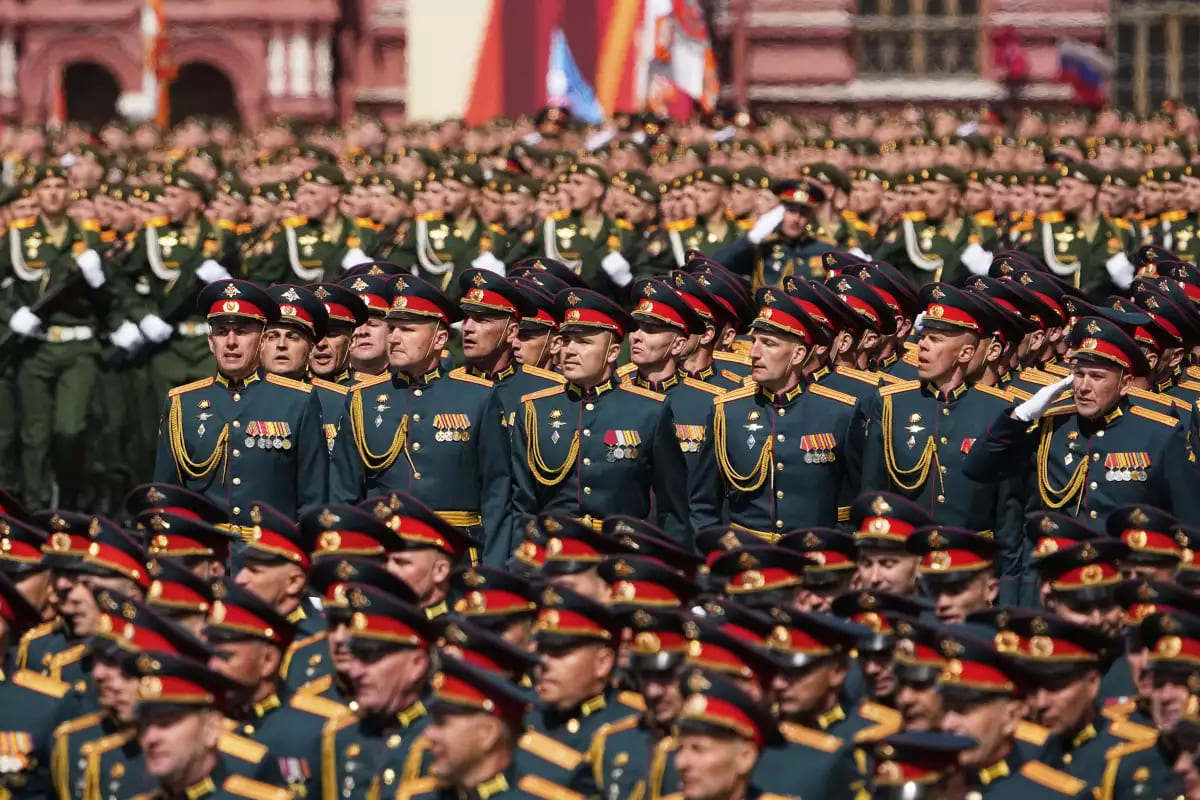
The May 9 Victory Day parade at Moscow’s Red Square marks the 80th anniversary of Victory in the Great Patriotic War, and the end of WW II. The German Instrument of Surrender was signed in Berlin, late in the evening on 8 May 1945, when it was already 9 May in Moscow. The surrender was signed in the Soviet Army headquarters in Berlin-Karlshorst, in both English and Russian. Many world leaders, including Chinese President Xi Jinping, have already accepted the invitation. Xi has also invited President Vladimir Putin to China in early September, when Beijing will hold its own events marking the 80th anniversary of Japan’s defeat in World War II. Meanwhile Russian Foreign Minister Sergey Lavrov has said that President Putin will visit India later this year and preparations for it are underway.
Stellar Role of Soviet Air Force in WW II
The Soviet Air Force (VVS) played a crucial role in World War II, gaining air superiority and helping defeat Nazi Germany on the Eastern Front, and turning the tide of the war. The VVS used a variety of aircraft, including dog-fight fighters, bombers, ground-attack planes, and dive bombers. Tupolev Tu-2, a twin-engine bomber with a large bomb load and high speed, was used for frontline day attacks, and was effective in the Red Army‘s final offensives. Petlyakov Pe-2, a twin-engine dive bomber and also used as a day and night fighter, and reconnaissance aircraft. Ilyushin Il-2 Shturmovik, single-engine, low-wing monoplane, was the most produced military aircraft (36,183) design in history. It was known as the “Flying Tank”. The Yakovlev Yak-3 was a single-engine, single-seat, and one of the smallest and lightest combat fighters fielded by any side in the war. Its high power-to-weight ratio gave it excellent performance and it proved to be a formidable dogfighter. Lavochkin La-5, and later La-7, which had a top speed of 661 kilometres per hour and was considered equal of any German piston-engined fighter. The Polikarpov U-2 (Po-2), a small single-engine biplane from the 1920s era, and Sukhoi Su-2, a light bomber, were used in the early stages of the war. Soviet aircraft production peaked at 40,000 aircraft in 1944. Soviets also used the British Spitfire Mk for air defence, in 1944 and 1945. And also the American P-39 Airacobra and North American T-6 Texan loaned by the USA.
The operations included deep interdiction targeting enemy transportation and strategic reserves. Air interception missions to prevent German fighters attacking strategic ground targets and interference with Soviet ground operations. The VVS played a great role in the “Defence of Moscow”, and turned the tide against Nazi Germany at the Battle of Stalingrad. The VVS dropped 30 million bombs on German targets, disrupted enemy plans for concentrating forces, striking railroad junctions, stations, bridges, and motor vehicle columns, and provided air cover to Allied convoys. Soviet military transport aircraft provided strategic and tactical airlift, and airborne dropping capabilities.
Air Aces of WW II
A flying fighter “air ace” is a military aviator credited with shooting down five or more adversary aircraft during aerial combat. The idea evolved in later part of WW I. Air aces in WW II had tremendously varying kill scores, and depended on pilot’s skill level, and the performance of own and adversary airplanes. Also, how long they had served, had opportunities to meet the enemy in the air, and whether they were the formation’s leader or wingmen, etcetera. There were over 2,500 air aces from Germany during WW II, mainly because a much smaller number were facing a much larger number of Allied aircraft. Each pilot was flying a much larger number of missions. 103 German fighter pilots each shot down 100 or more enemy aircraft, including two pilots with more than 300 victories. Erich Alfred Hartmann was the highest scorer in history with 352 aerial kills. The German Messerschmitt Bf 109 formed the backbone of the Luftwaffe’s fighter force and had the highest number of aerial kills of the war. There were 1297 aces from the United States. Richard Bong was the top American Ace with 40 victories. The United Kingdom had 753 air aces, but the highest aerial victories attributed to any pilot was around 32. The Soviet Union had 221 air aces, but its pilots scored much higher individual kills than the other Allied countries. Ivan Nikitovich Kozhedub was the highest-scoring Allied and Soviet fighter pilot of World War II, scoring 64 solo victories.
Ivan Nikitovich Kozhedub
Ivan was born into a poor rural family on 8 June 1920. For him, a boy of 16, and for thousands of other Soviet teenagers, the famous pilot Valery Chkalov was an inspiration. Chkalov’s bold long-distance flights were being admired around the world. In 1936, Chkalov had flown a Tupolev ANT-25, from Moscow to Udd Island, Kamchatka, covering 9,374 kilometres in 56 hours, 20 minutes. And also a very hazardous 8,504 km flight in 63 hours, 16 minutes from Moscow to Vancouver, via the North Pole, on June 18–20, 1937.
In April 1939, Kozhedub made his first flight in the Polikarpov U-2. In 1941 he was admitted to the Military Pilots’ Aviation School in Chuguev. He was one of the best students and graduated as an aviation instructor and remained there during initial years of the war. Finally in March 1943, he was posted, as a Senior Sergeant, to the 240th Fighter Aviation Regiment, one of the first units to receive the new Lavochkin La-5 aircraft. His first combat mission was on 26 March 1943 on a La-5. His plane was badly damaged in combat against Messerschmitt Bf 109s. He was able to land unhurt, but his aircraft was totally destroyed.
By October 1943, Senior Lieutenant Kozhedub had made 146 combat missions and brought down 20 enemy planes. In air fights over the Dnieper, in 10 days of intense fighting he shot down 11 enemy planes. He was awarded the order of the Hero of the Soviet Union on 4 February 1944. Aggressive, tireless, brave and skilful, Kozhedub was the ideal fighter pilot. His aircraft was his religion.
By mid-1944, Guard Captain Ivan Kozhedub had flown 256 combat missions and shot down up to 48 enemy planes. On 19 August 1944 he was awarded a second medal, this time a Gold Star. On 19 February 1945, during an operation near Frankfurt (Oder), Kozhedub shot down the newly inducted Me-262 German jet. The Me-262 was the world’s first jet plane. He claimed his last two victories over Berlin on 16 April 1945.
Out of the 44,000 aircraft lost by Germany on the Soviet-German front, 90 percent were downed by fighters. Kozhedub is regarded as the best Soviet flying ace of WW II. He was reputed to have a natural gift for deflection shooting against a fast-moving aerial target. His famous formula of air-to-air combat was: ‘Altitude-speed-manoeuvre-fire.’ He flew 330 combat missions, 120 aerial engagements, 64 enemy aircraft shot down. He was made a Hero of the Soviet Union for the third time on 18 August 1945. The victory belonged to those who knew their planes and weapons inside out and had the initiative, he felt. Ivan always respected the courage of the German aces. Post-war, he grew in the air force and became Aviation Marshal in 1985. Ivan Kozhedub died on 8 August 1991 at age 71 and is buried in the Novodevitchy Cemetery in Moscow. A special stamp was released to honour him by Russia in 2020. Kozhedub University of the Air Force at Kharkiv is named in his honour.
Alexander Ivanovich Pokryshkin
Alexander Pokryshkin was a Soviet ace, and the highest-scoring pilot ever to fly an American aircraft, having achieved the majority of his kills while flying the Lend-Lease Bell P-39 Airacobra. Pokryshkin earned the title Hero of the Soviet Union three times. Pokryshkin caught the “aviation bug” when he was 12 years old watching a local airshow. After the aviation school, he was assigned to the 55th Fighter Regiment. His airfield was bombed on 22 June 1941, the first day when his country entered WW II. His first air combat was a disaster. Seeing an aircraft that he had never seen before, he attacked and shot it down. It turned out to be a Soviet Su-2 light bomber piloted by squadron commander Mikhail Gudzenko. Luckily, Gudzenko survived, although the navigator was killed.
He claimed his first enemy aircraft when he shot down a Bf 109 the next day. On 3 July, having claimed several more victories, he was shot down by German flak behind enemy lines and spent four days getting back to his unit. Things were tough. The Soviet Union was under retreat. Germans were a superior opponent. He later said “one who hasn’t fought in 1941–1942 has not truly tasted war”. Pokryshkin survived several close calls during this time. During the German summer offensive of 1942, flying the Yakovlev Yak-1 fighter, Pokryshkin flew escort missions. He shot down many German Air Aces, including Feldwebel Hans Dammers.
Pokryshkin’s most impressive kill record came during the battle for the Kuban region in 1943. Pokryshkin’s regiment fought against the most renowned German fighter units such as JG 52 and JG 3 “Udet”. The area saw some of the fiercest fighting with daily engagements of up to 200 aircraft in the air. Pokryshkin’s innovative tactics of using different fighter types stacked in altitude, and the so-called “pendulum” flight pattern for patrolling the airspace, contributed to the first great Soviet air victory over the Luftwaffe.
In early January 1943, his regiment converted to the American P-39 Airacobra under a lend-lease arrangement. He had learned that shooting down the flight leader would demoralise the enemy. Pokryshkin shot down the plane of 9-kill ace Unteroffizier Heinz Scholze, and Leutnant Helmut Haberda (with 58 victories). Pokryshkin received his first Hero of the Soviet Union award on 24 May 1943, and was promoted to Major in June, and made commanding officer of his squadron. Later Pokryshkin shot down the 56-kills experte Uffz. Hans Ellendt.
On 19 August 1944, for 550 front-line sorties and 45 solo kills, Pokryshkin was awarded the Gold Star of the Hero of the Soviet Union for the third time. Some records attribute 65 kills to him. He was the first person to receive the award three times, and was the only one to receive all three during wartime itself. The bulk of Pokryshkin’s victories came during the time when the Soviet Air Force was still fighting at a disadvantage, and his victories are considered more significant.
After the war, he served in the Soviet Air Defence Forces, reaching the rank of Marshal of Aviation and retired in 1981. Pokryshkin died on 13 November 1985 at the age of 72, and was buried at Novodevichy Cemetery. In Novosibirsk, a street, a square, and a subway station are named in his honour. He wrote several books, in Russian, about his wartime experiences. He appeared in the documentary TV Series “The Unknown War” hosted and narrated by Burt Lancaster. In addition to his Soviet awards, he had been honoured by many countries, including the USA, East Germany, Poland, among others.
Fighter Ace Lydia Litvyak “White Lily”
Lydia Litvyak was the first female fighter pilot to shoot down an enemy aircraft, and along with Yekaterina Vasilyevna Budanova, was among the only two female fighter pilots in the world to earn the title of fighter ace. She holds the record for the highest aerial victories by a female fighter pilot. She was herself shot down near Orel during the Battle of Kursk as she attacked a formation of German aircraft.
Lydia Litvyak was born in a Russian Jewish family in 1921, and grew up reading about aviation, and watching military pilots practice nearby. At 14, she enrolled in a flying club, and made her first solo flight at 15. She became a flight instructor at Kalinin aero club, and by the time the German-Soviet war broke out, she had already trained 45 pilots. She finally joined the all-female 586th Fighter Aviation Regiment. Marina Raskova, a famous Soviet women navigator, had used her personal connections with Joseph Stalin to form the three combat regiments for female pilots, one of which would eventually fly over 30,000 sorties in WW II and produce at least 30 Heroes of the Soviet Union.
800,000 Russian women had volunteered for front-line action. Lydia trained on the Yakovlev Yak-1 aircraft, and was assigned a men’s regiment fighting over Stalingrad. Litvyak flew her first combat flights in the summer of 1942 over Saratov. Litvyak scored her first two kills on 13 September. The first was a Ju 88 which fell in flames after she fired several bursts. Then she shot down a Bf 109 G-2 “Gustav” piloted by decorated German ace Staff Sergeant Erwin Maier. Maier parachuted down and was captured and made to meet the Russian ace. When he was taken to Litvyak, he thought it was a joke. Litvyak described each manoeuvre of the fight and he was convinced that he had been shot down by her. On 14 September, Litvyak shot down another Bf 109. Her victim was reportedly Knight’s Cross holder and “71 kill ace” Lt. Hans Fuss. Boris Yeremin (later Lt General of aviation), then a regimental commander in her division, saw her as “a very aggressive person” and “a born fighter pilot.”
On 23 February 1943, Litvyak was awarded the Order of the Red Star, and made a junior lieutenant, and selected to take part in the elite air tactic called “okhotniki” (free hunter), where pairs of experienced pilots searched for targets on their own initiative. Twice, she was forced to land due to battle damage, she was also severely wounded in air combat once.
While in the 73rd Regiment, she often flew as a wingman of Captain Aleksey Solomatin, a flying ace (39 victories). She had a crush on him. On May 21, while training a new flyer, Solomatin was killed when his aircraft flew into the ground, in front of the entire regiment. Litvyak was devastated. Now Litvyak wanted nothing but to fly combat missions, and she fought angrily and desperately.
Litvyak shot a manned German artillery observation balloon on 31 May 1943. Shooting the balloons had been attempted by other Soviet airmen but all had failed due to a dense protective belt of anti-aircraft fire defending the balloons. Litvyak attacked it from the rear after flying in a wide circle around the air defences. The tactic worked. The hydrogen-filled balloon caught fire under her stream of tracer bullets and was destroyed.
On 13 June 1943, Litvyak was appointed flight commander. On August 1, 1943, Litvyak did not come back to her base at Krasny Luch, Luhansk Oblast. It was her fourth sortie of the day, escorting a flight of Ilyushin Il-2 ground-attack aircraft. A pair of Bf 109 fighters dove on Litvyak while she was attacking a large group of German bombers. Lily just didn’t see the Messerschmitt 109s. She did try to engage in a dogfight, but it was too late. Her Yak-1 was seen pouring smoke. No parachute was seen, and no explosion either. Litvyak was just 21 years old. Soviet authorities suspected that she might have been captured, a possibility that prevented them from awarding her the title of Hero of the Soviet Union.
After a 36-year search of her Yak-1 crash site, a team led by Pasportnikova and assisted by the public and the media, in 1979, discovered that an unidentified woman pilot had been buried in the village of Dmitrievka, Shakhterski district. A special commission was formed to inspect the exhumed body and it concluded the remains were those of Litvyak.
On 6 May 1990, USSR President Mikhail Gorbachev posthumously awarded her the title Hero of the Soviet Union. Litvyak had earlier been awarded the Order of the Red Banner, Order of the Red Star, and was twice honoured with the Order of the Patriotic War. Litvyak displayed a rebellious and romantic character. Returning from a successful mission, she would “buzz” the aerodrome and then indulge in unauthorised aerobatics, knowing that it enraged her commander. Litvyak could also be superstitious. She never believed that she was invincible. She believed that some pilots had luck on their side and others didn’t. She firmly believed that the more you flew and the more experience you got, your chances of making it would increase.
Despite the predominantly male environment, she never renounced her femininity, and would carry on dyeing her hair blonde. She would fashion scarves from parachute material, dyeing and stitching the small pieces in different colours. She would not hide her love of flowers, which she picked at every available occasion, favouring red roses. She would make bouquets and keep them in the cockpit.
Litvyak was called the “White Lily of Stalingrad” in Soviet press releases. She has also been called the “White Rose of Stalingrad” in Europe and North America since reports of her exploits were first published in English. Litvyak is the major character in Mary Ann Cook’s romanticized novel “The White Rose”, a fictional account of her wartime experiences. Perhaps the most detailed work of literary fiction about Litvyak, her life, times and loves, was written by an American, M.G. Crisci, in cooperation with Valentina Vaschenko, the curator of the Lilya Litvyak Museum and School in Krasny Luch, Eastern Ukraine. The book entitled “Call Sign, White Lily”, also contains never-before-seen photographs contributed by the museum. On March 22, 2019, director Andrei Chaliop announced a film about Lydia Litvyak.
Other Air Aces and Aviators
Grigory Andreevich Rechkalov scored over 50 solo shoot-downs, making him one of the high-scoring Soviet fighter pilots. He was twice awarded the title Hero of the Soviet Union for his aerial victories and went on to become a Major General after the war. Nikolai Dmitriyevich Gulayev made 200 combat sorties and fought in 69 aerial engagements, scoring 55 aerial victories. He had one of the highest kill ratios of any Allied ace in the war. Marina Mikhaylovna Raskova was the first woman in the Soviet Union to become a professional air navigator. She was the navigator to many record-setting as well as record-breaking flights and the founding commanding officer of the 587th Bomber Aviation Regiment, which was later renamed in her honour. She was referred to as the “Russian Amelia Earhart” for her achievements. She was the first female to receive Hero of the Soviet Union, and that too before World War II. Raskova died on 4 January 1943, when her aircraft crashed attempting to make a forced landing on the Volga bank. Her ashes were buried in the Kremlin Wall Necropolis on Red Square. Streets were named after her in Moscow and Kazan, as well as a square in Moscow.
The author, an Indian military aviator, salutes the great Soviet aviators of WW II.
Note: The article was originally written by the Author for Russia Today on 10th, May 2025, it has since been updated.
Header Picture Credit: Los Angeles Times (Associated Press)
Twitter: @AirPowerAsia
 Air Power Asia