
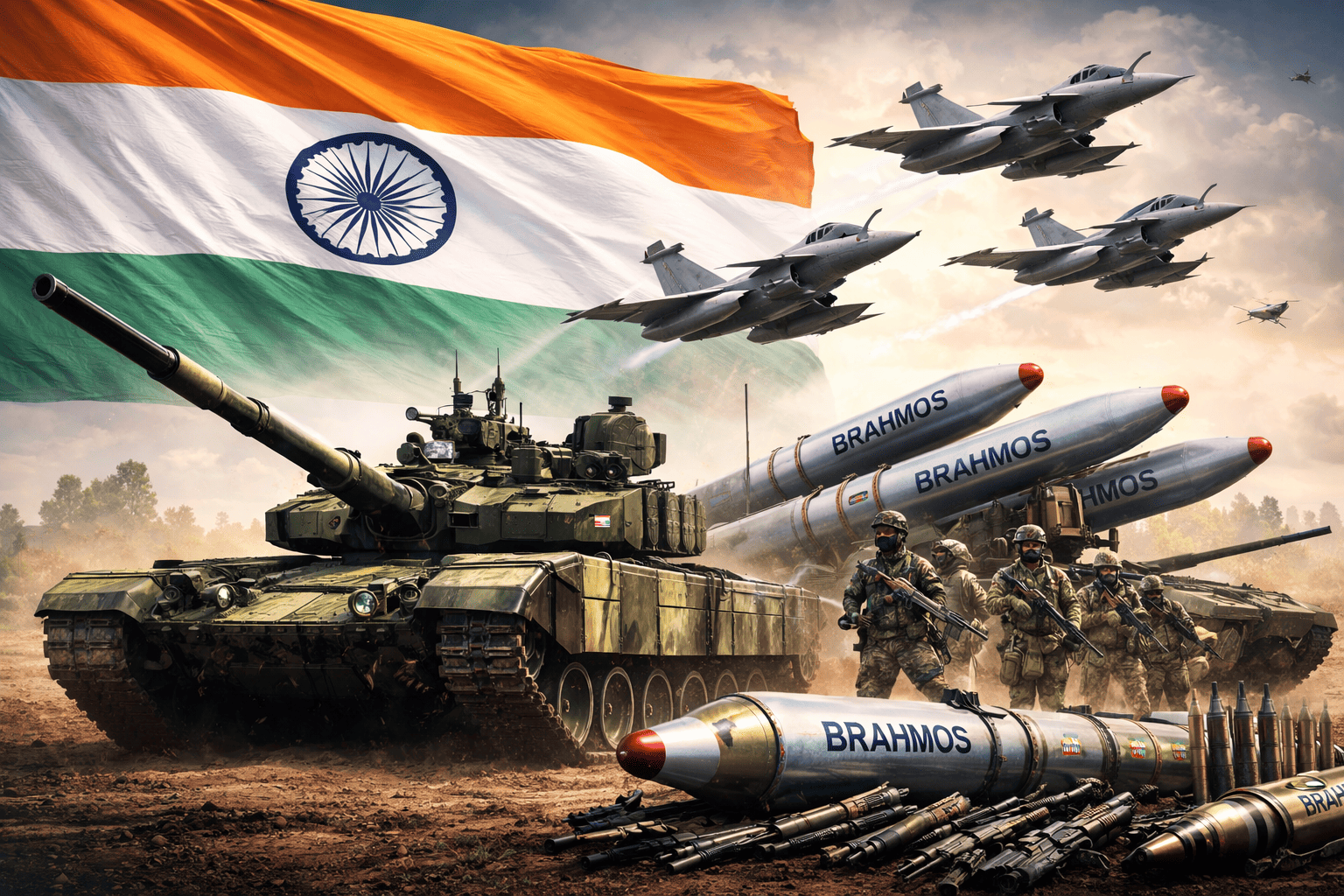
Atmanirbharta (self-reliance) in defence is the flavour of the season in India. India’s defence manufacturing sector is rapidly emerging as a cornerstone of the country’s strategic and economic ambitions. The government policies and initiatives are driving “Design” or certainly Make-in-India. Over 5,000 items are in the Positive Indigenisation List (PIL), 75 percent defence capital budget has to be spent procuring India-made products. Defence production and defence exports are being monitored at the highest levels of the executive. Ambitious targets are being set. The hitherto dominated by public sector, the private sector is being encouraged to come in big into defence production. Some big industrial groups have entered defence. There are a large number of Micro, Small & Medium Enterprises (MSMEs) and start-ups in the defence sector now and some of them are producing international quality components and subsystems to global OEMs.
The newly independent India in early 1950s was greatly influenced by the Soviet “socialist” approach to economy and evolved its five-year plans. Perhaps that was the best for those times. Throughout the 1950s, there was Soviet assistance and technology transfer in multiple industrial sectors such as steel, defence, railways, construction equipment, metal, mining, petrochemicals and more to India. A very important part was the building of military aircraft, aero-engines and avionics factories. At one point Indian Armed Forces had nearly 85 percent of military equipment of Soviet/Russian origin. After the implosion of the Soviet Union, Russia realised the need to compete with rest of the world through play of market forces. India too realised that they had to diversify their defence sourcing. Interestingly, among the top global defence companies are 41 from the USA. All are private. These companies had $317 billion in arms revenues, which was half of the total revenue of the top 100 companies. The top five arms companies were all US-based. Nine Chinese, three Indian, and two Russian companies are in top 100. All these were public sector companies.
In 1990s when India’s economy began growing, it was possible to allocate large amounts to defence sector and also the private sector started coming of age. The manufacturing capabilities increased. Cars and motorcycles were being produced in large numbers. The much-protected defence sector also began being opened to private players.
Advantages Public and Private Sector
In initial decades the private sector of India was very small and concentrating on day-to-day needs of masses. The government used public funding to set up essential infrastructure. Banks, cars and aircraft manufacturing were nationalised. It was perhaps alright for that period.
But in the long term public and private sectors have their own strengths and weaknesses. While public sector has advantage of government funding, but then they remain under bureaucratic control of the government departments. Decision making in the government is often complex and so is progress monitoring. Since the money involved is that of the public, accountability is relatively low. The salaries are fixed as per government scales. Once hired, the workers cannot be sacked easily for lack of performance. Productivity of workers is invariably much lower than the private sector.
The private sector can pick up the best talent by paying high salaries. Non-performers can be de-hired at short notice. With increased efficiency the task can be done by much fewer workers. Private sector now has the capacity to raise funds from banks and other financial institutions including from abroad.
While any joint venture and foreign tie-up by public sector companies will require navigating the labyrinth of government corridors for approvals, the private sector can do the same much faster. Also, foreign corporates find it much easier to deal directly with Indian companies than go through the oversight of bureaucracy which often tests their patience. It is also easier for private sector to pay for and acquire critical technologies and raw materials on pure commercial considerations.
How can Governments Support the Private Sector
Every government must make policies to make it a level playing field for private sector to be able to compete with DPSUs and also with the large foreign players. Private players also need some seed money or easy access to funds for R&D. Often there is price undercutting in tender competition. The government has to ensure that there is balance between quality and cost. Defence equipment have stringent technical specifications, and failure to meet the same delays product supply and affects security capability. A DARPA-type approach could be that the Request for Information (RFI) be floated. Among the responses, 4–5 serious contenders are shortlisted. They are then given development funds. After the product is ready, they compete with each other in the final Request for Proposal (RFP).
Innovation for Defence Excellence (iDEX) is a good government initiative to nurture and help create functional prototypes of products/technologies relevant for national security (prototyping), and spur fast-moving innovation in the India Defence sector. The Defence India Startup Challenge has been launched by the Ministry of Defence (MoD) in partnership with Atal Innovation Mission, aimed at supporting Startups/MSMEs/Innovators to create prototypes and/or commercialize products/solutions in the area of national defence and security.
In the Defence Acquisition Procedure 2020, there are specific reservations on orders up to Rs. 100 Crore/year for MSMEs. The Self-Reliant Initiatives through Joint Action (SRIJAN) are being placed on the portal to facilitate indigenization by Indian industry, including MSMEs.
MoD has urged industry bodies to have separate defence industry chapters. The Confederation of Indian Industry (CII) has the Society of Indian Defence Manufacturers (SIDM). These bodies have huge membership and create events and environment to help industry interface with the government and service headquarters. They also convey industry concerns to the policy makers.
The government has urged public sector banks and financial institutions to bring out defence industry-friendly loan schemes. The Small Industries Development Bank of India (SIDBI) has specific defence sector loan schemes.
Armed Forces Specific Initiatives
To promote defence start-ups and MSMEs, the Armed Forces have set up special directorates for ease of interaction with defence industries. Specific service initiatives include the ‘MeharBaba’ Swarm Drone Competition by the Indian Air Force (IAF) for Indian start-ups to develop swarm drones. The Indian Army’s defence innovation initiatives include the Defence Innovation Unit (DIU), the Defence Innovation Centre, and the Defence Innovation Challenge. These initiatives aim to strengthen national security by accelerating the adoption of commercial technology and developing new capabilities. Through initiatives like the Autonomous Fast Interceptor Boat (A-FIB), Jalkapi Based Autonomous Underwater Vehicle (AUV) prototype, ULAUV project, and XLUUV development, the Indian Navy aims to leverage innovative technologies that improve operational efficiency.
DRDO and DPSU Support to Private Sector
The Defence Research and Development Organisation (DRDO) was created in late 1950s to support defence equipment research. Similarly, the DPSUs have huge infrastructure for both R&D and manufacturing. They have sophisticated testing infrastructure and laboratories. The very expensive wind tunnels and other such infrastructure are considered a national asset. The government has begun insisting that such facilities be offered to private sector to support their defence production. Setting up an independent nodal umbrella body for testing, trial, and certification requirements of defence systems will improve access to existing facilities while reducing the need for investments to recreate the capital-intensive infrastructure.
The Centre for Military Airworthiness & Certification (CEMILAC) is a laboratory under DRDO. Any airborne product has to be certified by them. It is important that the private sector gets access to them.
MSMEs are important partners in DRDO projects and DRDO transfers technologies to them and through its scheme Technology Development Fund (TDF) supports industries, especially start-ups and MSMEs up to an amount of Rs 10 Crore for innovation, research and development of Defence Technologies in the field of Defence and Aerospace.
Challenges and Opportunities for Public and Private Sector
Mixed economy is a tried and tested system in India. Government has got out of or thinned presence in many sectors where private industry has matured. Private sector in India dominates in automobiles, IT, FMCG, housing, pharmaceuticals, civil aviation, hospitality etc. They are becoming significant in banking, education, transportation, telecommunication, insurance, and healthcare, among others. On many counts the private sector while providing high-quality services are expensive, and not accessible by masses. There are strengths and challenges in both sectors. There is thus a great case for public-private partnership.
In defence private sector there has long been a feeling that DRDO and DPSUs are keeping their technology R&D cards very close to their chest and are reluctant to share with private sector. They also continue to treat them as competitors rather than partners. Meanwhile, government has offered increased governance and control rights to foreign companies. While major foreign defence OEMs have chosen to partner with major Indian conglomerates like Tata, Reliance, Adani, L&T, and others to invest in defence in India, similar projects with public sector have been few.
A few good examples of FOEMs joining private sector partners are Lockheed Martin and Boeing joining with Tata Group manufacturing aero-structures and sub-systems for global supplies. Adani Group is making UAVs and drones with Israel’s Elbit Group. The Airbus C295 is built by Tata Group in India. The Ministry of Defence (MoD) issued an Expression of Interest (EoI) to the private sector to participate in the Advanced Medium Combat Aircraft (AMCA) program through a Special Purpose Vehicle (SPV). The project will include ADA, HAL and the selected private company under PPP model. The name is expected to be announced by mid-2025.
There are many private companies making defence electronics, large aero-components, advanced technology components and sub-systems. Dynamatic Technologies makes assemblies of vertical fins for Sukhoi 30 MKI fighters. They are also supplying aero-structures to Airbus for its A320 family of aircraft and the wide-body A330 aircraft. Hyderabad’s VEM Technologies manufactures centre fuselage for LCA Tejas.
The BrahMos is a joint venture between the DRDO and the Russian Federation’s NPO Mashinostroyeniya, who together have formed BrahMos Aerospace, and has had very significant success in missile production and exports. The AK-203 assault rifle is being produced in India through a joint venture between Russia and India. Russia has recently offered to make the fifth-generation Sukhoi Su-57 in India through a JV with Indian partners.
JVs can leverage the resources and infrastructure of defence PSUs and the flexibility and marketing skills of the private sector. JVs can help expand India’s defence industrial base. JVs with partners from friendly foreign countries can help India become a global leader in defence.
To Summarise
India’s aerospace and defence sector has witnessed remarkable growth in recent years, with the private sector contributing a staggering 20 percent to its turnover. Leading business conglomerates such as L&T, Tatas, Mahindras, Hindujas, and Bharat Forge have made significant investments in this sector, driving it to new heights of success.
Meanwhile, public enterprises and organisations, including Hindustan Aeronautics Limited (HAL), Bharat Electronics Ltd (BEL), BEML Ltd, and National Aerospace Laboratories (NAL), have also scaled up their operations to meet the government’s ambitious aspirations under the ‘Atmanirbhar Bharat Abhiyan’ and ‘Make in India’ schemes.
The Indian Government’s defence procurement policies, which include market opportunities, have lured several global players, such as Airbus, BAE, Boeing, Collins Aerospace, Dassault Aviation, Israel Aerospace Industries (IAI), Pilatus, Lockheed Martin, Raytheon, Rafael, Safran, and Thales, to set up operations and form joint ventures in India.
Developing a strong research base in India and a robust supply chain for components and sub-systems, most currently sourced from abroad, will help create the market for civilian and defence systems in the aerospace sector.
The C295 JV is set to create a comprehensive industrial ecosystem in India. This first-of-its-kind ‘Make in India’ aerospace program in the private sector is expected to involve more than two dozen MSME suppliers, producing over 60% of the 30,000 detail parts, sub-assemblies, and component assemblies locally. Interestingly, Russian Army wears boots crafted in India’s Hajipur district in Bihar.
Domestic defence production in India has already reached ₹1.27 lakh crore ($14.5 billion) in FY 2023–24. 75 percent of all defence capital acquisitions have to be domestically procured, giving huge boost to Make-in-India. The target is ₹1.75 lakh crore ($19 billion) in the current fiscal year, with aspirations to achieve ₹3 lakh crore ($34 billion) in defence production by 2029. India’s defence exports reached ₹21,083 crore ($2.4 billion) in the same period. India has set a defence export target of ₹50,000 crore ($5.7 billion) by 2028–29. Currently, India exports to over 100 nations, with the top three destinations for defence exports in 2023–24 being the USA, France, and Armenia.
India has 16 Defence Public Sector Units (DPSUs), over 430 licensed companies, and approximately 16,000 Micro, Small, and Medium Enterprises (MSMEs). Notably, 21 percent of this production comes from the private sector, bolstering India’s journey toward defence self-reliance. India is solidifying its position as a global manufacturing hub for defence.
Finally, public funding for investments in several critical future technologies, such as artificial intelligence (AI), robotics, autonomous vehicles, hypersonic, directed energy weapons, augmented and virtual reality, and blockchains, will be foundational for future innovations, both for commercial and military applications. Building intellectual property is crucial for India to sit on the global defence manufacturing high table.
Note: The article was originally written by the Author for Russia Today on 19th, March 2025, it has since been updated.
Header Picture Credit: Representative Image Generated using AI
Twitter: @AirPowerAsia
 Air Power Asia