
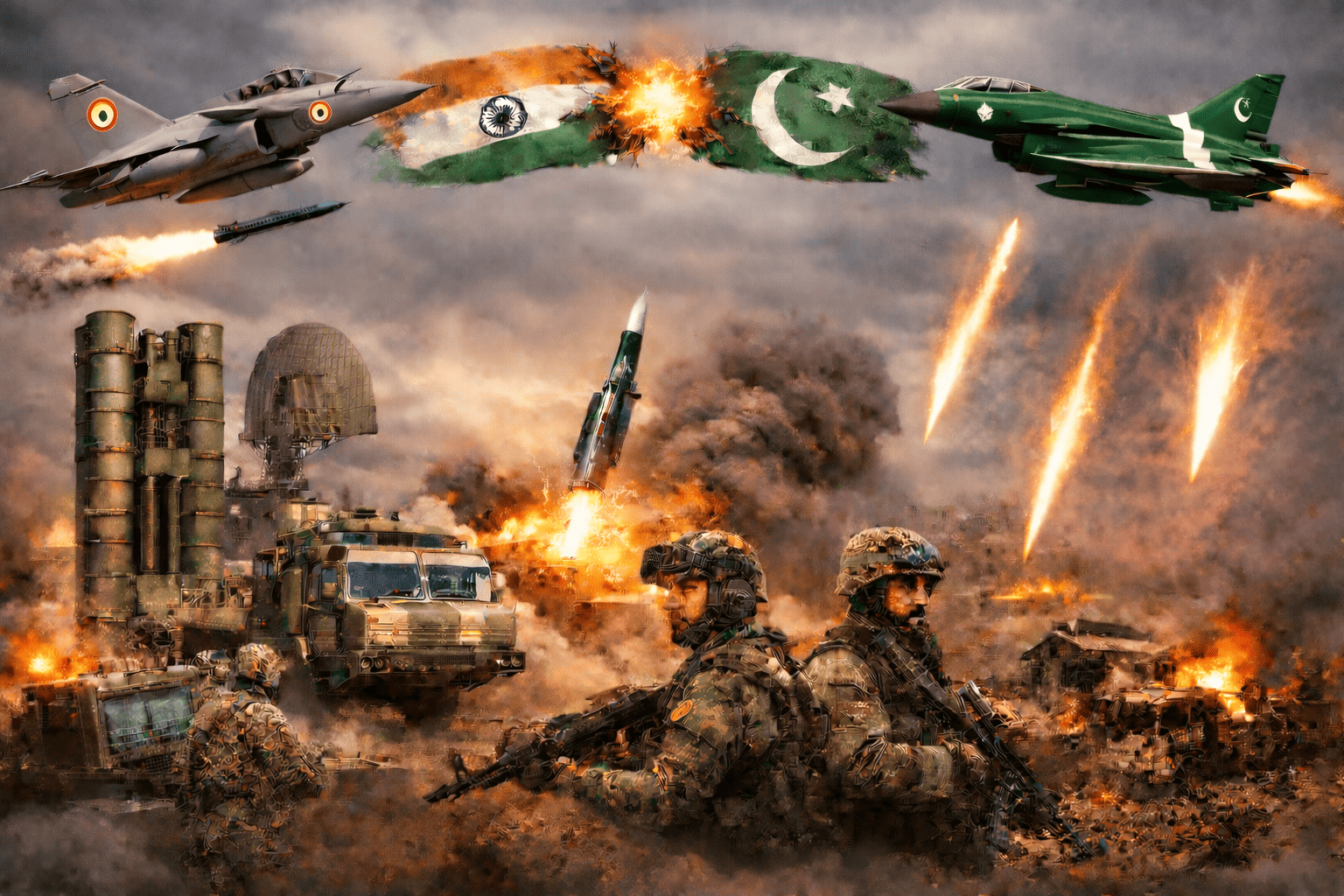
As “Op Sindoor”, the India–Pakistan conflict, has been put on a temporary pause, it is time to reflect on what happened. For the first time after the “Battle of Britain”, and the 1950 Korean War, two near-peer air forces were engaged in an air campaign. This was also the first conflict between two nuclear powers. Both sides had imbibed lessons from the Russia-Ukraine conflict. It was clear that aircraft crossing across the borders would face strong hostile air defence action. Therefore, all strikes would have to be undertaken using long-range stand-off precision weapons, and yet hit targets accurately without much civilian collateral damage. Also, the side with better air defence systems would be able to inflict significant damage and deter the adversary from carrying out strikes.
For long, Indian Air Force (IAF) strategy, tactics, and therefore inventories have been designed for offensive strikes against the Western neighbour with whom India has had three full-fledged wars and many shorter skirmishes. Having a smaller economy and military, Pakistan was conscious and built an air force that would be stronger at defending. In recent decades India had also to prepare to take on a possible China threat. Notwithstanding the known positions, the success of Indian strikes against both terror and military targets all across Pakistan proved very successful and defensive systems could not engage or thwart them.
There were weapon platforms and armaments belonging to many countries at play. These included the USA, Russia, China, France, and Turkey among others. Most analysts started comparing and analysing the performance of major weapons. This was also of interest to the manufacturing companies and their host countries. Some of the writings were also part of the narrative building to introduce motivated biases with politico-commercial considerations. The shares of some of these saw huge fluctuations on the stock markets on a day-to-day basis. Both sides claimed to have shot down each other’s aircraft on the opening round, but since no aircraft crossed the border, the wreckage, if at all, would have fallen in their own territories and so proof may have been concealed.
There was no controversy about the Scalp anti-surface cruise missiles, as proof of strikes was available in Battle Damage Assessment (BDA) pictures in open domain. The Chinese HQ-9 Surface-to-Air Missile (SAM) system, a poor copy of the Russian S-300, could not intercept any of the Indian strikes. Nor did Pakistan claim any aircraft having been shot using these SAMs as all claims were being assigned to the much-touted Chinese PL-15 Air-to-Air Missile (AAM). There were mixed opinions about the PL-15. A few of them landed in India in complete form, perhaps having been fired at ranges outside the envelope or having had technical failures, and will allow them to evaluate the system and technology. There were also doubts about the variant of PL-15 supplied to Pakistan. The upend variant with China has a claimed range of 180 kilometres. Pakistan was supposed to be having the export variant, the PL-15E with a range of 145 kilometres. Aircraft of neither side crossed the border or even came close to it. Both sides claim to have shot down each other’s aircraft. Losses, if any, would have fallen in their own territories and confirmations will take some time to come in the open.
But there was a unanimous opinion of all global experts on the good performance of two weapons, the S-400 SAM system and the BrahMos anti-surface missiles (ASM). Both performed flawlessly. Both are of Russian origin, and both are universally feared (respected) for their range, speed of engagement, and precision. At least 15 Indo-Russian BrahMos missiles were fired. The number of S-400 system missiles fired is still not in the public domain.
Cross Border Air Strikes
Just to recap, in the early hours of 7 May 2025, India launched air strikes on nine terrorist targets in Pakistan using 24 stand-off weapons. Operation was codenamed “Operation Sindoor”. It was in India’s response to the Pahalgam attack of 22 April by Pakistan-backed terrorists, in which 26 civilian tourists, mostly Hindu, were killed. India accused Pakistan of supporting cross-border terrorism, which Pakistan denied.
The missiles targeted the camps and infrastructure of militant groups Jaish-e-Mohammed and Lashkar-e-Taiba, and no Pakistani military or civilian facilities were targeted. The 23-minute duration initial Indian strikes were reportedly carried out by the Rafale aircraft using SCALP missiles and BrahMos cruise missiles, as well as Indian Army’s Indo-Israeli SkyStriker loitering munitions. Photographic proof of success of strikes was presented to the Indian and global media.
Following these strikes, there were gun duels and enhanced border skirmishes along the Line of Control (LoC). Pakistan also launched massive drone and missile strikes at military and civilian targets under operation codenamed Operation Bunyan-un-Marsoos. This included targeting airfields from Kashmir to Gujarat. India negated these strikes with its integrated air defence and counter-drone systems. The S-400 missile system, denominated as Sudarshan Chakra, marked India’s first combat use of this missile system. India’s indigenous Akash AD system played a huge role. Pakistani strikes caused insignificant damage and very few civilian casualties. Meanwhile, the IAF carried out SEAD/DEAD operations, neutralizing Pakistani air defence systems, including the Chinese HQ-9 in Lahore.
On 10 May, in response to Pakistani strikes against Indian military targets, the IAF made major airstrikes across the length and depth of the country targeting a variety of military targets including airfields, AD systems, weapon and logistic storage sites. The “Nur Khan” military airfield at Chaklala, which is just next to the capital Islamabad, and Pakistan Army’s HQs at Rawalpindi were also hit. Other airfields hit were Sargodha, Rafiqi, Rahim Yar Khan, and radars and storage dumps at Pasrur, Malir, Chunian, Sukkur, Pasrur, and the Sialkot aviation base. India also inflicted extensive damage on air bases at Skardu, Jacobabad, and Bholari in Pakistan.
During its retaliatory strikes on Indian military targets, Pakistan claimed that the BrahMos storage facilities at Beas and Nagrota were destroyed, and that two S-400 systems at Adampur and Bhuj were neutralised. International media acknowledged that all such claims were false. Immediately after the ceasefire, Indian Prime Minister Modi visited Adampur and addressed the personnel with the S-400 launcher forming the background. A similar visit was made by Defence Minister Rajnath Singh to Bhuj.
Debt-ridden Pakistan, which was already seeking financial bailout from the IMF, was rattled by the audacity and accuracy of the air strikes, and their Director General of Military Operations (DGMO) called his Indian counterpart on the hotline requesting a ceasefire. Clearly, a new normal had been set between the two nuclear-armed neighbours. Similar strikes could be triggered again in case of another Pakistan-backed terror attack.
There was significant cyber warfare. There was also a war of narratives fought across the globe, especially to highlight the success or failure of specific military hardware for commercial reasons. Turkey had supplied large quantities of drones to Pakistan. These were used, but caused little damage on ground. Clearly, Israeli Harop large loiter munitions were very effective. While the two sides were effectively at war, neither side had mobilized ground forces fully. A fragile ceasefire was achieved around midday on 10 May. Some call it a pause of hostilities. But it seems to be holding for the moment. Meanwhile, many non-kinetic actions such as suspension of the Indus Water Treaty, trade, visa restrictions, over-flights, among others, continue to be in place.
India said that 21 civilians and 5 military personnel had died in the conflict. The casualties and majority of the injuries occurred due to cross-LoC firing. Pakistan said that 51 people had died in the clashes, including 40 civilians and 11 military personnel. India claimed nearly 130 terrorists had been killed. India got global backing against terror, however not many were willing to take sides during the conflict.
Few systems got universal praise. These included the S-400 AD system, India’s indigenous Akash AD system, the DRDO 4D (Drone, Detect, Deter, Destroy) counter-drone system, and the BrahMos anti-surface missiles. French Scalp missile proved extremely accurate and destructive. Let us look at the two Russia-origin systems.
S-400 Missile System “Sudarshan Chakra”
The S-400 is a Russian mobile SAM system developed in the 1990s by Russia’s NPO Almaz as an upgrade to the S-300 family of missiles. The S-400 joined Russian armed forces in 2007. The system is complemented by its successor, the S-500. The S-400 system has four radars and four sets of missiles covering different ranges and vertical bubbles. The maximum target detection range is 600 kilometres and targets can be engaged as far as 400 kilometres. The five batteries of S-400 contracted by India in 2018 cost $5.43 billion including reserve missiles.
All the sub-units are data-linked and controlled by a central command and control system with sufficient redundancy. The system is capable of layered defence and integrates with other Indian air defences. One system can control 72 launchers, with a maximum of 384 missiles. All missiles are equipped with directed explosion warheads, which increase the probability of complete destruction of aerial targets. The system is designed to destroy aircraft, cruise, and ballistic missiles and can also be used against ground targets. It can engage targets up to 17,000 km/h or Mach 14. It can intercept low-flying cruise missiles at a range of about 40 km due to line-of-sight requirement. The anti-ballistic missile (ABM) capabilities of the S-400 system are near the maximum allowed under the (now void) Anti-Ballistic Missile Treaty. The number of simultaneously engaged targets by the full system is 36.
The system ground mobility speed is close to 60 km/h on roads and 25 km/h cross-country. It takes 5 minutes to be operational and fire when ordered while driving. Otherwise, system response time is just 10 seconds. Time between major overhauls is 10,000 hours. The service life is at least 20 years.
In Russia, the system was made operational around Moscow in 2007. Russia reportedly deployed S-400 in Syria. The system has been widely used in the ongoing conflict in Ukraine, and claimed to have shot down many aircraft. Meanwhile, Ukraine has reportedly used Western weapons, mainly U.S.-made ATACMS missiles, to hit S-400 units on the ground.
Belarus has unspecified numbers of S-400 units. Deliveries to China, of the six batteries ordered, began in January 2018. Four batteries consisting of 36 fire units and 192 or more missiles were delivered to Turkey. Algeria is another operator. Some other countries like Iran, Egypt, Iraq, Serbia, have also shown interest. South Korea is developing the KM-SAM, a medium-range SAM system based on technology from S-400 missiles, with assistance from NPO Almaz.
Three of the five batteries have arrived in India. India took deliveries despite the American threat of CAATSA (Countering America’s Adversaries Through Sanctions Act). The remaining two are expected in 2025/26. The recent conflict has revealed the rough location of two systems, one each being in Punjab and Gujarat. As per open sources, the third is somewhere in the east. The systems have been tested in various Indian military exercises. India’s first combat usage of the S-400 was during the recent “Op Sindoor” in which India credited it with thwarting Pakistan’s swarm drone and missile attacks.
BrahMos
The BrahMos is a long-range ramjet supersonic cruise missile that can be launched from land, submarines, ships, and fighter aircraft. It is a joint venture between the Indian Defence Research and Development Organisation (DRDO) and the Russian Federation’s NPO Mashinostroyeniya, who together have formed BrahMos Aerospace. The missile is based on the Russian P-800 Oniks. The name BrahMos is a portmanteau formed from the names of two rivers, the Brahmaputra of India and the Moskva of Russia. India holds 50.5 percent share of the joint venture. Seventy-five percent of the missile is manufactured in India and there are plans to increase this to 85 percent.
Large numbers of land-launched, ship-launched, as well as air-launched versions, have been inducted and are in service of the Indian armed forces. The missile guidance has been developed by BrahMos Aerospace. In 2016, after India became a member of the Missile Technology Control Regime (MTCR), India and Russia gradually increased the range of the missile to 800 km. The latest deliveries to the Indian Navy are of this type.
The cruise missile has anti-ship and land-attack roles, and is in service since June 2007. The other operator is the Philippine Marine Corps. The unit cost is around $3.5 million. The extended-range variant costs around $4.85 million. Many futuristic variants are evolving. Smaller-sized variants like BrahMos-NG could be carried on more types of aircraft, even on LCA.
This solid-propellant missile can carry a 200–300 kg warhead that could be nuclear or conventional semi-armour-piercing. Max operational ranges are up to 8–900 kilometres. Export variants are currently restricted to 290 km. Currently, missile speed is Mach 3. Later variants will be hypersonic (M 5+). The missile is very accurate with a CEP of less than one metre. BrahMos is India’s fastest cruise missile.
BrahMos was first test-fired on 12 June 2001 from the Integrated Test Range (ITR), Chandipur in a vertical launch configuration. The September 2010 test of BrahMos created a world record for being the first cruise missile to be tested at supersonic speeds in a steep-dive mode. BrahMos was tested with an Indian seeker for the first time in March 2018, and was tested with an India-developed propulsion system, airframe, and power supply in September 2019. On 30 September 2020, India successfully test-fired an extended-range BrahMos, offering a range of around 350 km, at speeds up to Mach 2.8. The submarine-launched variant of BrahMos was test fired successfully for the first time from a submerged pontoon on 20 March 2013.
The BrahMos-A is a modified air-launched variant of the missile with a reduced size and weight (2.55 tons). It has a range of 500 km when launched from Su-30 MKI, and it can carry only one BrahMos missile. Fifty IAF SU-30MKI were modified to carry the BrahMos-A missile.
Even BrahMos Block III land-attack variants are operational. There are plans to have 1500 km-plus range missiles. BrahMos-NG (Next Generation) or BrahMos-MA is a shortened version. Additionally, the BrahMos-NG will have an AESA radar rather than the current mechanically scanned one. The Sukhoi Su-30MKI will carry three missiles while the Mikoyan MiG-29K, HAL Tejas, including Dassault Rafale, will carry one. The BrahMos-NG will be ready by end 2025. BrahMos-II will be a hypersonic cruise missile. A UCAV variant is planned.
BrahMos is operationally deployed in large numbers by the three services. Additional missile orders have been recently placed for extended-range variants. The Philippines has placed a substantial order for their services and deliveries began in 2024. Russia too has plans to buy many missiles. Brazil has shown interest in the missile system. Vietnam and Indonesia have already signed deals.
Way Ahead
Resolute political will, choice of targets, weapon matching and accuracy, actionable intelligence, strong Indian air defences, great IAF professionals, and hitting strategic targets in depth were the clear clinchers.
India-Russia relations are time-tested. Russian platforms and weapons with Indian armed forces have performed exceedingly well for many decades. The S-400 and Su-30MKI–BrahMos combination have excelled in Op Sindoor. Could the S-500 (600 km) range be the next acquisition? Will India select the Su-57 fifth-generation aircraft and Make-in-India? Can Russia help accelerate the Indian nuclear submarine program? Should India acquire the “AWACS Killer” Russian R-37M AAM and the two work on futuristic long-range aerial missiles? Should there be more work together on Su-30MKI upgrade? Can the two enter into a joint venture for kamikaze drones required by both sides in large numbers, and India can help scale up production? Clearly, the sky is no more the limit.
Note: The article was originally written by the Author for Russia Today on 21st, May 2025, it has since been updated.
Header Picture Credit: Representative Image Generated using AI
Twitter: @AirPowerAsia
 Air Power Asia