
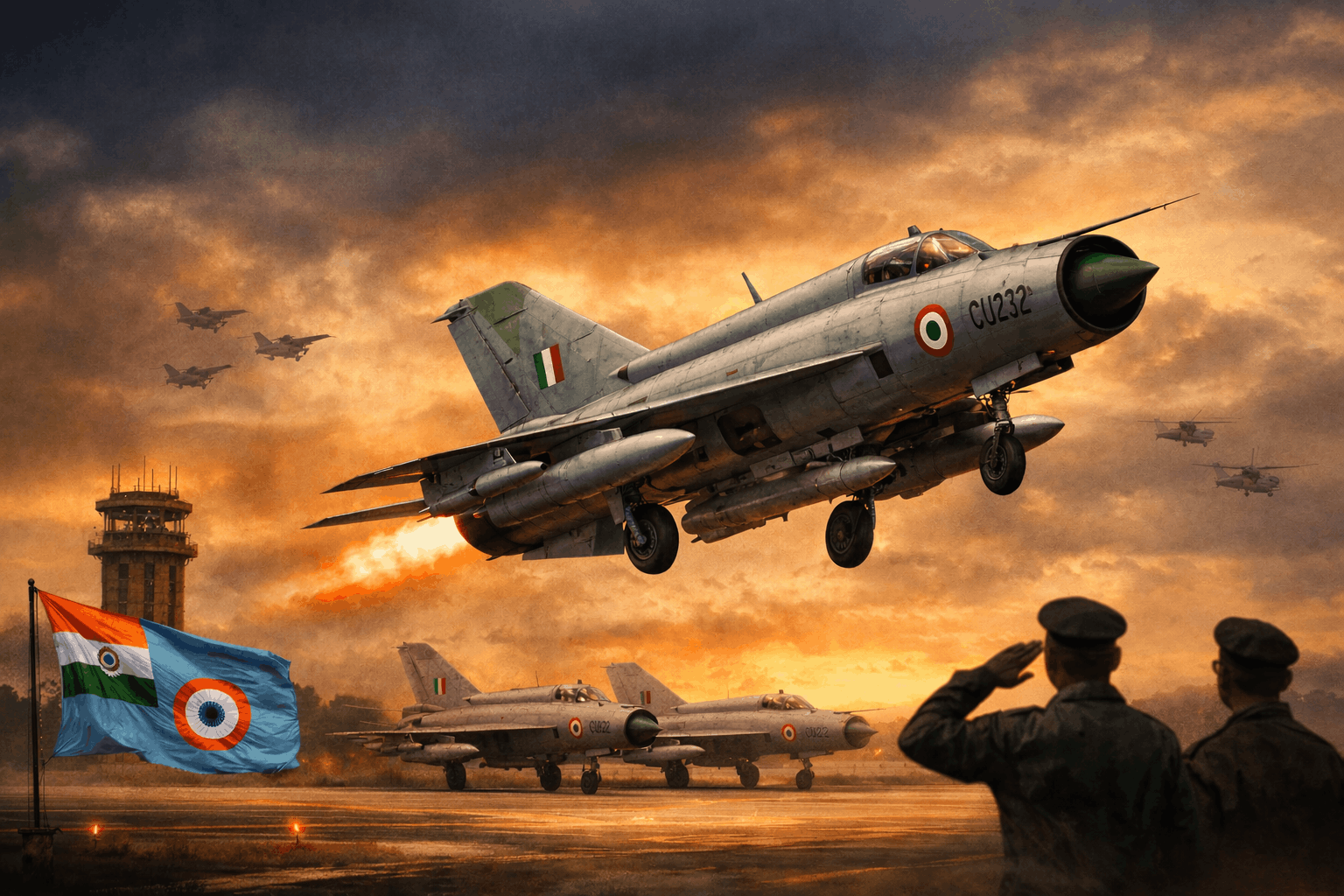
The Indian Air Force (IAF) is finally all set to retire its MiG-21 fleet in September 2025 after over 60 years of glorious service. India was among the three major operators after the Soviet Union and China (licensed variant Chengdu J-7). The iconic MiG-21 protected the Indian skies through all major conflicts. Its retirement is an emotional time for a few generations of Indian fighter pilots. Indian media is replete with nostalgic reminiscences of great aviators and Air Veterans. The author himself honed his combat flying skills on this aircraft starting 1974, and later was the Team Leader of the MiG-21 Upgrade project in Russia during 1996–2000.
IAF’s Wing Commander Abhinandan Varthaman shot down a Pakistani F-16 while flying a MiG-21 Bison, on February 27, 2019 during a showdown between the IAF and the Pakistan Air Force (PAF). It not only sent ripples across the world but also brought the MiG-21 in headlines again. The Mikoyan-Gurevich MiG-21 was designed as a supersonic jet interceptor aircraft by the MiG Design Bureau of the Soviet Union. MiG-21 was an airplane that hewed to the classic “perfect is the enemy of good enough” approach. The Soviets wanted to fill the sky with thousands of simple, lightweight, reliable jets. That strategy had worked splendidly with the Soviet AK-47 rifle.
Over 60 countries across four continents have flown the MiG-21, and it still serves in a few smaller air forces 65 years after its maiden flight. It made aviation records, and became the most-produced supersonic jet aircraft in aviation history (11,496), the most-produced combat aircraft after the Korean War, and once the longest production run of a combat aircraft, now exceeded by both the McDonnell Douglas F-15 and the Lockheed Martin F-16. Its baby brother, the transonic MiG-15, holds the all-time jet record with around 18,000 units produced. The MiG-21 had a long production run from 1959 to 1985, and the airplane was thereafter upgraded by India and Romania.
Initial Design and Development
Development of what would become the MiG-21 began in the early 1950s, when Mikoyan OKB finished a preliminary design study for a swept-wing prototype designated Ye-1 in 1954. After evolution, the first prototype with a delta-wing was the Ye-4. It made its maiden flight on 16 June 1955 and its first public appearance at Moscow’s Tushino airfield in July 1956.
The MiG-21 was the first successful Soviet aircraft combining fighter and interceptor capabilities. It was a lightweight Mach 2 fighter with a relatively low-powered afterburning turbojet when compared to the American F-104, F-5, or even the French Mirage III. The very characteristic shock cone in the front air intake was unique and peculiar, and left little space for a decent-sized radar. Like many aircraft designed as interceptors, the MiG-21 had a short range.
The delta-wing was excellent for a fast-climbing interceptor, but in turning combat led to a rapid loss of speed. A combat-loaded MiG-21bis could climb at 46,250 ft/min, quite close to the performance of the later F-16A. MiG-21’s Tumansky R-25 jet engine had an Emergency Power Rating (EPR) that allowed the engine to develop 97.4 kN of thrust at lower altitudes. Use of this temporary power gave the MiG-21bis a slightly better than 1:1 thrust-to-weight ratio. Given a skilled pilot and capable missiles, the aircraft could give a good account of itself against contemporary fighters. Aircraft G-limits were increased to +8.5G in the later variants. MiG-21s were replaced by the newer variable-geometry MiG-23 and MiG-27 for ground support duties. However, it was only the MiG-29 that ultimately replaced the MiG-21 as a manoeuvring dogfighter to counter new American air superiority types.
MiG-21’s simple controls, engine, weapons, and avionics were typical of Soviet-era military designs. The use of a tail with the delta wing aids stability and control at the extremes of the flight envelope, enhancing safety for lower-skilled pilots. This, in turn, enhanced its marketability in exports to developing countries with limited training programs and restricted pilot pools.
The maximum permitted speed was 2,237 km/M2.05 at 13,000 m (42,651 ft), and 1,300 km/h/M1.06 at sea level. The service ceiling was 17,500 m (57,400 ft). The aircraft could operate from semi-prepared surfaces. The aircraft armament included one GSh-23 mm gun with 200 rounds. Aircraft had 4 hard-points with a capacity of up to 2,000 kg of stores, with provisions to carry combinations of bombs, rockets and missiles or fuel drop-tanks. In later variants it included the latest air-to-air missiles, the R-73, R-77, and R-27. Its low production and maintenance costs made it a favourite of many nations.
A total of 10,645 aircraft were built in the USSR. They were produced in factories at Moscow, Gorky (now Nizhny Novgorod) and Tbilisi (now Georgia). A total of 194 MiG-21F-13s were built under license in Czechoslovakia, and India’s Hindustan Aeronautics Ltd (HAL) built 657 MiG-21FL, MiG-21M and MiG-21bis. About 2,400 J-7s were manufactured in China, including for export. Due to the mass production, the aircraft was very cheap. The MiG-21MF, for example, was cheaper than the BMP-1 Soviet amphibious tracked infantry fighting vehicle. The American F-4 Phantom cost was several times higher than MiG-21.
Vietnam War
The MiG-21 was a key fighter aircraft used by the North Vietnamese Air Force (VPAF) in the Vietnam War against the United States. Known for its high speed, agility, and ability to make successful hit-and-run attacks, VPAF pilots developed tactics to exploit the MiG-21’s strengths. Ground controllers would vector the MiG-21s into position, often from lower altitudes, to ambush vulnerable American strike formations. The first-ever MiG-21 victory came in 1966 over Vietnam, when a North Vietnamese pilot shot down an American Ryan Firebee surveillance drone cruising at 59,000 feet.
The MiG-21 was a fast and nimble fighter with a high rate of climb, making it an effective interceptor designed to engage and disengage quickly. VPAF pilots fired missiles, and then rapidly dived away before US fighter cover could respond. Its small frontal profile and lightweight design made the MiG-21 difficult for adversary pilots to spot, providing a crucial element of surprise. The effectiveness of the MiG-21 forced American bombers to jettison their payloads prematurely, disrupting crucial air campaigns. On 26 December 1972, a VPAF MiG-21MF claimed the first aerial combat kill of a B-52 Stratofortress, launching two K-13 missiles from 2 kilometres.
Despite US F-4 Phantoms having massive firepower, good on-board radar, better speed and acceleration, F-4s suffered higher losses. It led the US Navy to create their Naval Fighter Weapons School (TOPGUN) in March 1969. The USAF quickly began Dissimilar Air Combat Training (DACT) in a program called “Red Flag”. The losses forced American pilots to adapt new strategies and ultimately develop improved tactics. The MiG-21 significantly outperformed the F-105 in most flight regimes.
According to Russian data, in air battles, the North Vietnamese MiG-21s credited 165 air victories, with the loss of 65 aircraft (few by accident) and 16 pilots. The losses of the MiG-21 pilots were the smallest in comparison with all other airplanes, they said. As per another source (migflug.com), the MiG-21 variants scored 240 lifetime victories by the end of 2017.
Operational History India
In 1961, the IAF opted to purchase the MiG-21 over several other Western competitors. As part of the deal, the Soviet Union offered India full transfer of technology (ToT) and rights for local assembly. Since 1963, IAF has inducted more than 1,200 different MiG fighters. In 1964, the MiG-21 became the first supersonic fighter jet to enter service with the IAF. Meanwhile, factories were set up at Nasik (aircraft), Hyderabad (Avionics), and Koraput (engines) with Soviet assistance. HAL produced 657 aircraft of three variants: MiG-21FL, MiG-21M, and MiG-21bis.
Due to limited induction numbers and insufficient pilot training, the IAF MiG-21 played a limited role in the Indo-Pakistan War of 1965. However, the IAF gained valuable experience. The capabilities of the MiG-21 were put to the test during the 1971 Bangladesh Liberation War. The MiG-21s played a crucial role in giving the IAF air superiority in both western and eastern theatres. The 1971 war witnessed the first supersonic air combat in the subcontinent when an Indian MiG-21FL claimed a PAF F-104A Starfighter with its GSh-23 twin-barrel 23 mm cannon. By the end of the hostilities, the IAF MiG-21FLs had shot four PAF F-104s and two Shenyang F-6, and one PAF Lockheed C-130 Hercules. According to one Western military analyst, the MiG-21FLs had clearly “won” the much-anticipated air combat between the MiG-21FL and the F-104A.
In the eastern sector, the MiG-21 played a crucial role for the IAF, earning the moniker “runway buster” for its ground attack capabilities. Repeat attacks on December 6 and 7, 1971, successfully cratered the runways at Tejgaon and Kurmitola near Dhaka, effectively grounding the PAF in the eastern sector. On December 14, 1971, four MiG-21s from Tezpur airbase led by Wg Cdr Bishnoi (VrC & Bar) attacked the Governor’s House in Dhaka, paving the way for the surrender of Pakistani forces.
Because of the performance of India’s MiG-21s, several nations, including Iraq, approached India for MiG-21 pilot training. By the end of 1970s, more than 120 Iraqi pilots were being trained by the IAF. On 10 August 1999, two MiG-21FLs of the IAF intercepted and shot down a Pakistan Naval Air Arms Atlantic maritime patrol aircraft with an R-60 missile after it entered Indian airspace for surveillance, killing all on board.
However, the plane had been plagued by safety issues. Since 1970, more than 170 Indian pilots and 40 civilians have been killed in MiG-21 accidents. The aircraft engine operates very close to its surge line in some regimes, and the ingestion of even a small bird can lead to an engine surge/seizure and flame out. On 11 December 2013, the MiG-21FL was decommissioned after being in service for 50 years. The final Soviet-produced variant was the MiG-21bis, manufactured between 1972 and 1985.
MiG-21 Bison
To stretch its operational life and to give it significant multi-role capability, IAF went for the MiG-21 Upgrade in the mid-1990s, jointly with the MiG Design Bureau in Russia. Aircraft was named “Bison”. It had a MiG-29 bubble canopy and wraparound windscreen; far more capable radar; a helmet-mounted weapons sight; and beyond-visual-range, fire-and-forget advanced missiles such as the R-73 and R-77. These and other modifications created a fourfold increase in the airplane’s capability and brought it up to roughly the level of the early F-16 variants. It also got a radar warning receiver, an internal jammer, improved avionics and a new head-up display. It also got TV-guided bombs. 125 were inducted in six squadrons.
The Indian Upgrade Team operated with the MiG Design Bureau in Moscow. The physical modification was at Sokol Aircraft Plant “Sokol” at Nizhny Novgorod. During 45 years of serial production this plant had manufactured about 13,500 combat aircraft, including MiG-15, MiG-17, MiG-19, MiG-21, MiG-25, MiG-29, and MiG-31, among others. The Indian team had excellent working relations with the Russians, and some old timers had worked in India to help set up the MiG plant at Nasik. We also had skiing, camping and cruise outings together. The final MiG-21 Bison proved a formidable fighter.
MiG-21s in Other Wars
The MiG-21s saw a lot of action in the Middle East. Israel was surrounded by MiG-21s operated by Egypt, Syria, and Iraq. Israel was desperate to know about the MiG-21 so that they could evaluate and refine the air-to-air tactics of its fleet of delta-wing Mirage IIICJs. Israel’s Mossad intelligence agency (Operation Diamond) recruited a disgruntled Iraqi MiG pilot to defect with his airplane, in exchange for $300,000 and Israeli citizenship. The Israel Air Force flew the Iraqi MiG enough to determine that it was a good high-altitude interceptor, was easy to fly, and that, against a Mirage, pilot skill would determine the outcome. In 1968, the airplane was lent to the USA for its own testing and evaluation.
In the 1967 Six-Day War, the Israeli Air Force struck Arab air forces in four attack waves. A large number of MiG-21s were lost on the ground in Egypt and Syria. Both sides achieved aerial kills. In view of high losses in 1967, in March 1970, Soviet pilots and SAM crews arrived with their equipment. Soviet pilots flew many missions and Israel lost many F-4 and A-4E fighters in the coming days. Israel was forced to review tactics. During the Yom Kippur War (October 1973), the MiG-21s performed very creditably in air combat resulting in many adversary aircraft claims.
During the Iran–Iraq War from 1980 to 1988, the Iraqi MiG-21s shot down 43 Iranian fighter aircraft against 49 MiG-21 losses in the same period. Egyptian MiG-21s were used in combat against Libyan Mirages and MiG-23s during the brief Libyan–Egyptian War of July 1977. MiG-21s were later used extensively to bomb forces loyal to the rival General National Congress in Benghazi. Both Somalia and Ethiopia operated MiG-21s and fought wars with each other.
During Angola’s long civil war, MiG-21s of the Cuban Air Force were frequently deployed to attack ground targets manned by rebel forces or engage South African Air Force Mirage F1s, conducting cross-border strikes. During the early stages of the 1990s’ Yugoslav Wars, MiG-21s were used in a ground-attack role. From 1962 to 1990, Romania had acquired a total of 322 MiG-21s. Romania upgraded 111 MiG-21s with help of Israel’s Elbit Systems. The Bulgarian Air Force received a total of 224 MiG-21 aircraft, beginning September 1963.
In Praise of MiG-21
The MiG-21 has been called the AK-47 of airplanes. “Rock-solid airframe,” noted a former MiG-21 ground technician. “Really, the thing only needs to be topped off with fluids, and it just goes and goes.” When the US Air Force operated MiG-21s as adversary aircraft combat trainers, they found them to be, in the words of one crew chief, “Just like your family car. As long as it’s full of fuel, you pull it out of the garage and start it up.” “With a set of home socket wrenches and screwdrivers, you could get a lot of maintenance done on the little jet,” said another crew chief. Even more important is the fact that a MiG-21bis can be had for $500,000. A second-hand F-16C can cost a small country $15 million. MiG-21s or their Chinese-produced variants were flown in more than 60 countries. During the Cold War, the United States acquired many MiG-21 variants. American pilots spoke well of the plane, and it performed more than adequately in aggressor training situations. Indeed, highly trained American pilots probably pushed the MiG-21 farther than most Soviet pilots could have done. There still are around 44 privately owned MiG-21s in the US. Draken International had acquired 30 MiG-21bis/UM, mostly ex-Polish, and was last known to be still operating them.
Robert Farley wrote in the National Interest portal that a few designs stand the test of time. The B-52 Stratofortress first flew in 1952, and is expected to cross a century in service. New C-130s continue to roll off the production line, based on a design that became operational in 1954. But those are bombers and transport aircraft; they don’t fight one another. Fighters face a special problem of longevity, because they must compete directly with newer models. Thus, very few fighters have had long life spans, either in production or in service. The MiG-21 was an exception. The MiG-21 would exceed Mach 2.0, with an internal cannon and the capacity to carry between two and six missiles. Like most fighters, the MiG-21 would eventually serve in a ground attack role, in which it can carry a limited number of bombs and rockets.
Most modern fighters don’t fly much faster than the MiG-21 or manoeuvre much more capably. While they do carry more ordnance and have more sophisticated electronic equipment, many air forces can treat these as luxuries, as they simply want a cheap, fast, easy-to-maintain aircraft that can patrol airspace and occasionally drop a few bombs. The MiG-21 fitted the bill. The MiG-21 has reached 65 years, and probably will reach 70 years. It remains one of the iconic fighters of the supersonic age.
Several pilots attained ace status (five or more aerial victories) while flying the MiG-21. Nguyen Van Coc of the VPAF, who scored nine kills in MiG-21s, is regarded as the most successful MiG-21 pilot of all time. Twelve other VPAF pilots were credited with five or more aerial victories while flying the MiG-21. Additionally, three Syrian pilots are known to have attained ace status while flying the MiG-21.
The record for highest number of sorties on a MiG-21 belongs to Air Commodore Surendra Singh Tyagi (Retd.) of the IAF, with 6,316 sorties. He also holds the world record for the most flying hours on the aircraft, with 4,306 hours. His extensive experience with the MiG-21 is recognized by the Russians. As the great era closes to its end, some ancient MiGs may still be flying in the hands of war-bird enthusiasts long after the last B-52 shuts down forever.
Note: The article was originally written by the Author for Russia Today on 20th, September 2025, it has since been updated.
Header Picture Credit: Representative Image Generated using AI
Twitter: @AirPowerAsia
 Air Power Asia