UAE President Mohamed bin Zayed Al Nahyan is scheduled to visit the Indian capital, New Delhi, amid flaring tensions in the Middle East. In Iran, the United States is mulling an attack on the Islamic Republic amid raging protests in the country and possibly even removing the Supreme Leader, Ali Hosseini Khamenei, from power. Tensions have erupted between ‘Iron Brothers’ Saudi Arabia and the UAE, who are finding themselves on opposite sides of the divide in the decades-long Yemen Civil War.
Turkey, which aims to lead the Islamic world and revive its ‘Ottoman Dream’, is actively exploring options to join the Saudi-Pakistan SDMA (Strategic Mutual Defence Agreement), a possible threat to India.
Under SDMA, both countries have committed to treating any act of aggression against one as an act against both (collective security). The news of SMDA quickly attracted the Western news media to speculate that Pakistan’s nuclear weapons could be deployed in the Kingdom. The addition of Turkey would add fuel to the fire! Should India and the UAE, which share extremely close relations, be apprehensive of these developments?
A New “Med QUAD” in the Making?
Greece, Cyprus, and Israel signed a 2026 Trilateral Military Cooperation Plan in late December 2025, formalizing deeper defence ties for the upcoming year, focusing on joint exercises (air, naval), strategic dialogue, specialized training (unmanned systems, electronic warfare), and expertise exchange to bolster regional stability, especially in the Eastern Mediterranean, as announced by the Israeli Defence Forces (IDF).
India has been formally invited to join the “3+1” summit and strategic forum by Israel, Greece, and Cyprus. India already shares extremely close ties with all three countries. This plan follows a trilateral summit and includes bilateral work plans, signalling a strong security alignment against shared threats, particularly concerning Turkey. The plan was signed in Nicosia, Cyprus, by military officials from the three nations. The plan is to create working groups for defence fields and strategic discussions on security issues. Separate bilateral agreements between Israel and each nation (Greece, Cyprus) are also part of the deal. The cooperation is seen as a strategic message to Turkey, with Israel, Greece, and Cyprus solidifying their alliance as pillars of regional stability.
Islamic NATO Rising?
In January 2026, Turkey moved to join the defence arrangement between Pakistan and Saudi Arabia, opening talks with both countries on accession. A draft document is reportedly ready. Turkey already maintains defence cooperation with both countries, including naval shipbuilding for the Pakistan Navy and joint work in aerospace and unmanned systems, which formed the basis for its proposed inclusion. Does that mean both Saudi Arabia and Turkey need Pakistan’s nuclear umbrella, and the “Islamic Bomb” has actually become a reality? Azerbaijan is another country already in the Turkey-Pakistan fold. India and Israel have maintained traditional strong defence relations. They have congruence of interests. India maintains close relations with Greece and Cyprus. Is there a scope for greater Indian interest and involvement in the Mediterranean?
IDF plans to bolster regional ‘stability, security and peace’. The deal includes the transfer of intelligence and know-how from Israel to address ‘asymmetrical’ and ‘symmetrical’ threats. The three will step up joint military exercises in the Eastern Mediterranean in 2026, deepening their defence cooperation. Strengthening maritime security cooperation and advancing energy interconnection projects are important parts. There will be bilateral work plans between the IDF, Greece’s Hellenic Armed Forces, and the Cypriot National Guard. Greece and Israel will intensify joint exercises after the ceasefire in Gaza, with Cyprus as a participant. Greece also plans to join Israel’s Noble Dina naval exercise in the coming months in the Eastern Mediterranean.
Greece and Cyprus have already purchased missile systems from Israel worth billions of dollars. Athens is also in talks to buy from Israel medium- and long-range anti-aircraft and anti-ballistic missile systems for a planned multi-layer air and drone defence system known as the “Achilles Shield,” estimated to cost about $3.5 billion. This month, the Greek parliament approved the purchase of 36 PULS rocket artillery systems from Israel to bolster defences along Greece’s north-eastern border with Turkey and on Greek islands in the Aegean Sea. The initiative is meant to deter Turkey’s military activity in the region. Senior officials from Israel, Greece, and Cyprus discussed the possibility of establishing a rapid-response force composed of about 2,500 personnel, some 1,000 soldiers each from Greece and Israel, and 500 from Cyprus.
The force would not be a permanent standing unit but one that could be deployed quickly in times of crisis on land, at sea, or in the air.
Israel-India Defence Cooperation
Israel provides cutting-edge technology to modernize India’s military against regional threats. India-Israel defence relations are deeply strategic, built on strong cooperation in advanced weapon systems (drones, missiles, radars), joint R&D (like Barak-8), tech transfer, and counter-terrorism, with Israel being a key supplier supporting India’s “Make in India” goal, fostered by high-level visits and mutual security interests against threats like terrorism.
Israel’s share of India’s defence imports peaked at around 34% (2015–2019) and is currently roughly 9–13%, behind Russia and France. India is acquiring Israeli drones (Heron, Searcher), missile systems (Barak-8/MRSAM, Spyder), loiter munitions (Harop), advanced radars (airborne and ground-based), and light machine guns (IWI Negev NG-7). Joint development collaboration on projects like the Barak-8 missile system (for land & naval forces) and upgrading Indian drones (Project Cheetah) for indigenous production.
Israeli firms are sharing technologies with Indian defence companies such as Tata, Bharat Forge, and Adani for Pinaka rocket systems, the Arbel smart rifle system (co-production), guided munitions, and Elbit Systems UAVs and artillery projects. Joint development with Premier Explosives. ELTA Systems/Tata JV (Hela Systems) for EW, communications, and systems for combat aircraft. Air-to-Air Refuelling collaboration with IAI to convert Boeing 767s. Joint ventures with IAI, Rafael, and Belrise with Indian firms. Emerging technologies cooperation in AI, cybersecurity, counter-terrorism, and integrated production. Joint efforts in intelligence sharing and combating cyber threats. Shared commitment to fighting terrorism, with both nations affected by extremist attacks.
Both countries are active members of the I2U2 Group, a strategic partnership among India, Israel, the United Arab Emirates (UAE), and the United States (US) that promotes economic and technological collaboration. The Bilateral Innovation Agreement (BIA) was signed in 2021 by India’s DRDO and Israel’s DDR&D to foster joint research & development (R&D) with start-ups on advanced, dual-use technologies (such as AI, drones, and quantum technologies).
India and Israel conduct joint military exercises, notably the IAF’s participation in Israel’s biennial “Blue Flag” air combat drills (since 2017) and joint counter-terrorism exercises, enhancing aerial tactics, special forces, and defence tech cooperation, with regular naval exchanges also occurring. These drills, including ground infiltration and asset protection, solidify their defence partnership, focusing on modern warfare challenges and knowledge exchange. India and Israel held a joint counter-terrorism drill in Delhi in 2024.
In essence, the partnership has moved beyond simple buyer-seller to deep strategic trust, co-development, and shared security objectives, making Israel a vital defence partner for India.
India and Greece
India and Greece have significantly boosted military ties, holding their first bilateral naval exercise in the Mediterranean in September 2025. The Indian Air Force (IAF) participated in the multinational INIOCHOS-25 air exercise in Greece in April 2025, demonstrating growing defence cooperation in maritime security and air warfare, with joint drills like anti-submarine warfare and air defence enhancing interoperability.
Indian Navy’s INS Trikand, and Hellenic Navy’s HS Themistokles, HS Pipinos, and Special Forces boats participated. The exercise included a harbour phase at Salamis Naval Base, followed by a sea phase with anti-submarine warfare, gun firing, VBSS (Visit, Board, Search, and Seizure) drills, and cross-deck helicopter operations. A joint Passing Exercise (PASSEX) also occurred off Mumbai in July 2025.
In INIOCHOS-25, the Indian Air Force (IAF) fielded Su-30 MKI fighters, IL-78 tankers, and C-17 aircraft. Other air forces included those from the United States, Israel, France, Italy, the UAE, Poland, Spain, Qatar, Slovenia, and Montenegro. Greece used all types of fighter jets, helicopters, transport, and training aircraft. 1300 sorties were conducted throughout the Athens FIR during the exercise.
Planning and executing combined air operations and refining tactics in complex scenarios were practised. These exercises signify growing defence cooperation and strategic alignment, driven by shared interests in maritime security and stability. The enhanced engagement builds on a strategic partnership established in 2023.
India-Cyprus Relations
India-Cyprus relations are traditionally strong, built on shared democratic values, mutual trust, and cooperation since the establishment of diplomatic ties. Recent high-level visits established a 5-year roadmap to boost strategic, economic (trade and investment), gateway-to-the-EU, defence, digital, and maritime collaboration, focusing on innovation, connectivity, and addressing global challenges such as terrorism.
Both nations consistently support each other on international platforms, with Cyprus backing India’s push for UNSC reform and India supporting Cyprus’s sovereignty. PM Modi’s 2025 visit has accelerated ties, focusing on a strategic roadmap for growth. Collaboration includes the India-Greece-Cyprus (IGC) Business Council, digital & tech innovation (AI, cybersecurity), and exploring joint ventures.
Cooperation deepened through a 2025 Defence Cooperation Programme that aims to enable real-time information exchange on terrorism and maritime security.
Cyprus-Turkey Relations
Cyprus-Turkey relations are defined by the island’s 1974 division, with Turkey recognizing only the self-declared Turkish Republic of Northern Cyprus (TRNC), while the Republic of Cyprus (RoC) has no official ties with Ankara. Tensions stem from Turkey’s military presence, maritime disputes over energy exploration in the Eastern Mediterranean, and Turkey’s continued support for the isolated North, while the RoC, now an EU member, seeks reunification under a bi-communal federation, highlighting ongoing diplomatic deadlock and complex geopolitical dynamics.
Israel-Turkey Relations
Turkey-Israel relations are currently at a low point, marked by severe diplomatic strain and trade halts, primarily due to President Erdoğan’s strong condemnation of Israel’s actions in Gaza post-October 7, 2023, with Turkey accusing Israel of genocide and openly supporting Hamas. Once close strategic allies with strong military and intelligence ties, relations have deteriorated significantly since the 2010 Mavi Marmara incident, with brief normalization attempts in 2022 failing to hold amid ongoing Palestinian issues and regional power struggles, making energy cooperation and broader Middle East stability critical yet currently blocked.
Turkey-India Relations
India-Turkey relations are complex, historically warm, with strong economic ties (trade of ~$8.7B in FY25), but strained by Ankara’s strong support for Pakistan, especially regarding Kashmir, leading India to support Armenia and Greece. Its recent ‘open’ support to Pakistan during Operation Sindoor has further strained ties between Ankara and New Delhi.
While both nations are rising powers with shared democratic ideals, geopolitical alignments, particularly Turkey’s closeness with Pakistan, create friction despite growing tourism.
India-Saudi Arabia Relations
India-Saudi Arabia relations are a deepening strategic partnership rooted in centuries-old socio-cultural ties, now focused on major investments, energy security, defence cooperation, and strong people-to-people connections, with India being a key energy destination and Saudi Arabia a significant trade partner, further elevated by the 2019 Strategic Partnership Council.
Both nations cooperate on counter-terrorism, cultural exchanges (such as the Hajj), and large infrastructure projects, solidifying their bond beyond traditional oil and remittance flows. Indian workers (the highest in any country) form a significant part of Saudi Arabia’s large expatriate workforce, with millions employed across sectors such as construction, domestic work, and services, contributing to the Saudi economy.
Saudi Money, Pak Nukes & Turkish Military Industry
Saudi Money, Pak Nukes, Turkish Military, are creating a collective defence framework which some are terming as “Islamic NATO.” Turkey is in talks to join a Saudi Arabia-Pakistan security arrangement. The proposed pact echoes NATO’s Article 5, stating that “any aggression” against one member would be treated as an attack on all. Under the emerging division of roles, Saudi Arabia would provide financial backing, Pakistan would contribute its nuclear deterrent, ballistic missile capability, and manpower, while Turkey would add military expertise and support for its indigenous defence industry.
With Trump promoting “America First”, denying F-35s to Turkey for buying the Russian S-400 AD system, the United States backing Israeli interests in the region, and West Asia seeing new alignments, Turkey has been looking for new partners.
Turkey’s strategic interests increasingly converge with those of Saudi Arabia and Pakistan. The three have already begun closer coordination. They held their first-ever naval meeting in Ankara a week back (8–10 January 2026). It needs to be understood that Turkey is not just a regional player but a long-standing member of the United States-led NATO alliance and fields the second-largest military within NATO after the United States.
Turkey also hosts United States nuclear weapons, specifically about 50 B61 nuclear bombs, at Incirlik Air Base as part of NATO’s nuclear sharing policy. Is Turkey unsure about the nuclear umbrella, or does it have much larger ambitions in the Islamic world? Saudi Arabia and Turkey, both predominantly Sunni, share long-standing concerns about Shiite-majority Iran, though both favour engagement with Tehran over military confrontation. Pakistan, too, is Sunni. They all support a stable, Sunni-led world and advocating Palestinian statehood.
Turkey’s defence ties with Pakistan are well established. Ankara is constructing corvette warships for the Pakistani Navy, has modernised dozens of Pakistan’s F-16 fighter jets, and is already sharing drone technology with both Riyadh and Islamabad. Turkey has also invited them to participate in its Kaan fifth-generation fighter jet program.
These trilateral defence discussions have accelerated since Pakistan’s drubbing during Op Sindoor in mid-2025. Pakistan is looking for partners to deter India from further launching attacks on its terror infrastructure. On paper, Turkey is one of the strongest options for Pakistan.
Way Ahead
India-Pakistan relations are at a low. Op Sindoor is on temporary hold. A terrorist attack could again spark hostilities. Saudis have long aspired for a nuclear bomb. Pakistan is in a financial mess. The American defence umbrella over Saudi Arabia is insufficient and may change over time. Saudis can bail out Pakistan in exchange for nuclear cover, or even a bomb. In the event of the next India-Pakistan conflict, the Saudis are treaty-bound to help Islamabad. Militarily, they may not, but financially, they could.
Turkey wants to lead the Islamic world. Turkey is a significant global military power, consistently ranked in the Top 10 in Global Firepower (GFP). As per reports, it is discussing proposals to join the Pak-Saudi SDMA. More countries could follow, such as Azerbaijan and even Bangladesh. Currently, the United States is also imposing high tariffs and threatening sanctions against India. India needs to navigate its foreign policy with great maturity and finesse.
Israel continues to be an important friend, albeit it too has American pressures. India has made some good moves by befriending Greece, Cyprus, and Armenia, all of which are Turkey’s immediate neighbours.
Military-controlled Pakistan is currently in the good books of the Trump Administration, primarily because Washington wants to use it against Iran and balance heavy Chinese influence in the region. Also, Trump is looking at rare-earth deposits in Balochistan. A Saudi-Pakistan-Turkey strategic alliance raises major strategic concerns for India by combining Saudi financial support, Turkish technology, and Pakistan’s nuclear deterrent, shifting power dynamics in South/West Asia, and complicating maritime security.
India’s options involve further boosting its own ties with countries like Israel and the United States, and immediate Turkish neighbours, Greece, Cyprus, and Armenia; enhancing maritime surveillance, leveraging economic influence (of both Saudi Arabia and UAE), and preparing for a more complex regional security landscape by boosting domestic defence capabilities. India technically does not really need an alliance to counter Pakistan and its allies, like Turkey, which has supported Islamabad in almost all wars, unsuccessfully. The “3+1” framework involves Israel, Cyprus, Greece (the “3”), and the United States (the “+1”), focused on energy security, defence, counterterrorism, and economic cooperation.
Amid all the geopolitical shifts in the Middle East and South Asia, will India formally join or expand the existing Greece-Cyprus-Israel-United States framework? How will the UAE manage its “deteriorating” ties with Saudi Arabia? Will the Emirati Kingdom expand its security ties with India and Israel? Let’s wait and watch.
Note: The article was originally written by the Author for The Eurasian Times on 18th, January 2026, it has since been updated.
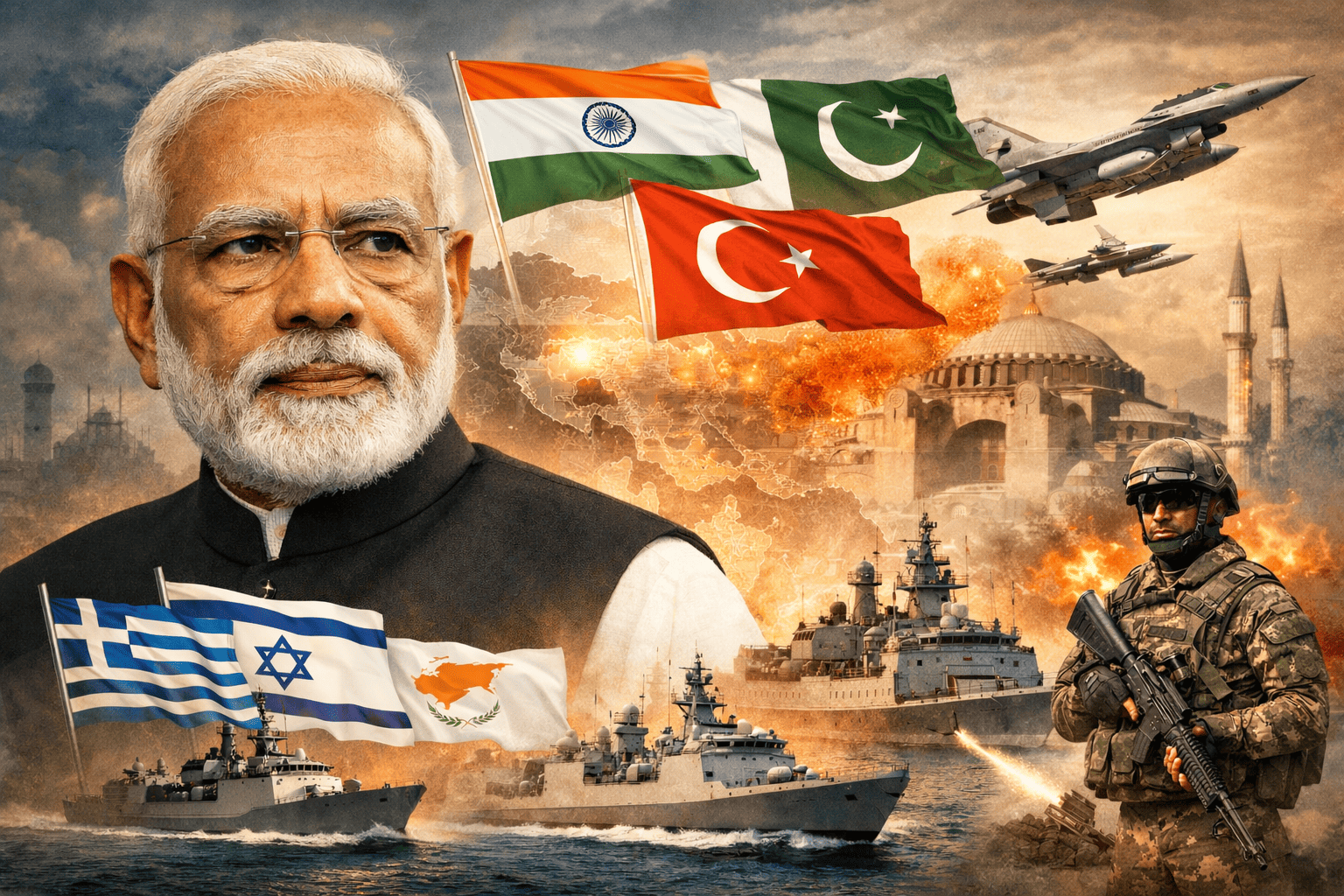
Header Picture Credit: Representative Image Generated using AI
Twitter: @AirPowerAsia
 Air Power Asia