
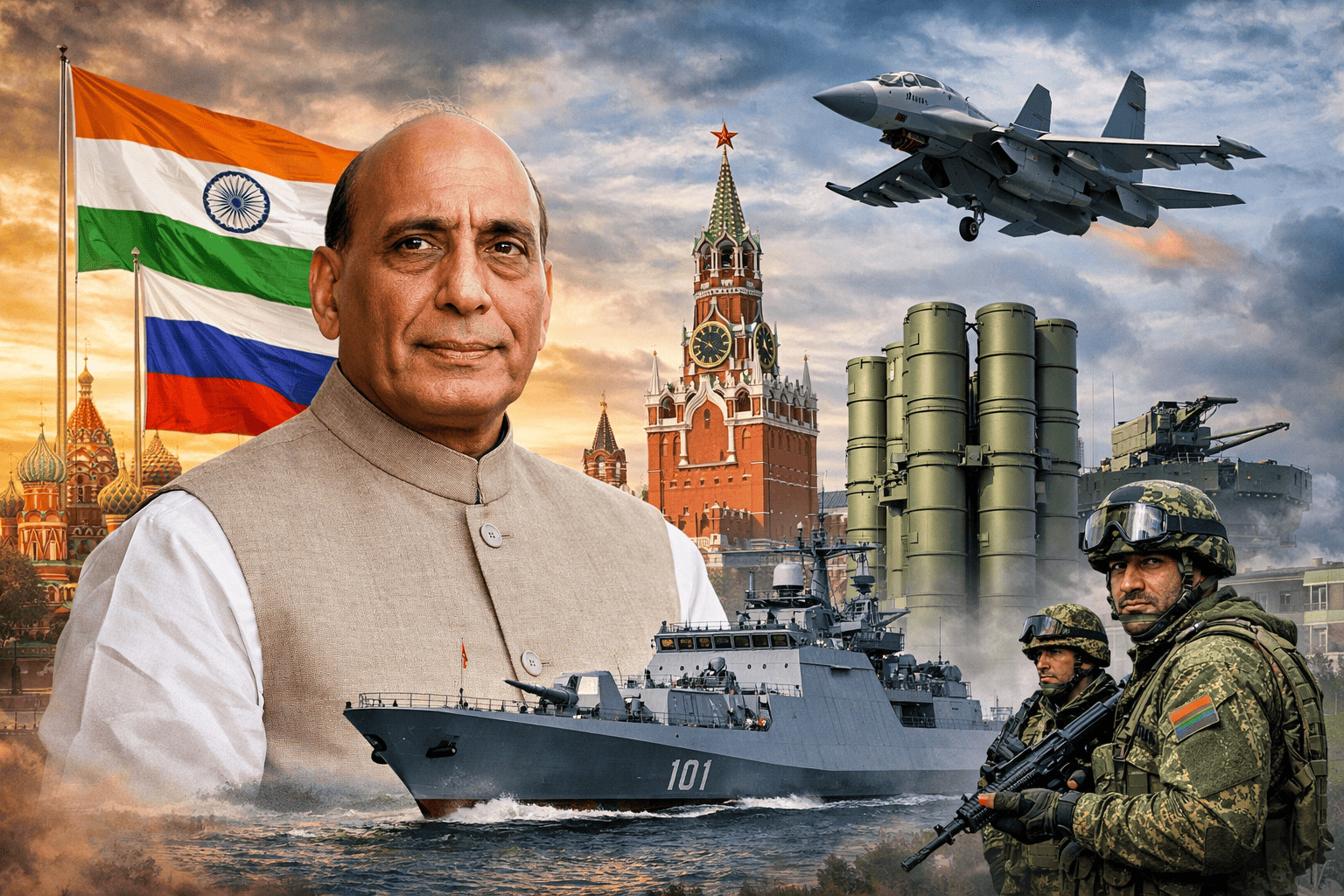
Indian Defence Minister Rajnath Singh arrived in Moscow on Sunday night on a 3-day visit. The Minister was received by Indian Ambassador Vinay Kumar and Russian Deputy Defence Minister Alexander Fomin. Rajnath Singh’s trip comes shortly after Prime Minister Narendra Modi visited Russia in October. During that visit, PM Modi attended the 22nd India-Russia Summit and also participated in the two-day BRICS Summit in Kazan. Rajnath’s visit also comes ahead of the planned visit of Russian President Vladimir Putin to India early next year for the annual summit level meeting.
Rajnath will participate in the commissioning ceremony of the Russian-made warship INS Tushil at the Yantar Shipyard in Kaliningrad. Chief of the Naval Staff, Admiral Dinesh K Tripathi will be present at the ceremony. The multirole stealth-guided missile frigate is known to be one of the most technologically advanced warships globally. It is expected to significantly bolster the Indian Navy‘s operational capability in the Indian Ocean.
The Minister will co-chair, with counterpart Andrei Belousov, the 21st meeting of the India-Russia Inter-Governmental Commission on Military and Military Technical Cooperation (IRIGC-M&MTC) in Moscow. They will review the entire range of multi-faceted defence relations between the two countries, including military-to-military and industrial cooperation.
The Ministers will also exchange views on contemporary regional and global geo-political and security issues of mutual interest. They will review the ongoing defence projects, and a key focus of discussions will be on the delivery of the remaining two units of the Russian S-400 Triumf air defence system, widely regarded as one of the most advanced in the world. The $5.43 billion deal for five units of the S-400 was inked in 2018.
The Western sanctions in the aftermath of the Ukraine conflict had affected some payments, and in turn delayed some projects and affected procurement of spares for existing Russian-origin weapons, as well as maintenance and servicing of legacy equipment.
Rajnath is slated to call on President Putin. He will pay tributes at the ‘Tomb of the Unknown Soldier‘ in Moscow and also interact with the Indian community.
INS Tushil
INS Tushil is part of an over $2.5-billion deal with Russia for four more Krivak/Talwar class stealth frigates for the Indian Navy. Two of these are being constructed at the Yantar shipyard and the remaining two will be built at the Goa Shipyard Limited (GSL) with technology transfer from Russia. The second Russia-made frigate, Tamal, is expected to be commissioned into the Indian Navy in mid-2025.
INS Tushil is an upgraded Krivak III class frigate, and six such vessels are already in service. The 125 metre, 3900 ton ship’s new design provides it with enhanced stealth features and better stability characteristics, according to the Navy.
By collaboration between Indian naval specialists and Severnoye Design Bureau, the indigenous content of the ship has been enhanced to an impressive 26% and the number of made-in-India systems have more than doubled to 33, according to the Indian Navy. The ship’s construction was closely monitored by an Indian team of specialists from the Warship Overseeing Team stationed at Kaliningrad.
Time Tested Indo-Russian Defence Relations
India has enjoyed close bilateral ties with the Russian Federation, formerly the USSR, since India’s independence in 1947. Initially, the USA tried to woo India to act as the Asian bulwark against growing communism. But the new nation had decided to remain non-aligned. The USA then chose to befriend Pakistan and India chose to make friends with the Soviet Union. India began acquiring the Soviet military hardware starting with battle tanks, combat ships, submarines, helicopters, transport aircraft, and later the formidable MiG-21. At its peak, 85% of India’s military hardware was of Soviet origin.
During the Cold War, India and the USSR formed a strong and strategic relationship. Even after the dissolution of the Soviet Union, Russia kept the same close ties to India through a “special and privileged strategic partnership”. The two sides support the creation of a multipolar world order with both being important and responsible “poles.”
Indo-Russian Strategic Partnership
Traditionally, the Indo-Russian strategic partnership has been built on five major components: politics, defence, civil nuclear energy, anti-terrorism co-operation, as well as the advancement of and exploration of outer space travel.
Both countries are members of international bodies including the UN, BRICS, G20 and SCO. Russia supports India receiving a permanent seat on the United Nations Security Council. India helped the induction of Russia as a dialogue partner in the Indian Ocean Rim Association, which may give Russia a major role in the Indian Ocean.
In addition to annual summits, India-Russia hold 2+2 ministerial dialogue of foreign and defence ministers. A poll conducted in summer 2022 shows that Indians most frequently named Russia their most trusted partner.
Defence Hardware Make-In-India Joint Ventures
The USSR helped India build its aircraft, tanks, and submarine and ship factories. Russia supported India with nuclear submarines, aircraft carriers, guns, and missiles. India built over 800 MiG-21s, 170 MiG-27s and 230 Sukhoi Su-30MKI in India. India built over 1,000 T-72 Ajeya and T-90S Bhishma, and many naval ships with Russian support. India has a huge helicopter fleet of Russian origin. India’s missile program has been developed with significant help from the USSR/Russia.
Between 2012 and 2016, Russia accounted for 68% of India’s defence imports. Russia and India co-operation is not limited to a buyer-seller relationship but includes joint research and development, training, service to service contacts, including joint exercises. India and Russia have deepened their Make in India defence manufacturing cooperation by signing many joint ventures (JV), such as BrahMos cruise missile. The AK-203 assault rifles are being built in India since 2022 in the Indo-Russia Rifles Private Limited (IRRPL).
An Inter-Governmental Commission on Military-Technical Co-operation is co-chaired by the defence ministers of the two countries. In October 2018, India signed the historic agreement worth US$5.43 billion with Russia to procure five S-400 Triumf surface-to-air missile defence system, one of the best missile defence systems in the world, ignoring America’s CAATSA act. Russian and Indian armed forces hold several joint military exercises.
Way Ahead
The Declaration on the India-Russia Strategic Partnership was signed in 2000, which was elevated to the level of Special and Privileged Strategic Partnership in 2010. Defence cooperation is an important pillar of this strategic partnership. India and Russia have an institutionalized structure to oversee the complete range of issues of military and military technical cooperation.
As India perceives increasing threats from Pakistan and China, it has ambitious plans to produce its own major arms. Russia has offered JVs for production of futuristic main battle tank, infantry fighting vehicle, fifth-generation aircraft, and other types of modern weapons.
Russia has also pitched to jointly make six (Air Independent Propulsion) conventional submarines for the Navy under the P75-I project, along with four other international bidders. India and Russia have also had talks to lease two nuclear-ballistic submarines, Chakra 3 and Chakra 4.
Russia considers the Quad as the ‘Asian NATO’ and has claimed military alliances in Asia as counterproductive. India remains wary of the growing military partnership between Russia and China and their shared opposition to the Indo-Pacific framework.
But Russia is also conscious of not depending too much on its growing large neighbour China and needs India as a hedge and balance. Clearly, both Russia and India need each other and the umbilical cord between the two will continue to remain connected for decades ahead.
Note: The article was originally written by the Author for Russia Today on 10th, December 2024, it has since been updated.
Header Picture Credit: Representative Image Generated using AI
Twitter: @AirPowerAsia
 Air Power Asia