
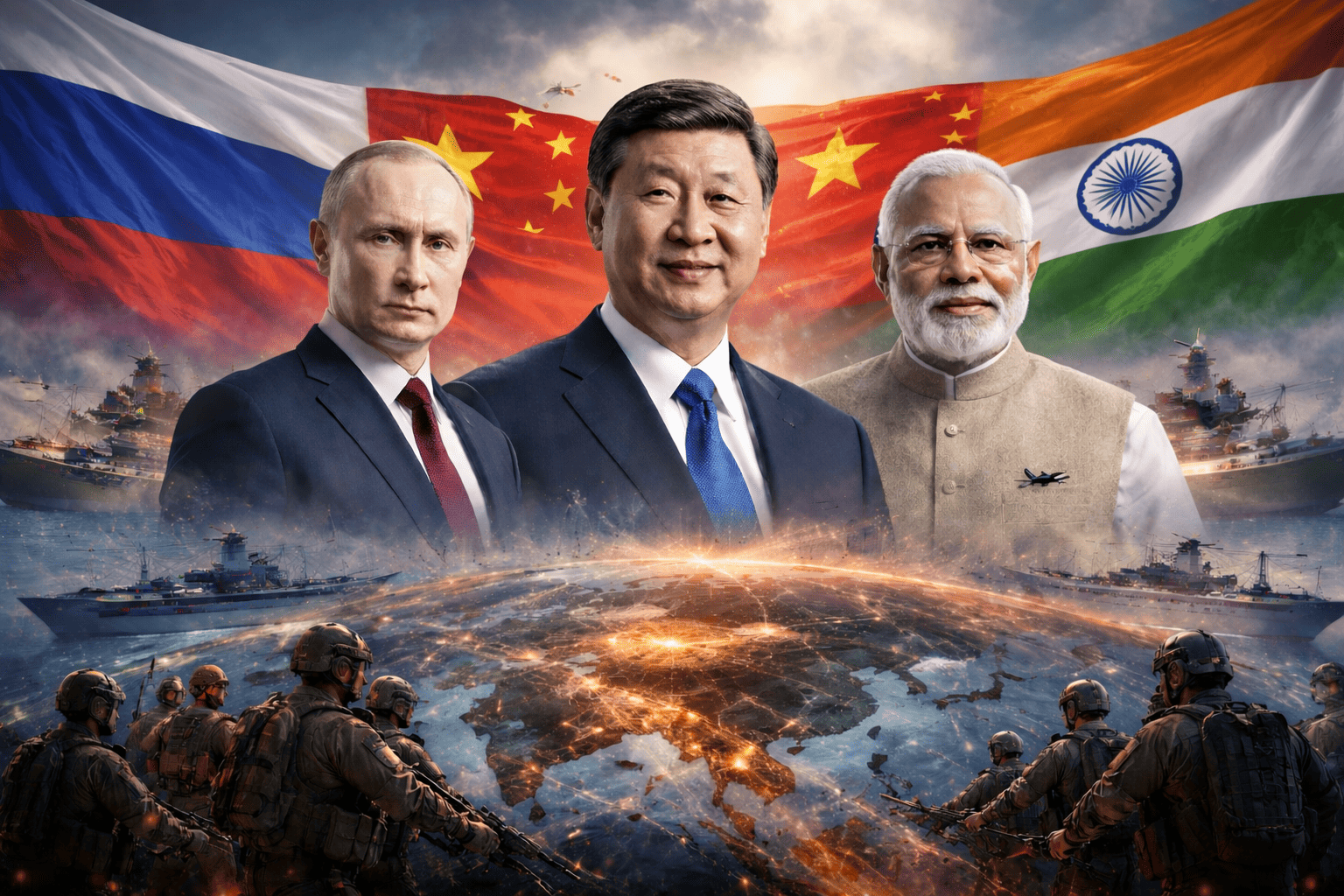
Russia and China are two giant neighbours that occupy the largest landmass of Asia. Traditionally they have been two antagonist societies but often chose marriage of convenience. Their relations in the post-World War II era have been vacillating between extremes. By literally nudging Russia to invade Ukraine, and then confronting it strongly, the West pushed Russia into Chinese arms. USA and China are already in confrontation in the Western Pacific. Is this “dual-containment” condition good for USA? Russia and India have been strategic partners and genuine friends. India and China have serious boundary issues, and have had military confrontations. Russia-China “Bear Hug” has implications for India.
Vacillating Relations and Sino-Soviet Split
In the 17th Century, China and Russia contested the control over Siberia. As Europe grew during the Industrial Revolution, the Russian Empire and Western powers exacted many concessions from China. Early 20th Century, both China and Russia went through revolutions that brought in Communism. With Soviet support the communists won the Chinese Civil War and established the People’s Republic of China (PRC) in 1949.
The two were still divided on many issues. Chairman Mao was not happy with post-Stalin soft communism pursued by the Soviet Union. China did not like Soviet closeness with India. Mao ridiculed the Soviet incompetence in the Cuban Missile Crisis of 1962. There were skirmishes in the eastern Sino-Soviet border along the Ussuri River in 1969.
In 1979, China invaded Soviet ally Vietnam. There were skirmishes between the two giants in 1979–80. China also sent aid to the Mujahedin against the Soviet invasion of Afghanistan in 1979. Differences between the two reduced after Deng Xiaoping came to power in 1978. When Mikhail Gorbachev became President in 1985, trade resumed, and border issues were dropped. Rapprochement accelerated after the dissolution of the Soviet Union in 1991.
Complex US – China Relations
The United States did not formally recognize the PRC for 30 years after its founding. Instead, the US maintained diplomatic relations with Taiwan, recognizing it as the sole legitimate government of China. US had fought the 1950 Korean War against China and the Soviet Union that ended in a stalemate in July 1953, dividing Korea. China provided resources and training to North Vietnam during the Vietnam War. When China became nuclear armed in 1964, USA considered pre-emptive attacks to halt its nuclear program.
Watching the 1962 Sino-Indian border war, and Beijing’s response to the Cuban Missile Crisis, USA concluded that China was more militant and more dangerous than the Soviet Union. To accelerate the Sino-Soviet split, and as part of the Ping Pong Diplomacy, US President Nixon visited China in 1972. USA acknowledged the One China policy. The two sides opened trade and communication. Differences remained on many issues. Chinese demands for advanced technology from the US were often denied.
Deterioration of US-China Relations
President Reagan’s vociferous anti-communism saw deterioration in US-China relations. Differences increased after the suppression of the Tiananmen protests. The US and others slapped sanctions against China’s violation of human rights. All arms transfers were banned. Differences on Taiwan also intensified. China was also upset with Obama’s new Asia-Pacific defence strategy, which was widely viewed as aiming to isolate China. China’s claims in the South China Sea and rapid island-building brought to open the Chinese expansionist plans.
President Trump was more aggressive on China. USA placed high tariffs on many Chinese goods, and a massive trade war followed. The US increased military build-up in Asia, and armed South Korea with the THAAD missile-defence system, close military cooperation with India and support to QUAD complicated relations further.
“Emperor” Xi Jinping pushed China back to one-man rule. Beijing has refused the US demand for China to participate in US-Russia nuclear disarmament negotiations, wanting parity in numbers first.
Beijing, meanwhile, has stepped up military activities in the contested South China Sea, and is holding regular intimidating exercises around Taiwan and close to Japan. USA and QUAD partners are also exercising more aggressively. Other European nations like UK and France are increasing forays and presence in the region. Japan has come out of the pacifist mode and is increasing defence spending.
China-Russia Trade Complexities
After the Soviet dissolution, the Russian currency collapsed and was steeply devalued. China used this opportunity to flood the Russian market with cheap Chinese goods. China became a major beneficiary of Russian oil. It has been a major purchaser and producer of Russian military equipment under license. But soon China reverse engineered most systems and started becoming independent in arms production and, in fact, started weaning away many Russian markets in Asia, Africa, and Latin America. Russia objected to this intellectual theft, but to no avail. Cash-strapped Russia also sold natural resources at cheaper prices. Russia has also had concerns about China’s ambitions and influence in Central Asia, an area traditionally within Russian influence.
Russia-China Strategic Closeness
In December 1998, Russia and China issued a joint communiqué pledging to build an “equal and reliable partnership”. The United States became their main competitor. In 2001, the two countries joined with junior partners to form the Shanghai Cooperation Organisation (SCO), to counter the growing influence of the United States military in Central Asia. Russia-China signed a twenty-year treaty of good-neighbourliness and friendly cooperation, covering strategic and economic dimensions.
Want to Change World Order
By 2019, both Russia and China had serious issues with the United States. USA was concerned about China’s actions in the South China Sea, Belt and Road Initiative (BRI) inducements, and piracy of American technology. For Russia, the main issue was severe economic penalties imposed by the US and Europe to punish its seizure of Crimea from Ukraine in 2014.
Both Russia and China are ruled by autocratic leaders who will rule their nations till health permits. Both want to change the US-led world order. China and Russia support de-Dollarization of international trade.
Russia and China stand for the transformation of BRICS (Brazil, Russia, India, China, and South Africa) into a mechanism of cooperation and coordination on global financial, economic, and international geo-political issues.
NATO’s Eastward Push
The America-led NATO has been moving closer to Russian borders by taking more erstwhile Warsaw Pact countries into the NATO and EU fold. Ukraine’s joining NATO would have been the “Cuba moment” for Russia. Russia had no choice but to invade Ukraine. The entire NATO garnered behind Ukraine. This pushed Russia, to its own detriment, into Chinese arms. And it’s no coincidence that this surge in Russia-China trade came at the same time that the US has tightened sanctions on Russia and concerns about the US-China trade war have intensified.
Russia’s Concerns on Overdependence on China
International relations are complicated. The relationship between great powers cannot be generalized with simple values and ideologies. Russia’s natural resources and China’s investments are where Chinese and Russian interests most strongly overlap. Russia is trying to attract investments from India, Saudi Arabia, and others as a counter-balance. China and Russia differ on many issues. China does not recognize Russia’s annexation of Crimea, and Russia does not support China’s claims in the South China Sea.
While China and Russia have been carrying out strategic coordination, especially when it comes to USA, Russia is conscious that in the long run, China could leave it high and dry. Conversely, the Chinese are worried that under the context of the deterioration of China-US relations, Russia could be drawn by the US to its side.
Russia becoming a junior partner after having been a superpower and having groomed Chinese communism and defence industry is an unhappy situation. China’s economic power, proximity, and desire to dominate could eventually compel Russia to look again to the West.
Despite bulk of Russia’s landmass being in Asia, Russia always wanted to be a European nation. 80 percent of its natural wealth is in Asia, but 80 percent of corporate control is in European cities such as Moscow, Saint Petersburg, etc. The West has a lot to offer, and gain, by weaning away Russia.
Russia and India Need Each Other
During the 1962 Sino-India war, the Soviet Union diplomatically sided with communist friend China, pushing India towards USA. But after the Sino-Soviet split of the mid-1960s, Soviets befriended India and openly supported India in the 1971 India-Pakistan War. They deterred USA and China. They also made a pro-India veto intervention at the UN Security Council.
India still has high dependence on Russia for military hardware. This umbilical cord cannot be separated or weakened for another three decades or so. India has also had Russian technological support for nuclear power plants and Space. India imported large amounts of Russian crude oil in the last two years.
India is one of the world’s large markets and fastest growing. India is already the biggest market for Russian military hardware. Russia needs it at any cost.
The Russia-India-China (RIC) grouping is currently not so active. But it remains a forum for diplomatic contact and interaction. Russia may have played a tacit role in the recent Sino-Indian thaw, nearly 4.5 years after Galwan. India has the largest population and will soon be the third-largest economy. Russia would also need India to counter-balance China.
It may be India’s long-term interest that Russia moves away from China. Currently India may not have the geo-political heft to achieve the same, but it is fast growing.
Despite pressures and arm-twisting, India remained neutral in the highly avoidable Ukraine conflict. India’s policy of strategic autonomy is maintaining international balance and paying dividends. Russia will remember this. President Putin and PM Modi are meeting frequently and coordinating closely. India is among the best placed to bring Russia and Ukraine to the negotiating table. Wait and watch with maturity, and play your cards wisely is the mantra for India.
Note: The article was originally written by the Author for Russia Today on 15th, November 2024, it has since been updated.
Header Picture Credit: Representative Image Generated using AI
Twitter: @AirPowerAsia
 Air Power Asia