USA led Western economic sanctions after the beginning of the Ukraine War included limiting Russian crude oil price to $60 per barrel. Since this did not work, the West imposed sanctions targeting the tankers used to ship Russia’s oil. But Russian oil exports actually increased, as Moscow found alternatives. China and India began buying Russian oil in much larger quantities. It was win-win for both sides. China receives bulk of its Russian petroleum through pipelines. India, which bought 10 times more oil in 2023 than the previous year, required tankers to transport. Over 60 percent of Russia’s seaborne oil exports go to India. Therefore, India was most affected by tanker sanctions.
Oil Tankers
The oil tankers are ships designed for the bulk transport of oil or its products. The modern oil tanker was developed around 1877. The product tankers are generally much smaller, and are meant to move refined products from refineries to points near consuming markets. Oil tankers are often classified by their size. The size ranges from a few thousand metric tons of deadweight (DWT) to ultra-large crude carriers (ULCCs) of 550,000 DWT and a cargo capacity of 3,166,353 barrels (503,409,900 litres). Tankers move approximately 2.0 billion metric tons of oil every year. Second only to pipelines in terms of efficiency, the average cost of transport of crude oil by tanker amounts to only $5 to $8 per cubic metre ($0.02 to $0.03 per US gallon). Some specialized types of oil tankers have evolved such as the naval replenishment oiler, a tanker which can fuel a moving vessel.
It takes roughly two years from order to delivery of a tanker, with 9–15 months of actual construction. In recent years, between 150 and 250 new ocean-going tankers have been delivered annually, with almost all new tankers built in China, South Korea, and Japan.
Western Domination of Tanker Fleets
The global oil tanker fleets are dominated by Western companies. Also, the big global insurers are sitting in Western capitals. Tokyo-based Mitsui OSK Lines ranks first among the list of the largest oil tanker companies. It operates a fleet of more than 930 vessels with 66 million tons DWT.
Large tanker companies offer chartering by oil companies or government agencies. Owners of large oil tanker fleets include Teekay Corporation, A P Moller Maersk, DS Torm, Frontline PLC, MOL Tankship Management, Overseas Shipholding Group, and Euronav.
International law requires that every merchant ship be registered in a country, called its flag state. A ship’s flag state exercises regulatory control over the vessel and is required to inspect it regularly, certify the ship’s equipment and crew, and issue safety and pollution prevention documents. The two largest flag registries for tankers (Liberia and the Marshall Islands) are run by firms headquartered in the USA. Panama was the world’s largest flag state for oil tankers, with 528 registered vessels. Six other flag states had more than 200 registered oil tankers: Liberia (464), Singapore (355), China (252), Russia (250), the Marshall Islands (234) and the Bahamas (209). The United States has only 59 registered oil tankers. As of January 2023, the global oil tanker fleet had an average age of 20.1 years.
What is Shadow Fleet?
The term “shadow fleet” includes the “gray fleet”, which typically hides the owner, and the “dark fleet” hides the origin of the oil products. The “shadow fleet” concept has existed for some time. It was initially used when Iran and Venezuela transported oil under sanctions. Shadow fleets are often comprised of old tankers and lack insurance. In case of accident, no party may be responsible for addressing the environmental consequences like an oil spill. Such vessels are barred from some ports, leading them to conduct oil transfers at sea. Estimates suggest that up to 18 percent of the world’s tankers make up the shadow fleet. With around 7,800 tankers globally, about 1,500 belong to the shadow fleet.
Russian Shadow Fleet
Russia quickly discovered a workaround to the sanctions and used shadow fleets to sell a significant portion of its oil above the price cap of $60 per barrel. Such tankers initially transported up to 70 percent of the country’s seaborne oil. The volume of such transfers almost doubled in the first year of conflict. As per estimates, Russia has invested at least $10 billion into the shadow fleet since early 2022. The strategy significantly reduced the sanctions regime’s leverage.
More than 630 tankers, some more than 20 years old, are involved in shipping Russian oil, as well as Iranian crude that has been subjected to sanctions, according to Lloyd’s List Intelligence, a maritime information service. The West did give a blind eye as a compromise amid concerns that a full embargo could lead to rocketing oil prices and a global oil price shock. The shadow fleets have their own negative dynamics. The fourth Russian tanker in a week broke down near the Kuril Islands in the Pacific. The tanker “Mercury” lost propulsion due to a failure of its main engine, according to the Russian Emergency Ministry’s office in Sakhalin.
Russia’s vessels are mostly under twenty years old. But the Russian fleet is on average three to four years older than the fleets that serve the major Arab countries. That’s not a drastic difference. Arab countries also employ many tankers that are older than most of the Russian fleet.
Since 2022, Russia has pivoted its oil exports away from Europe, where many major oil-trading hubs do not allow any ships older than twenty years, to Asian markets with less stringent requirements.
Western Sanctions Being Bypassed
Russia began increasing its tanker fleet in 2022. Prices for a single tanker range upwards of $35 million. By March 2023, CNN reported that Russia had about 600 tankers of various capacities. Today, Russia may directly or indirectly control 1,400 to 1,800 tankers, making it the largest operator of a shadow fleet.
Russia’s leading tanker group Sovcomflot did report lower financials due to sanctions, but many sanctioned Sovcomflot tankers delivered oil priced above the price cap to Indian refiners. The huge Russian shadow fleet continues to operate without impunity. Even the blacklisted tankers are now operating more freely.
Even the earlier wariness and worries of Western financial repercussions among Russia’s customers to accept the fleet in their ports appears to have dissipated, as per a Bloomberg report. Such operators are no more trying to conceal their activities or their location at sea.
Some of the oil is still carried by vessels owned by ship-owners and/or insured by insurers that are subject to the price cap coalition legislation. Often the lodging documents, perhaps even stamped by Russian customs offices, vouch for the load’s sale price not exceeding the price cap. The blacklisted ships don’t call at Western ports, don’t use Western services such as insurance or finance and are owned by companies similarly insulated from potential penalties.
The vessels carried an average of 48 million barrels of oil per day (the rest most likely travelled via pipelines to the refineries). Hardly any ships engaged in the international transportation of crude oil dedicate all of their capacity to Russia, Iran, or Venezuela. With a quarter of the global tanker fleet transporting Russian cargo in 2024, the so-called “shadow fleet” is neither as separate nor as obscure as might have been thought. It has shown impotence of Western governments in hampering Russian oil transfers.
Indian Oil Tanker Fleet
The global supply chain dynamics has made it important for both Russia and India to build larger tanker fleets. In 2023, there were 197 oil tankers in the Indian fleet, up from 168 in 2018. The DWT of Indian oil tankers was around 12.7 million tons. Government-owned Shipping Corporation of India (SCI) is the largest tanker owner in India, with a well-diversified fleet of crude oil tankers consisting of all sizes.
Many Indian ports have constraints of terminal infrastructure and limitations like draft, availability of tankages, length/capacity of jetties, etc., and tankers have to be scheduled. Lighterage operations are also undertaken to facilitate quick turnaround of tankers, which otherwise cannot call on ports due to port restrictions/limitations. Clearly, the Indian tanker fleet must expand.
To Summarize
Oil and gas revenues currently make up at least a third of Russia’s budget, roughly equivalent to what it has spent on the war in 2024. Russia accounts for about 12 percent each of the world’s crude oil and refined products exports. China and India were the major recipients of Russian oil. Most tankers went to India. There are almost 7,500 oil tankers in the global fleet, of which over 1,600 are estimated to have participated in carrying sanctioned oil. Sanctions have increased the value of older tankers by double. In 2022, there were a record over 600 second-hand tanker sales.
The US sanctions against Russia have clearly failed. Russia in fact increased oil sales. Even Europe continued to benefit from Russian crude, which was refined in India and elsewhere and reached destinations in Europe. Europe also continued to get Russian gas piped through Ukraine, and Russia paid Ukraine for transit. Global sanctions and supply chains remain an issue. All countries including India need to factor such eventualities. Since India is a major importer and refiner, it needs to enlarge its tanker fleet. More private players need to come in. Alternative tanker insurance sources are required.
Note: The article was originally written by the Author for Russia Today on 8th, January 2025, it has since been updated.
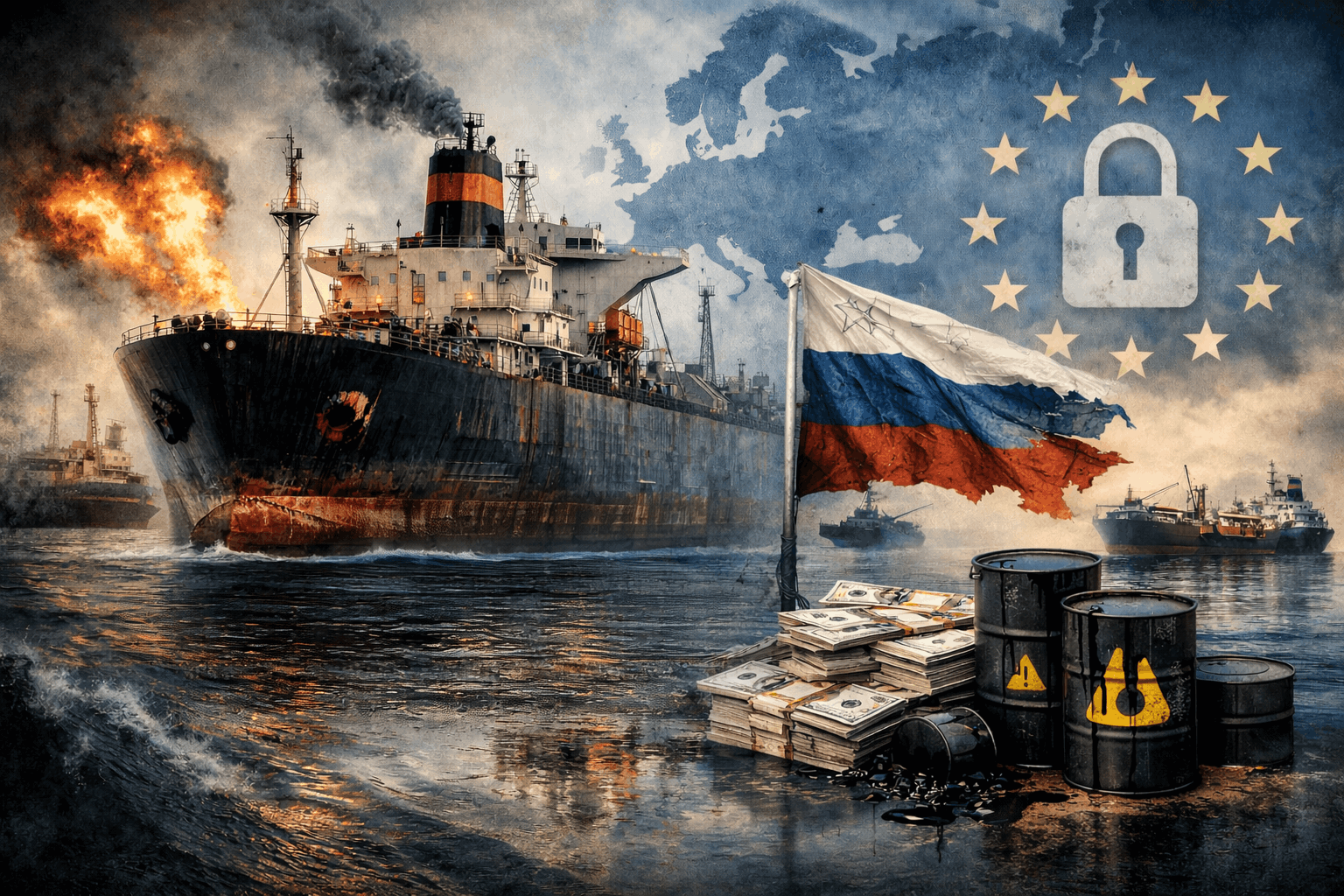
Header Picture Credit: Representative Image Generated using AI
Twitter: @AirPowerAsia
 Air Power Asia