
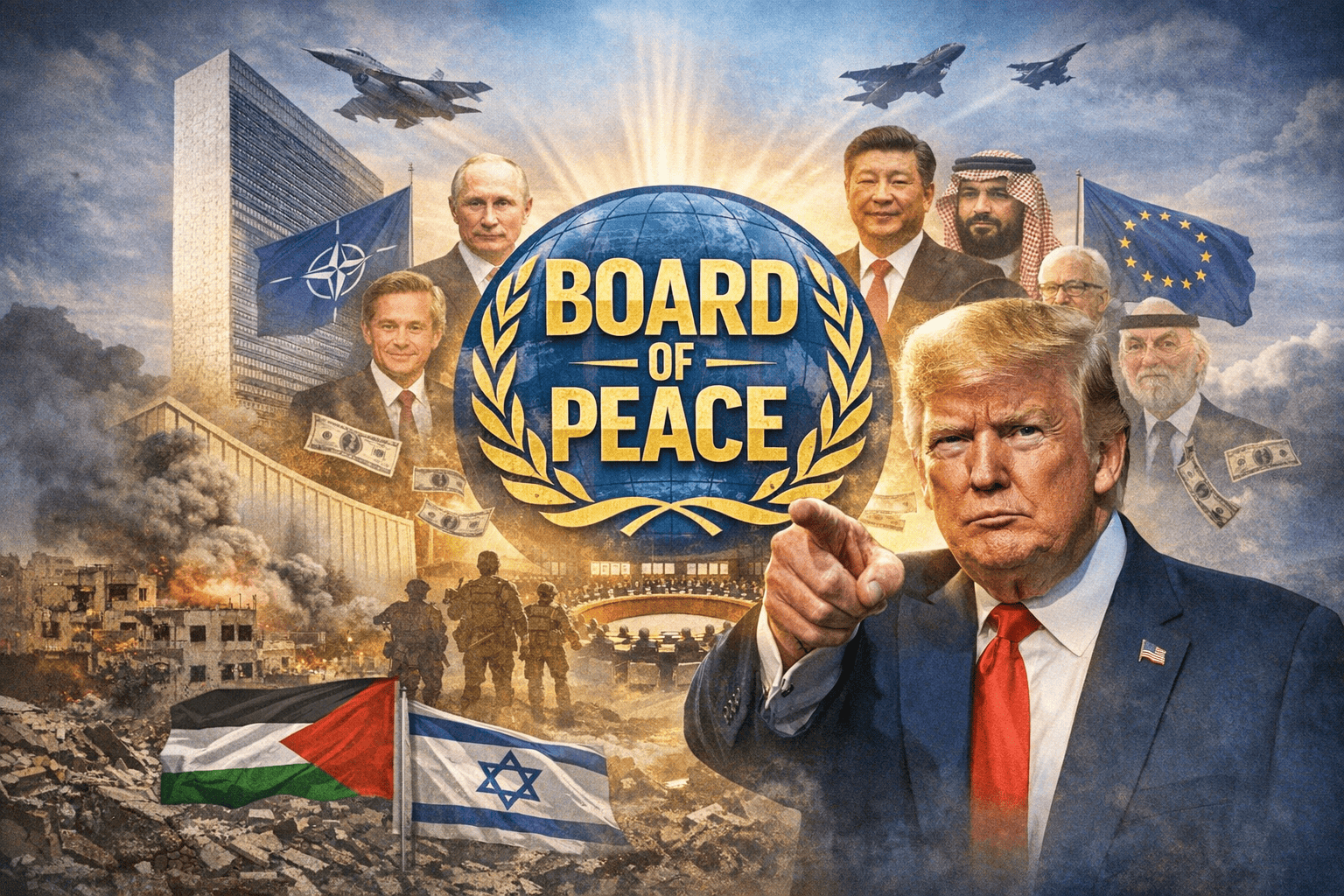
Former British Prime Minister Tony Blair initially proposed placing the Gaza Strip under international administration in August 2025. United States President Donald Trump presented a similar plan in late September 2025, which was partially accepted by both the Israeli government and Hamas the following month. Trump’s proposed “Board of Peace” (BoP) was to be an organization that was nominally to “promote stability, restore dependable and lawful governance, and secure enduring peace in areas affected or threatened by conflict”. It was as part of a second phase of the US-brokered 20-point Gaza ceasefire plan. Trump declared “the war is over” and that the Board of Peace (BoP) would be formed quickly.
The United Nations Security Council (UNSC) backed the plan based on how the plan was presented at the time. It was passed as UNSC Resolution 2803 on 17 November 2025, giving it international legitimacy, and authorized the establishment of the board as a “transitional administration” in Gaza for the purpose of coordinating reconstruction efforts. It was treated as an external initiative, and not as an official UN body, and as such not accountable to the General Assembly and lacked treaty-based foundations.
Trump’s Board of Peace Takes a Turn
The BoP establishment was announced by Trump on 15 January 2026. A few days earlier, the former United Nations Special Coordinator for the Middle East Peace Process, Nikolay Mladenov, had been chosen to serve as the Director-General of the BoP. Mladenov subsequently held meetings with Israeli Prime Minister Benjamin Netanyahu and Palestinian Vice President Hussein al-Sheikh.
With the commencement of the second phase of the Gaza Peace Agreement on 14 January 2026, it was reported that the United States had sent invitations to several countries to join the board and that it would have its first meeting on the sidelines of the World Economic Forum (WEF) summit the following week. Trump obviously had had different longer-term plans, and the charter draft now circulated described the BoP as an “international organization” promoting stability, peace, and governance “in areas affected or threatened by conflict.”
On 20 January 2026, Trump referenced the BoP and said “the United Nations never helped me” as a reason for its existence, claiming his board “might” replace the United Nations (UN). Interestingly, the membership is presently being determined by Donald Trump alone, and it is to be paid for. It is governed by its own private charter, which only names one person, “Chairman Trump,” who may adopt resolutions or initiatives on its behalf without consulting the board, and who is a member for life. Is Trump trying to create an organization that is an alternative to the UNSC, where only he will have veto power? When proposed earlier, the board was presented as seeking to support the administration, reconstruction, and economic recovery of the Gaza Strip as part of a peace plan for the aftermath of the October 7 attacks and Gaza war, and it invoked easy endorsement from the UNSC. Critics fear that the institution now outlined bears little resemblance to what was presented at the time of the endorsement.
Countries that wish to be permanent members of the BoP must pay $1 billion into a fund controlled by Chairman Donald Trump, otherwise they will serve a 3-year term.
Just a few world leaders have publicly accepted Trump’s invitations or said if they have paid for membership. But it has failed to gain support from some important countries, notably the United Kingdom, France, Norway, and Sweden, all of which are also angered by Trump’s plans to acquire/annex a NATO territory, Greenland. Interestingly, Russia’s President Vladimir Putin has endorsed it, as long as it causes a split in NATO, it is good for Russia. France has voiced concern that it seeks to usurp the role of the UN, for which Trump threatened 200 percent tariffs on French wine and champagne. President Cyril Ramaphosa has clarified that he wasn’t invited to Trump’s BoP. The board could be indefinitely chaired by Trump, as long as he is in power, or even beyond, as per the charter.
Role and Structure of the Board
The White House says this body will focus on issues such as “governance capacity-building, regional relations, reconstruction, investment attraction, large-scale funding and capital mobilisation.” In invitation letters sent to world leaders, Trump said the body would “embark on a bold new approach to resolving global conflict.” “At the heart of the plan is the BoP, the most impressive and consequential board ever assembled, which will be established as a new International Organisation and Transitional Governing Administration,” Trump wrote.
The charter of the BoP outlines a multi-level structure for the organization which includes Donald Trump as Chairman in the charter of the BoP and a member for life. The main BoP is composed mainly of the leaders of countries. The Executive Board will focus on diplomacy and investment. Seven members have been appointed. The Gaza Executive Board is to direct the National Committee for the Administration of Gaza (NCAG), which will administer the territory.
Founding Executive Board
The “founding Executive Board” includes Secretary of State Marco Rubio, special envoy Steve Witkoff, former British Prime Minister Tony Blair, and Trump’s son-in-law Jared Kushner. It will also have billionaire U.S. financier Marc Rowan, World Bank President Ajay Banga, and Robert Gabriel, a loyal Trump aide on the National Security Council. The UN has coexisted with other bodies, spokesperson says on Trump’s Gaza BoP.
Members of the Gaza Executive Board
A Gaza Executive Board supports the High Representative and the National Committee for the Administration of Gaza. On 17 January 2026, Bulgarian diplomat Nickolay Mladenov was appointed as the “High Representative for the Board of Peace,” tasked with leading the transition from Hamas governance to a Palestinian administration of technocrats known as the National Committee for the Administration of Gaza (NCAG). Mladenov was a Member of the European Parliament from 2007 to 2009. The NCAG is headed by Ali Shaath, a former Deputy Minister of the Palestinian Authority, and is responsible for reinstating public services and stabilising daily life in the region. The NCAG will have, along with Steve Witkoff, Jared Kushner, and Tony Blair, international leaders such as Mladenov, Sigrid Kaag, the Turkish Foreign Minister Hakan Fidan, Qatari diplomat Ali Al-Thawadi, and General Hassan Rashad from Egypt’s intelligence agency. The White House proposal includes a “Gaza Executive Board” that will collaborate with the Office of the High Representative and the NCAG, to “support effective governance” and deliver essential services for the people of Gaza. Minister of State for International Cooperation of the United Arab Emirates Reem Al-Hashimy, businessperson Yakir Gabay, and United Nations Special Coordinator for the Middle East Peace Process Sigrid Kaag will also be there.
Major Concerns About the Proposal
Many leaders, thinkers, and officials have expressed major concerns over the expanded remit of the board, Trump’s indefinite chair, and the potential damage it could cause to the UN’s work. The board’s charter mentions “institutions that have too often failed,” without naming the UN, an organization Trump has repeatedly criticized. Should the world allow Trump to create a body that supersedes the body established 80 years ago to maintain global peace?
Initially, the member states will serve for three years, after which they must pay $1 billion for a permanent seat. The funds raised will go toward rebuilding Gaza, according to a US official. Some have criticized the move as being vulnerable to corruption.
Countries On-Board
Trump has invited leaders of at least 60 countries to join the BoP. About 35 of the 60 invited nations are expected to attend a signing ceremony on the sidelines of the WEF in the Swiss resort of Davos. In the letters sent to various world leaders inviting them to be “founding members” of the board, the US President says the body would “embark on a bold new approach to resolving global conflict.” US adversaries Russia and China, as well as the so-called repressive state Belarus, are among those invited to join the board. European allies, the world’s largest democracy India, oil-rich Gulf States, former Soviet republics, and even the Pope have also received offers to join.
The charter draft, which was sent along with the invitations, does not even reference Gaza, and the purpose seems to have been expanded to tackle conflicts the world over. The invitation has had a mixed response and is still struggling to attract Western allies. Those who want to impress Trump for short-term gains for themselves or their countries have immediately agreed to join. He has garnered the support of Middle Eastern monarchs.
The United Arab Emirates, Saudi Arabia, Egypt, Qatar, Bahrain, Pakistan, Turkey, Hungary, Morocco, Kosovo, Argentina, and Paraguay have accepted Trump’s invitation. As have the Central Asian states of Kazakhstan and Uzbekistan, and Southeast Asian nations of Indonesia and Vietnam. Israel’s Benjamin Netanyahu is also on board, even though he has fumed at the inclusion of Turkish and Qatari officials on the Gaza Executive Board and faces an arrest warrant from the International Criminal Court (ICC). Armenia and Azerbaijan, which signed a US-brokered peace agreement last year in a deal that would give the US exclusive development access to a critical transit corridor in the region, have also agreed.
Hungary’s PM Viktor Orban, known for his nationalist stance and one of Mr. Trump’s strongest allies in the European Union, is on-board. The UAE, a key partner of the US, also expressed support.
Trump claimed that Putin has agreed to join. Meanwhile, Putin has floated the idea of using Russian assets frozen in the US to pay the $1 billion fee for a permanent seat. Putin’s potential inclusion has raised alarm about how a country actively waging war could be involved in an effort to secure peace. Belarusian leader Alexander Lukashenko, a key ally of Russian leader Vladimir Putin, has signed up.
Canadian PM Mark Carney, an economist who has repeatedly criticised Trump for ripping apart the global “rules-based order” and imposing punishing tariffs, intends to join with conditions, saying the details, including financial ones, were yet to be worked out. The Canadian government expressed that Canada would not “pay for a seat” on Trump’s proposed BoP.
Who Have Declined
Some European Union ambassadors reportedly raised “serious doubts” and said they would examine the legal framework before taking a position. France and Norway have declined because they feel that the BoP must operate in conjunction with the UN. France voiced concern that it seeks to usurp the role of the United Nations. In response to France stating its intention to “not answer favourably” to Donald Trump’s invitation to join his BoP, Trump threatened 200 percent tariffs on French wine and champagne. Germany, Slovenia, and Sweden have declined to join.
The UK’s PM Keir Starmer called Putin’s role “concerning.” Brazil, under President Lula da Silva, viewed the proposal with caution, expressing concern that it could concentrate excessive power in the US presidency and overshadow the role of the UN.
Uncommitted or Unresponsive
China has confirmed receiving the invite but not decided either way. A Foreign Ministry spokesperson has said that China “will stay firmly committed to safeguarding the international system with the UN at its core.” Ukrainian President Volodymyr Zelensky said it was difficult to see being “together with Russia and Belarus in any council.” Italian PM Giorgia Meloni said there could be constitutional issues with joining and she would not attend the signing ceremony. The Irish Foreign Minister Helen McEntee said that they will give the invitation “careful consideration.”
Options and Challenges for India
PM Narendra Modi welcomed Trump’s ‘comprehensive’ peace proposal for Gaza, saying it provides a viable pathway to long-term peace, but India has yet to give any official confirmations regarding its participation. India’s involvement with the proposed BoP presents opportunities to boost its global leadership and influence in Middle East reconstruction but faces challenges like potential undermining of the UN, high costs, and navigating regional sensitivities, especially given its balanced ties with Israel/Palestine and the presence of Pakistan and Turkey on the board, requiring careful strategic balancing of multilateralism, autonomy, and financial commitment.
Opportunities for India include an elevated role. Participation validates India’s status as a global leader (Vishwaguru) and key player in West Asia. Offers a platform to shape reconstruction efforts, promote long-term stability (de-radicalization, vocational training), and support the Global South. Allows India to advance its energy security and diaspora interests in the region while maintaining distinct ties with all parties and promoting strategic autonomy. It aligns with the trend of smaller groups addressing specific issues, bypassing larger, slower bodies like the UN.
Challenges for India include a multilateralism dilemma. It risks undermining India’s traditional support for UN-centric multilateralism and potentially alienating the Global South. The reported $1 billion annual cost for permanent membership requires careful cost-benefit analysis. Navigating the polarized Gaza conflict and balancing ties with Israel and Arab nations is complex, though both parties seem to be on board currently. Sharing the platform with Pakistan and Turkey could draw domestic scrutiny and complicate diplomatic optics, but India and Pakistan already share memberships in the Shanghai Cooperation Organisation (SCO) and the South Asian Association for Regional Cooperation (SAARC), and global platforms like the UN and its agencies. They also interact within the global trade system (WTO).
The board’s exact role, governance, and long-term scope beyond Gaza remain ambiguous. India must engage pragmatically. Participate to maintain influence and support peace but clarify involvement is for strategic interests, not aligning with US specific goals. India must work with key Arab stakeholders (UAE, Saudi Arabia) to ensure the framework is viable.
To Conclude
Trump’s plan has been described as a vanity project. After not getting the 2025 Nobel Peace Prize, Trump said he no longer feels an “obligation to think purely of Peace”. The Guardian called it “a Trump-dominated pay-to-play club, a global version of his Mar-a-Lago court aimed at supplanting the UN itself,” arguing that the body ultimately outlined bore little resemblance to what the UNSC believed it was endorsing. The charter circulated to national capitals two months after the resolution’s adoption made no reference to Gaza, instead presenting the BoP as a permanent global institution.
The proposal is focused on internal rules granting sweeping authority to the Chairman, Donald Trump, the only individual named, including sole power to appoint and dismiss members, set agendas, and issue resolutions, while other members could obtain permanent status only by paying the hefty fee, leaving effective control concentrated in Trump’s hands, with him holding the board’s “ultimate decision-making power.”
Is the world so weak that no one is willing to stand up against him? Is it the end of multi-polarity? Are we heading for a unipolar world? Is it a fixed match between Trump and Putin? Europe becoming weak helps Russia increase its dependency for them. Will China also be a gainer by staying low-key and then taking Taiwan as a prize?
For long, the UN has been seen as a weak body. The International Court of Justice (ICJ) and many other institutions also have blunt teeth. Will Trump shake up the entire global system? Will everyone start asking what is for me?
For India, the best option is to take cues from the other major powers, and there is no need to bend too much forward or backwards. Take calls on moral positions. Anything that brings global peace and allows free trade is desirable. India must work to ensure engagement complements, rather than replaces, existing UN frameworks. It needs to carefully evaluate the financial and diplomatic costs versus the strategic influence gained.
Note: The article was originally written by the Author for The First Post on 23rd, January 2026, it has since been updated.
Header Picture Credit: Representative Image Generated using AI
Twitter: @AirPowerAsia
 Air Power Asia