
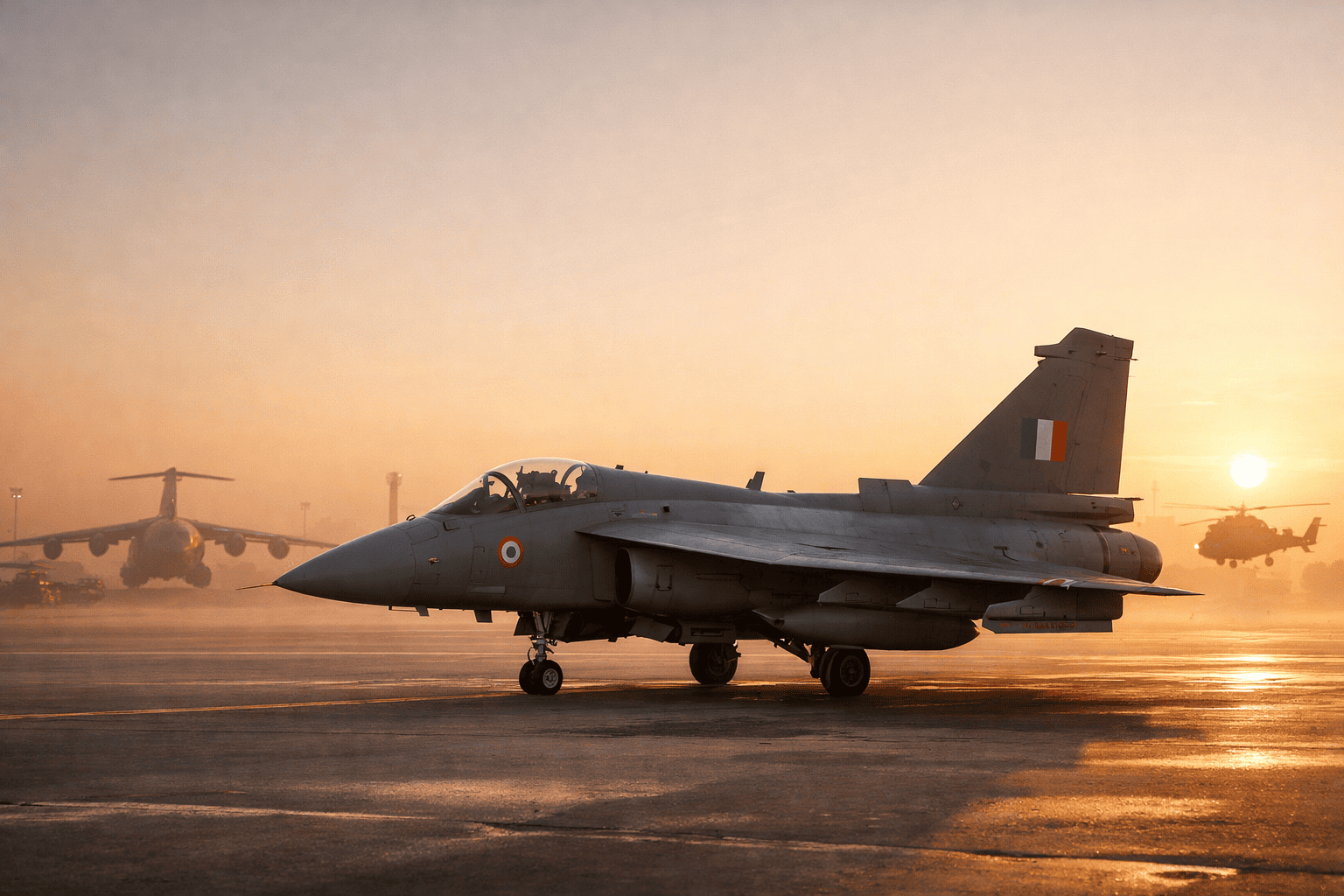
Indian Air Force (IAF) is all set to celebrate its 92nd anniversary. It has just wrapped the mother-of-all-exercises the “Tarang Shakti”, the greatest multi-lateral exercise ever in India. Earlier IAF conducted exercise “Vayu Shakti” in February, and participated in tri-services “Bharat Shakti” exercise in March 2024.
The aerospace industry accounts for nearly 40 percent of global military expenditure which was $2.24 trillion in 2022. India already is a major global aerospace market. Indian Armed Forces have increasing defence aerospace requirements and budgets. India has a booming commercial aviation market. But, unfortunately, India continues to be one of the largest importers of aviation products.
Aviation technologies are always the leading and cutting edge, and often game changing. They add deterrent capabilities. The aerospace industry involves development, production and maintenance of aircraft, missiles and UAVs. It also involves many airborne systems, avionics, aero-engines, rockets, and weapons. For India to be a global player, it must become self-sufficient in defence and aerospace. These require investments in research and development. Also, obsolescence sets in faster. For India to sit on the global high table, it must master some of these.
The Defence Research and Development Organisation (DRDO), the Hindustan Aeronautics Ltd (HAL), other Defence Public Sector Undertakings (DPSU) and private industry have seen rising technological and manufacturing capabilities. India has clear advantage of higher skills and lower costs of production. The present government’s ‘Atamnirbharta’ push supports the ‘Make in India‘. Time is ripe for mastering new technologies and boosting domestic defence production. Artificial Intelligence (AI) and Information Technology will support the process.
India’s Huge Military Aviation Requirements
Indian Armed Forces require many fighter aircraft, transports and helicopters. IAF will still require 114 imported fighters to make good the gap. India will soon procure the General Atomics Predator MQ-9 UAVs. India requires additional Flight Refuelling Aircraft (FRA), Airborne Early Warning and Control (AEW&C) aircraft, drones, among others. There is a need for air defence radars, missile systems, long-range precision aerial weapons, and much more. India remains dependent on foreign help in aero-engines, many avionics, radars, some weapons, and ejection seats, among others.
HAL – Heavily Committed
HAL is the leading aerospace company with its 19 production units. It has manufactured 26 different types of aircraft, mostly military, through indigenous development and licence-production deals. HAL license-produced fighters including Su-30 MKI, medium transport aircraft, trainers, and helicopters. HAL has also built both Russian and Western aero-engines under license. HAL will now make GE 414 engines in India. HAL also supplies components for major global companies such as Airbus, Boeing, Eurocopter, among others. HAL’s composite manufacturing capability is of world class. But HAL has potential to do better in human productivity and quality assurance.
HAL will soon complete deliveries of 40 Light Combat Aircraft (LCA) ‘Tejas’ Mk1. 83 LCA MK1A with modern AESA radar are on order, and deliveries are delayed to November 2024. IAF has committed to an additional 100 Mk1A recently. HAL is also working on LCA Mk2 with the more powerful GE 414 engine, now called the Medium Weight Fighter. The first flight of Mk2 is planned in 2024, and induction around 2032. IAF needs around 200 LCA Mk2. IAF also awaits the indigenous HAL-DRDO fifth-generation stealth Advanced Medium Combat Aircraft (AMCA). This is work still in initial progress and the aircraft may fly around 2028 and induct around 2035.
India has done well in helicopter production. Nearly 400 Advanced Light Helicopter (ALH), ALH-WSI ‘Rudra’, the Light Combat Helicopter (LCH) ‘Prachand’ and Light Utility Helicopter (LUH) are already flying. HAL is also developing the Indian Multi Role Helicopter (IMRH). Meanwhile the NAL-HAL Saras continues to be developed slowly.
DRDO Great Potential – Needs to Harness Aviation Technology
Many of DRDO’s 52 laboratories run aviation technology projects. These include aeronautics programs, unmanned aerial vehicles, missiles and other weapons including lasers, precision-guided munition, glide bombs, electronic warfare, and the Hypersonic Technology Demonstrator Vehicle (HSTDV). There is a Defence Technology Commission with the defence minister as its chairman. What matters for defence preparedness is the R&D systems that actually get inducted into armed forces. The DRDO systems that have actually been inducted include the LCA, Akash AD missile system, Sukhoi Su-30MKI avionics, the Tarang radar warning receiver, Lakshya PTA, retarder bomb kits, Netra AEW&C, series of surveillance and missile control radars, Prithvi and Agni series of missiles, Helina ATGM, BrahMos and Nirbhay cruise missiles, Astra AAM, the ABM project’s AAD (Advanced Air Defence) and PAD (Prithvi Air Defence) missiles.
Among the ongoing projects are DRDO/HAL AMCA, Rustom, TAPAS-BH-201 and AURA UAV, missile approach warning system (MAWS), multi-role radar ‘Uttam’ for LCA, laser and Directed Energy Weapons (DEW), FLIR and wide-angle HUDs, Barak 8 LRSAM, NGARM (New Generation Anti-Radiation Missile) Rudram-1, ASAT capability enhancement, Sudarshan laser-guided bomb, Garuthmaa & Garudaa 1000 kg glide bombs, Smart Anti-Airfield Weapon (SAAW), High Speed Low Drag Bomb, Solid Fuel Ducted Ramjet (SFDR) and GTX-35VS Kaveri engine, among few more. DRDO is also converting six each pre-owned airliners into AEW&C and FRA aircraft for IAF. Also IAF has ordered six more ‘Netra’ AEW&C. These need hastening.
The infrastructure is in place. There has been significant success in the LCA program, missiles, and radars. In many other areas, it is work still in progress. The committee set up for ‘restructuring and redefining’ role of DRDO under the former Principal Scientific Advisor to government, K. Vijay Raghavan, has submitted the report. Action is awaited.
Private Industry Becoming Significant
Private sector has finally started entering aerospace in a big way. The Indian conglomerate, Tata, set up aerospace production facility in Hyderabad. They are making aero-structures for CH-47 Chinook, AH-64 Apache, S-92 helicopters, C-130 Hercules, and for the Pilatus PC-12NG. They make wings for F-16s. Tata group will be making the CASA C-295 MW transport aircraft. Tatas produce Akash SAM launchers. TASL will soon make UAVs and kamikaze drones.
Dynamatic Technologies makes assemblies of vertical fins for Sukhoi 30 MKI fighters, and also supplying aero-structures for Airbus aircraft. Hyderabad’s VEM Technologies manufactures central fuselage for LCA Tejas. Many Indian MSMEs and start-ups are in defence production.
UAVs and Drones
Indian Armed Forces have a huge requirement of large and medium UAVs. India needs drones. Manned Unmanned Aircraft Teaming (MUMT) is an area of action. Adani Elbit Advanced Systems India Limited is producing Hermes-900 UAVs in India. Many start-ups have entered drone and counter-drone manufacturing. These include NewSpace Research & Technologies, Paras Aerospace, Veda Aeronautics, Throttle Aerospace, General Aeronautics, Redwing Labs, Dhaksha Unmanned Systems, UrbanMatrix Technologies, Thanos Technologies, and Auto Micro UAS, among many others.
New Aviation Technologies – Need to Harness
India needs to cover a lot of distance on aero-engine, stealth, network-centric systems, advanced multifunction AESA radars, Infra-Red Search and Tracking (IRST), Electronic Warfare, Directed Energy Weapons (DEW), hypersonic platforms and weapons, Artificial Intelligence (AI), secure communications, among others. The aero-engine and hypersonic require a task-force-like approach.
Advanced Long Range Precision Weapons
Air engagements are becoming farther, there is thus a need for long-range sensors and weapons that can operate in adverse electronic environment. Precision and range are the two critical requirements for both air-to-air and air-to-surface weapons. India has a successful missile program, including the Astra, Akash, BrahMos, among others. Astra Mk 3 and BrahMos II need to be accelerated. In many cases India has partnered with Russia and Israel. The JV route is working well. Gradually, critical components like weapon sensor heads and control systems must be increasingly Indian. DEW allow ‘high off bore sight’ and even rear-hemisphere kills and ‘lower cost per kill.’
Harnessing Space
Space is the ultimate vantage point and future for all action and capabilities, the real force multiplier. Space is the enabler for most ISR, communications, navigation, and targeting capabilities on earth. Air and space domains have already begun to merge and need to be exploited together. For the success of any surface or sub-surface campaign, aerospace superiority would be the starting point. India needs to build and secure its assets in space. China has pulled significantly ahead. Their number of launches, satellites and constellations, space-station, and satellite navigation systems are way ahead. India has all space capabilities. Only the numbers have to increase for better redundancy, and higher revisit for ISR. Also India must quickly operationalize its satellite navigation system NavIC. IAF is best placed to harness space for its networked operations and Integrated Air Command and Control System (IACCS). Ultimately, the space must be merged with air for better exploitation of these two contiguous domains that have great commonality.
Way Ahead India
IAF is already facing depletion in numbers of fighter squadrons. Modernisation is behind schedule. Going forward, indigenous production has to be ramped up in terms of quality, numbers and deliveries on time. India is still at LCA Mk1 stage. Other variants are still to come. The AMCA may require foreign help for a few technologies. HAL still has production and quality issues to resolve. HAL platforms continue to be import dependent and therefore costly. Also, manpower productivity must increase.
Long project delays force revision of service air staff requirements as technologies move ahead. More efficient corporate structure will help, and the PSUs must be released from bureaucratic control. There are only a handful of major aircraft engine manufacturers in the world. China and India are still evolving their engine design and manufacturing abilities. India has been dependent on Russian, French and American engines for long. India has to make a reliable gas turbine engine.
India should not have to import trainer aircraft. India also does not have a significant transport aircraft project. India also needs help in advanced AESA radars, EW systems, modern weapons, Artificial Intelligence (AI) and other advanced avionics. It is best to take a collaborative approach and use economic muscle and high military systems requirements to seek transfer of technology. The Prime Minister has given a clear direction for “Atmanirbhar Bharat”. India needs to think ahead, and harness its numbers, lest we get left behind again.
Note: The article was originally written by the Author for Raksha Anirveda on 29th, October 2024, it has since been updated.
Header Picture Credit: Representative Image Generated using AI
Twitter: @AirPowerAsia
 Air Power Asia