
China has recently unveiled two sixth-generation fighter jets. Also, Pakistan has left the “cat-among-the-pigeons” by announcing plans to acquire 40 J-35 stealth fighters from China, marking the first export of Beijing’s fifth-generation jets to a foreign ally. It could mean induction by around 2029. That will change the entire air dominance dynamics in the sub-continent.
Meanwhile, India’s Advanced Medium Combat Aircraft (AMCA), fifth-generation, multirole combat aircraft received approval from India’s Cabinet Committee on Security (CCS) for the prototype development in March 2024. The stated timelines are for 2035 induction. Realistically it may be later. This has generated a hot debate for India’s immediate plans and options.
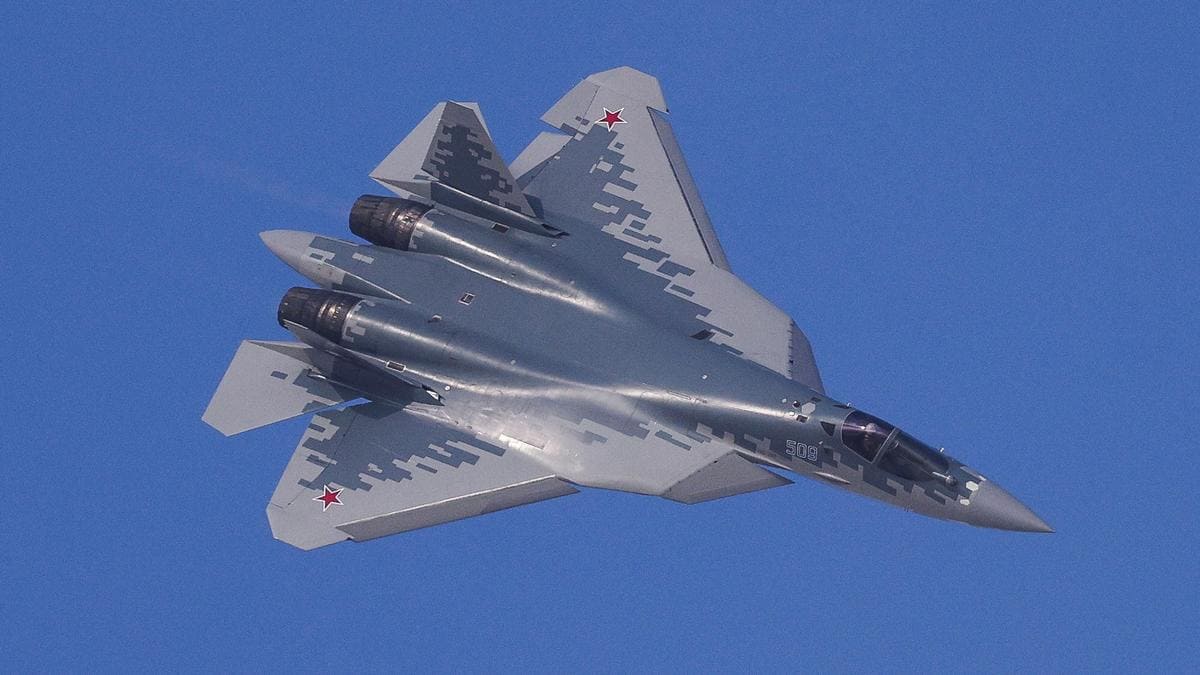
Meanwhile, the Russia’s Sukhoi Su-57 ‘Felon’ flew at its first out-of-country airshow in Zhuhai, China, in November 2024. It is now all set to be showcased at “Aero India 2025” at Bengaluru, and will be eyed with significant interest. The Americans had brought the F-35A for the first time at Aero India 2023.
Attributes of a Fifth Generation Fighter
Starting with the Lockheed Martin/Boeing F-22 Raptor, fifth-generation fighters were designed from the start to operate in a network-centric combat environment, and to feature extremely low, all-aspect, multi-spectral signatures employing advanced materials and shaping techniques. The active electronically scanned array (AESA) radars with high-bandwidth low-probability of intercept, Infrared Search and Track (IRST), and other sensors are fused for Situational Awareness (SA) and to constantly track all targets of interest around the aircraft’s 360-degree bubble. In addition to its high resistance to ECM, they could function as a “mini-AWACS”. Integrated electronic warfare system, integrated communications, navigation, and identification (CNI), centralized vehicle health monitoring, fibre-optic data transmission, and stealth are important features. Manoeuvre performance is enhanced by thrust-vectoring. Super-cruise is inbuilt. Signature-reduction techniques include special shaping approaches, thermoplastic materials, extensive structural use of advanced composites, conformal sensors and weapons, heat-resistant coatings, low-observable wire meshes to cover intake and cooling vents, heat-ablating tiles on the exhaust troughs and coating internal and external metal areas with radar-absorbent materials and paints. These aircraft are very expensive.
The US and Chinese Fifth Generation Fighters
USA has two fifth-generation fighters. They built around 190 Lockheed Martin/Boeing F-22 Raptor, which began inducting in 2005. Three variants of Lockheed Martin F-35 Lightning II are in service since 2015 with over 1,000 built. The aircraft is already being operated by 11 countries and nine more have ordered. As of July 2024, the average flyaway cost for F-35A is reportedly $82.5 million. The production rate currently is 135 F-35 variants a year. USA itself plans to buy nearly 2450 aircraft.
China’s J-20 was unveiled in 2011, and over 300 have been built till date. China’s second fifth-generation fighter, the F-35 look-alike J-35A, was showcased when it flew during the Zhuhai Airshow in November 2024.
Russian Fifth-Generation Aircraft
Russian Sukhoi Su-57 ‘Felon’ evolved from the Indo-Russia Fifth Generation Fighter Aircraft (FGFA), contract for which was signed in October 2007. The FGFA itself had evolved from Russia’s PAK FA. By 2014, however, India began voicing concerns over performance, cost, and work-share. India eventually left the partnership in 2018. Sukhoi continued to develop and promote the Su-57 for prospective export customers. The export variant, designated Su-57E, was officially unveiled at the MAKS-2019 Airshow in August 2019.
The Su-57 first flight in its original design took place in January 2010. The first operational unit was formed in 2021. It is a multi-role aircraft with significant air-to-air and ground attack capability. The aircraft were first used in the Syrian campaign in 2018. They have seen significant combat in Ukraine. Around 42 Su-57 have been produced till date. The Sukhoi Su-75 “Checkmate”, also designated as the Light Tactical Aircraft (LTA), is a smaller, single-engine, stealth fighter aircraft under development with planned induction around 2027.
Su-57 a Very Capable Fighter
The West acknowledges that the Su-57 is a highly manoeuvrable fighter like most others from the Sukhoi fighter stable. The 360-degree thrust vectoring allows aerodynamics-defying combat manoeuvres.
The Su-57’s Integrated Modular Avionics Combat Systems, uses fibre-optic channels. It consists of the main nose-mounted N036-1-01 X-band AESA radar and two side-looking N036B-1-01 X-band AESA radars embedded in the cheeks of the forward fuselage for increased angular coverage. It also has an L-band array on leading edges.
Aircraft has an electro-optical system that includes IRST, Directional Infrared Counter Measures (DIRCM), Ultraviolet Missile Approach Warning Sensors (MAWS), thermal imager for low-altitude flight and landing, and a navigation and targeting pod.
The aircraft is capable of deploying countermeasures such as flares and radar decoys, as well as single-use programmable ECM transmitters. The Su-57 would also serve as a test-bed for advanced AI and Man-Unmanned Teaming (MUM-T) technologies.
Russia is continuously integrating new weapons on the aircraft. Several new air-to-surface weapons have evolved based on the combat experience in Ukraine. As part of the MUM-T, the Su-57 will be able to launch and/or control the S-71M “Monochrome” combat UAV for deep penetration attacks.
Work is on to integrate the Okhotnik UCAV as ‘loyal wingman’ for uncrewed teaming. A carrier-based variant of the aircraft is also under development. A ‘swarm’ teaming experiment had been conducted with a group of Su-35s and a Su-57 acting as a command and control aircraft.
All new production Su-57 fighters transferred to the Russian Air Force would feature second-stage AL-51 engines. Unlike its AL-41F1 predecessor, the engine has glass-fibre plastic IGVs and convergent-divergent nozzles that use serrated flaps to reduce its signature as well as 6.4 percent better specific thrust, 19 percent higher thrust-to-weight ratio, and 9 percent lower specific fuel consumption. The new engines allow the plane to reach a maximum speed of 2,600 km/h.
The Su-57 can carry four beyond-visual-range (BVR) missiles (R-37M) in its two main internal weapons bays and two short-range missiles (upgraded R-74) in the side bays. It can also carry bombs and surface-attack missiles in the main bay. For missions that do not require stealth, the Su-57 can carry stores on its six external hard-points which could include the hypersonic Kh-47M2 Kinzhal air-launched ballistic missile.
Reasonably Priced and Low Life-Cycle Costs
The Su-57’s flyaway cost is reportedly around $35 million per aircraft. If true, it makes the Su-57 nearly half the price of the Chinese J-20, and even further cheaper than the much smaller single-engine American F-35. Russians suggest that the Su-57’s lifecycle costs are comparable to those of the Su-27, Su-30, and Su-35, which it was designed to replace.
Su-57 Production Going Up Despite Sanctions
Su-57, the most advanced front-line aircraft in Russia, is produced at the Komsomolsk-on-Amur Aviation Plant in the Russian Far East. The pilots and engineers are reportedly happy with the aircraft performance. More Su-57s are at various stages of production. Russian industry has delivered 6 in 2022, 12 in 2023, and now with 20 aircraft in 2024, it is a substantial increase. Total delivered are 42 aircraft.
The Western defence analysts have been highlighting that the Su-57 development and production has been delayed due to a number of factors such as the Ukraine war, and also Western sanctions which have restricted some critical micro-electronic components for major sensors, and cockpit displays.
But Russia seems to have sorted out most technology development issues and supply chain bottlenecks. Meanwhile, the Sukhoi Design Bureau is continuously working on improving and expanding the aircraft functionality, and also building infrastructure for further expanding production. The planned orders will be more than met in time and additional orders are expected.
In June 2019, Russian Ministry of Defence signed a contract for the production of 76 Su-57. As per plan, by 2028 there are to be three full Aviation Regiments of Su-57 fighters. Meanwhile, the Russian government has stated that the order numbers are going up and the production rate for the Su-57 will double in 2025. Target is to deliver more than 20 Su-57s this year. If Su-57 production begins to increase, could it be of interest to India?
India’s AMCA
India’s fifth-generation AMCA will be a stealth, multirole, single-seat, twin-engine, air-superiority fighter with ground-strike, Suppression of Enemy Air Defences (SEAD) and Electronic Warfare (EW) missions. Designed by Aeronautical Development Agency (ADA), it will be built by a public-private joint venture between ADA, Hindustan Aeronautics Limited (HAL), and an Indian private company. The initial development cost is estimated to be around ₹15,000 crore (approx. $2 billion). In March 2024, the project received approval from India’s Cabinet Committee on Security (CCS) for the prototype development and mass production expected to begin by 2035.
The development of AMCA will take place in two phases, AMCA Mk-1 and AMCA Mk-2. Mk-2 will focus more on stealth, EW, and futuristic pilot-AI interface. The AMCA Mk-2 will have DEWs and thrust-vectored engines with serrated nozzles. Mk-2 will also incorporate sixth-generation technologies. The aircraft will one day replace the Sukhoi Su-30MKI.
AMCA successfully completed its systems-level Critical Design Review (CDR) in 2022. Metal cutting has already begun. DRDO expects to roll out the first prototype by 2027 and the first flight in 2029. The first three prototypes will carry out developmental flight trials, whereas the next two will focus on weapon trials. The prototypes will be rolled out at an interval of 8–9 months. Mass production of the aircraft is planned to start by 2035. The IAF plans to procure at least 125 AMCA in Mk-1 and Mk-2 configurations.
Does India Need an Interim 5th Generation Fighter?
India is one of the most threatened nations with two very significantly powerful nuclear-armed adversaries as its neighbours. With both of them, there are serious boundary disputes and India has fought wars. China plans to increase its J-20 production to 100 a year and targets to have 1,000 by 2030 when AMCA will be making its first flight. It will have 1500 by 2035 when India will optimistically induct the AMCA.
Pakistan is already talking to China to induct the J-35A by around 2029. A country with a failing economy might have a fifth-generation aircraft earlier than the country that will have the third-largest economy by then. That will be unfortunate for India.
There is a school of thought that India may be forced to acquire an interim imported fifth-generation aircraft. The choices are few. The Americans are currently not open to giving the F-35 because they have earlier refused their NATO ally Turkey, because like India, they had acquired the S-400 air defence system from Russia. S-400 reportedly has sensors that will be able to record F-35 electronic signatures. Indians are also wary about the much greater ability of USA to arm-twist and even leave a friend in the lurch if its own interests are at variance. USA may also want India to distance itself from Russia.
The second option is to acquire two squadrons of the Su-57 aircraft. The aircraft is fast maturing. Production is still slow but increasing. But Russia is fighting a war. Their industry is geared up more towards that. Because of Western sanctions, there are issues related to payment. The balance of payments is becoming more adverse due to India’s higher oil imports. Lastly, IAF already has 60 percent of its fleet of Russian origin and therefore is reluctant to increase that basket any more.
Way Ahead India
As China’s air combat capabilities grow, India will have to invest more in its advanced fighter aircraft to maintain a credible deterrence. Undoubtedly, India must drive “Atmanirbharta” (indigenisation). For India to be part of the big league, the AMCA must succeed. AMCA requires a “whole of nation” vision and approach. The private partner must be inducted quickly. Spelling out clear end-states, timelines and regular path-line reviews would be important. Adequate funds must be made available. Buy technologies if required. Increase spend on R&D.
Choose a reliable partner country that will not arm-twist. France and Russia are contenders. But France still doesn’t have its own fifth-generation aircraft. Russia is a time-tested strategic partner. They are the best in thrust-vectoring aero-engines, and India can seek support. A fair “win-win’’ deal must be evolved. While India must invest more and take a task-force approach for developing the LCA Mk2 and AMCA, it needs an interim solution to make good numbers and reduce capability gap with China. The choices are far and few. Acquiring a few Su-57s remains an interim option. Surely India’s security establishment must be contemplating. Time to exercise is now, lest we get left far behind.
Note: The article was originally written by the Author for Russia Today on 8th, February 2025, it has since been updated.
Header Picture Credit: Reuters
Twitter: @AirPowerAsia
 Air Power Asia