
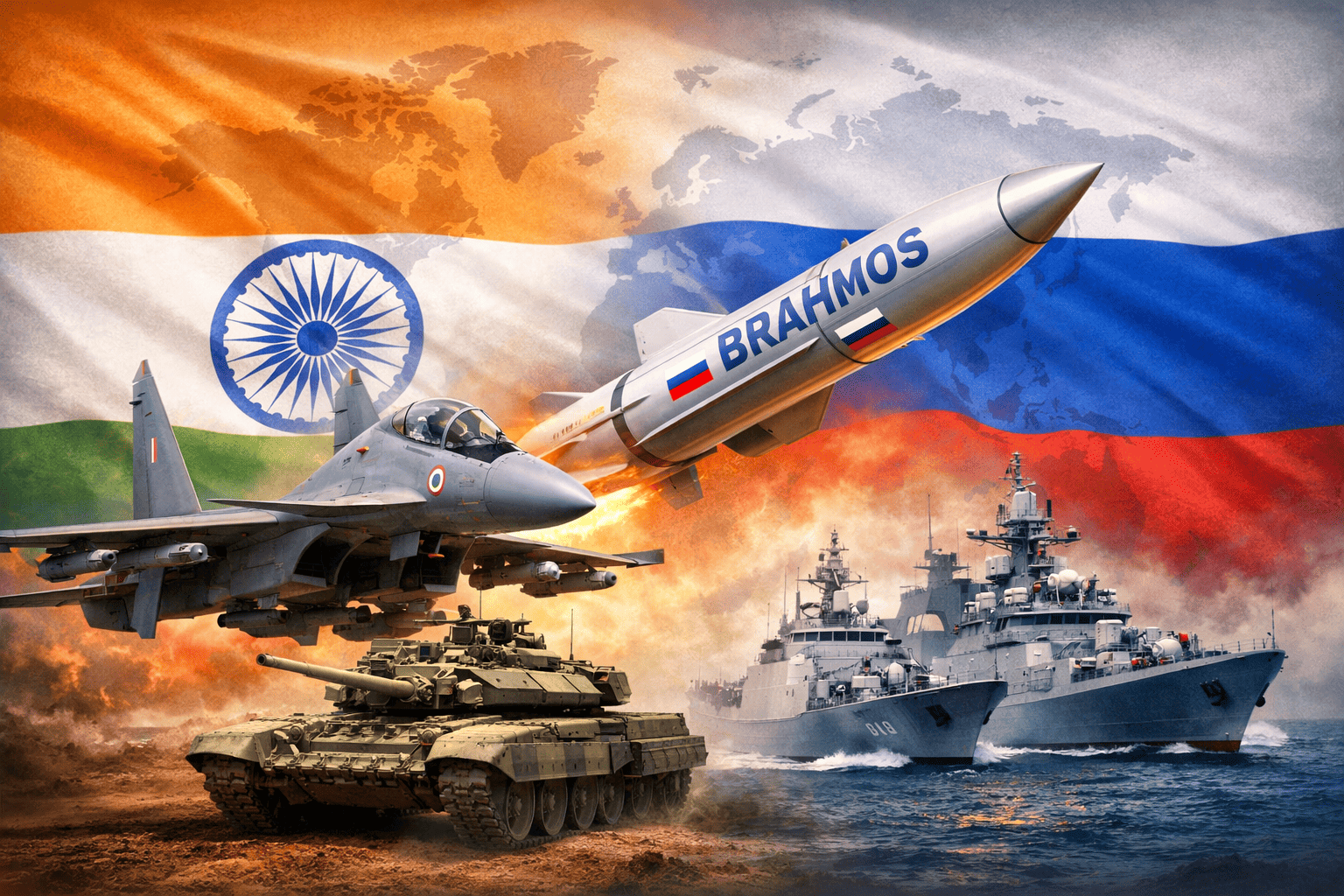
India and the Soviet Union, and now Russia, have time-tested relations since India’s independence in 1947. In 1951, the USSR exercised its veto power on the Kashmir dispute in support of India. The Soviet Union declared its neutrality during the 1959 border dispute and the Sino-Indian War of October 1962, despite strong Chinese objections.
The Soviet Union gave India substantial economic and military assistance, and by 1960, India had received more Soviet assistance than China had. In 1962 the Soviet Union agreed to transfer technology to produce the Mikoyan-Gurevich MiG-21 jet fighter in India, which the Soviet Union had earlier denied to China. They helped India set up factories for the aircraft, aero-engines, and avionics.
Cold War and Beyond
In 1965, the Soviet Union served as a peace broker between India and Pakistan after their war of 1965. India’s relationship with the Soviet Union grew strategically and resulted in the Indo-Soviet Treaty of Friendship and Cooperation of August 1971. Through the 1971 India-Pakistan War for liberation of Bangladesh, the Soviet Union stood by India against US and Chinese pressures.
During the Cold War, India and the USSR maintained a “special and privileged strategic partnership” that was built on five major components: politics, defence, civil nuclear energy, anti-terrorism co-operation, and space. Even after the dissolution of the Soviet Union, India continued warm relations with successor Russia. The first major political initiative, after the dissolution, was the Strategic Partnership signed between the two countries in 2000.
The IRIGC (India-Russia Intergovernmental Commission) is the main body that conducts affairs at the governmental level between both countries. Both countries are members of international bodies including the UN, BRICS, G20, SCO, and the Russia-India-China (RIC) grouping. Russia supports India receiving a permanent seat on the United Nations Security Council.
India is one of the largest markets for the Russian defence industry. Approximately 60 percent of the Indian military’s hardware today is of Russian origin. Military hardware supplies and more recently production joint ventures (JVs) have been a key pillar.
Military Hardware
Since the mid-1950s, India received Soviet hardware including rifles to tanks for the Indian Army; ships, aircraft, and submarines for the Indian Navy; fighters, transport aircraft, and helicopters for the Indian Air Force (IAF). At its peak in the 1980s, 85 percent of Indian military hardware was of Soviet origin.
Soviet Make-in-India Began in the 1960s
The Soviet Union was the first to support India for Make-in-India defence production. The MiG-21 factories set up in the early 1960s later made the MiG-27, and Su-30 MKI. Su-30 MKI was a joint D&D project. In fact, Russia learnt a lot too and used some of these ideas for their Su-30SM. 222 Su-30 MKI were produced under license at HAL’s Nashik plant since 2004. An estimated 920 AL-31FP turbofans were manufactured at HAL’s Koraput Division. The Su-30MKI will be the backbone of the IAF’s fighter fleet for some years to come.
In 1965, Heavy Vehicles Factory (HVF) was set up at Avadi, Chennai, with Soviet assistance. HVF products included Russian-designed T-72 Ajeya, and T-90 Bhishma tanks.
In September 1965, the Soviet Union and India signed the first contract for the delivery of naval equipment that included four Project I641 diesel-electric submarines, five Project 159E corvettes, and five Project 368P motor boats. The agreement also envisaged rendering Soviet technical assistance for the construction of a submarine naval base in Vishakhapatnam.
Recently, two frigates, the INS Tushil and INS Tamala, were built by Russia at the Yantar Shipyard, while the remaining two are being constructed at the Goa Shipyard Ltd (GSL) in India through technology transfer. Russia is reportedly expanding its shipbuilding cooperation with India, with two Indian shipyards being considered for the construction of four non-nuclear icebreakers. Russian shipbuilding officials have offered New Delhi their nuclear-powered design for an Indian Navy aircraft carrier, according to reports.
GSL is also to construct 24 river-sea class cargo ships for Russian clients in the Caspian Sea by 2027. Cooperation with India in shipbuilding has its benefits for Russia, as the unit cost per vessel is projected to be half of what it would cost Russian shipbuilders. Russia is offering transfer of technologies as indigenization by Indian companies is a priority to be met during the implementation of Project P-75(I).
Joint Ventures
India and Russia have a good success story for Joint Ventures (JV). The BrahMos is a medium-range ramjet supersonic cruise missile that can be launched from submarines, ships, and fighter aircraft. BrahMos Aerospace is a joint venture between the Indian Defence Research and Development Organisation (DRDO) and Russia’s NPO Mashinostroyeniya. The missiles are already being exported.
Under an over ₹5000 crore contract signed in July 2021, over 610,000 AK-203 assault rifles are to be manufactured in India with technology transfer from Russia, by the JV Indo-Russian Rifles Private Limited (IRRPL). Indian companies hold the controlling 50.5 percent share, and 49.5 percent is with Russian companies. In May 2024, the first batch of 27,000 rifles was delivered while another batch of 8,000 was delivered in July 2024. The level of indigenous content achieved is already 25 percent and is going up rapidly. India and Russia have also agreed to expedite the delivery of spare parts of Russian-origin military platforms by setting up a JV in India.
Notwithstanding the above, some JVs did not take off. India had withdrawn from the joint Fifth Generation Fighter Aircraft (FGFA) due to technical reasons. Finally, Russia continued the project and today has a successful Sukhoi Su-57 ‘Felon’ 5th generation fighter. Russia is once again suggesting India join back.
Following the selection of the Ka-226T to meet an Indian requirement for 197 helicopters, an agreement was signed in December 2015 for the creation of a JV between Rostec, Russian Helicopters, and Hindustan Aeronautics Ltd (HAL) to build the helicopters at a new factory to be built at Tumakuru in India. Later, India decided to make its own Light Utility Helicopter (LUH) based on the indigenous ‘Dhruv.’
Similarly, the Indo-Russian program to develop a new Multi-Role Transport Aircraft (MTA) for both countries through a JV between Russia’s United Aircraft Corporation (UAC) and India’s HAL was cancelled by India.
Bright Future
In the last two decades, India did look for alternative military hardware sourcing from the USA, France, and Israel. But invariably, India went back to its time-tested strategic partner Russia. India bought 5 batteries of the formidable S-400 AD system, ignoring American threats to impose CAATSA sanctions.
Most of the platforms bought from the Western nations were also through G2G deals, as has been the case with all Soviet/Russian deals. Despite promises, there has been very little ToT in most deals. India did manage to get better ToT with Make in India Russian deals/JVs.
Recently, India ordered 12 additional Sukhoi Su-30 MKI worth $1.5 billion. India also placed orders for 240 Lyulka-Saturn AL-31FP aero-engines worth $3.05 billion. Though both orders are with HAL, they will require major supplies from Russia. The engines are being built from the raw material stage with technology transfer from Russia, and some spares, forgings, and castings are expected to be imported.
India plans to begin upgrading its Su-30 MKI in India. Initially, it will involve 84 aircraft, but subsequently, the entire fleet will get upgraded. Sukhoi will also be involved in the project for the upgrade of the fly-by-wire system. The jets will also be modified to fire BrahMos-ER missiles. All this will require major Russian support. India is in the process of procuring 21 additional MiG-29s from Russia, which would enable replacement of earlier losses and raise another squadron. India earlier upgraded its MiG-29 and MiG-21 fleets with Russian support.
There have been reports that negotiations are on between HAL and Russia for exporting Indian-produced, Russia-supported Su-30MKIs to global customers. Also, Russia needs to circumvent American economic sanctions. More Russian companies are wanting to set up production facilities in India.
Defence cooperation is an important pillar of the India-Russia Strategic Partnership. It is guided by the IRIGC Military Technical Cooperation (IRIGC-MTC), set up in 2000. The Agreement for 2021-2031 was signed during the inaugural meeting of the India-Russia 2+2 Dialogue, which was held in Delhi in December 2021. This Agreement guides further cooperation in research and development, production, and after-sales support of armament systems and various military equipment. Uninterrupted supply of spare parts to Soviet/Russian-origin equipment is a critical issue being discussed between the two countries.
Russia has approved the long-delayed draft logistics agreement Reciprocal Exchange of Logistics Agreement (RELOS) that will facilitate military logistic exchanges for exercises, training, port calls, disaster relief, and ease access to Russian military facilities, especially in the Arctic. The agreement would be signed soon. New Delhi has already entered into similar agreements with many countries, including all Quad partners.
Two Russian aircraft, the MiG-35 and Su-35S, are competitors for India’s Multi-Role Fighter Aircraft (MRFA) contract, for which the Request for Proposal (RFP) has still to be sent out. Russia’s Su-57 ‘Felon’ stealth fighter made its debut at the 2024 Zhuhai Airshow in China. Its appearance at Aero India 2025 would mark a significant diplomatic and strategic signal from Russia. Russia can then pitch it as an interim option, as the Indian AMCA seems to be getting delayed. Russia could also bring the Tu-160M strategic bomber at the airshow if they want to make a marketing push. Can Russia and India explore developing an aero-engine with Indian intellectual property? As the Russian Ambassador to India Nikolay Kudashev said recently, “Sky is the limit for expansion of Russia-India Partnership.”
Note: The article was originally written by the Author for Russia Today on 22nd, January 2025, it has since been updated.
Header Picture Credit: Representative Image Generated using AI
Twitter: @AirPowerAsia
 Air Power Asia