
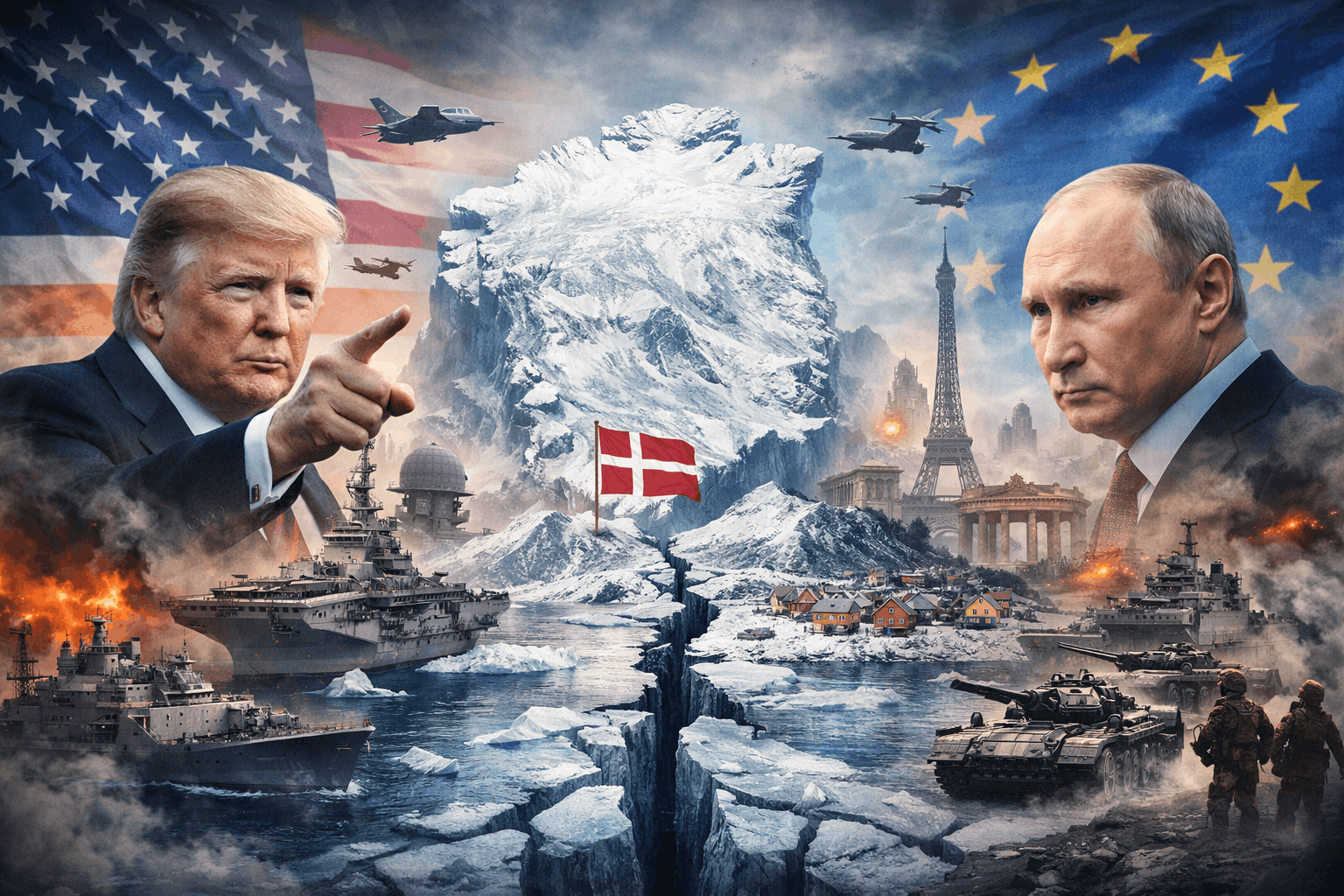
Give me Greenland or else… President Trump has threatened Europe and NATO (North Atlantic Treaty Organization). Trump the disruptor is being viewed by some as a “Bull in the China shop.” The world is being made and unmade by President Trump. At the World Economic Forum (WEF) in Davos, he took jabs at NATO, Canada, windmills, and much more. Yet Trump has a huge constituency within the USA comprising senior citizens, youth, and the right wing, who want America to be great again. Many in the USA also feel that Europeans were the real colonisers and they have no reason to feel upset that the USA wants to take over Greenland. There are some who feel NATO may not survive the Trump Era.
Europe was the centre of both the World Wars. Europeans fought each other and engulfed the world. The Americans had come to bail them out on both occasions. Imploding of the Soviet Union in 1991 was a landmark event. Collapsing of NATO may be the next. Trump has been publicly mocking European leaders, especially the EU hierarchy, UK PM Starmer, and French President Macron.
During WW II the French had built the supposedly impregnable Maginot Line, which the Germans bypassed by attacking through northern states. NATO (especially US support) had created a similar false sense of security and prevented Europe from preparing to meet its existential challenges. Was it failure of the European imagination, or had they chosen slumber? As on date NATO remains vital for the defence of Europe.
The USA has been an untrustworthy ally for many decades, and once its own interests were met, it left the others to fend for themselves. Lord Hastings Lionel Ismay, the British general and diplomat who served as the first Secretary General of NATO, had famously remarked that the purpose of the alliance was “to keep the Americans in, the Soviets out and the Germans down.”
A recent study conducted by the European Council on Foreign Relations (ECFR) reveals that only 16 percent of Europeans view the United States as an ally. A fifth of the respondents described it as an adversary or a rival. Can NATO survive without the USA? Will Europeans also split between themselves?
NATO Current Status
NATO is an intergovernmental military alliance between 32 member states, 30 in Europe and 2 in North America. Founded in the aftermath of World War II, NATO was established in 1949. The organization serves as a system of collective security, whereby its independent member states agree to mutual defence in response to an attack by any outside party. This is enshrined in Article 5 of the treaty, which states that an armed attack against one member shall be considered an attack against them all.
Throughout the Cold War, NATO’s primary purpose was to deter and counter the threat posed by the Soviet Union and its satellite states, which formed the rival Warsaw Pact in 1955. Following the dissolution of the Soviet Union in 1991, the alliance adapted, conducting its first major military interventions in Bosnia and Herzegovina (1992–1995) and Yugoslavia (1999). Article 5 was invoked for the first and only time after the September 11 attacks, leading to the deployment of NATO troops to Afghanistan as part of the International Security Assistance Force (ISAF). The alliance has since been involved in a range of roles, including training in Iraq, intervention in Libya in 2011, and countering piracy. Europeans were mesmerized by American military power, and they found little reason to doubt Washington’s commitment to the security of the Old Continent.
In the aftermath of the Cold War, NATO has accepted sixteen new members, incorporating former Warsaw Pact countries and post-Soviet states. NATO and Russia co-operated, but Russian leaders have called this eastward enlargement a threat to its security interests, and oppose Ukraine joining NATO. The Russian annexation of Crimea in 2014 prompted strong condemnation from NATO and a renewed focus on collective defence. The 2022 Russian invasion of Ukraine led to a major reinforcement of NATO’s eastern flank and caused Finland and Sweden to abandon their neutral status and join the alliance. NATO recognizes Bosnia and Herzegovina, Ukraine, and Georgia as aspiring members.
NATO’s main headquarters are in Brussels, while its military headquarters are near Mons, both in Belgium. The combined militaries of all NATO members include approximately 3.5 million soldiers and personnel. Their combined military spending constitutes over half of the global total. Members have committed to a target of spending at least 5% of their GDP on defence to ensure the alliance’s continued military readiness.
The existence of NATO made it possible for the majority of Europeans to fantasize that a major war in Europe was unthinkable in the 21st century. Contrary to conventional wisdom, the expansion of NATO to Central Europe in 1999 came not as a response to the perceived Russian threat, but out of fear of the return of nationalism and wars inspired by nationalism.
“European peace today is not merely the absence of war but the marginalization of war-making from national life, a profound cultural and institutional shift,” James J. Sheehan wrote in his 2008 history of post-war Europe, “Where Have All the Soldiers Gone.”
Europe’s Laissez-faire Approach
European militaries were not prepared for autonomous defence but to fight together with the Americans and invariably under American command. Sweden and Finland, which resisted membership for decades, joined NATO only after Russia’s invasion of Ukraine and now stand as the alliance’s most combat-ready members. Around 15 years ago, Robert Gates, the US Secretary of Defense in the Obama Administration, had warned of American impatience with European complacency over international security and gaps in defence funding for NATO. He had also cautioned that future US political leaders may not consider the return on America’s investment in NATO worth the cost.
When Donald Trump arrived on the political stage, in July 2016, he spoke about American defence of NATO and the lack of adequate contribution by European allies. In his first term, Trump tacitly threatened to withdraw from the alliance during a summit in Brussels. Europeans ignored it as bluster and waited for him to leave office. In January 2025, Trump returned to the White House. It was time for Europeans to wake up. But Europeans just increasing defence budgets will not be enough to defend Europe in the absence of the United States. Europeans are now also bracing themselves for Trump’s ongoing threats to annex/acquire Greenland (Trump’s Crimea) that would violate the territorial integrity of a NATO member state. In the last one year, European leaders used many means, including flattering Trump, and even promised to buy American weapons, but his ultimatum to Europe to give up Greenland or face increased tariffs was pushing them against the wall. Europe desperately needs NATO now to face the dual threats from Trump and Putin. But the paradox is that the welfare mind-set of European masses is still not prepared to spend too much on defence. They have to choose between the “cliff and the hard rock.” America is unlikely to change even after Trump.
NATO’s Defence Spend
NATO’s common-funded budgets, which cover shared, direct contributions for civilian and military structures, are set at $6.22 billion in 2026. The US and Germany are the top contributors, at approximately 16% each of common funds, followed by the UK (11%). In addition, each country’s defence budgets build defence capability which in turn contributes to overall strength. While the US contributes heavily to common funds, it is also the largest contributor in terms of total absolute defence spending.
As of 2026, Poland leads in defence spending as a percentage of GDP (4.12%), followed by Estonia (3.43%), the U.S. (3.38%), and Latvia (3.15%). All members agreed to aim for 2% of GDP on defence, with many aiming for higher (5% by 2035). The US has called for NATO allies to spend 5 percent of GDP on defence. NATO members also pledged that at least 20 percent of their defence expenditure would go on acquiring and developing military equipment (capital budget).
As of 2025–26, NATO’s 32 member countries have a combined active military force of over 3.4 million personnel. The United States holds the largest military with approximately 1.35 million active troops, followed by Turkey (447,000), France (207,100), Germany (188,500), and Italy (174,800).
Ukraine Conflict Was West Driven
After US withdrawal from Afghanistan, it was expected that the USA would concentrate its energies and assets in the Indo-Pacific, where China is the main competitor, challenger, and reason for possible confrontation. But the US Military-Industrial Complex, which has huge political influence, would always like to see the USA at war. The Russian demand to keep Ukraine outside NATO was a legitimate one. Crimea was very crucial for Russian security. As long as there was a friendly regime in Ukraine, Russia’s Black Sea Fleet could operate safely from Sevastopol. The four years of conflict have destroyed most of the crucial infrastructure in Ukraine. A very large number of young people have died. Many have fled the country. Ukraine has lost over 20 percent of its territory.
Western funding for Ukraine in its war against Russia has been massive and sustained, with total aid commitments surpassing $360bn from over 41 countries (including non-NATO) as of August 2025. This assistance includes military, financial, and humanitarian support, primarily from the United States, European Union institutions, and various NATO members. Trump has made it clear that as per his peace plan, Ukraine is not going to get back the lost territory, nor will it be allowed to join NATO.
Trump and NATO
For Trump, Europe is not the centre of the world. There are many more players in this world with whom Trump would rather engage. He sees “America First.” He considers America’s current alliance system as a liability rather than an asset. He finds China and Russia as countries with no ally baggage to carry, and working on their own self-interest. He feels Europeans messed the world by starting the two Great Wars in the last century, and engulfing the world for their own petty gains. He found that Europe had pushed Ukraine into the war with Russia. That a powerful Russia’s security concerns about Ukraine were genuine. Trump wouldn’t want to draw the USA into war with Russia or China.
Trump finds no reason why Putin’s Russia cannot be America’s good friend where the USA benefits from its large natural wealth. If there were to be no NATO, this could automatically happen. Trump finds Europeans as self-centric and confused as a group. That America was spending time and money to keep them together. Trump does not view the European Union as an American project. His only interest is maintaining dominating influence over Europe. Europe has now realised, to its peril, that it will now have to spend much more on defence and find means to keep the flock together.
The audacious US special operation in Venezuela was a theatrical display of majestic might. It gave global signals and created fear among most countries. Trump is not so much interested in destroying NATO as in creating anxiety about American abandonment, and in turn greater subjugation. The “transactional Trump” seems to enjoy European vulnerability and the increased tension between Russia and its European allies. Europe will require political will, time, technologies, and money to make up for America’s reduced involvement. Belgian PM Bart De Wever had averred that Europe must choose between “being a happy vassal or being a miserable slave.”
Defence of Europe without USA
NATO without the USA or with reduced US contribution is the ground reality that needs to be faced head-on. The US will also begin removing equipment, stocks, supplies, and military personnel from Europe. An IISS (International Institute for Strategic Studies) report assesses the financial costs and defence industrial requirements for a European NATO to defend against a future Russian threat if the United States were to withdraw from NATO.
The war in Ukraine is likely to end on the terms laid by Putin. Putin would then take a while to consolidate Russia’s economy and military. It will reassign military forces. Russia could pose a threat to the Baltic States in 2–3 years. Russia’s air and maritime forces remain significantly intact. Europe’s window of vulnerability could open quickly. Not only would European allies need to replace major US military platforms and manpower (128,000 US troops), but also address shortfalls in space and all-domain ISR (Intelligence, Surveillance, Reconnaissance) assets.
For Europe to be able to defend itself against Russia, without the United States, it is estimated that Europe could need 300,000 (50 brigades) more troops and an annual defence spending hike of at least $260 billion in the short term to deter Russia. In many countries, the youth are unwilling to join the military. Troops from such a large number of countries are not easy to harmonise into combat-ready assets in a short period.
The EU has relied on some critical US strategic enablers, including intelligence and satellite communications. These will be difficult to replace in the short term. Europe cannot manage without the US Military-Industrial Base. There are estimates that to prevent a rapid Russian breakthrough in the Baltics, Europe would require at minimum 1,400 tanks, 2,000 infantry fighting vehicles, and 700 artillery pieces. This is more combat power than currently exists in the French, German, Italian, and British land forces combined.
Europe would also need to greatly increase military combat aviation assets and force multipliers, including AEW&C, FRA, transport aircraft, and missile, electronic warfare, and intelligence capacities. All this will cost money and require time.
They would also need to replace the significant US contribution to NATO’s Command and Control (C2) arrangements and fill many senior military positions in NATO organisations currently occupied by US personnel. Directly replacing key parts of the US contribution would amount to approximately $1 trillion over time.
Unlocking such funds would come with considerable challenges for many European states. Average spend would need to exceed 3 percent of GDP. The process has already started. A better defence investment environment will be required. Europe also faces defence-industrial challenges, especially in the naval and much of the aerospace sector. Both these sectors are important for replacing US capabilities. Other defence-industrial challenges relate to contracts, financing, workforce shortages, regulation, and security of supply.
Effectively Europe will require nearly two decades to compensate for a US exit or thinning down. Europe would need to concentrate on uninhabited systems. Presently there is little to no European option available for rocket artillery or low-observable fighter aircraft. To fill certain gaps more quickly, buying abroad will remain necessary.
Who will lead after the USA moves out? The USA not only takes a leadership role but also provides strategic enablers. Will Germany take the lead role? Will France want equal importance? What will be the UK’s position when it comes to the defence of Europe, even though it’s not an EU member but is active in NATO?
To Summarise
The USA will reduce but not withdraw from Europe. It will focus on greater control over the American continents (North and South). It would prioritise the Indo-Pacific theatre to counter China overtaking it in the next few decades. The ground reality is that the United States could simply move into Greenland, and that no actor could credibly prevent it. Russia and China are far and are not currently interested.
Minus the United States, NATO will weaken, but may not collapse. NATO without the US still includes Canada, the United Kingdom, France, Germany, Italy, Poland, the Nordic states, Eastern European frontline nations, and Turkey. What remains is a fully armed, nuclear-capable, industrially deep military system spanning Europe and the North Atlantic. Minus the USA, NATO will still have nearly 2.3 million active-duty personnel. NATO without the US retains two independent nuclear deterrents: the United Kingdom and France each maintain sovereign, submarine-based second-strike nuclear forces, independent command structures, and credible escalation control.
The United States is unquestionably formidable and uniquely dominant. But the alliance helps it increase and multiply its reach, political cover, legitimacy, strategic depth, and escalation stability.
Can the world allow the USA to force a system where one nation can impose its will without consequence? Europe is not Venezuela. Greenland may be taken over through a framework arrangement and not through force. Danish sovereignty has to be maintained for the world order to survive.
Trump Tariffs have affected practically everyone, and America cannot be trusted sufficiently anymore by friends or foes. Most in the world have chosen to play the game of “Engage, but wait and watch.”
The setback to multi-polarity may be short-lived. Trump rightly expects Europe to play a far bigger role in the continent’s future security. He doesn’t even consider Russia an adversary and would rather deal with it for a win-win solution. He has called for European NATO members to increase defence spending to five percent of GDP.
Note: The article was originally written by the Author for The Eurasian Times on 25th, January 2026, it has since been updated.
Header Picture Credit: Representative Image Generated using AI
Twitter: @AirPowerAsia
 Air Power Asia