
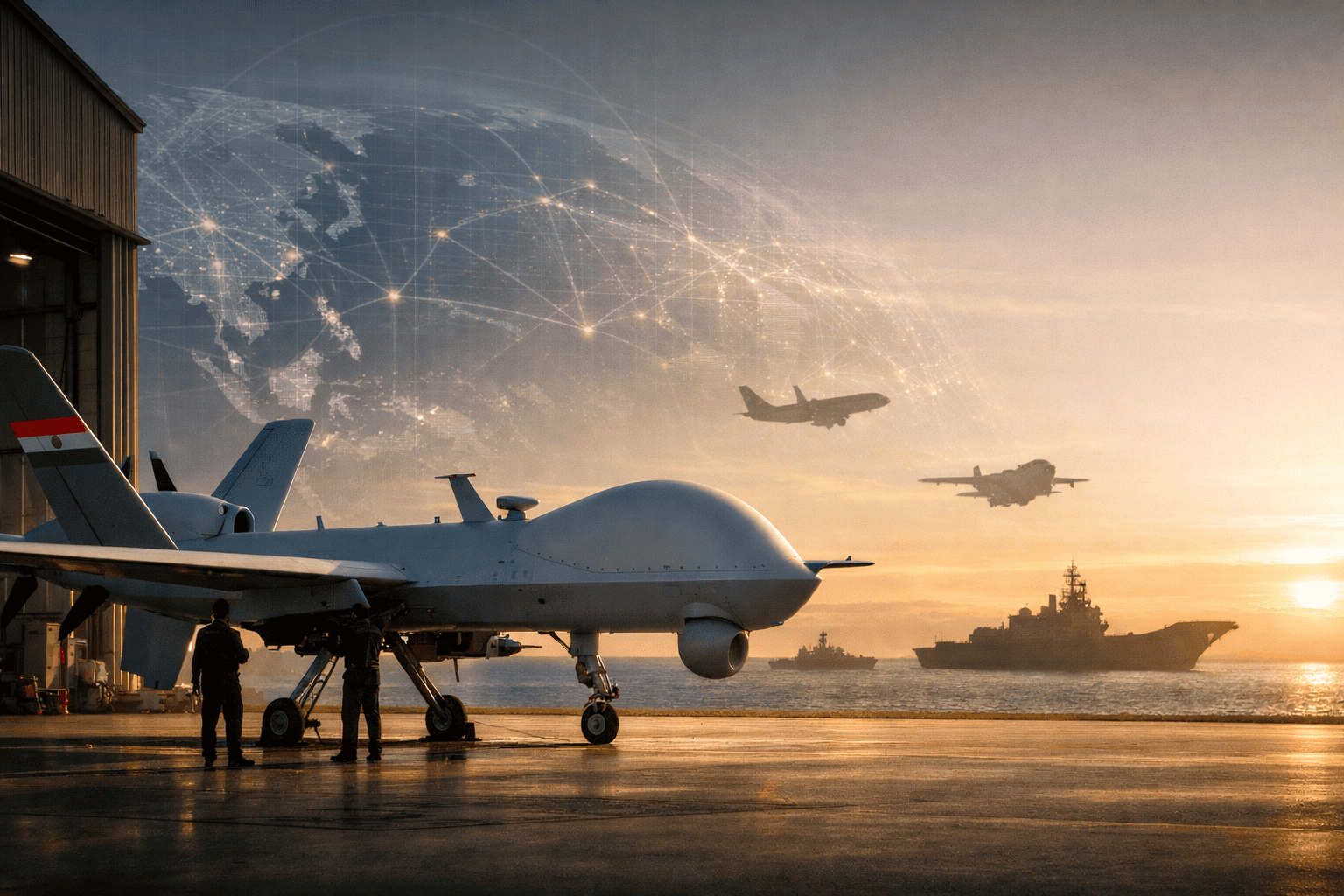
India has just approved the lease of two additional General Atomics MQ-9 unmanned aircraft for the Indian Navy. The approval was cleared by the Defence Acquisition Council (DAC), chaired by Defence Minister Rajnath Singh, and is being seen as a significant boost to India’s intelligence, surveillance and reconnaissance capabilities along its borders and across the Indian Ocean region particularly amid mounting Chinese naval activity.
The latest Indian decision comes five years after India first leased two MQ-9 aircraft from General Atomics in 2020. This deal is valued at Rs 1,600 crore ($175 million)
On October 15, 2024, India and the United States (US) concluded a Rs 32,000 crore ($3.8 billion) agreement for the acquisition of 31 Predator MQ-9B drones and the establishment of a Maintenance, Repair, and Overhaul (MRO) facility in India. The armed High Altitude Long Endurance (HALE) Remotely Piloted Aircraft Systems (RPAS) is manufactured by USA’s General Atomics. The deal was based on an inter-governmental agreement, via the Foreign Military Sales (FMS) programme of the US. 15 will go to the Indian Navy (IN), and 8 each to the Indian Army (IA) and the Indian Air Force (IAF). The drones will be supplied by 2027.
Earlier in August 2024, during Indian Defence Minister Rajnath Singh’s visit to the US, the two countries concluded the Security of Supplies Arrangement (SOSA) agreement. SOSA is a key enabling pact, which would allow closer defence industry cooperation between the US and India. The next step will be the signing of the Reciprocal Defence Procurement Agreement (RDP), which will be legally binding. A Memorandum of Understanding (MoU) has also been signed regarding the assignment of Liaison Officers to each other’s select defence formations, to bolster defence ties between the two countries.
End of the Cold War, and growing US interest to take on China in the Indo-Pacific brought the USA closer to India. Since the turn of the century, there has been increased activity in security fields with many military, industrial, logistics, and communication-related agreements. As India and the USA further their geo-strategic interests, there is a congruence of views and vision. The militaries are exercising more regularly and need logistics agreements. India needs some high-end technology to further ‘Atmanirbharta’ in defence production. The USA needed assurance about the security of communications and end-use of equipment and technologies. The military-industrial complexes of both countries wanted to engage much more and without sensitivities and hindrances. And therefore the continued need for agreements. Military aviation uses the highest-level technologies, and obsolescence sets in much faster. The greatest beneficiary of the Indo-US cooperation has been the military aviation.
Logistics and Communication Agreements
In 2002, the two countries signed the General Security of Military Information Agreement (GSOMIA) to facilitate the sharing of military intelligence between India and the USA. The Logistics Exchange Memorandum of Agreement (LEMOA) was signed in 2016, which allowed the two countries to use each other’s military bases to carry out repairs and for resupplying during exercises and transit of ships and aircraft.
The Communications Compatibility and Security Agreement (COMCASA), signed in 2018, allowed secure communications exchange between the two during training exercises and operations. The agreement allowed India to procure and transfer specialized equipment for encrypted communications for US-origin military platforms like the C-17, C-130, and P-8I, thus improving operational efficiency.
And in 2020, the Basic Exchange and Cooperation Agreement (BECA) was signed. BECA focuses on providing American geospatial intelligence to India. Geospatial intelligence is the intelligence on human activity gathered by closely examining satellite images and other allied information. This agreement was signed in the backdrop of deteriorating US-China relations and the India-China border clash in the Galwan Valley. Using these accurate maps and satellite images, India can enhance its topographical and aeronautical data which will aid in guarding its borders more effectively.
Security of Supplies Arrangement (SOSA)
In recent years, the US has emerged as the biggest defence importer of India-made subsystems, which has contributed significantly to the big jump in India’s defence exports. SOSA would give US companies more freedom and allow them to widen their base in India by manufacturing and sourcing from within the country. The US has signed SOSA with 18 other nations, including a few non-allies and non-NATO countries.
SOSA will allow the US to request priority delivery for its contracts, subcontracts, or orders from companies in India. Similarly, it also permits signatory nations to request priority delivery for their contracts and orders from American firms. The arrangement will enable both countries to acquire the industrial resources they need from one another to resolve unanticipated supply-chain disruptions and meet national security needs.
The US will provide India assurances under the US Defence Priorities and Allocations System (DPAS), supported by the Department of Defence (DoD) and rating authorisation by the Department of Commerce (DOC). In turn, India will establish a government-industry understanding, wherein Indian firms will voluntarily make reasonable efforts to provide US priority support. SOSA encourages the defence industrial ecosystems of both countries to work together and enhance supply-chain resilience. SOSA will also support commonality and strengthen interoperability.
The arrangement will be institutionalised, furthered, and supervised by specially designated and created working groups. These groups will also proactively iron out hindrances to supply-chain functioning in peacetime, emergencies, and armed conflict. SOSA represents an important moment in the US-India Major Defence Partner relationship and will be a key factor in strengthening the Defence Technology and Trade Initiative (DTTI) between the two countries. But SOSA has no legal bindings.
Reciprocal Defence Procurement (RDP) Agreement
The next logical step after SOSA is to make it binding on companies to prioritise the selection of the other, eventually opening up joint production and sourcing on a larger scale. It will also pave the way for standardisation, interchangeability, and in turn interoperability of conventional defence equipment. The US has signed Reciprocal Defence Procurement (RDP) agreements with 28 countries.
Such an agreement would provide a framework for interaction regarding market access and procurement matters. The agreement will also allow American companies to bypass the “Buy American” statute and more easily allow them to set up manufacturing bases in India.
Liaison Officers MOU
Based on an earlier joint decision, India had deployed three colonel-level officers, one each at the Hawaii-headquartered Indo-Pacific Command (INDOPACOM), the Special Operations Command (SOCOM/USSOCOM) in Florida, and the US-led Combined Maritime Forces (CMF) in Bahrain early this year. The above arrangements are over and above the increased number of defence attachés, keeping in view India’s overall global stature and defence and security profile.
US-India Strategic Congruence
The US interests to contain competitor and possible rival China brought India into USA’s Indo-Pacific strategy. India needed US cooperation on global security matters; support for its inclusion in the United Nations Security Council (UNSC); a greater role in the World Bank and IMF; and admission into multilateral export-control regimes like the Nuclear Suppliers Group, MTCR, Wassenaar Arrangement, and Australia Group. Post-2000, the USA became more open to selling high-end military equipment to India.
India is an important member of the Quad now. All four partners have regular summit-level and 2+2 minister-level meetings. There are military logistics agreements between all, and they all take part in regular military exercises. The USA has been supplying military equipment.
USA Military Aircraft in India
Among the increasing cooperation in defence, aviation has seen the fastest results. IAF first ordered the Lockheed C-130J-30 Super Hercules aircraft in early 2008 for special operations under the US FMS program. Indian Navy received the Boeing P-8I Poseidon for maritime surveillance, Electronic Intelligence (ELINT) and anti-submarine warfare (ASW) roles. In 2009, the IAF inducted three specially equipped Boeing 737 Business Jet (BBJ) for VVIP duties. Boeing C-17 Globemaster III strategic airlift aircraft were inducted next. Two custom-made B-777 have also been procured to replace the older Air India B-747 jumbo jets for VVIP duties. Boeing Apache AH-64E attack helicopters and Boeing CH-47 Chinook heavy-lift helicopters formed the rotary-wing purchases. In June 2017, the US State Department approved the sale of General Atomics MQ-9 Guardian/Predator-B UCAV drones to India. Two had been on lease with the Indian Navy since 2020. The deal was finally signed in October 2024.
Lockheed Martin Big in India
Lockheed Martin, the world’s biggest arms manufacturer, is looking for a “game-changing” partnership in India. They have a joint-venture company with TASL, where airframe components for the C-130J airlifter and the S-92 helicopter are manufactured in India in large numbers. All C-130Js delivered globally have major aero-structure components from India. TASL is producing the F-16 Wings in India. Meanwhile, Lockheed Martin is promoting many defence and aerospace start-ups. It also provides research grants for teams from Indian universities to work with local industry partners.
Boeing Make-in-India
Other than civil airliners, Boeing also has a huge presence in military aircraft with the IAF’s C-17, BBJ, VVIP B-777, Chinook and Apache helicopters, and the Indian Navy’s P-8I.
A public-private partnership brings together Boeing, Hindustan Aeronautics Limited (HAL) and Mahindra. HAL has been the single-source producer of 757 over-wing exit doors. HAL has also manufactured the 777 up-lock boxes, F/A-18 gun bay doors, F/A-18 wire harnesses, P-8I weapons bay doors, and P-8I IFF transponders. BEL is also on contract to provide F/A-18 flight deck cockpit panels. HAL makes gun-bay doors for the F/A-18.
Boeing has invested in engineering centres at Bengaluru and Chennai with over 3,000 engineers. The Boeing–TASL joint venture manufactures aero-structures for CH-47 Chinook and Apache helicopters, including for global customers.
Boeing also works with many others like BEL, Dynamatic Technologies (DTL), Tata Advanced Materials Limited (TAML), TAL Manufacturing Solutions, Avantel, and Cyient (formerly Infotech).
General Electric (GE)
GE Aviation is the world’s leading producer of large and small engines for commercial, military, business, and general aircraft. GE supplies F404-IN20 engines for the Light Combat Aircraft (LCA) Tejas Mk-1. The F414-INS6 engines are selected to power the Tejas Mk-2 version. These will be made in India through a technology transfer clause. GE has joined with the Tata Group to make LEAP engines in India.
India Innovation Growth Program
As part of its larger commitment, Lockheed Martin has sponsored and supported the India Innovation Growth Program (IIGP) since 2007 in partnership with the Department of Science and Technology, Indo-US Science and Technology Forum, FICCI, Stanford GSB, and the IC2 Institute at the University of Texas. IIGP has supported more than 400 innovators and start-ups with technology commercialisation training. To date, over $1 billion in revenue has been generated for Indian entrepreneurs.
Defence Technology and Trade Initiative (DTTI)
The India-US Defence Technology and Trade Initiative (DTTI) was signed in 2012. DTTI aims to strengthen India’s defence industrial base, explore new areas of technological development, and expand Indo-US defence trade. Among the ambitious projects identified are plans to share jet engine technology, an initiative slowed by the US export control regime. Focus on start-ups is likely to enable US-based research labs to work with Indian companies on cutting-edge defence technologies. The two sides are also discussing jointly developing systems for approved third nations to enable export opportunities.
Strategic Trade Authorisation (STA-1)
The United States has designated India as an STA-1 country, allowing it to buy highly advanced and sensitive technologies from America. This places India on par with NATO, Japan, South Korea, and Australia. With this, restrictions ease for high-technology product sales, and India receives license-free access to a wide range of dual-use technologies. Bilateral defence trade, which was near zero in 2008, reached $22 billion by the end of 2022.
US-India Business Council (USIBC)
The US-India Business Council (USIBC) was formed in 1975 as a business advocacy organization to encourage private-sector investment flows between India and the US. Aerospace and defence are major areas today.
Defence Policy Group (DPG)
The India-US Defence Policy Group (DPG) in Washington is the top official-level meeting mechanism on defence issues. It reviews and guides cooperation in defence trade, technology, procurement, industry, R&D, and military engagement. There are multiple working sub-groups.
Air Exercises
The USA and India regularly engage in air exercises. The USA, UK, and Australia carried out India’s first multilateral exercise “Shiksha” in 1963. IAF and USAF participate in the PACAF FTX “Cope India” series, begun in 2004, conducted in India. IAF participates in Red Flag advanced air-combat training in the US. The US had a major presence in the Pitch Black air exercise in Australia, where many countries fielded F-35s. The US had a large contingent for the “Tarang Shakti” exercise in India in August–September 2024.
Way Ahead
India is already a leader of the Global South. It maintains excellent relations with Russia, Europe, and the USA. PM Modi has recently had very successful visits to Russia, Poland, and Ukraine. He attended the Quad summit in the USA in September. He will be visiting Russia soon for the BRICS summit.
India’s relations with the USA are special because both are major democracies. With increasing security activity in the Indo-Pacific, defence cooperation has been rising. India and the US are looking at cooperation in critical minerals and semiconductors.
The recently signed military logistics and communication-enabling agreements have supported interoperability. SOSA and RDP will ease military-industrial cooperation. Both are taking slow but steady steps as they come closer as global security partners. Military aviation remains the biggest beneficiary. In all this, India retains its “Strategic Autonomy.”
Header Picture Credit: Representative Image Generated using AI
Twitter: @AirPowerAsia
 Air Power Asia