
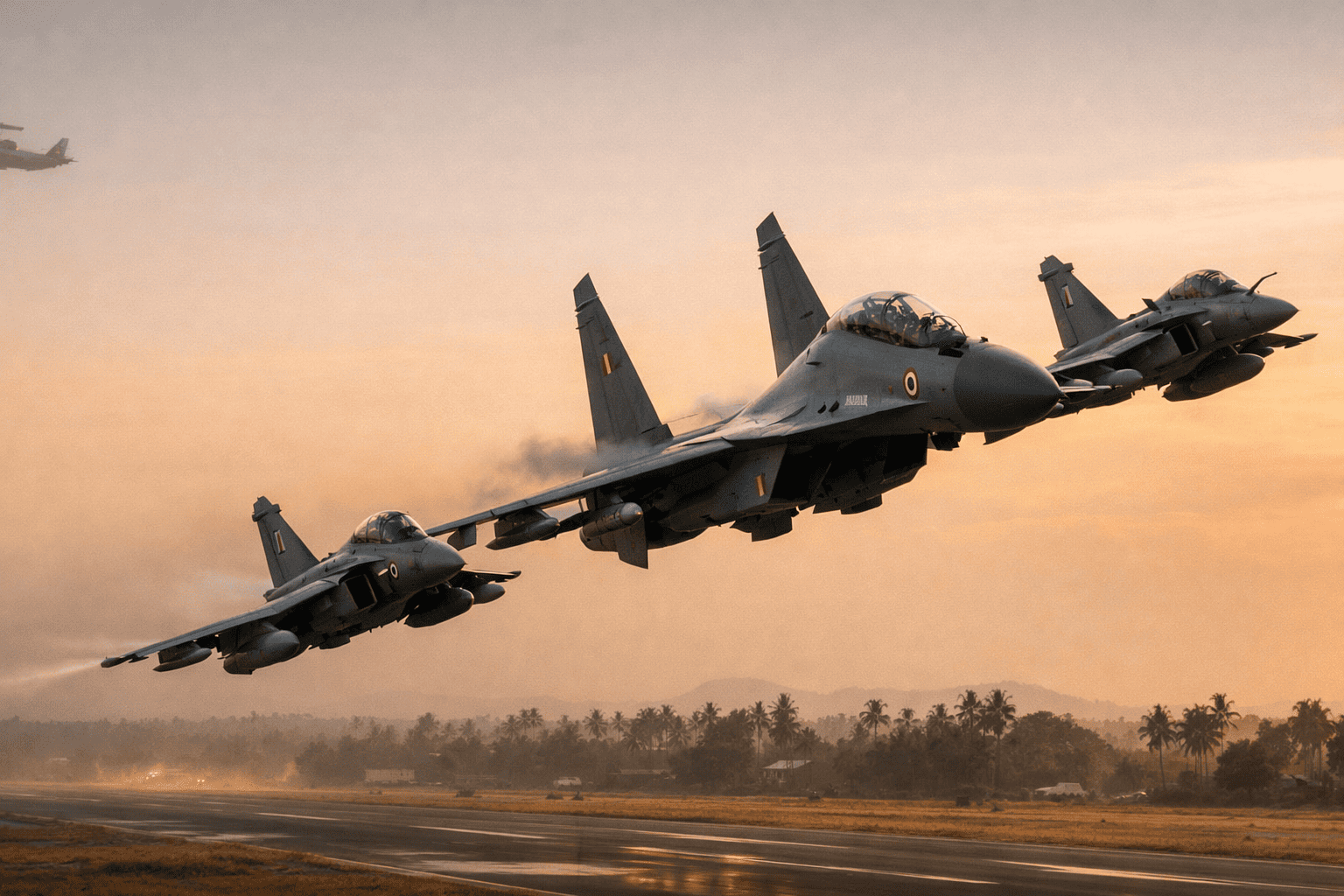
The Phase I of Indian Air Force’s (IAF) Mother-of-all-Exercises “Tarang Shakti” concluded on 14 August at Sulur Air Base, near Coimbatore, in India’s southern peninsula. The ultimate show of multinational synergy on the concluding day was a joint fighter aircraft mission by four Air Chiefs of participating air forces. These included ACM VR Chaudhari, CAS IAF (flew Su-30 MKI); Gen Stephane Mille, CAS French Air & Space Force (FASF) (LCA Mk1); Lt Gen Ingo Gerhartz, German Air Chief (LCA Mk1); Air General Francisco Braco Carbo, Chief of Spanish Air & Space Force (Su-30 MKI).
It is a first-of-its-kind and largest multinational air exercise in India. Perhaps smaller in size and scope only to the “Air Defender” exercise of NATO, “Red Flag” of the USA, and “Pitch Black” in Australia. The IAF had extended invitation to 51 Friendly Foreign Countries. Air Forces of 10 countries are participating, and at least 67 combat aircraft will be in action. The focus was on enhancing mutual understanding of air power, realistic operations, strengthening military ties, and showcasing indigenous defence equipment. The exercise is planned in two phases.
Countries Invited
Air Forces of 51 friendly foreign countries were invited. The IAF regularly exercises or interacts with many of them and has a certain degree of interoperability. The invited countries cover all the continents. Many of those invited are from Asia and Africa. All India’s friendly neighbours were invited. Some are using Indian defence equipment.
From Africa, invites went to (alphabetically) Algeria, Angola, Botswana, Ethiopia, Egypt, Ivory Coast, Kenya, Morocco, Mozambique, Nigeria, South Africa, Tanzania, and Tunisia.
From Asia were Armenia, Bangladesh, Brunei, Cambodia, Indonesia, Japan, Kazakhstan, Kyrgyzstan, Laos, Malaysia, Maldives, Nepal, Oman, Philippines, Republic of Korea (RoK), Saudi Arabia, Singapore, Sri Lanka, Tajikistan, Thailand, Turkmenistan, UAE, Uzbekistan, and Vietnam.
Invited from Europe were France, Germany, Greece, Italy, Spain, Sweden, and UK. USA is the only North American country. From South America were Argentina, Brazil, Chile, Colombia, and Venezuela. Australia, which has been busy winding up exercise “Pitch Black”, will participate in Phase II.
It can be noticed that India’s great military equipment partners Russia and Israel are not in the list. Both are currently engaged in conflicts in their regions. Bangladesh is to bring the C-130 in Phase II, but actual participation will depend on internal situation.
Participating Airborne Assets
Australia will bring F-18, and France Rafale. Germany, Spain, and UK the Typhoon. Greece, USA, and UAE F-16. UAE will also bring AWACS. Singapore and Bangladesh C-130. The USA will also bring A-10, and FRA. The F-35 will not take part. The IAF got exposed to F-35 elsewhere in Red Flag and the recent Pitch Black exercises. Germany will also showcase the A-400M, which is competing for an IAF tender.
The IAF will field LCA Tejas, Su-30 MKI, Rafale, Mirage 2000, Jaguar, MiG-29, LCH Prachand, ALH Mk IV Rudra, C-130, IL-78 (FRA), and Netra and Phalcon AEW&C. Many of the IAF assets and personnel who normally don’t deploy abroad for exercises will now be able to participate. These include air traffic and radar controllers, missile crew, and some types of aircraft. The IAF’s Agniveers also took part.
Phase I at Sulur Airbase
The just concluded Phase-I at AF Station Sulur was held from 06–14 Aug 24. The air forces of India, Germany, France, Spain, and UK participated. Most of these countries are already engaged in Exercise ‘Pitch Black’ in Australia and found it convenient to engage in the first phase while on their way back from Australia. The Indian Navy’s MiG-29K fighters were part of Phase I.
Sulur is the home base of LCA Tejas. It is India’s second largest airbase after Hindon. It is one of the bases responsible for protection of India from the sea side. It is among the few airbases in India which host both fighter, transport, and helicopters at one location. The base is home for 5 Base Repair Depot and 43 Wing of the IAF. There is an Antonov An-32 medium transport aircraft squadron, a Mi-17 V5 transport helicopter unit, it is the Sarang Helicopter Display Team’s home-base, and since July 2018, it became the base for LCA Tejas.
Phase I Flying Operations
One day before the beginning of Phase I, the IAF’s indigenous fighter aircraft LCA Tejas carried out a practice interception of the Eurofighter Typhoons of the German and Spanish Air Forces, and the Rafale of the French Air Force. While the Tejas was being flown by Air Force Vice Chief Air Marshal AP Singh (Now the current Air Chief), the German plane was being flown by the German Air Force Chief.
The Air Chief addressed and welcomed all the participants of this landmark multilateral air exercise on the opening day. Commander of the German Air Force Lt Gen Ingo Gerhartz expressed gratitude on behalf of Germany, France, Spain, and UK. He expressed readiness for a meaningful and impactful exercise.
The aircraft that took part included Rafales, Typhoons, Su-30s, LCA, A-400 military transport aircraft, and Airbus A330 MRTT.
The skies above Sulur have been humming with the roar of fighter aircraft, including Eurofighter Typhoons, French Rafales, and India’s own LCA Tejas. The atmosphere is charged with the sight of these powerful machines cutting through the air, symbolising a strong spirit of cooperation and mutual respect among the participating nations. Thanks to the Mutual Logistics Support Agreement (MLSA) between India and France, the French Rafale needing a spare part could borrow it from the IAF.
In Praise of LCA
The IAF Chief Chaudhari said this was the first time the LCA Mk-1 took part in such large force engagements and the IAF was proud of its performance. “Tejas is the epitome of our success in the self-reliance campaign. We will use the aircraft more in air combat drills both within and outside the country,” he said. ‘Tejas,’ the world’s smallest fighter, proved its capabilities in realistic combat settings as part of both ‘blue force’ (friendly) and ‘red force’ (hostile), Chaudhari said. Major Alexis Galouzeau, 38, a French Air Force Rafale pilot who flew missions with and against the LCA Mk-1, was impressed with the capabilities of the Indian fighter jet. “It has fantastic manoeuvrability and can carry out a variety of missions,” he said. “If we had adequate numbers of LCA Mk-1As, the aircraft would have taken part in Tarang Shakti,” Air Chief Chaudhari said in response to a question.
The LCA Mk1A were earlier to be delivered by 31 March 24, and are now likely to be delivered only in November 2024, after missing the revised timeline of August. The main reasons for the delay is the supply of the F404 engines to HAL by US firm GE Aerospace. These are delayed by around 10 months. Also, the certification of new systems in the aircraft is still pending.
Tarang Shakti Operational and Administrative Planning
Tarang Shakti will help the IAF build professional relationships with the leading air arms of the world. Hosting a complex multinational exercise is of extreme learning value for the host. Over the years India has very successfully hosted large aviation events such as the Aero India “Airshow” at Yelahanka, Bengaluru. The IAF understands the support required to host and position diverse equipment and platforms. Also, it will be a major challenge to accommodate such large number of personnel in secure accommodations nearby.
The operational planning and flying require months of hard work and coordination. Broad arrays of operational scenarios will be evolved. The missions would include beyond visual range (BVR) combat exercises as part of Large Force Engagements (LFE), in offensive counter air and air defence roles. LFE require very detailed mission plans. One has to look into de-confliction and flight safety. Every sortie must have a very detailed briefing. Flight safety considerations have to be spelt out. Plan ‘B’ will be put on the table. Mission aims have to be explicit. Electronics briefing will be important. Electronic warfare will be selectively practised. There will be detailed debriefs to derive lessons and even make amends for future missions.
Both phases will see similar operational complexity and involve the full range of platforms and equipment including fighters, AEW&C, FRA, transports, helicopters, radars, missile systems, and Special Forces. The exercise will also be a test for maintenance crew to ensure high serviceability and meet the high mission tempo.
Showcasing India
A large number of indigenous platforms will be seen in action. “Make-in-India equipment including LCA Tejas, LCH Prachand, Netra AEW&C, and Akash SAM, and some other weapon systems were showcased. LCA and some other indigenous aircraft performed air displays. There was a defence and technology related industrial exhibition of Made in India at Sulur, and will be repeated at Jodhpur during the exercise. Several high-level military engagements are planned on the side-lines. The Diplomatic Corps, officers of other services, members of industry, media, analysts from Think Tanks were all present.
Phase II at Jodhpur
After a two-week break, the slightly larger Phase-II will be at AF Station Jodhpur, Rajasthan, from 29 Aug to 14 Sep 24, and include Australia, Bangladesh, Singapore, Greece, UAE, and USA along with 18 countries as observers.
Jodhpur is one of the major airbases facing Pakistan in the desert sector and played a great operational role in both 1965 and 1971 Indo-Pakistan Wars. It has been home to the indigenous HF-24 “Marut”, MiG-23 BN, MiG-27, Sukhoi Su-30MKI, HAL Dhruv, Mil Mi-17, and the first base of indigenous LCH Prachand. The airbase has hosted many bilateral air exercises with the US Air Force (USAF), “Garuda” series with FASF, and more recently air exercises with Oman.
IAF’s Growing International Air Exercises
The IAF has participated in over 91 international air exercises since the beginning of this century. In the last decade, the number of military exercises with foreign air forces has increased exponentially. Some of the regular exercises where IAF participates include Exercise Garuda (India, France), Cope India (India, USA), SINDEX (India, Singapore), Indradhanush (India, UK), Exercise Red Flag (Multinational, Host: USA), Exercise Desert Eagle (India, UAE), Exercise Eastern Bridge (India, Oman), Siam Bharat (India, Thailand), Exercise INDRA – tri-service (India, Russia), Exercise Blue Flag (Host: Israel), Exercise Pitch Black (Host: Australia), Shinyuu Maitri (India, Japan), Exercise Desert Knight (India, France, UAE), Cobra Warrior (UK, multinational), Iniochos (Greece, multinational), and Exercise Desert Warrior (India, Egypt).
There are some air exercises carried out within India without foreign participation. These are Multi-Agency Exercise ‘Pralay Sahayam’ (Disaster response exercise), Exercise DANX (Defence of Andaman & Nicobar Exercise), Gaganshakti, Vayushakti, Exercise Iron Fist, and Bharat Shakti (Tri-service) and have been of very major scale. Exercise Tarang Shakti now will be the first very large multinational exercise hosted by India.
To Summarise
It can be seen that India’s economy and diplomacy have transformed and the world is wooing it. India has the fourth most powerful military, and will soon be the third largest economy. New Delhi is thus in a position to engage the world on its own terms.
Tarang Shakti is showcasing the IAF and India more broadly. The IAF will learn and share best practices with the leading visiting air arms, making this a win-win for all involved. This theatre-level exercise would involve nearly 70 aircraft. The exercise has allowed the country to showcase its indigenous military capabilities to the world, including the LCA ‘Tejas’, Prachand light combat helicopter, Dhruv advanced light helicopter, and its armed version Rudra, among many others.
Some of the key takeaways from the exercise would include enhancing interoperability with international partners and a collaborative understanding of employment philosophy in a multinational environment. It will be a huge exposure for young crew members. All the participating Friendly Foreign Countries also joined hands together to spread the message of environment sustainability.
The exercise will prove the IAF’s professional reputation, and cement the country’s place as a serious geopolitical player. Could Tarang Shakti become a regular multi-national triennial exercise for years to come, will evolve in due course.
Note: The article was originally written by the Author for Indian Aerospace Defence Bulletin on 5th, September 2024, it has since been updated.
Header Picture Credit: Representative Image Generated using AI
Twitter: @AirPowerAsia
 Air Power Asia