
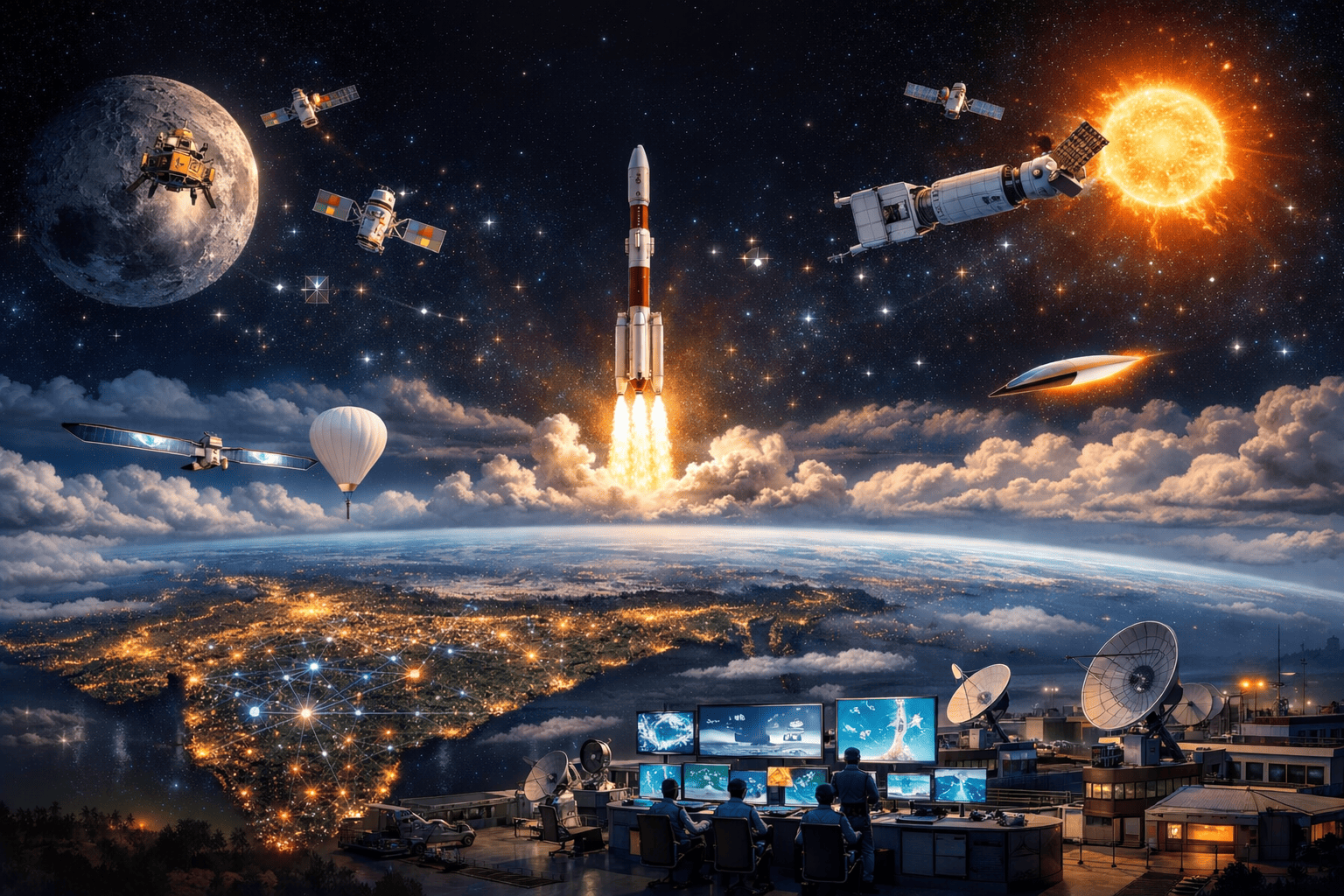
Space has already emerged as the next great frontier, where geostrategic play is quickly unfolding. Space impacts all activities on planet Earth. More importantly, all major powers are not only building capabilities to harness the great potential of space but also evolving means to secure assets and dominate the domain. India is a significant player and is one among the only six countries in the world that possess full launch capabilities, deploy cryogenic engines, launch extra-terrestrial missions, and operate large fleets of artificial satellites. It is also the only country to have landed a spacecraft on the Moon’s south pole. India builds all kinds and sizes of satellites. Its Chandrayaan-3 landing on the Moon has ignited a global lunar race that was somewhat on the back burner. India’s Aditya L1 is in position at the designated orbit. We just witnessed the successful experimental flight of India’s Re-usable Launch Vehicle (RLV) “Pushpak Viman” (RLV LEX 02).
Clearly, the United States and China are racing ahead in space exploration and capability building. India has all the building blocks in place but needs to invest more to become a significant space power. Luckily, India’s space sector is being driven directly by the Prime Minister’s Office. PM Modi has directed that the space sector be “unlocked” and has set a five-fold increase target in its share of the global space economy. The Space Budget has seen an exponential increase in the last decade. The Indian Space Policy 2023 and the setting up of the Indian National Space Promotion and Authorization Centre (IN-SPACe) have been created to support private sector participation in space activities. The Anusandhan National Research Foundation (NRF) supports greater Public-Private Partnership (PPP) in scientific research. The NRF Budget envisions funding of Rs. 50,000 crore over five years.
India’s Current Capabilities in Space
India’s space programme is run by the state-controlled Indian Space Research Organisation (ISRO). The broad capabilities, including putting Indian-designed and built satellites in Low Earth Orbit (LEO), Medium Earth Orbit (MEO), and Geostationary or Transfer Orbits (GTO), are in place. India’s most powerful Launch Vehicle Mark-3 (LVM3) can carry a 10-ton payload to LEO and 4 tons to GTO and is being human-rated for the Gaganyaan project. The other three major space powers, including China, have launch vehicles that can put in excess of 25 tons. India too is working to develop Heavy Lift Vehicles (HLV) and Super-Heavy Lift Vehicles (SHLV) to deliver 50–100 tons and also reusable launch vehicles. India also has the Small Satellite Launch Vehicle (SSLV) for smaller payloads around 500 kg to LEO and 300 kg to Sun-synchronous orbit (500 km).
India operates a large number of home-grown remote-sensing, communications, and meteorological satellites. Indian satellites also support Intelligence, Surveillance, and Reconnaissance (ISR) for India’s strategic community needs. The major space powers have small satellite constellations. India too is working on having its own. It has begun operating its IRNSS (NavIC) satellite navigation system. It has sent three missions to the Moon and one to Mars. India has demonstrated anti-satellite kinetic-kill capability. The crewed spaceflight programme is expected in 2025. The realistic timeline for India’s three-crew, 20-ton space station operating at 400 km would be 2030. China’s Tiangong Space Station has been operational since 2021. India targets putting an astronaut on the lunar surface by 2040.
NASA-ISRO Synthetic Aperture Radar (NISAR) is a Low Earth Orbit observatory being developed by ISRO and NASA, which will map the entire Earth in 12 days. India’s private space sector is becoming significant, with players in launch vehicles, cost-efficient rockets, small satellites, satellite constellations, and propulsion systems.
Near Space: A Place of Action
Typically, Near Space lies between 23 km and 100 km altitude. This under-utilised region has very little air to support conventional aircraft. The region would see spy balloons, solar-powered drones, and hypersonic missiles. Quasi-satellites, tethered solar drones, and High Altitude Platforms are evolving. China has reportedly established the world’s first Near-Space Command. Dominating Near Space is seen as critical in future space wars.
The NASA Near Space Network delivers critical communications and navigation services. The IAF Chief VR Chaudhari has highlighted the importance of Near Space. NewSpace Research and Technologies Pvt Ltd (NRT) has flown its High Altitude Pseudo-Satellite (HAPS).
Merging Air and Space
The United States, United Kingdom, France, and Russia have merged air and space domains. India operates the Defence Space Agency (DSA). The Indian Air Force (IAF) outlined the Defence Space Vision 2020 and the IAF Doctrine 2022. These aim to enhance defence preparedness, aerospace deterrence, and space security.
Space Militarisation and Deterrence
More platforms such as ballistic missiles and hypersonic glide vehicles are transiting through space. Hard-kill and soft-kill anti-satellite systems are operational. Space-based jamming, directed energy weapons, and electromagnetic pulse systems are being developed. Space is now a domain for electronic warfare and cyber warfare. China’s satellite capture systems pose risks to adversaries. Space capabilities are emerging as a major pillar of strategic deterrence.
Indian Military Capabilities in Space Need a Boost
India requires stronger ISR satellites, communication satellites, and electro-optical sensors. Satellite-based navigation, secure data links, and space communications are critical. Armed forces must migrate from GPS to NavIC. But presently, only 3 of the 11 planned satellites are functional. A lot more needs to be done.
India’s Positioning, Navigation, and Targeting (PNT) capability must expand. Small-satellite constellations and launch-on-demand capability are essential.
The management of big data, sensor fusion, and multi-domain integration is vital. Partnerships with the Quad countries and France support space security cooperation.
India must reduce dependence on foreign Earth observation data. Real-time satellite imagery is essential for security.
India’s ASAT capability, supported by the Agni-5-class missile, enables counter-space operations. Development of Directed Energy Weapons (DEW) and plasma thrusters enhances satellite survivability.
Space Situational Awareness (SSA) enables orbital tracking, threat assessment, and debris management.
India must develop offensive and defensive space capabilities. Around 100 military satellites will be needed by 2030. The Integrated Air Command and Control System (IACCS) must evolve into the Integrated Air and Space Command and Control System (IASCCS). Strengthened military demand articulation and government funding are essential. Time to act is now.
Note: The article was originally written by the Author for Indian Aerospace Defence Bulletin on 14th, April 2024, it has since been updated.
Header Picture Credit: Representative Image Generated using AI
Twitter: @AirPowerAsia
 Air Power Asia