
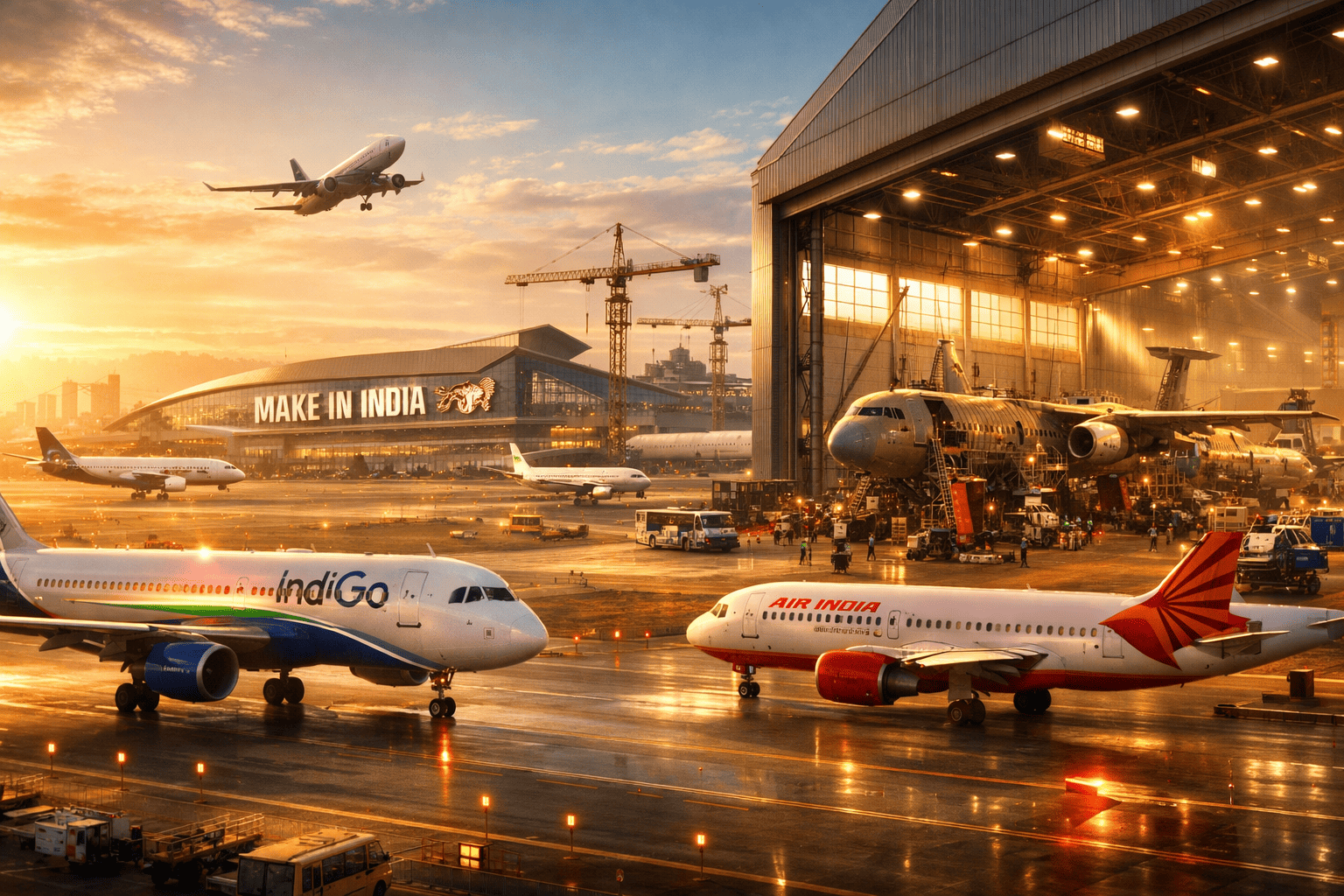
On a typical day, Indian airports receive nearly 3,100 domestic and 625 international flights, involving 6,200 aircraft movements, having over 1,115,000 passenger footfalls. The airlines’ passenger load factor is close to 90 per cent. India’s post-Covid-19 civil aviation turnaround has been extraordinary. India has 157 operational airports. Positive attitude, progressive policies, and deep trust among passengers are taking it to new heights every day. The two largest Indian airlines IndiGo and Air India have announced plans to acquire over 500 aircraft each in the coming decade.
Civil Aviation Statistics
India’s domestic air passenger traffic was 153 million in 2023. It is expected to increase two-fold to touch 300 million by 2030, the Civil Aviation Minister Jyotiraditya Scindia told the Wings India 2024 conference and exhibition in Hyderabad in January. The year 2023 saw a growth of 26.98 per cent compared to the year before. The increase reflects India’s rising economy, income levels, and demonstrates the strength and durability of India’s aviation sector, and the rising demand for air transportation.
In its 2023 report, Airbus’ Global Market Forecast (GMF) for 2023–2042 predicts demand for passenger traffic will grow annually by 3.6% CAGR (Compound Annual Growth Rate) over the next 20 years. As of June 2022, the total worldwide commercial aircraft fleet size was 28,674 aircraft (23,513 active and 5,161 grounded). Airbus has forecast a demand for 40,850 new passenger and freighter aircraft deliveries over the next 20 years, of which 32,630 will be typically single-aisle and 8,220 wide-body. A June 2023 Boeing forecast expects airlines will need to buy 42,595 jets from now until 2042, with 32,420 single-aisle jets, 7,440 wide-body planes, 1,810 regional jets, and 925 freighters.
A Bain and Company report forecasts that by 2030, Europe–North America travel could increase about 17% from its 2019 demand volume in the baseline scenario, while Asia intra-regional travel could jump 61%. Asia maintains a much stronger outlook for long-term disposable income growth, and low-cost carriers also continue to accelerate growth.
Transport Aircraft Production Ecosystem in India
Hindustan Aeronautics Ltd (HAL) has been producing the HS-748 ‘Avro’ and Dornier D-228 aircraft in India under licensed production. Both have also been used for civil aviation. Also, the National Aeronautics Laboratory (NAL) has designed and test-flown the ‘Saras’ small transport aircraft. This work is still in progress.
The Tata Group companies are already building aero-structures for many helicopters and also C-130J transport aircraft for global customers. Tata Group is working with GE to manufacture CFM International LEAP engine components in India. Many Indian MSMEs and start-ups are in aircraft systems production.
Meanwhile, a Tata consortium will be building 40 EADS CASA C-295 MW aircraft and significant numbers of its sub-systems in India at a plant in Baroda, Gujarat. The first Made-in-India aircraft will roll out of the new facility in September 2026. Before the completion of deliveries in 2031, a D-level MRO (maintenance, repair, and operations) facility will be set up in India. This facility will act as a regional MRO hub for various variants of C-295 aircraft. The indigenous content in these planes will be the highest ever in India, with 96 per cent of the work that Airbus does in Spain gradually being done at the new facility in India. This project should also help India in pushing its commuter aircraft.
In February 2024, Embraer Defence & Security and India’s Mahindra Group announced that they have signed a Memorandum of Understanding (MoU) with the objective of jointly fulfilling the acquisition of the C-390 Millennium multi-mission aircraft by the Indian Air Force (IAF) in its upcoming Medium Transport Aircraft (MTA) procurement project. More than 125 domestic MSME suppliers are spread across different states.
Global Regional Jet Players
While Boeing and Airbus have dominated the large commercial aircraft market, regional jets are smaller aircraft, fly shorter ranges, and carry fewer passengers. Bombardier of Canada and Embraer of Brazil are the historical leaders in the regional jet market. Commercial markets also include turboprops. There are other players in the business jet market such as Beechcraft, Cessna, Dassault, and Gulfstream, etc. The HAL/NAL Indian Regional Jet (IRJ) is planned to be a 90-seater with a targeted first flight around 2026. But the work is still in slow progress.
Boeing and Airbus each manufacture roughly 500 narrow-body aircraft and 100 wide-body aircraft annually. Around 200 regional jets are built by various manufacturers every year. Boeing has delivered over 20,000 jetliners since the era of the B-707, which was inducted in the late 1950s. Airbus, a European multinational aerospace corporation, was founded in 1970. Airbus has built more than 13,500 commercial aircraft. Clearly, the United States and Europe dominate the sector.
Both Russia and China depend on the West for globally certified aero-engines and for some avionics. They also need US Federal Aviation Administration (FAA) and European Union Aviation Safety Agency (EASA) clearances for their airliners to fly to most destinations. China has a huge civil aviation sector with nearly 16 per cent of global civil aircraft. Their civil aircraft fleet comprises close to 3,500 medium- to large-sized aircraft and 240 small-sized aircraft. The fleet size is expected to grow up to 8,500 by 2041. It is pertinent to mention that China’s COMAC C919 narrow-body airliner is about to enter service and has nearly 1,000 orders from Chinese airlines.
Indian Airliner – When?
Indian civil aviation market has huge demand for a civil aircraft and their aero-engines. There is also a huge Maintenance, Repair, and Overhaul (MRO) market to be tapped. The next logical step would be to build our own short-haul ATR-42 class (42–48 seats) aircraft, and later also single-aisle aircraft of Boeing 737 and Airbus A320 class.
Initially, ATR, Airbus, or Boeing should be asked to set up a production line in India. Similarly, India must also get some major civil airliner aero-engine manufacturer to set up a production line in India with a local partner. Even the C-295, which is being made in India, has been certified for civil purposes, and India could consider a civil variant.
The GE-414 fighter aero-engine will be made in India by General Electric in a joint venture with Hindustan Aeronautics Ltd (HAL), with some level of technology transfer. These will be used for the Light Combat Aircraft (LCA) and Advanced Medium Combat Aircraft (AMCA). For civil aero-engines, we must insist on a joint venture with significant technology transfer by leveraging high numbers and a growing market. All this will give further push to the Atmanirbharta (self-reliance).
Tapping the Huge MRO Market
India has a huge MRO market for civil and military aircraft and engines. The current airliner fleet of around 750 aircraft will more than double in five years. IATA predicts that it will be the third-largest fleet in the world by 2026, surpassing the UK. A 2023 CRISIL report states that India’s MRO sector still faces obstacles such as difficulty obtaining credit, inadequate infrastructure, high taxes, licensing and certification issues, and high rental costs. But the Indian government has introduced several policies to support making the country a global MRO hub. These include reducing GST on MRO services from 18% to 5%, land lease policies for longer durations to lower rental costs, and discontinuing the 13% government-charged royalty on revenue. These should support a reduction of costs by 10–20 per cent.
Setting up an MRO is highly capital-intensive with a long break-even time. It requires continuously reskilled manpower and repeat investments in tooling, and certification from safety regulators such as the FAA and EASA, and global OEMs such as Airbus and Boeing, and many others.
The second aircraft MRO hub in MIHAN-SEZ, Nagpur has been operational since 2021. Meanwhile, the Delhi and Bengaluru airports have established dedicated MRO facilities, and these are being extended. A huge MRO hub will come up at the upcoming Noida International Airport, Jewar, Uttar Pradesh. More airports like Belagavi, Bhopal, and Tirupati will have MRO facilities. India’s Directorate General of Civil Aviation (DGCA) would have to stipulate international standards on the lines of those by the FAA and EASA for international recognition.
India’s top think-tank, NITI Aayog, has recommended an incremental approach, by first setting up joint ventures in India with global players, and gradually ascending the work-value chain. Ultimately, India must aspire to be an international-class MRO hub like Singapore. A surge in local MRO facilities will be good for airline operations, safety, and costs.
As per the NITI Aayog report of October 2022, the Indian MRO industry was $1.7 billion in 2021. The global MRO market was worth US$78.6 billion in 2022. The Indian market is expected to be $4.0 billion by 2031, growing at 8.9% CAGR, faster than any other country. India thus has great potential to be a significant regional MRO hub and gradually strive to establish its foothold in the global supply chain.
Current MRO Players
The current major Indian MRO players are AIESL (Air India Engineering Services Ltd), Air Works India, and GMR Aero Technic Limited, among a few others. The airline’s growth makes a great case for strategic investors, Original Equipment Manufacturers (OEMs), and global MRO players. Policy initiatives such as the MRO Policy 2021, National Civil Aviation Policy 2016, and rationalization of GST are great incentives.
Hindustan Aeronautics Limited (HAL) and Airbus have formalized an agreement to establish state-of-the-art Maintenance, Repair, and Overhaul (MRO) facilities for the A320 family of aircraft.
Way Ahead India
In November 2022, at the foundation stone ceremony of a Tata–Airbus manufacturing facility in Gujarat, Prime Minister Narendra Modi said that India would soon be manufacturing large passenger aircraft. He added that they would also be marketed across the globe. The PM perhaps meant two things. Firstly, to convince foreign civilian aircraft makers to set up a final assembly line in India. Secondly, or in parallel, design and build an Indian passenger plane from the ground up.
Prime Minister Modi also inaugurated the Boeing India Engineering & Technology Center (BIETC) campus in Bengaluru, Karnataka, in January 2024. Built with an investment of Rs 1,600 crore, the 43-acre campus is Boeing’s largest such investment outside the United States. The Prime Minister said that this facility demonstrates India’s commitment to drive global tech, research and innovation, design, and demand. “This strengthens the ‘Make in India–Make for the World’ resolution,” he said.
One hundred per cent FDI is already cleared in most sectors of civil aviation, but India has not yet leveraged large airliner orders. The country does have manufacturing and assembly skills but lacks original design work. The narrow-body airliner market is huge. India must insist Boeing and Airbus set up assembly lines in India and give component orders to local manufacturers. Large groups like Tata, with aero-structure manufacturing experience and simultaneously operating a huge airline, can bag more manufacturing orders. In the civil aviation sector, HAL is already manufacturing aircraft parts for Boeing and Airbus, and manufacturing Dornier 228 for RUAG of Switzerland. But it is a minuscule part.
India must set up an independent authority on the lines of the Aeronautical Development Agency (ADA) to push civil aviation aircraft development. It must function under the PMO as it would involve inter-ministerial support. It may subsume the transport aircraft building facilities of HAL and NAL. The agency can also be tasked to work on the MTA for the IAF. The agency must also drive building MRO facilities. We may seek foreign consultancy for aircraft design. India must insist on foreign OEMs to set up engine manufacturing through a joint-venture route. We must do all aircraft interiors work in India to begin with. Why cannot India make aircraft seats and other interiors in India itself? Avionics is another area where India is way behind, and that requires task-force-like action.
The West is moving out of China. Europe has a high cost of production. India is the next best destination. India also has large land banks near airports, especially the newer greenfield airports. Government policies are becoming more attractive for promoting manufacturing and shifting MRO to India. Finally, India has to invest much more in R&D. Developing your own designs and having your own patents is important. It has to be a whole-of-nation approach. India is a rising star; the time to act is now, lest we lose another golden opportunity.
Note: The article was originally written by the Author for Indian Aerospace Defence Bulletin on 28th, June 2024, it has since been updated.
Header Picture Credit: Representative Image Generated using AI
Twitter: @AirPowerAsia
 Air Power Asia