
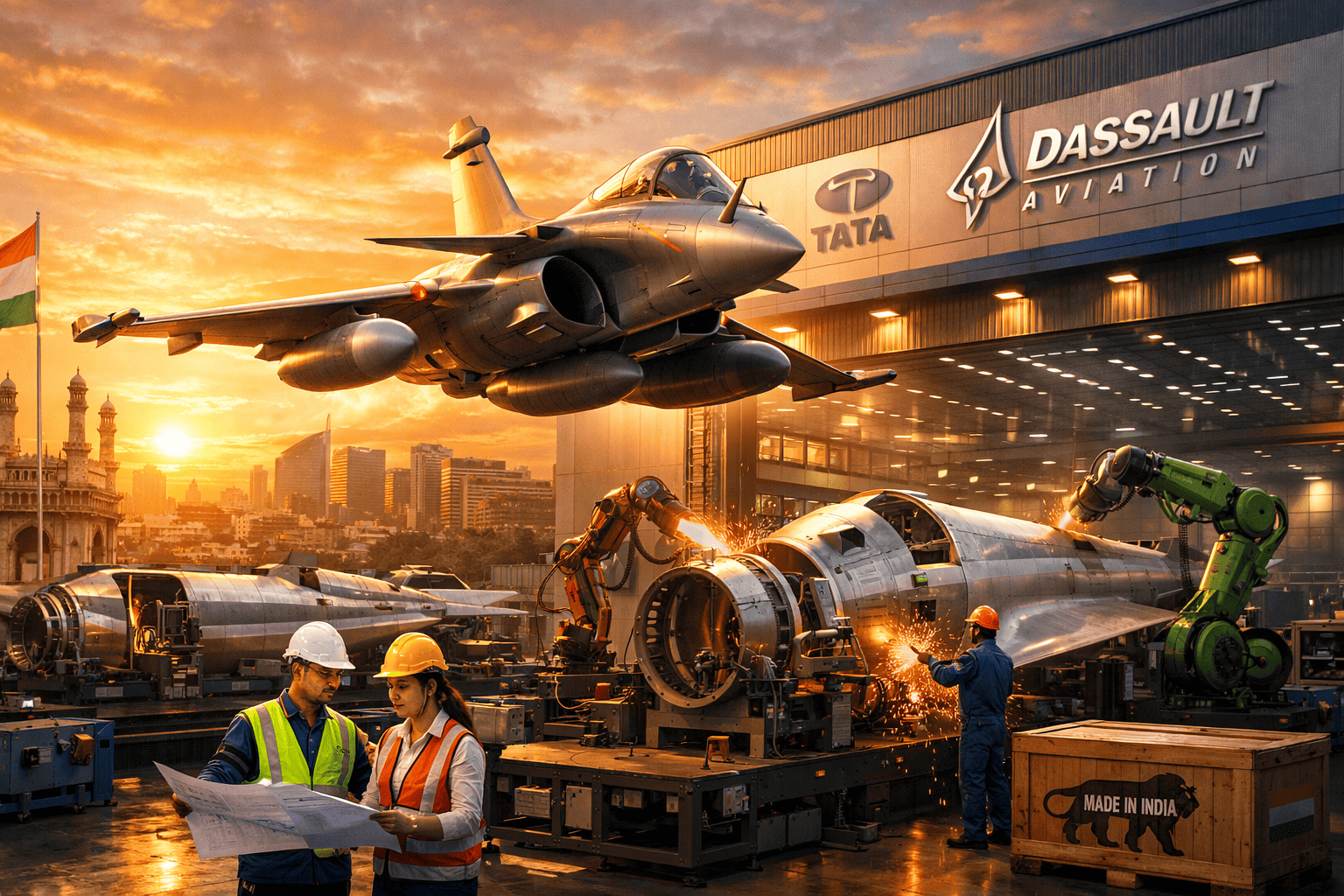
In a big boost to Make-in-India, Dassault Aviation of France and India’s Tata Advanced Systems Limited (TASL) will partner for Rafale aircraft fuselage manufacturing at a dedicated facility in Hyderabad. The key structural sections of the aircraft, to be manufactured in India, include the central fuselage, rear section, lateral rear shells, and the front section. The first fuselage sections are expected to roll out by FY2028, with a production capacity of up to two complete fuselages per month.
Rafale fuselage will be produced in India for both domestic and global markets. This marks the first time in history that Rafale fuselages will be manufactured outside France. Four Production Transfer Agreements (PTA) have been signed between the companies. Eric Trappier, Chairman and CEO of Dassault Aviation, emphasised that this partnership is a “decisive step in strengthening our supply chain in India,” noting that it aligns with the company’s long-term strategy to collaborate with Indian aerospace firms like TASL.
Sukaran Singh, CEO and MD of TASL, described the partnership as a milestone in India’s aerospace journey, demonstrating both India’s manufacturing prowess and the trust international aerospace leaders place in Indian partners. “The production of the complete Rafale fuselage in India underscores the deepening trust in Tata Advanced Systems’ capabilities and the strength of our collaboration with Dassault Aviation. It also reflects the remarkable progress India has made in establishing a modern, robust aerospace manufacturing ecosystem that can support global platforms,” Singh said. This facility will represent a significant investment in India’s aerospace infrastructure and will serve as a critical hub for high-precision manufacturing.
Indian Air Force (IAF) has already acquired 36 Rafale, and they have demonstrated their combat skills in the recent Op Sindoor. Indian Navy is procuring 26 maritime variants Rafale-M. The IAF’s case for 114 Multi-Role Fighter Aircraft (MRFA) procurement is in an advanced stage. Rafale is one of the contenders. Will these two developments tilt the case in favour of Rafale has to be seen?
IAF transition from Mirage 2000 to Rafale was like from one dream machine to another. In the initial training for test pilots, one is taught to assess an aircraft’s characteristics by just looking at it. One look at the wing-body blending, the shape of the intakes, the twist in the wing, the incline of fuselage, the size of the vertical stabilizer, the base of the wheels, all indicate great design features. France has made some great aircraft.
With over 10,000 military and civil aircraft, including 2,700 Falcon aircraft, delivered in more than 90 countries over the last century, Dassault Aviation has built up expertise recognised worldwide in the design, production, sale, and support of all types of aircraft, ranging from the Rafale fighter to the high-end Falcon family of business jets, military drones, and space systems.
France – A Major Aviation Manufacturer
Major French aviation companies include Airbus, Dassault Aviation, Safran, Thales Group, and MBDA. Airbus is a major manufacturer of commercial and military aircraft, while Dassault Aviation specialises in business jets and military aircraft, including Falcon and Rafale. Safran is a key player in aircraft engine manufacturing and other aerospace technologies, and Thales Group provides a wide range of aerospace and defence systems and specialises in electronics. MBDA is a European missile manufacturer. Airbus, a global aircraft manufacturer with headquarters in France, is known for its commercial aircraft and helicopters. ATR is a joint venture between Airbus and Leonardo (Italy), known for regional turboprop aircraft. Daher is a French company that manufactures light aircraft and business turboprops. France is one of the very few countries that makes all constituents of an aircraft and is not dependent on other countries.
India’s Time-Tested French Aviation Connect
After World War II, aviation designer Marcel Dassault re-established the military aviation industry. The M.D.450 Ouragan was the first French-designed jet fighter-bomber to enter production. The Ouragan was later operated by France, Israel, India, and El Salvador. In June 1953, India ordered 71 Ouragans (Toofani). Finally, 104 were bought and were operated by IAF till 1965. The IAF started to replace the Ouragan gradually with the Dassault Mystère IVA in 1957. India procured 104 “supersonic-in-a-dive” Mystère. The aircraft were used extensively in the Indo-Pakistani War of 1965. On 7 September 1965, an Indian Mystère, piloted by Squadron Leader Devayya, shot down a Pakistani Lockheed F-104 Starfighter in a raid over Sargodha. Mystère IV aircraft were also very successful in surface strikes. The aircraft were phased out by 1973.
Hindustan Aeronautics Limited (HAL) licence-built versions of French Aérospatiale SA 315B Lama (Cheetah) and Aérospatiale Alouette III (Chetak) in the mid-1960s. Indian Navy procured 14 French Bréguet Br.1050 Alizé in 1960 for carrier operations. French Turbomeca TM 333 2B2 engine powered the initial HAL Dhruv, later replaced by the Shakti engine, which was jointly developed by HAL and Turbomeca. TM 333 2M2 powers HAL Cheetal and Chetan, upgraded versions of the Cheetah and Chetak, respectively.
India bought the Anglo-French SEPECAT Jaguar deep penetration strike aircraft (DPSA) in the late 1970s, but the contract was serviced by the British. IAF built and upgraded many Jaguar aircraft and continues to fly significant numbers even today.
Finally, IAF bought the Mirage 2000, which was inducted in 1984. It was the first relaxed stability fly-by-wire aircraft with active controls technology to be inducted in IAF. It also brought a modern Air Interception (AI) radar with look-down/shoot-down capabilities, and the first BVR missile, the Super R530. Later, the all-aspect Magic 2 missile changed the dynamics of close combat. IAF also got the first comprehensive Electronic Warfare (EW) suite on any aircraft, with a self-protection jammer, Radar Warning Receiver (RWR), chaff and flare dispenser, an escort jammer, and an ELINT pod. The aircraft was later upgraded to the Mirage 2000-5 Mk 2 standards, extending its useful life for another 20–25 years. The upgrade included a new mission computer with higher memory, new radar, advanced navigation and electronic warfare systems, advanced communication and identification systems. It also has a new glass cockpit and helmet-mounted displays. Re-designated Mirage 2000I, the aircraft also got the MICA air-to-air missiles. It can also carry the Israeli Spice-2000 glide bomb and the indigenous Astra AAM. Mirage 2000 performed exceedingly well in the 1999 Kargil conflict. Easy maintenance and a very high sortie rate made it one of the most efficient fighters of the IAF. Mirage 2000 was the chosen platform for the Balakot Strike and took active part in Op Sindoor.
Rafale the MMRCA Winner
IAF needed additional medium multi-role combat aircraft (MMRCA). The aircraft in the fray were Lockheed Martin F-16C/D, Mikoyan MiG-35, Saab JAS 39 Gripen, Dassault Rafale, Eurofighter Typhoon, and Boeing F/A-18E/F Super Hornet. The 126 aircraft were to fill the gap between the Light Combat Aircraft (LCA) and the in-service Sukhoi Su-30MKI. On 27 April 2011, two fighters, Typhoon and Rafale, cleared technical evaluation. On 31 January 2012, Rafale was declared the winner due to its lower life-cycle cost.
The 4.5 Generation Rafale Aircraft
The French twin-engine delta-wing fighter aircraft is an omni-role fighter with frontal-stealth capabilities. It can undertake air supremacy, interdiction, reconnaissance, and airborne nuclear deterrent missions. Rafale was inducted in the French Air Force and Navy in 2000. It has been used in Afghanistan, Libya, Mali, Iraq, Syria, and Op Sindoor. It uses digital fly-by-wire controls and has very high agility. The canards improve aerodynamic performance. The glass cockpit is designed around data fusion and HOTAS.
The Rafale features an advanced avionics suite and the SPECTRA electronic survival system, incorporating RWR, Laser Warning Receiver, Missile Approach Warning (MAW), phased array jammer, and decoy dispenser. The AREOS reconnaissance system provides real-time imagery. The RBE2 AA AESA radar has a range of 200 km.
The €7.87 billion (Rs 58,891 crore) G2G Rafale deal included 28 single-seat and eight twin-seat aircraft, along with IAF-specific enhancements, weapons package, and performance-based logistics.
The aircraft’s 14 hardpoints can carry 9,500 kg external load. Weapons include Matra Magic II, MICA IR/EM, and MBDA Meteor BVRAAM. Meteor offers multi-shot capability in heavy ECM environments.
India also procured SCALP cruise missiles and HAMMER glide bombs. Indian Rafale conforms to F3R standard. Two squadrons are based at separate airbases. The F4 variant features improved radar, HMDS, OSF, IRST, network-centric warfare, and satellite communications.
Make in India Rafale – Win-Win for India and France
Indian Navy has ordered 26 Rafale-M. French Air and Space Force and Navy have ordered 286. Other operators include IAF, Croatia, Egypt, Qatar, UAE, Indonesia, and Serbia. Production is 25 aircraft annually. India manufactures structures for Apache AH-64, Sikorsky S-92, and C-130J Super Hercules, as well as F-16 wings and LCA airframes.
114 Rafale for IAF – Best Way Ahead
India and France share strong strategic ties. France has never imposed sanctions. IAF conducts Garuda exercises since 2003. Garuda VII was held in Jodhpur in 2022. French Air and Space Force participated in Tarang Shakti in 2024.
IAF operates 30 squadrons against an authorised 42. The RfP for 114 aircraft is pending. Selection may take 6–8 years. Rafale offers commonality, infrastructure readiness, and proven performance.
Recent deals are largely G2G. Multiple fleets create logistics challenges. Acquiring 114 Rafale 4.5-generation aircraft is prudent. India can gradually expand manufacturing and collaborate with Safran for aero-engine development. Larger orders will enable full indigenous production and cost amortization.
Note: The article was originally written by the Author for Indian Aerospace Defence Bulletin on 15th, June 2025, it has since been updated.
Header Picture Credit: Representative Image Generated using AI
Twitter: @AirPowerAsia
 Air Power Asia