
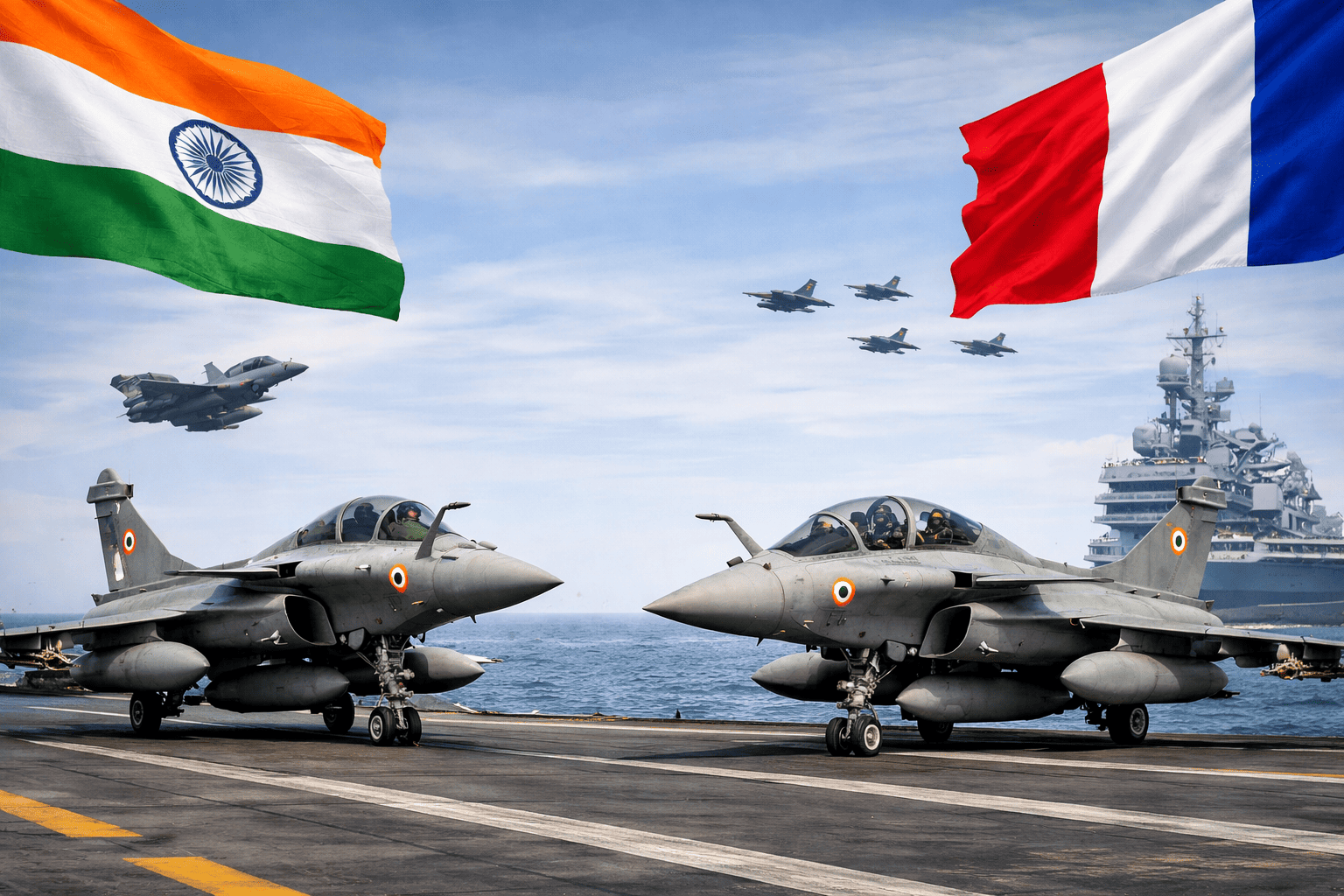
India has signed an Inter-Governmental Agreement (IGA) with France for the purchase of 26 Rafale-Marine fighter jets for the Indian Navy (IN) that includes 22 single-seat and 4 twin-seat versions. The IGA was signed by Defence Minister Rajnath Singh and Minister of Armed Forces of France Sebastien Lecornu remotely. The signed copies of the agreement, aircraft package supply protocol, and weapons package supply protocol were exchanged by Indian and French officials in the presence of Defence Secretary Rajesh Kumar Singh at Nausena Bhawan, the Defence Ministry said in a statement. Navy Vice-Chief Vice-Admiral Krishna Swaminathan and French Ambassador in India Thoerry Mathou were also present at the event. In addition to the IGA, several associated Government-to-Business agreements were concluded.
The deal also includes training, simulators, weapons, and a five-year Performance-Based Logistics (PBL) support package. It also includes additional equipment for the existing Rafale fleet of the Indian Air Force (IAF). Deliveries are expected to begin in mid-2028 and be completed by 2030. The key aspects of the deal are that the Rafale-Marine jets are designed to operate from aircraft carriers, specifically the INS Vikrant and INS Vikramaditya, enhancing India’s naval capabilities.
The deal is worth approximately ₹63,000 crore (around Euro 7 billion). It includes not only the aircraft but also pilot training, simulators, weapons, essential equipment, and long-term maintenance support. The agreement includes Transfer of Technology for the integration of indigenous weapons, such as the Astra Beyond Visual Range (BVR) air-to-air missile (AAM), on the Rafale. “It also includes the setting up of production facility for Rafale fuselage as well as Maintenance, Repair and Overhaul (MRO) facilities for aircraft engine, sensors and weapons in India,” the statement said, adding that the deal is expected to generate thousands of jobs and revenue for a large number of Micro, Small, and Medium Enterprises (MSMEs).
India is the first international operator of this naval variant of the Rafale, strengthening India’s naval power. Interestingly, the Rafale-M has a high degree of commonality with the Indian Air Force Rafale, and on many counts they can be used for land-based operations, and increase jointness.
Indian Military Aviation’s Time Tested French Connection
After the Second World War, aviation designer Marcel Dassault re-established the aviation industry. The M.D.450 (Marcel Dassault) Ouragan was the first French-designed jet fighter-bomber to enter production. The Ouragan was later operated by France, Israel, India, and El Salvador. In June 1953, India ordered 71 Ouragans (Toofani). Finally, 104 were bought. The IAF started to replace the Ouragan with the Mystère IVA in 1957. Toofanis were withdrawn fully from front-line service in 1965, although they continued to be in use for some years as advanced trainers and for target towing. India procured 104 “supersonic-in-a-dive” Mystère aircraft. The aircraft were used extensively in the Indo-Pakistani War of 1965. On 7 September 1965, an Indian Mystère, piloted by Squadron Leader Devayya, shot down a Pakistani Lockheed F-104 Starfighter in a raid over Sargodha. Mystère IVs were also very successful in surface strikes. The aircraft were phased out by 1973.
Hindustan Aeronautics Limited (HAL) license-built versions of the French Aérospatiale SA 315B Lama (designated Cheetah) and Aérospatiale Alouette III (designated Chetak) in the mid-1960s. The Indian Navy procured 14 French Bréguet Br.1050 Alizé in 1960 for carrier operations. The French Turbomeca TM 333 2B2 engine powered the initial HAL Dhruv, later replaced by the Shakti engine, which was jointly developed by HAL and Turbomeca. TM 333 2M2 powers HAL Cheetal and Chetan, upgraded versions of the Cheetah and Chetak, respectively.
The IAF kept procuring Soviet aircraft for a long time from the 1960s onwards. India did buy the Anglo-French SEPECAT Jaguar deep penetration strike aircraft (DPSA) in the late 1970s, but the contract was serviced by the British. The IAF built and upgraded many Jaguars and continues to fly significant numbers even today.
The Mirage 2000
India procured the Dassault Mirage 2000, a multirole, single-engine jet fighter, in 1984. It was the first relaxed stability fly-by-wire aircraft with active controls technology to be inducted in the IAF. It also brought the first look-down/shoot-down capabilities, combined with the Super R530 beyond-visual-range (BVR) missile and the all-aspect Magic 2 missile. The IAF also got the first comprehensive Electronic Warfare (EW) suite on any aircraft, with a self-protection jammer, Radar Warning Receiver (RWR), Chaff and Flare Dispenser, an escort jammer, and an ELINT Pod. The aircraft has since been upgraded to Mirage 2000-5 Mk 2 standards, extending its useful life for another 20–25 years. It can now carry the MICA air-to-air missiles, Israeli Spice-2000 glide bomb, and the indigenous Astra AAM. The Mirage 2000 performed exceedingly well in the 1999 Kargil conflict, which took place over some of the highest terrain in the world. Easy maintenance and a very high sortie rate made the Mirage 2000 one of the most efficient fighters of the IAF in the conflict. Later, the Mirage was the chosen platform for the Balakot Strike. It played a great role in “Op Sindoor.”
The Rafale
The French twin-engine delta-wing fighter aircraft is an omni-role fighter with frontal-stealth capabilities. It can simultaneously undertake air supremacy, interdiction, reconnaissance, and the airborne nuclear deterrent missions. Rafale was inducted in the French Air Force and for carrier-based operations in the French Navy in 2000. Rafale has been used in combat over Afghanistan, Libya, Mali, Iraq, and Syria. The aircraft uses digital fly-by-wire controls and has a very high level of agility. The aircraft’s canards reduce the minimum landing speed to 115 knots (213 km/h) and provide better aircraft-carrier performance. The Rafale’s glass cockpit was designed around the principle of data fusion that prioritises information display to pilots. The primary flight controls are arranged in a hands-on-throttle-and-stick (HOTAS)-compatible configuration. The cockpit features a wide-angle holographic head-up display (HUD), two head-down flat-panel colour multi-function displays (MFDs), as well as a central collimated display. The cockpit is fully compatible with night vision goggles (NVG).
Rafale also features an advanced avionics suite. The passive front-sector electro-optical system can operate in both the visible and infrared wavelengths. The total value of the radar, electronic communications, and self-protection equipment is about 30 percent of the cost of the entire aircraft. The Rafale features an integrated electronic survival system named SPECTRA, which protects the aircraft against airborne and ground threats. The system incorporates Radar Warning Receiver, laser warning, Missile Approach Warning (MAW) for threat detection, plus a phased array radar jammer and a decoy dispenser for threat countering. AREOS all-weather, night-and-day-capable reconnaissance system used on the Rafale has the ability to transmit information such as images in real time to ground stations. The RBE2 AA Active Electronically Scanned Array (AESA) radar has a range of 200 km.
The 36 aircraft, €7.87 billion (₹58,891 crore), Government-to-Government (G2G) Rafale deal meant the supply of 28 single-seat and eight twin-seat aircraft. The deal included tailor-made IAF-specific enhancements, including the integration of an Israeli Helmet-Mounted Display (HMD), radar warning receivers, and low-band jammers. It included a weapons package and a performance-based logistics agreement. The aircraft’s 14 hardpoints can carry 9,500 kg of external load. The air-to-air missiles include Matra Magic II, MBDA MICA IR/EM, and MBDA Meteor. Meteor is an active radar-guided Beyond Visual Range Air-to-Air Missile (BVRAAM) that offers multi-shot capability against long-range manoeuvring jets, UAVs, and cruise missiles in a heavy Electronic Countermeasures (ECM) environment, with a range well in excess of 150 kilometres. The no-escape zone of over 60 km is the largest among air-to-air missiles according to the manufacturer.
India also procured SCALP air-to-ground cruise missiles. Subsequently, the HAMMER (Highly Agile Modular Munition Extended Range) glide bomb was bought. The Indian Rafale is a modified version of the F3R standard. The two squadrons are located at two different airbases. Both these airbases have infrastructure and capacity for an additional squadron each. France has already tested the F4 variant with upgraded radar, improved HMDS, and OSF (Long-Range Optoelectronics System), which will add IRST for detecting and identifying airborne stealth targets at long range. It will be more effective in network-centric warfare, with more data exchange and satellite communication capacity.
Rafale-M
According to simulations by Dassault, the Rafale has sufficient low-speed performance to operate from STOBAR-configured aircraft carriers, and can take off using a ski-jump with no modifications. The Rafale-M features a greatly reinforced undercarriage to cope with the additional stresses of naval landings, an arrestor hook, and “jump strut” nose wheel, which only extends during short take-offs, including catapult launches. It also features a built-in ladder, carrier-based microwave landing system, and the new fin-tip Telemetry System for syncing the inertial navigation system to external equipment. Altogether, the naval modifications of the Rafale-M increase its weight by 500 kilograms compared to other variants. The Rafale-M retains about 95 percent commonality with Air Force variants, including, although unusual for carrier-based aircraft, being unable to fold its multi-spar wings to reduce storage space. The size constraints were offset by the introduction of Charles de Gaulle, France’s first nuclear-powered carrier, which was considerably larger than previous carriers, Foch and Clemenceau. Since Rafale wingtips do not fold, the aircraft storage space and use of lifts on existing Indian aircraft carriers would remain a challenge to contend with.
Rafale-M Operations with French Navy
The French Naval Aviation (Aéronavale), the air arm of the French Navy, received its first two Rafale-M fighters in December 2000. After almost four years of training, the Rafale-M was declared operational with the French Navy in June 2004. The Rafale-M is fully compatible with United States Navy aircraft carriers, and some French Navy pilots have qualified to fly the aircraft from US Navy flight decks. In 2002, the Rafales were first deployed to a combat zone; seven Rafale-Ms embarked aboard Charles de Gaulle during “Mission Héraclès”, the French participation in “Operation Enduring Freedom.” The aircraft carrier was stationed in the Gulf of Oman. In 2016, Rafales operating from Charles de Gaulle struck targets associated with the Islamic State of Iraq and the Levant (IS).
Rafales have launched and landed on U.S. carriers to demonstrate interoperability. The May 2018 Operation Chesapeake was a test of this interoperability, when 12 Rafale-Ms, along with nearly 350 support personnel, embarked aboard USS George H.W. Bush for two weeks of carrier qualifications and exercises after conducting a month of shore-based training at Naval Air Station Oceana.
On 9 January 2025, Rafale-M conducted joint anti-aircraft drills with Su-30MKI and Jaguar aircraft of the IAF. The French Carrier Strike Group (CSG) centred on the Charles de Gaulle, the carrier air wing including Rafale-M, her escort ships, and fleet support ship Jacques Chevallier, were on a visit to India between 4 and 9 January 2025 during Mission Clemenceau 25. Simultaneously, INS Mormugao conducted joint navigational drills and Maritime Partnership Exercise with the escort ships.
Rafale-M Great Operational Asset
Traditionally, India and France have been enjoying an exceptionally warm relationship, which is the fruit of deep affinities and unwavering trust between the two countries since India’s independence. France is considered the most reliable Western “friend.” The IAF regularly carries out the Garuda series of air exercises with the French Air Force since 2003. The latest “Garuda VII” was held at Jodhpur in November 2022. The French Air and Space Force (FASF) also participated in the IAF multilateral exercise “Tarang Shakti” in Aug–Sep 2024.
Rafale-M will carry all the weapons that the IAF currently deploys on them. In addition, it will have anti-shipping and anti-submarine weapons. One can say that for all practical purposes, India will soon have 62 Rafale for use against India’s Western and Northern adversaries, even for aerial engagements and land-strike stand-off roles.
The IAF is already down to 30 fighter squadrons vis-à-vis the authorised 42. India has a two-front war threat. The IAF urgently needs more fighter squadrons. The Indian government is closely looking at buying 114 “Make-in-India” new fighters. With the Indian Navy choosing the Rafale-M, it will make better economic sense for the IAF also to choose Rafale and acquire the latest F4 variant in a G2G deal, and make in India in larger numbers to amortise costs.
Note: The article was originally written by the Author for India Strategic on 30th, April 2025, it has since been updated.
Header Picture Credit: Representative Image Generated using AI
Twitter: @AirPowerAsia
 Air Power Asia