
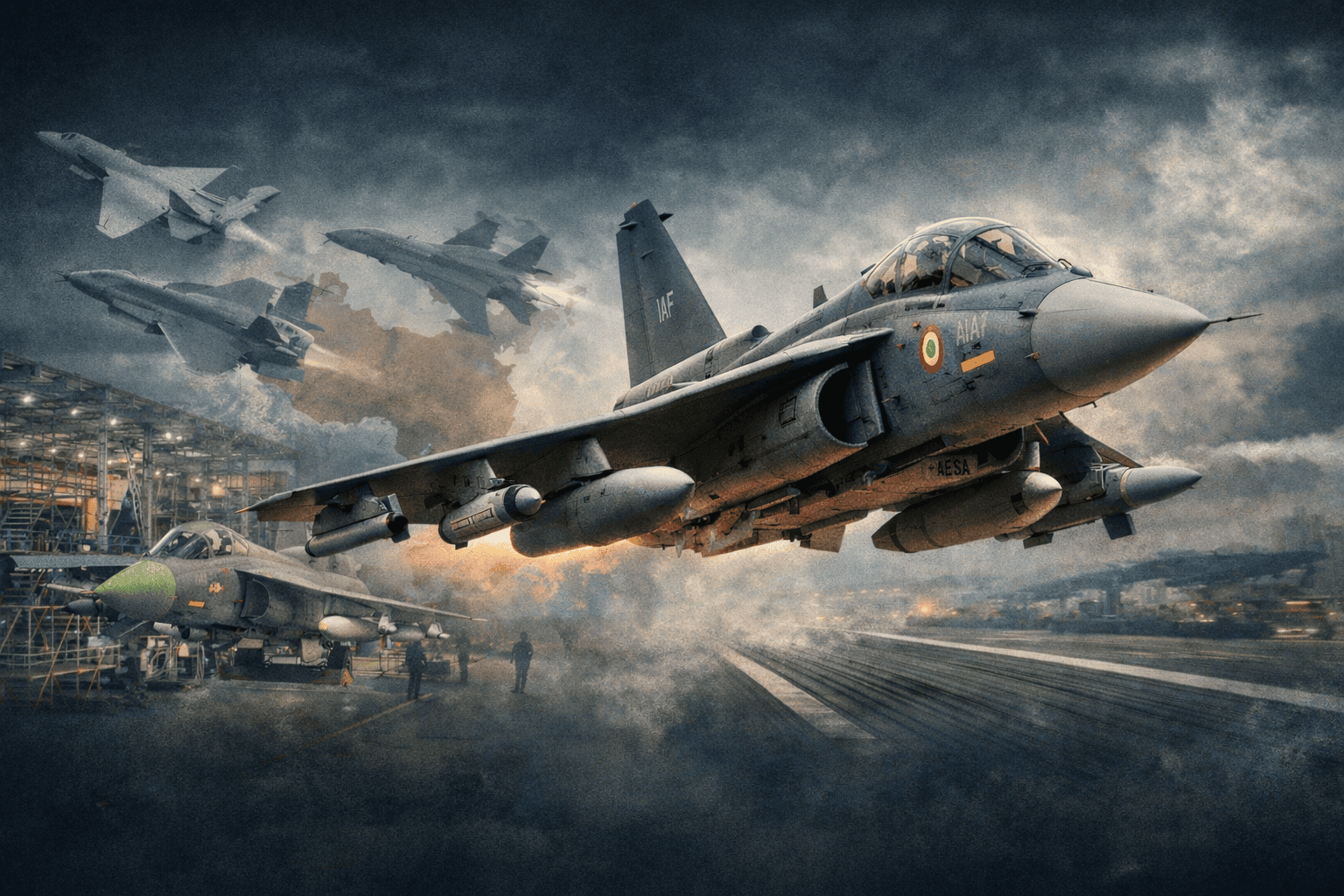
The IAF Chief expressed serious concerns with the sluggish pace of Tejas production. “Technology delayed is technology denied,” said Air Chief Marshal AP Singh while speaking at the 21st Subroto Mukerjee Seminar. Only 40 aircraft have been handed over in 10 years, averaging just four a year. Further, the deliveries of Tejas LCA Mk1A have been delayed by over a year. The Air Chief also highlighted the need to involve private players. “We need to have competition. Otherwise, things will not change.”
He referred to increased militarisation by China and Pakistan on the borders as a security concern for India. His remarks came in the wake of China’s testing of the reported sixth-generation stealth jets and reports of Pakistan seeking fifth-generation jets from Beijing to induct by 2029. “China is investing heavily in its air power, and it is not just the numbers, even the technology is growing at a very rapid pace,” he added.
Parliamentary Standing Committee on Defence Concerns
The IAF chief’s concerns were also reflected in a recent government report. The report pointed out delays in the Tejas Mk-1A programme due to design and development challenges, issues related to aero engine availability, and Hindustan Aeronautics Limited (HAL)‘s struggle to maintain the required production pace. The Ministry of Defence (MoD) was advised by the Parliamentary Standing Committee on Defence to urge HAL to accelerate Tejas combat aircraft production and expedite fighter jet procurement to ensure the IAF’s operational capability is not undermined by its declining squadron strength.
HAL has been instructed to ramp up production to ensure timely delivery of the Mk-1A, which is essential to address the fighter shortfall caused by the phase-out of older aircraft. The Committee’s “Demands for Grants (2024-25)” report, released in December, highlighted that the IAF’s active squadrons have declined to 31, well below the authorised 42, with an ageing fleet and delayed inductions worsening the situation. Long-term solutions, such as the induction of Multi-Role Fighter Aircraft (MRFA) and LCA Tejas Mk-1A, along with projects like the LCA Mk-2 and Advanced Medium Combat Aircraft (AMCA), are either delayed or still years away, emphasising the urgent need for immediate measures to address this critical shortfall.
The report cited the Rs 36,468.63 crore contract for 83 LCA Mk-1A aircraft, for which deliveries were to begin in February 2024. It also mentioned that the IAF had initiated a proposal to acquire an additional 97 LCA Mk-1A jets, for which the Request for Proposal (RFP) had been issued. The Contract Negotiation Committee was already deliberating on the nearly Rs 65,848 crore contract.
The report stated that the IAF was awaiting the LCA Mk-2 and the fifth-generation AMCA in the next decade. The AMCA had already received Cabinet approval in March 2024. The Committee also mentioned the IAF’s need for 114 4.5-generation MRFA, for which a Request for Information (RFI) was issued in April 2019. The Rafale has just received the Acceptance of Necessity (AoN).
HAL LCA Tejas Status and Timelines
The Hindustan Aeronautics Limited (HAL) Light Combat Aircraft (LCA) “Tejas” is a single-engine, delta-wing, multirole combat aircraft designed by the Aeronautical Development Agency (ADA) and manufactured by HAL for the IAF and Indian Navy (IN). Tejas made its first flight in 2001 and entered into service with the IAF in 2015. Tejas is the smallest and lightest in its class of supersonic combat aircraft.
The first Tejas squadron, No. 45 “Flying Daggers”, became operational in 2016 at Sulur Air Base in Tamil Nadu. Tejas has three production variants — Mark 1, Mark 1A, and a trainer/light attack variant. The IAF has already placed an order for 220 Tejas Mk1 variants. The IAF plans to procure at least 324 aircraft or 18 squadrons of Tejas in all variants, including the heavier Tejas Mark 2, which is currently being developed.
The indigenous content in the Tejas Mark 1 is 59.7 percent by value and 75.5 percent by the number of line replaceable units (LRU). The indigenous content of the Tejas Mk 1A is expected to surpass 60 per cent by 20230.
The LCA Programme originated in the early 1980s. In 1983, the Government of India established the LCA project with the initial goal of developing a new light combat aircraft to replace the ageing IAF fighters, especially the MiG-21 variants. In 1984, the Government of India established the Aeronautical Development Agency (ADA) under the aegis of the Defence Research and Development Organisation (DRDO) to manage the LCA programme.
The project definition phase was commenced in October 1986. India developed its own digital quadruple fly-by-wire control laws. Its own multi-mode radar (MMR) could not come on board. Off-the-shelf Israeli Elta EL/M-2032 multi-mode and EL/M-2052 Active Electronically Scanned Array (AESA) radar units were selected for the Mk1 and initial Mk1A aircraft, respectively. The Indian “Uttam” radar is undergoing flight trials.
The Tejas got its Initial Operational Clearance-I (IOC-I) in January 2011. An interim IOC-II was issued in December 2013. The first squadron, consisting of Tejas in IOC-II configuration, became operational in 2016. In January 2019, Centre for Military Airworthiness and Certification (CEMILAC) cleared Final Operational Clearance (FOC) Tejas production. The second Tejas squadron, No. 18 “Flying Bullets”, was formed at Sulur on 27 May 2020 with the first four serial production FOC aircraft.
Tejas Mk 1A
It was decided that the shortcomings of Tejas from its Service Qualification Requirements (SQR) would be addressed in Tejas Mk 1A aircraft by increasing the use of composites in manufacturing and reducing the supersonic drag by using more aerodynamic pylons. The Mk 1A was also to have AESA radar, a self-protection jammer, updated avionics, and electronic warfare capabilities, among other nearly 40 improvements.
The Tejas can carry pod-based sensors such as forward-looking infrared (FLIR). Currently, the Tejas is cleared to carry the Rafael Litening III targeting/reconnaissance pod, while an advanced version named Litening 4I will be integrated on the Tejas. Currently, Tejas pilots are flying with the Elbit DASH IV helmet-mounted display system.
The Tejas Mk 1 is currently powered by the F404-IN20 engine. The Mk 1A variant will be powered by the same power plant. The heavier Tejas Mk 2 will be powered by a General Electric F414-INS6 engine.
The expanded weapon suite consists of Astra BVRAAM and ASRAAM. Two ASRAAMs are intended for use on Tejas Mk 1A on dual-rack pylons. The upgraded Tejas Mk 1A will have a reduced turnaround time. The Radar Warning Receiver from the Combat Aircraft Systems Development and Integration Centre (CASDIC) and the Head-Up Display from the Central Scientific Instruments Organisation (CSIO) will come between now and 2028. On 19 April 2024, ADA delivered the first batch of Secondary Flight Control for Tejas Mk 1A, which consists of an indigenously designed leading-edge slats and airbrake control module.
On 20 May 2022, the Tejas Mk 1A prototype completed its first flight. On 28 March 2024, the first production series Mark 1A aircraft (LA 5033) conducted its inaugural flight, which lasted for 18 minutes. The aircraft will undergo more testing before being officially transferred to the IAF. The first Tejas Mk 1A, originally scheduled for delivery on 31 March 2024, will now arrive around March 2025 due to delays in obtaining new engines (F404-IN20), a Danish export ban on the aircraft’s engine charge amplifier, delays in the delivery of software from Israel, and necessary certifications.
In FY2024-25, HAL was scheduled to deliver 16 fighter jets. Afterwards, 16 jets will be produced by the Bengaluru production line and eight by the Nashik production line. A total of 87 jets are expected to be delivered by 2028.
Tejas Mk 2
The Tejas Mk 2 is a larger aircraft with canard controls and the more powerful General Electric F414-INS6 engine. It will be a Medium Weight Fighter (MWF) that will one day replace the Mirage-2000 and Jaguar. The Tejas Mk 2, which is expected to be rolled out in 2025, will have an increased payload-carrying capacity and internal fuel capacity, more external hard points, improved combat range, a completely redesigned cockpit, and an integrated infrared search and track (IRST) system, in addition to the AESA radar. The first flight of Tejas Mk 2 is expected to be in 2025.
TEDBF
At Aero India 2021, a new twin-engine naval fighter, the Twin Engine Deck Based Fighter (TEDBF), was unveiled. The experience gained in the Naval-LCA programme will help in the development of TEDBF. In February 2023, the naval prototype completed its maiden landing and take-off from the indigenous aircraft carrier INS Vikrant.
Development and Aircraft Costs
The LCA Programme has cost ₹9,063.96 crore ($1.2 billion in 2023). In addition, the Kaveri engine programme cost ₹2,032 crore ($280 million in 2023). Additional D&D costs have been ₹1,202 crore ($160 million in 2023). The flyaway cost for FOC Mk 1 in 2010 was ₹156 crore ($41 million in 2023). In 2020, it was ₹303 crore ($40 million in 2023) for Mk 1A and ₹309 crore ($41 million in 2023) for the export variant.
02 February 2021 — The Indian Government signed an order for 83 HAL Tejas, comprising 10 additional twin-seat trainers and 73 single-seat Mk 1A LCA, with a contract value of ₹48,000 crore ($6.3 billion in 2023). On 12 April 2024 — MoD issued a ₹65,000 crore (US$7.6 billion) tender to HAL for 97 Tejas Mk 1A fighter jets.
Production lines
HAL’s first Tejas eight-aircraft production line is situated at HAL’s Bengaluru Complex. An additional line for eight aircraft was sanctioned in the same complex in March 2017. Production of sub-components like the front fuselage, centre fuselage, rear fuselage, and wings was outsourced to private partners. On 5 April 2023, the then Defence Secretary Giridhar Aramane officially opened a third production line at HAL’s Nashik factory, to accelerate delivery. This brought the total production capacity from 16 to 24 aircraft annually. The first aircraft from Nashik was expected by the end of FY2024-25. HAL also plans to set up another production line at Nashik to ramp up production capacity from 24 to 32, as reported on 10 January 2025. The line can start production within 1.5 years of sanction.
By August 2023, the delivery of all 32 single-seat Tejas Mk 1 aircraft (IOC and FOC) was completed. As of 18 September 2024, four trainer aircraft had been delivered to the IAF, while the remaining four were to be delivered by March 2025. As of 10 January 2025, 38 of the 40 aircraft had been delivered, and the last two trainers were to be delivered soon.
IAF will raise the first squadron of Tejas Mark 1A at Nal Air Base near Bikaner. The delivery was scheduled to start on 3 February 2024. According to reports, the Ministry of Defence had asked HAL to deliver 18 Tejas Mk 1A by March 2025 and all 180 jets within 10 years. This was necessary to negate the shortfall in the IAF’s combat squadrons, which is much below the sanctioned strength. There is a further delay in the supply of F404-GE-IN20 engines by GE Aerospace to April 2025. These delays are attributed to supply chain issues, as a South Korean firm with financial problems is unable to deliver certain components of the engine. This subsequently pushed the delivery date of the first Mk 1A until mid-2025.
HAL has five to six aircraft ready for delivery, minus the engines. As of late December, reports suggested that further critical trials of Tejas Mk 1A using Category B F404 engines were to commence in January 2025 as part of a contingency plan. The new deadline set for delivery of the first aircraft is 31 March 2025. The Category B F404 engines are to be replaced once the new engines are delivered. The aircraft will be delivered after certain certifications are completed.
As of 10 January 2025, GE had a backlog of 26 engines, but the delivery deadline of the engines and aircraft remained unchanged. Initially, one or two engines will be delivered per month, while the rate will be stabilised by 2026, after which the delivery rate will be 24 aircraft per year and is to be enhanced to 30 units later. The first aircraft from the Nashik production line is expected to roll out in March as well.
MoD Committee to Address IAF Shortages
The Ministry of Defence (MoD) has just announced the formation of a high-level committee to address shortages in the Indian Air Force (IAF). For some time, the IAF has been grappling with shortages of fighter aircraft, with the squadron strength coming to an all-time low of 30 vis-à-vis the authorised strength of 42. The committee, headed by the Defence Secretary, will include senior ministry officials, Defence Research and Development Organisation (DRDO) Chairman Dr Samir V Kamat, and senior IAF officers. It will look at the shortage of fighter jets, weapons, and other equipment and suggest solutions, including accelerating indigenous production and selectively inviting foreign collaborations, amid growing security challenges from China, Pakistan, and Bangladesh. The report is expected in 2–3 months.
The Way Ahead
Notwithstanding the teething technical problems and delayed production, the IAF air and ground crew are very happy with the quality and class of aircraft. The aircraft has successfully test-fired the Python-5 high off-boresight (HOBS) close combat missile and further validated the enhanced capability of the I-Derby ER (extended range) BVR missile. Tejas has successfully test-fired the Astra Beyond Visual Range Air-to-Air Missile (BVRAAM) off the Goa coast. This is the first time that India has test-fired an indigenously developed BVRAAM from a home-grown fighter aircraft. The aircraft is also cleared for very significant air-to-surface armaments, including precision-guided weapons. Many more are planned.
The aircraft has been showcased and attended many airshows abroad. They have taken part in a large number of IAF and tri-services exercises. The IAF participated in Exercise Desert Flag VIII, with five Tejas and two C-17 Globemaster III aircraft, held in the UAE from 27 February to 17 March 2023. It was the first international exercise for Tejas. On 26 January 2024, during the 75th Republic Day of India, four Tejas took part in the parade fly-past held at Kartavya Path, New Delhi.
HAL Tejas Mk 1 participated in Exercise Tarang Shakti 2024. The then Vice Chief of the Air Staff (now Chief of the Air Staff) Air Marshal Amar Preet Singh flew the LCA along with the Chief of the French Air Force, General Stéphane Mille, and the Chief of the German Air Force, Lieutenant General Ingo Gerhartz, piloted HAL Tejas. The first production aircraft of Tejas Mk 1A will be showcased at Aero India 2025.
The aircraft has had a good flight safety record, having lost only one aircraft on 12 March 2024 in an accident in 24 years of operations. The investigation reported that it was a case of “oil pump malfunction” that led to engine seizure, resulting in the crash.
India is exploring the possibility of exporting LCA variants to many Asian and African countries. This would actually be possible only after production stabilises. LCA is also being marketed as a Lead-in Fighter Trainer (LIFT).
As part of HAL’s Manned-Unmanned Teaming (MUM-T) initiative, a twin-seater Tejas Mark 1A has been modified with the Combat Air Teaming System (CATS) interface to act as the mother ship of CATS components.
Finally, for the programme to succeed, product quality assurance has to be maintained at a very high level. Performance and flight safety are the best advertisements. Production numbers have to go up quickly, and supply chains have to be further secured. Lastly, indigenous content must increase considerably. The most critical element in this would be an indigenous aero-engine. Time to act is now, lest it be too late.
Note: The article was originally written by the Author for Indian Aerospace Defence Bulletin on 8th, February 2025, it has since been updated.
Header Picture Credit: Representative Image Generated using AI
Twitter: @AirPowerAsia
 Air Power Asia