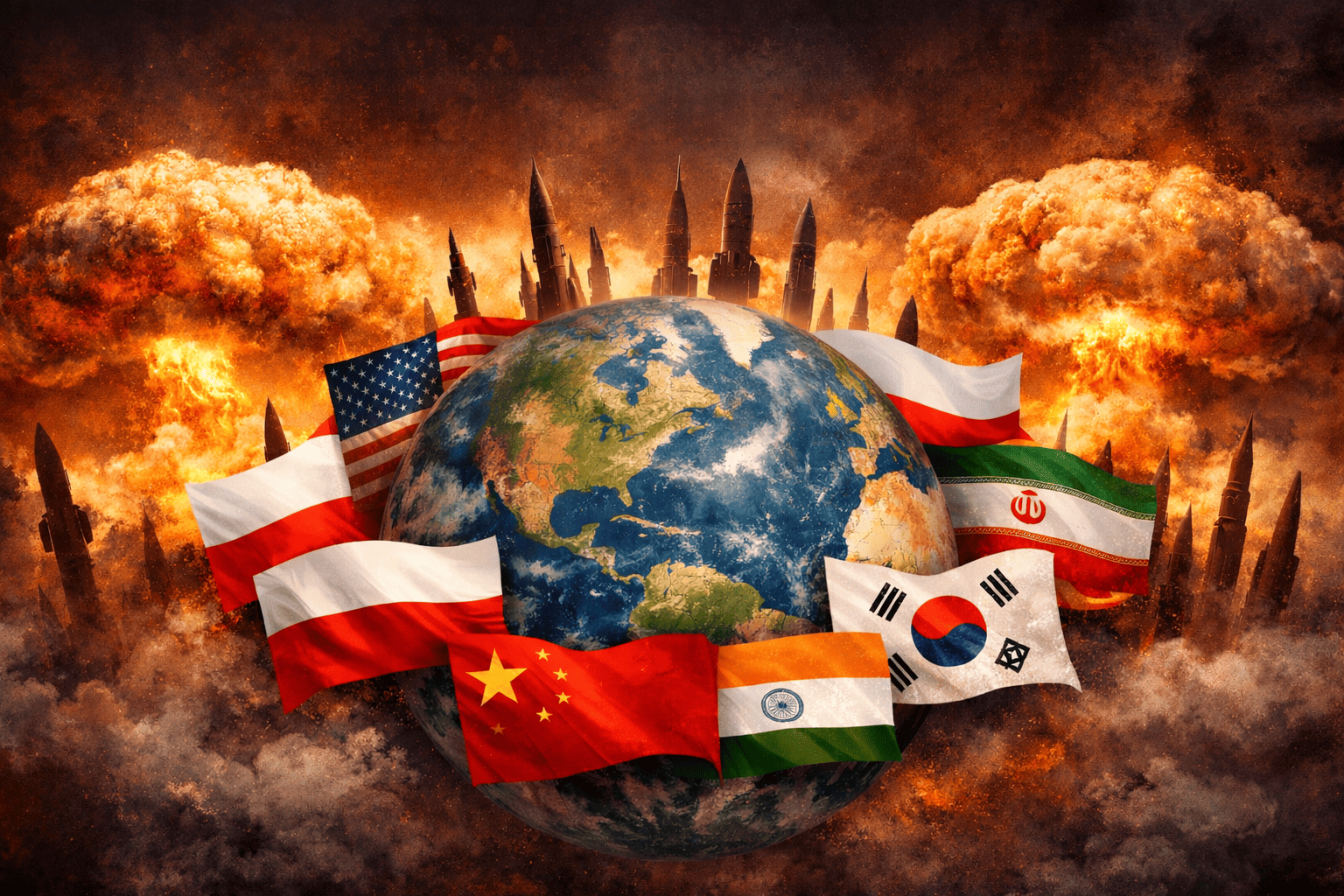
An unreliable American nuclear umbrella means more countries want the nuclear bomb. For long, Europe and some other Asian countries were banking on US security guarantees. Ukraine had denounced nuclear weapons after the Soviet Union imploded, but after the Russian invasion of February 2022, and Russian threats to use a tactical nuclear weapon, Ukraine is repenting that decision. Poland and South Korea are among the countries that have expressed interest in nuclear weapons on their soil. There are others in Europe who want a formal nuclear umbrella. Highly threatened Iran has been clandestinely pursuing a nuclear weapons program with a hope that one day it will be able to stand up to the American and Israeli threats and sanctions. Could this start another round of nuclear proliferation?
Ukraine Nuclear Weapons Denunciation
In 1990, after Ukraine’s “Declaration of Sovereignty”, they pledged not to acquire, produce, or accept nuclear weapons. In 1991, Ukraine declared itself a non-nuclear-weapon state. In 1994, Ukraine agreed to give up over 1,700 Soviet nuclear weapons in exchange for security assurances from Russia. There is the International Campaign to Abolish Nuclear Weapons (ICAN) that condemns all threats to use nuclear weapons, regardless of the circumstances. Ukraine has accused Russia of violating the Budapest Memorandum of 1994 by annexing Crimea in 2014 and invading Ukraine in 2022. Ukrainian leaders now feel that NATO membership or nuclear weapons are needed for security from Russia. However, Ukraine would face technical and political challenges in acquiring nuclear weapons. ICAN says that Russia’s threats to use nuclear weapons increase the risk of nuclear war. Having once renounced nuclear weapons, Ukraine condemns threats to use them. Russia had to repeatedly use the “nuclear political threat card” to ward off greater NATO intervention in favour of Ukraine.
Other Nations That Renounced Nuclear Weapons
In addition to Ukraine, several nations that became independent after the Soviet Union imploded, including Belarus and Kazakhstan, voluntarily relinquished their nuclear arsenals, choosing peace over military power. South Africa is the only country in the world to have developed and then dismantled its nuclear program. They all signed various international treaties like the Nuclear Non-Proliferation Treaty (NPT) and the Budapest Memorandum to ensure a safer world.
Countries Seeking Nuclear Weapons on Their Soil
After Russian threats to use nuclear weapons in Ukraine, Poland’s President Andrzej Duda has asked the US to share nuclear weapons with Poland. Poland has also shown interest in France’s offer to extend its nuclear umbrella to European allies. Poland is concerned that it could be Russia’s next target and wants nuclear deterrence.
With North Korea pushing ahead with nuclear weapons and its ballistic missile program, and threatening overtures, South Korea has expressed interest in a nuclear sharing arrangement with the US or in having US nuclear weapons stationed in South Korea. South Korea is concerned about being in the dark about US nuclear policy and whether the United States will protect it from a nuclear threat.
Country-wise Nuclear Weapons Holdings
The countries with nuclear weapons are Russia, the United States, China, France, the United Kingdom, India, Pakistan, Israel, and North Korea. Russia has the most nuclear weapons, with over 5,500 warheads. The United States is a close second with 5,044 nuclear weapons, and some are hosted in other countries. China is close to 500 nuclear weapons. France (290), UK (225), India (180), Pakistan (170), and North Korea around 40–50 weapons. Israel has not officially declared itself a nuclear weapons state and has an estimated 90 warheads and material for up to 200.
The United States, Russia, and China are continuing to modernise their nuclear weapons and increase numbers. The United States and other countries negotiated the NPT in 1968 and the Comprehensive Nuclear-Test-Ban Treaty (CTBT) in 1996. India, Israel, and Pakistan never signed the NPT. North Korea withdrew from the NPT in 2003, but its withdrawal is not recognized by France. Among the countries with suspected nuclear activities is Iran.
START Treaty
The Strategic Arms Reduction Treaties (START) were agreements between the United States and the Soviet Union (and later Russia) to reduce their strategic nuclear weapons arsenals. START I signed in 1991 was meant to reduce and limit the number of nuclear weapons. It included provisions for on-site inspections and data exchange to verify compliance. It was considered one of the most successful arms control agreements, with 80 percent of the world’s strategic nuclear weapons dismantled by the time of its full implementation in 2001.
START II (1993) was to further reduce strategic offensive arms. It called for reducing strategic warheads to 3,800–4,250 by 2000 and to 3,000–3,500 by 2003. It never entered into force due to a lack of ratification by the Russian Duma and the US Senate’s refusal to ratify an addendum to the treaty.
New START (2010) was to replace START I and the Strategic Offensive Reductions Treaty (SORT). It set limits on deployed strategic warheads (1,550), deployed and non-deployed ICBM launchers, SLBM launchers, and heavy bombers (800), and deployed ICBMs, SLBMs, and heavy bombers (700). It came into force on February 5, 2011. Later, the United States and Russia agreed to extend New START by five years, until February 5, 2026. On February 21, 2023, Russia announced it was suspending implementation of New START.
Nuclear Umbrella
The “nuclear umbrella” is a guarantee by a nuclear weapons state to defend a non-nuclear allied state. The context is usually the security alliances of the United States with Australia, Japan, South Korea, NATO, and the Compact of Free Association. Those alliances were formed during the Cold War. For some countries, it was an alternative to acquiring nuclear weapons themselves; other alternatives include nuclear-weapon-free zones or nuclear sharing.
NATO assumed American nuclear power as a major component of defence of Western Europe from possible Soviet invasion. Most non-Communist European states joined the alliance. Sweden and Switzerland considered developing nuclear weapons but abandoned the idea. Finland and Sweden have joined NATO. Bosnia and Herzegovina and Georgia have membership aspirations. Kosovo also aspires to join.
After the end of the Cold War, the United States promised its role as a “nuclear umbrella”. The US now has security alliances with around 30 countries. The US understood the power of deterrence beginning with massive retaliation during the Eisenhower administration.
Recent developments have caused concern. Currently, the United States holds only some “nonstrategic” military weapons in Europe. ANZUS is a security treaty between Australia, New Zealand, and the United States signed on September 1, 1951. In 1970, Australia considered nuclear weapons development but signed the NPT. Like Germany, Japan had a lab-based nuclear weapons program during World War II. After Hiroshima and Nagasaki, Japan came under the US nuclear umbrella and deployed the Aegis Ballistic Missile Defence System.
Following the Korean War, South Korea was welcomed under the US nuclear umbrella in 1953. Like NATO, the Warsaw Pact members were protected by Soviet nuclear weapons. The 1994 Budapest Memorandum was meant to provide assistance to Ukraine under the NPT. In 1994, China provided Ukraine with a nuclear security guarantee.
Ballistic Missile Defence
Missile defence provides another “umbrella”. NATO pursued missile defence against NBC threats. The Anti-Ballistic Missile (ABM) Treaty, signed under SALT I in 1972, limited ABM systems. The United States withdrew in 2002. In March 2013, NATO’s Ballistic Missile Defence (BMD) test succeeded. The European Phased Adaptive Approach (EPAA) operates from Kürecik, Deveselu, Ramstein, and Rota. The Missile Defence Advocacy Alliance (MDAA) was formed.
To Summarise
US President Donald Trump’s recent moves have alienated European allies. His approach is to stop a war Ukraine cannot win and reduce nuclear risk. What bothers is fresh nuclear proliferation. The 1993 denouncement by South Africa was unique. Threshold countries like South Korea, Japan, Iran, and Saudi Arabia could build nuclear weapons. The US feels it spent too much securing others. One off-shoot was containment of nuclear proliferation. Today, 190 countries are parties to the NPT.
Europe doubts US commitment. Allies like Japan, Taiwan, and South Korea face China and North Korea. A domino effect may follow. Right-wing nationalism is rising in Italy, France, Germany, the Netherlands, and Poland. Iran will have new incentives.
Some argue nuclear weapons reduce conventional war, citing China–India clashes and the Kargil War. Terrorist risks will rise. In Pakistan, attacks targeted nuclear facilities. Over 88 percent of nuclear weapons belong to two superpowers. China plans 1,500 warheads. India and Pakistan have MIRV capability. Israeli jets bombed Syria’s reactor and Osirak in Iraq.
As of 2025, nine countries held 12,331 warheads. About 3,904 are deployed. Around 2,100 are on high alert. Nuclear states plan to retain arsenals, conflicting with the NPT. Nuclear weapons are here to stay. Treaties are defunct. Defence spending is rising. These are troubling times.
Note: The article was originally written by the Author for Indian Aerospace Defence Bulletin on 4th, May 2025, it has since been updated.
Header Picture Credit: Representative Image Generated using AI
Twitter: @AirPowerAsia
 Air Power Asia