
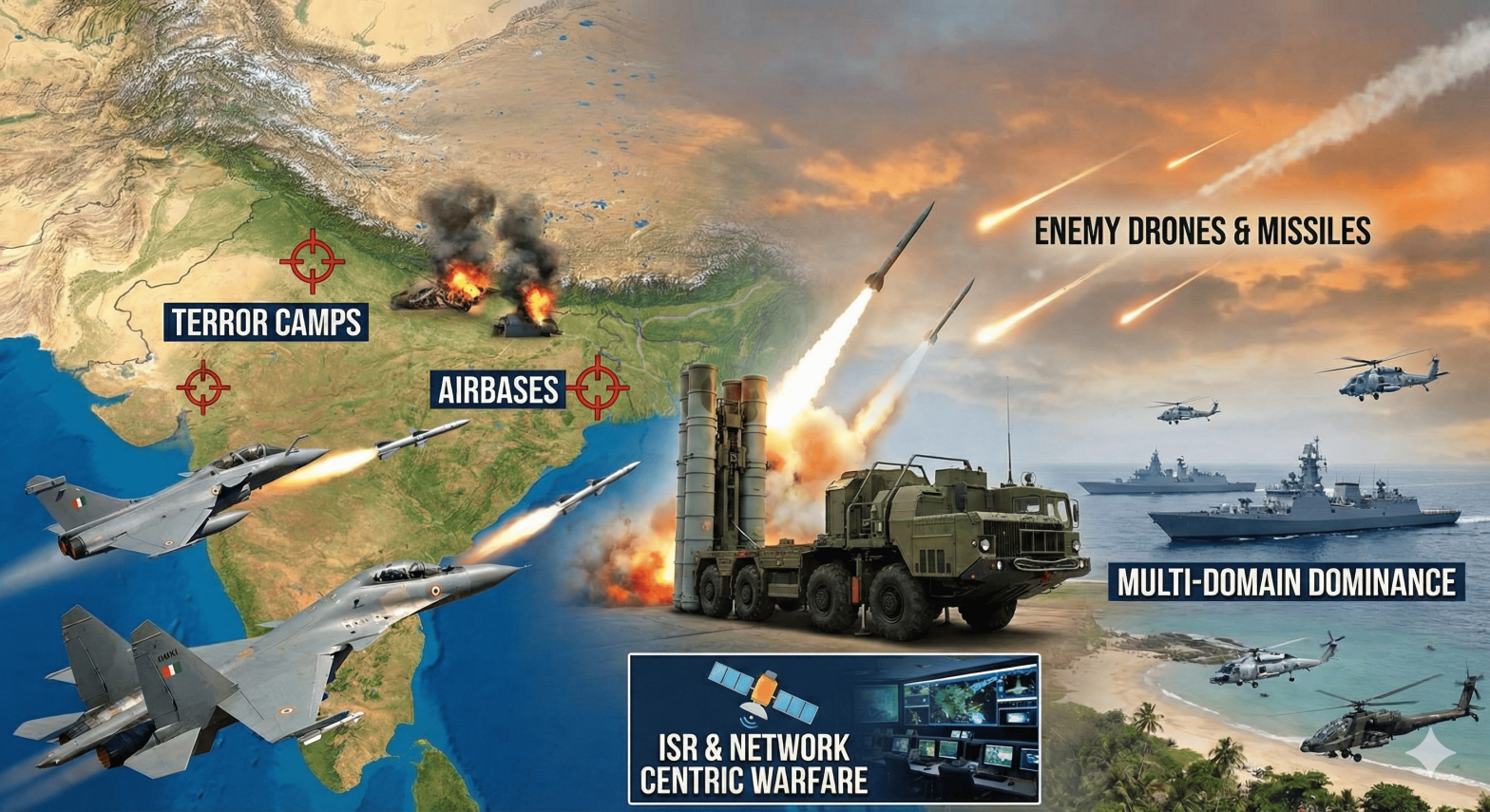
India launched “Operation SINDOOR” in response to the April 22 terror attack in Pahalgam to destroy the terroristbackers of the attack. Pakistan attempted a weak response using drones and shelling to hit Indian military and civilian targets, including religious sites. India responded by striking military targets across the length and depth of Pakistan to denude their offensive capability. As India struck, the world watched in awe and surprise at the resolve.
India Hits Terror Targets
Numerous terror camps and training sites were identified. The targets were finally shortlisted with due diligence. The self-imposed operational ethics and restraint meant avoiding collateral civilian damage. Many targets were deeper inside Pakistan. It was decided that air would be the best means for long-range precision strikes in the shortest possible time. The Indian Air Force (IAF) was thus to do the “Heavy Lifting”. 14 terror targets at 9 locations were struck in the early hours of 07 May, and India successfully destroyed the major terror training centres and launch-pads in Pakistan and Pakistan-occupied Jammu and Kashmir (PoJK). These included Lashkar-e-Taiba (LeT), Jaish-e-Mohammed (JeM), and Hizbul Mujahideen (HM) facilities. The targets were hit with precision, and over 100 terrorists were killed, including JeM chief Masood Azhar’s ten family members at the Bahawalpur HQs.
The five targets in PoJK included in Muzzafrabad (2), Kotli, Gurpur, and Bhimber. Those in Pakistani Punjab were Sialkot, Sarjal, Muridke (near Lahore), and Bhawalpur, which is around 140 kilometres from the Indian border. Weapons used were air-launched cruise missiles and ground-launched munitions, including indigenous ones. India clarified its response as focused, measured, and non-escalatory. Pakistan was told that any attack on military targets in India would invite a suitable response.
Pakistani Response
Pakistan’s retaliatory Operation Bunyan-un-Marsoos targeted several Indian military bases and civilian areas, including Hindu and Sikh religious sites. They used aircraft, surface-to-surface missiles (SSM), drones, and cruise missiles. Pakistan’s aim was also to swarm and saturate Indian air defences. These were thwarted and neutralised by India’s air defence systems,s which included S-400, Akash, and other Surface-to-Air-Guided Weapons (SAGW) systems, including the Pechora, OSA, Igla, L-70, and Shilka AD systems. Only a few Pakistani weapons reached close to the targets but made no impact because of low accuracy and small warheads. India has an indigenously developed counter-drone grid called 4D (Drone, Detect, Deter, and Destroy). IAF’s Integrated Air Command and Control System (IACCS) controls all airborne and ground-based combat assets and supports all interceptions.
Aircraft from either side did not cross the border. Pakistani Inter-Services Public Relations (ISPR) also started running a media campaign stating a large number of Indian fighters were shot down during the 7th morning raids. The claims were credited to Chinese PL-15 missiles fired from J-10CE and JF-17 aircraft. India countered all such claims with facts and actually claimed to have shot four Pakistan Air Force (PAF) hi-tech fighters, one High-Altitude Very High-Value Asset, 2 SSMs, 2 Hypersonic Cruise Missiles, and numerous UAVs and Loitering Munitions (LM). IAF also destroyed one AEW&C and 4 F-16s on the ground. Since any wreckage would have fallen in their own countries, the truth will take some time to unfold. Meanwhile, India displayed a complete PL-15, which had landed in India unexploded. Obviously, it had either failed to lock on, or had a technical malfunction, or may have been fired well outside the authorised range of the weapon. These would need deeper technical analysis.
IAF strikes Major Military Targets
India responded to Pakistani strikes by destroying an HQ-9 supporting radar installation near Lahore and radar facilities near Gurjanwala. India followed this by major military strikes across the length and depth of Pakistan. On May 9–10, India became the first country to strike 11 airbases of a nuclear-armed nation in a single operation, destroying 20 percent of Pakistan Air Force (PAF) assets. The targets included airfields at Skardu, Nur Khan (Chaklala), Murid, Sargodha, Rafiqi, Rahim Yar Khan, Jacobabad, Sukkur, and Bholari. AD systems and ammunition storage were hit at Looni (Sialkot), Pasrur, Dha (Lahore), Arifwala, Chunian, and Malir cantonment (Karachi). These massive airstrikes covered the entire country. Interestingly, Nur Khan is within walking distance to the Capital Islamabad, andthe Pakistan Army HQ at Rawalpindi. Sargoda has PAF’s nuclear air vector with large nuclear weapon storage. Rafiqi is a major fighter base in the middle of the country. To hit targets in the country’s financial capital, Karachi, actually unnerved them, and the stock market spiraled down. IAF strikes called the Pakistani nuclear bluff and threat.
Battle Damage Assessment (BDA) pictures of each strike were made public the very next day, shutting up all naysayers in India and abroad. Indian Space Research Organisation (ISRO) played a great role in satellite-based ISR and communication, among others. The National Technical Research Organisation (NTRO), a technical intelligence agency, also supported target data.
The heavy damage inflicted by IAF strikes, and worried about many more that could come, Pakistan chose to seek a ceasefire. India accepted the same conditionally. For India, it was a pause. Pakistan was warned that any adverse act could restart hostilities. The non-military measures put in place earlier would not be withdrawn. India’s non-kinetic efforts played a crucial role in shaping the strategic environment and ensuring public and international support. Through strategic policymaking, information dominance, and psychological operations, India diplomatically and economically isolated Pakistan while strengthening domestic preparedness and global backing.
India has held in abeyance the Indus Waters Treaty of 1960. PM Modi said, “Blood and water cannot flow together.”India closed the Integrated Check Post at Attari. India also suspended all bilateral trade with Pakistan, imposing a high economic cost. India revoked the visas of all Pakistanis residing in the country and deported them immediately. A total ban was imposed on Pakistani artists. The military attaches were declared Persona Non Grata. The overall strength of the High Commissions was brought down.
IAF Succeeded in All Tenets of Air Power
Modern air power is characterized by several key principles, including precision, reach, flexibility, mobility, responsiveness, offensive lethality, and trans-domain operational capability. These characteristics allow for the concentration of force, decisive firepower, and the disruption of enemy systems and networks. Essentially, air power focuses on achieving effects rather than just mass, leveraging superior technology and stand-off weapons to target vulnerabilities and achieve strategic paralysis. All these tenets were more than amply displayed during this very short and swift air operation.
IAF displayed the ability to project power over vast distances (reach). The capacity to adapt and respond to changing circumstances (flexibility), deploying forces and resources in various ways to achieve objectives. Included switching from terror to specific military targets. The ability to move rapidly and strategically (mobility), taking advantage of the speed of air-based platforms to react quickly to unfolding events. Industry supported, and naval and army assets were brought in quickly where needed. The speed and efficiency with which air power can be deployed and utilized in response to evolving threats or opportunities (responsiveness) was very visible. Offensive lethality, implying destructive power and precision of air-delivered weapons, enabling the targeting and neutralization of enemy forces and infrastructure, was seen globally from the battle damage “then and now” pictures released.
Air Power has trans-domain operational capability. The ability to operate across different domains (land, sea, air, space, cyber-space) was achieved through integrated and synergistic effects. Indian Navy’s Carrier Battle Group was dominating the Arabian Sea, and IAF maritime Su-30MKI and Jaguars were closely coordinating. Similarly Indian Army’s offensive Loiter Munitions and AD assets were fully integrated.
Key principles of “concentration of force and decisive targeting was visible. IAF hit Pakistan’s crucial locations and vulnerabilities to achieve a desired effect. A lot was visibly happening in New Delhi (Centralized Control), but the physical action was taking place in the Regional Air Commands (Decentralized Execution). Resource prioritization was being done accordingly for effective results. Maintaining a balance between different air power capabilities, such as combat aircraft, missiles, drones, cyber, and electronic warfare, and logistics support was ensured. The assets guarding India’s other fronts were left in-situ for possible eventualities.
The IAF could maintain control of the airspace and prevent the enemy from any aircraft intrusions through aerial denial. Most of the intruding drones and missiles were shot down. IAF demonstrated its reach, speed, and shock effect. The adversary could not intercept India’s high-speed missiles. As a part of the narrative building, Pakistan claimed to have intercepted and destroyed 84 Israeli-made Harop drones, an absurdly exaggerated number. IAF targeted critical infrastructure, disrupting command and control systems, and impeding enemy logistics through strategic strikes. IAF leveraged technological advancements and strategic principles to achieve decisive effects in warfare and protect national interests.
Indian political leadership had given a well-selected “Aim” of the operation. It was first to hit terror targets and, in case of an escalatory response, to hit a host of military targets to dismantle capability. The same was fully achieved by the IAF. India’s military assets were fully protected from aerial attacks through very effective air defences.
To Summarise
Throughout the conflict, the focused objective against terrorism remained unchanged. PM Modi had given very clear political direction and, thereafter, full freedom tothe military leadership to deliver firm and clear combat effects. IAF’s was a measured, yet powerful response. No harm was inflicted upon civilians. This was despite repeated provocations from Pakistan, including using civilian call-signs for military aircraft missions while attacking India. Very careful targeting showed both India’s capability and its commitment to responsible warfare.
Addressing the nation on the eve of 12th May, PM Modimade it clear that “Operation Sindoor” is not just a name but is a reflection of the feelings of millions of people in the country and an unbroken pledge of justice. He declared that for every terrorist attack on India, a fitting reply will be given. India will not tolerate any nuclear blackmail. India will strike precisely and decisively at the terrorist hideouts developing under the cover of the so-called nuclear umbrella.
Aircraft and armaments of many countries, such as Russia, China, France, Israel, and indigenous systems of the two countrie,s were at play. Politico-military-industrial interests were driving narratives to high-light own, and downplay competitor equipment. Authentic-sounding analysts were hired to build scenarios. China was praising the performance of J-10CE, JF-17, and PL-15 to attract future buyers. Some Western analysts wanted to downplay Rafale in view of the upcoming likely Indian MRFA tender. The Chinese MQ-9 had genuinely failed as even Pakistan did not credit it with anyintercepts. There was universal praise of the S-400 and Akash AD systems. Also, all the strike weapons had done their job. India’s counter-drone system had come of age.
Indian armed forces were fully coordinated and demonstrated India’s growing joint military prowess. India’s political leadership had given unambiguous directions. India’s military leadership led from the front. The entire security establishment under the National Security Advisor (NSA) was backing the military operations. ISRO and NTRO had a great role. International diplomacy was handled very deftly. Yet China and Turkey provided significant hardware support to Pakistan; China also helped in satellite-based ISR and communications, and supported in command and control. We can say India was fighting a “one-front two-country” adversary.
Military conflicts will start at short notice after trigger events. The military would have to be ever ready. Capabilities will have to be in place all the time. Air will remain the preferred medium of combat action. While larger funds have been authorised for emergency purchases, defence budgets may have to go up. I recommend at least 2.75 percent of GDP to begin with. Backlog of modernisation, getting back fighter squadron numbers, pushing FRA and AEW&C inductions, enhanced munitions and drone stocking, securing data-links, and accelerating indigenous aircraft projects, and “Atmanirbharta in Defence”, among many others, have to be given priority. Every conflict also throws up doctrinal and tactical reviews. IAF will look into it.
India showed the world that it does not require anyone’s permission to defend its people. India is prepared for more equally decisive counter-strikes. India demonstrated animproved global standing and narrative control. India sent an unambiguous message – terrorism will be met with a swift and proportionate response, irrespective of borders or diplomatic complexities. IAF made us proud.
Note: The article was originally written by the Author for India Strategic on 2nd June 2025; it has since been updated.
Header Picture Credit: Representative Image Generated using AI
Twitter: @AirPowerAsia
 Air Power Asia