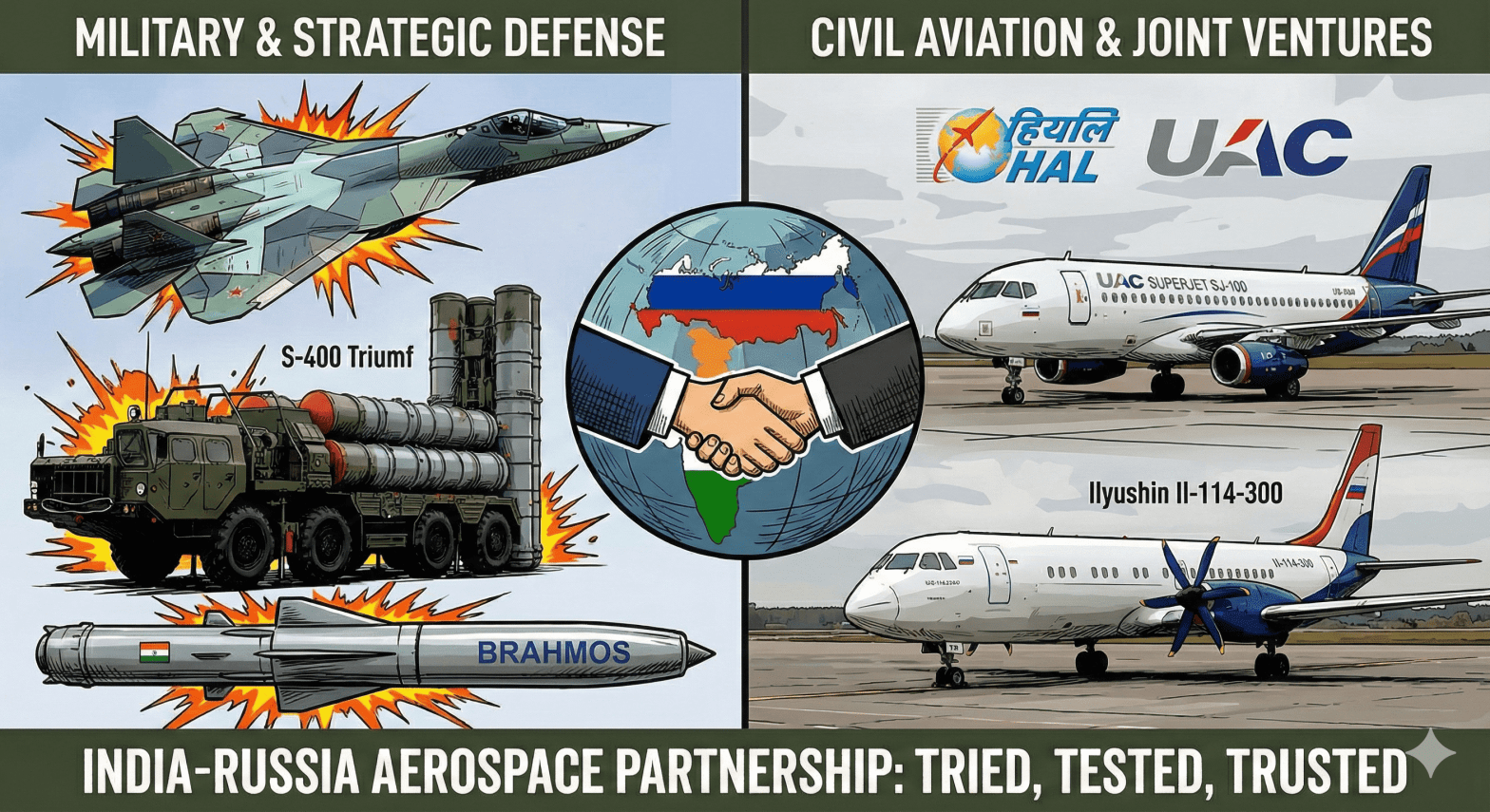
Russia just showcased the United Aircraft Corporation (UAC)’s Superjet SJ-100, and the turboprop Il-114-300 aircraft at Wings India 2026, in Hyderabad. India’s Hindustan Aeronautics Ltd (HAL) had earlier signed a MoU with UAC to make the near 100-seat SJ-100 regional jet in India. Russian aviation giant UAC has signed a deal to supply six Ilyushin Il-114-300 aircraft to India’s Flamingo Aerospace.
Russia is also aggressively pushing for India to co-produce the fifth-generation Su-57 fighter aircraft. Russia and India are working closely on air defence systems such as S-400, and the BrahMos missiles, which are both world-class military products. There are many other areas of joint work in space, submarines, and nuclear fields.
The cash-rich USA, and the West are often credited for more advanced technologies, but Soviets were the first to put a man in space, the first to set up a space station, and the first to use hypersonic missiles in combat. Their fighters manoeuvre with aerodynamics-defying agility, they produce some of the best aerial and ground-based missiles, they are very advanced in metallurgy and nuclear weaponry. The success of the MiG-21 had forced the USA to set up two MiG-killer air-combat schools. The Mi-8/17 were the most used helicopters of their class, and the AK-47 was a world-beater rifle. They managed all this with shoestring budgets, and only with hard work and technological prowess of their scientists. Russia is the world’s largest country with nearly 12% of Earth’s landmass, and also has abundant oil and gas, and other natural resources.
Today Russians face economic pressures, lack large-scale manufacturing skills and manpower, and find a shrinking defence market. India is a rising economic power with a soon-to-be third-largest economy, it has the largest population with growing consumption and among the bigger markets. India is also highly threatened by two nuclear-powered neighbours, with both of whom it has border disputes and has had conflicts. While India continues to reduce the Russian arms basket, it is still a good time for India and Russia to work closely in certain defence equipment, especially aerospace. It remains a tried-and-tested friend. Russia can bring in technology, India could set up the manufacturing hub with local skilled manpower, software, private sector strengths, bring in funding, and also global business best practices. The production can be for both Russia and India, and for the rest of the world. It is thus time to look at strengths of the Russian aerospace industry.
Early Political Congruence
India and the Soviet Union, and now Russia, have time-tested relations since India’s independence in 1947. In 1951, the USSR exercised its veto power on the Kashmir dispute in support of India. The Soviet Union declared its neutrality during the 1959 border dispute and the Sino-Indian War of October 1962, despite strong Chinese objections. The Soviet Union gave India substantial economic and military assistance, and by 1960, India had received more Soviet assistance than China had. In 1962, the Soviet Union agreed to transfer technology to produce nearly 800 MiG-21 jet fighters in India, which the Soviet Union had earlier denied to China. They helped India set up factories for the aircraft, aero-engines, and avionics.
Cold War and Beyond
In 1965, the Soviet Union served as a peace broker between India and Pakistan after their War of 1965. India’s relationship with the Soviet Union grew strategically and resulted in the Indo-Soviet Treaty of Friendship and Cooperation of August 1971. Through the 1971 India-Pakistan War for the liberation of Bangladesh, the Soviet Union stood by India against US and Chinese pressures.
During the Cold War, India and the USSR maintained a “special and privileged strategic partnership” that was built on five major components: politics, defence, civil nuclear energy, anti-terrorism cooperation, and space. Even after the dissolution of the Soviet Union, India continued warm relations with successor Russia. The first major political initiative after the dissolution was the Strategic Partnership signed between the two countries in 2000.
The IRIGC (India-Russia Intergovernmental Commission) is the main body that conducts affairs at the governmental level between both countries. Both countries are members of international bodies including the UN, BRICS, G20, SCO, and Russia-India-China (RIC) grouping. Russia supports India receiving a permanent seat on the United Nations Security Council.
India is one of the largest markets for the Russian defence industry. Approximately 60 percent of the Indian military’s hardware today is of Russian origin. Military hardware supplies and more recently production joint ventures have been a key pillar.
Soviet Make-in-India Began in 1960s
The Soviet Union was the first to support India for Make-in-India defence production. The MiG-21 factories set up in the early 1960s later made the MiG-27 (170), and Su-30MKI (230). Su-30MKI was a joint D&D project. Russia also learnt a lot from the Su-30MKI project and imbibed some of these ideas for their Su-30SM. 222 Su-30MKI were produced under licence at Hindustan Aeronautics Ltd (HAL)’s Nashik plant since 2004. An estimated 920 AL-31FP turbofans were manufactured at HAL’s Koraput Division. The Su-30MKI will be the backbone of the Indian Air Force (IAF)’s fighter fleet for some years to come.
In 1965, Heavy Vehicles Factory (HVF) was set up at Avadi, Chennai, with Soviet assistance. HVF products included Russian-designed T-72 Ajeya, and T-90 Bhishma tanks.
In September 1965, the Soviet Union and India signed the first contract for the delivery of naval equipment that included four Project I641 diesel-electric submarines, five Project 159E corvettes, and five Project 368P motor boats. The agreement also envisaged rendering Soviet technical assistance for the construction of a submarine naval base in Visakhapatnam.
Recently, two frigates, INS Tushil and INS Tamala, were built by Russia at the Yantar Shipyard, while the remaining two are being constructed at the Goa Shipyard Ltd (GSL) in India through technology transfer. Russia is reportedly expanding its shipbuilding cooperation with India, with two Indian shipyards being considered for construction of four non-nuclear icebreakers. Russian shipbuilding officials have offered New Delhi their nuclear-powered design for an Indian Navy aircraft carrier, according to reports.
GSL is also to construct 24 river-sea class cargo ships for Russian clients in the Caspian Sea by 2027. Cooperation with India in shipbuilding has its benefits for Russia, as the unit cost per vessel is projected to be half of what it would cost Russian shipbuilders. Russia is offering transfer of technologies for Project P-75(I).
Joint Ventures
Between 2012 and 2016, Russia accounted for 68% of India’s defence imports. Russia-India cooperation is not limited to a buyer-seller relationship but includes joint research and development, training, service-to-service contacts, including joint exercises. India and Russia have good success stories for Joint Ventures (JV). The BrahMos is a medium-range ramjet supersonic cruise missile that can be launched from submarines, ships, and fighter aircraft. BrahMos Aerospace is a joint venture between the Defence Research and Development Organisation (DRDO) and Russia’s NPO Mashinostroyeniya. The missiles are already being exported.
Under an over ₹5,000 crore contract signed in July 2021, over 610,000 AK-203 assault rifles are to be manufactured in India with technology transfer from Russia, by the JV Indo-Russian Rifles Private Limited (IRRPL). Indian companies hold the controlling 50.5 percent share and 49.5 percent is with Russian companies. The level of indigenous content achieved is already 50%, and going up rapidly, with a target of 100% later. India and Russia have also agreed to expedite the delivery of spare parts of Russian-origin military platforms by setting up a JV in India.
Notwithstanding the above, some JVs did not take off. India had withdrawn from the joint Fifth Generation Fighter Aircraft (FGFA) due to technical reasons. Finally, Russia continued the project and today has a successful Sukhoi Su-57 ‘Felon’ fifth-generation fighter. Russia is once again suggesting India join back.
Following the selection of the Ka-226T to meet an Indian requirement for 197 helicopters, an agreement was signed in December 2015 for the creation of a JV between Rostec, Russian Helicopters, and HAL to build the helicopters at a new factory to be built at Tumakuru in India. Later, India decided to make its own Light Utility Helicopter (LUH) based on the indigenous ‘Dhruv.’ India’s LUH is delayed, and Russia has been pushing the case for Ka-226T again.
Similarly, the Indo-Russian programme to develop a new Multi-role Transport Aircraft (MTA) through a JV between Russia’s UAC and India’s HAL was cancelled by India. In February 2023, on the sidelines of Aero India 2023, Russians offered joint development of the Il-276. However, India would prefer the aircraft to come with a European engine instead of a Russian engine, which is unlikely to be possible for Russia to propose.
S-400 Missile System “Sudarshan Chakra”
The S-400 is a Russian mobile Surface-to-Air Missile (SAM) system developed in the 1990s by Russia’s NPO Almaz as an upgrade to the S-300 family of missiles. The S-400 system has four radars and four sets of missiles covering different ranges and vertical bubbles. The maximum target detection range is 600 kilometres, and targets can be engaged as far as 400 kilometres. The five batteries of S-400 contracted by India in 2018 cost $5.43 billion, including reserve missiles. The systems have been tested in various Indian military exercises. India’s first combat usage of the S-400 was during the recent “Op Sindoor”, in which India credited it with thwarting Pakistan’s swarm drone and missile attacks, and for shooting down a Pakistani Airborne Early Warning and Control (AEW&C) aircraft at a record-breaking 313-kilometre range. In October 2025, India initiated a ₹10,000 crore ($1.1 billion) deal with Russia to acquire 300 additional missiles to replenish and strengthen its existing S-400 systems.
BrahMos JV
The BrahMos is a long-range ramjet supersonic cruise missile that can be launched from land, submarines, ships, and fighter aircraft. It is a joint venture between the Defence Research and Development Organisation (DRDO) and the Russian Federation’s NPO Mashinostroyeniya, who together have formed BrahMos Aerospace. The missile is based on the Russian P-800 Oniks. India holds a 50.5 percent share of the joint venture. Seventy-five percent of the missile is manufactured in India, and there are plans to increase this to 85 percent.
Large numbers of land-launched, ship-launched, as well as air-launched versions have been inducted and are in service of the Indian armed forces. The missile guidance has been developed by BrahMos Aerospace. In 2016, after India became a member of the Missile Technology Control Regime (MTCR), India and Russia gradually increased the range of the missile to 800 km.
The unit cost is around $3.5 million. The extended-range variant costs around $4.85 million. Many futuristic variants (1,500 km) are evolving. Smaller-sized variants like BrahMos-NG are ready. The Sukhoi Su-30MKI will carry three missiles, while MiG-29K, HAL Tejas, and Rafale will carry one. BrahMos-II will be a hypersonic cruise missile. A Unmanned Combat Aerial Vehicle (UCAV) variant is planned.
The Philippines has placed a substantial order for their services, and deliveries began in 2024. Russia too has plans to buy many missiles. Brazil has shown interest in the missile system. Vietnam and Indonesia have already signed deals.
Russian Sukhoi Su-57 “Felon” as Interim Fifth-Generation Aircraft for India
China has recently unveiled two sixth-generation fighter jets. Pakistan has also announced plans to acquire 40 J-35 stealth fighters from China. It could mean induction by around 2029. That will change the entire air dominance dynamics in the subcontinent.
Meanwhile, India’s Advanced Medium Combat Aircraft (AMCA), a fifth-generation multirole combat aircraft, received approval from India’s Cabinet Committee on Security for prototype development in March 2024. The stated timelines are for 2035 induction. Realistically, it may be later. This has generated a hot debate for India’s immediate plans and options.
The Su-57 is a highly manoeuvrable fighter like most others from the Sukhoi fighter stable. Its “Integrated Modular Avionics Combat Systems” use fibre-optic channels. It consists of the main nose-mounted N036-1-01 X-band AESA radar and two side-looking N036B-1-01 X-band AESA radars embedded in the cheeks of the forward fuselage for increased angular coverage. It also has an L-band array on the leading edges. The Su-57 uses advanced Artificial Intelligence (AI) and Man-Unmanned Teaming (MUM-T) technologies and will be able to launch and/or control the S-71M “Monochrome” combat UAV for deep-penetration attacks. Work is on to integrate the Okhotnik UCAV as a ‘loyal wingman’ for uncrewed teaming. A carrier-based variant of the aircraft is also under development.
The Su-57 can carry four Beyond-Visual-Range (BVR) missiles (R-37M) in its two main internal weapons bays and two short-range missiles (upgraded R-74) in the side bays. For missions that do not require stealth, the Su-57 can carry stores on its six external hardpoints, which could include the hypersonic Kh-47M2 Kinzhal air-launched ballistic missile.
The Su-57’s flyaway cost is reportedly around $45 million per aircraft, much lesser than the Chinese J-20, and even further cheaper than the much smaller single-engine American F-35. Russians suggest that the Su-57’s lifecycle costs are comparable to those of the Su-27, Su-30, and Su-35, which it was designed to replace.
Russia is willing to open the entire fifth-generation ecosystem, which includes engines, sensors, stealth materials, avionics, and other classified systems. Russia is also prepared to provide technological learning in areas such as fifth-generation engines, optics, AESA radar, artificial intelligence, low-signature technologies, and advanced air weapons, many of which have been denied by the West. The Su-57 is being termed the “mother of all offers” with complete technology transfer and co-production in India.
UAC SJ-100 Production in India
India has been wanting to have its own Indian regional jet (IRJ) airliner for some time. India finally found a partner in Russia’s United Aircraft Corporation (UAC) to make the SJ-100 in India. Hindustan Aeronautics Ltd (HAL) will initially have the right to produce the aircraft for domestic customers in India. HAL estimates that there is a market for over 200 regional jets in India over the next decade, with a further 350 required by the “Indian Ocean Region” countries. The move is seen as a pivotal step toward self-reliance in civil aviation, potentially injecting competition into a market long monopolized by Boeing and Airbus, and to some extent by Embraer.
UAC is currently under US, UK, and EU sanctions. India has said it does not subscribe to unilateral sanctions and has criticised the targeting of its ties with Moscow as unjustified and unfair, while accusing the West of double standards because the EU and the US still buy Russian goods worth billions of dollars. In due course, the sanctions will be over. Regional jets have yet to make significant inroads in the Indian market, with carriers preferring larger narrow-body aircraft. India’s major regional jet operator is Star Air, which operates seven Embraer E175s and two ERJ-145s.
The SJ-100 currently has 71 firm orders, all from Russian carriers. UAC is meanwhile conducting certification tests of the SJ-100, with Russian Aviadvigatel PD-8 engines. Some airlines have been attracted by its low introductory price. The later variants will have winglets, and cabin density up to 108 seats.
Undoubtedly, the SJ-100 has had its teething supply chain troubles. But that is true for many airliners, including the Boeing 737 Max. Western sanctions have made things more complex. China remains dependent on Western aero-engines for its home-grown C919 and C929 airliners. India will have to negotiate to get appropriate aero-engines for its own aircraft. FAA and EASA certification will need to be renegotiated. Airlines within India would have to be brought on board. The SJ-100 could be a win-win for India and Russia.
Russian Missiles among the Best in the World
India has been using Soviet/Russian aerial missiles since the early 1960s, and they have performed very well against Western missile-armed aircraft with Pakistan. Both India and Russia saw opportunities in working together and set up BrahMos Aerospace.
Russia’s top air-to-air missiles (AAM) include the R-37M, a long-range (300 km) hypersonic missile designed to target aircraft like AWACS from safe distances. The newer R-77-1 (RVV-SD), an upgrade of R-77 with a 200 km range, is intended to counter stealth aircraft. Other notable missiles include the KS-172 (also known as the K-100 or RVV-L), a project for an even longer-range missile with a 400 km range. Reports from May 2025 indicate this missile is operational. Russia is introducing new nuclear-tipped AAM as part of an overall expansion of its nuclear forces, according to an assessment from the Pentagon’s Defence Intelligence Agency (DIA).
India already operates the baseline version of the R-77 (export variant RVV-AE, 80 km), the Russian counterpart to the American AIM-120 AMRAAM. The R-77-1 variant range is 110 km. India also operates R-27 AAM (range 75 km), the extended-range R-27ER (130 km), and close-combat AAM R-73 (40 km).
Russia’s top air-to-ground missiles include the Mach 10 hypersonic Kh-47M2 Kinzhal, with an estimated range of 480 km. The Kh-59MK2 is a long-range precision-guided missile designed to strike radar-contrast targets at long distances, day or night. The Kh-31 is a multi-role supersonic missile that can be configured for anti-ship or anti-radiation roles and is used by various countries, including India. Other significant missiles include the Kh-38M, Kh-55, Kh-29, Kh-59, and Kh-31 missiles.
The air-to-sea missiles include the nuclear-capable, hypersonic (Mach 9) 3M22 Zircon, the supersonic P-800 Oniks, and the Kalibr cruise missile family. The Kh-35 is another widely used subsonic, turbojet anti-ship and anti-radar cruise missile.
Russia’s top surface-to-air missiles include the S-400 “Triumf”, the S-500 “Prometheus”, and the Buk-M3. The S-400 is a widely deployed advanced system with a range of up to 400 km, while the S-500 is a newer long-range system with a reported range of 600 km, designed to intercept a variety of aerial targets, including ballistic missiles. The Buk-M3 is another key system, and the Pantsir S-1 is a short-range system.
Western versus Russian Platforms
Having adequately flown both the Russian and Western aircraft, one can say that both had their own strengths, weaknesses, and idiosyncrasies. Russian aircraft were simpler in design, the cockpits were big, more mechanical than complex electronics, and had high standardisation and commonality. Switching from one Russian aircraft to another was so much easier. The levelling mode of the Russian autopilot brought you to level flight by pressing one button on the control column. This was handy if one got disoriented. Russian ejection seats were also very simple, and as foolproof as Western ones. Russian aircraft engines have brute power, but they were often fuel-guzzlers, and some had high specific fuel consumption (SFC), and many passed out smoke through their exhaust. Russian aircraft were cheaper in their base price, but in the long run, their lifecycle costs were higher. For example, a MiG-29 would overtake a Mirage 2000 in around seven years in lifecycle costs.
The Western avionics, including electronic warfare systems, were more sophisticated. Russians used brute power there too. Russian aircraft required greater stick displacement for any aircraft response; it was much lesser in Western aircraft. Russian cockpit switches were much larger and easy to operate in the cockpit, while the Western ones were smaller and one had to get used to them while operating with gloves on. The Russian and Western artificial horizon instrument display was quite different. In Russian aircraft, the artificial horizon bar turned with the aircraft, thus remained parallel to the aircraft and not to the actual horizon. The aircraft symbol/bar moved twice the degrees to indicate the bank. This worked well when one was head-down. Most pilots really liked this instrument (AGD). In the Head-Up Displays of initial Russian aircraft, they replicated the same display. This was most confusing because the displayed horizon was different from the real one. This was changed in more recent aircraft. Russian inner helmets were standardised between pilots, tank crew, and even ship or submarine crew. The Russian radio navigation system (RSBN) was more complex than the Western TACAN, and less accurate.
Soviet/Russian aircraft remained more than a match for the Western world. They often achieved results with simpler and cheaper means.
Bright Future Together
In the last two decades, India did look for alternative military hardware sourcing from the USA, France, and Israel. But invariably, India went back to its time-tested strategic partner, Russia. Most of the platforms bought from the Western nations were also through G2G deals, as has been the case with all Soviet/Russian deals. There was little or no Transfer of Technology (ToT) in Western deals. India did manage to get better ToT with Make-in-India Russian deals and JVs. But many foreign OEMs, Lockheed Martin, Boeing, and GE have many Make-in-India projects of late. Russia too is making bold offers.
Recently, India ordered 12 additional Sukhoi Su-30MKI worth $1.5 billion. India also placed orders for 240 Lyulka-Saturn AL-31FP aero-engines worth $3.05 billion. Though both orders are with HAL, they will require major supplies from Russia. The engines are being built from the raw material stage with technology transfer from Russia, and some spares, forgings, and castings are expected to be imported.
India plans to begin upgrading its Su-30MKI in India. Initially, it will involve 84 aircraft, but subsequently, the entire fleet will get upgraded. Sukhoi will also be involved in the project for the upgrade of the fly-by-wire system. The jets will also be modified to fire BrahMos-ER missiles. All this will require major Russian support. India is in the process of procuring 21 additional MiG-29s from Russia, which would enable replacement of earlier losses and raise another squadron. India earlier upgraded its MiG-29 and MiG-21 fleets with Russian support.
Russia had pitched to jointly make six Air Independent Propulsion (AIP) conventional submarines for the Indian Navy under the P-75(I) project, but the ₹70,000 crore ($8.2 billion) programme has now gone to state-run Mazagon Dock Shipbuilders Limited (MDL) in partnership with Germany’s ThyssenKrupp Marine Systems (TKMS). India and Russia signed a $3 billion deal in March 2019 for the lease of a third nuclear-powered attack submarine, INS Chakra-III (an Akula-class submarine).
There have been reports that negotiations are on between HAL and Russia for exporting Indian-produced, Russia-supported Su-30MKIs to global customers. While Russia works to circumvent American economic sanctions, more Russian companies are wanting to set up production facilities in India.
Defence cooperation is an important pillar of the India-Russia strategic partnership. It is guided by the India-Russia Inter-Governmental Commission on Military Technical Cooperation (IRIGC-MTC) set up in 2000. The Agreement for 2021–2031 guides further cooperation in the sphere of research and development, production, and after-sales support of armament systems and various military equipment. Uninterrupted supply of spare parts to the Soviet/Russian-origin equipment is a critical issue being discussed between the two countries.
The Reciprocal Exchange of Logistics Agreement (RELOS), which will facilitate military logistic exchanges for exercises, training, port calls, disaster relief, and ease access to Russian military facilities, especially in the Arctic, was signed on February 18, 2025.
India could consider buying two to three squadrons of Su-57 as an interim option till India’s own AMCA comes up in the late 2030s. There are some in India who believe that the Indian Air Force (IAF) must also consider buying about 15–20 Russian Tu-160M strategic bombers to counter the large bomber fleet of China.
Russia is conscious of not depending too much on its growing neighbour, China, and needs India as a hedge and balance. As the Russian Ambassador to India, Nikolay Kudashev, said recently, “The sky is the limit for the expansion of Russia-India Partnership.” Clearly, both Russia and India need each other, and the umbilical cord between the two will continue to remain connected for decades ahead.
Note: The article was originally written by the Author for The Eurasian Times on 1st, February 2026, it has since been updated.
Header Picture Credit: Representative Image Generated using AI
Twitter: @AirPowerAsia
 Air Power Asia