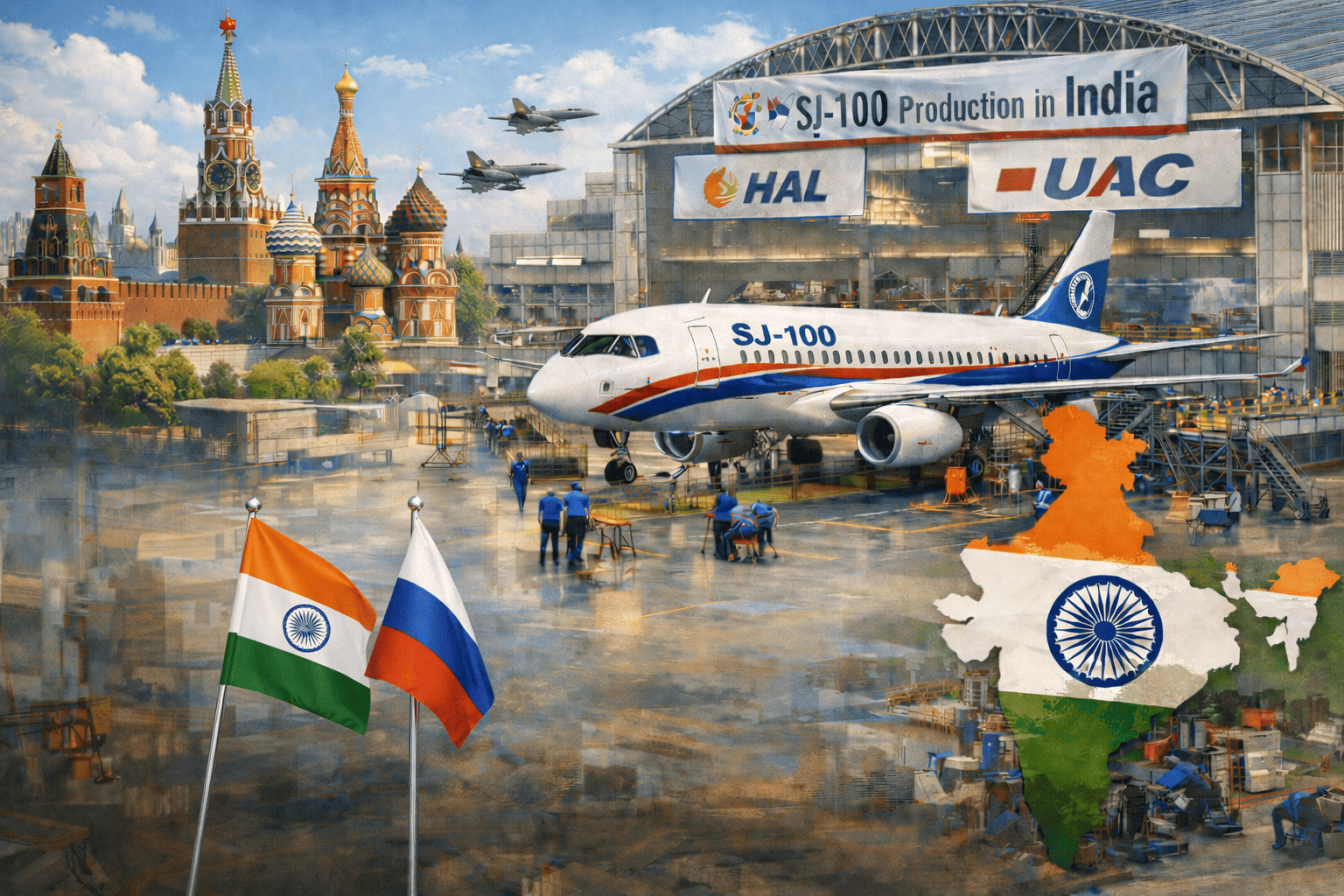
India’s Hindustan Aeronautics (HAL) and Russia’s PJSC United Aircraft Corporation (UAC) have signed a memorandum of understanding (MOU) for Sukhoi Superjet100 (SJ-100) production in India. It was signed in Moscow, Russia on October 27, 2025. Under the agreement, HAL will have the right to produce the aircraft for domestic customers in India. The MoU was signed by officials from the two companies. HAL has long co-operated with Russian industry to produce military aircraft such as Mikoyan MiG-21, MiG-27, and Sukhoi Su-30MKI. This collaboration represents the first time a “complete passenger” aircraft will be produced in India since the AVRO HS-748 project, which began in 1961 and ended in 1988, many decades ago. Yes, the Dornier 228 is also made in India by HAL under license. The aircraft is used for various roles by the Indian armed forces and is now also being used for commercial and civil aviation to connect remote areas.
New Delhi has been placing high priority on improving regional connectivity through its ‘Udan’ scheme. It will also support domestic job creation and local production. HAL estimates that there is a market for over 200 regional jets in India over the next decade, with a further 350 required by the “Indian Ocean Region” countries. No details were given as to potential Indian customers for the SJ-100 or when production might commence. The move is seen as a pivotal step toward self-reliance in civil aviation, potentially injecting competition into a market long monopolized by Boeing and Airbus, and to some extent by Embraer.
HAL has chosen to manufacture passenger jets with Russian firm that is under sanctions from US, UK, and EU. The US Treasury has called Moscow’s public joint stock company UAC a key enterprise in Russia’s military-industrial complex. India has said it does not subscribe to unilateral sanctions and has criticised the targeting of its ties with Moscow as unjustified and unfair, while accusing the West of double standards because the EU and the US still buy Russian goods worth billions of dollars.
Regional jets have yet to make significant inroads in the Indian market, with carriers preferring larger narrow-body aircraft. India’s major regional jet operator is Star Air, which operates seven Embraer E175s and two ERJ-145s.
The SJ-100 currently has 71 firm orders, all from Russian carriers, with Red Wings Airlines the largest holding 45 orders. The Superjet 100 from which it is derived is still powered by the PowerJet SaM146, a joint programme with French firm Safran. UAC is meanwhile conducting certification tests of the SJ-100, with Russian Aviadvigatel PD-8 engines.
Sukhoi Superjet 100
The UAC Sukhoi SJ-100 is a twin-engine, narrow-body, short-haul, regional jet aircraft that made its first flight in 2008 and made its first commercial flight in 2011. A five-abreast layout was chosen as being optimal for this size range. It is currently in operation with more than 16 commercial airline operators. Over 235 aircraft have already been produced at Komsomolsk-on-Amur Aircraft Plant. Primary users are Aeroflot, Yamal Airlines, Red Wings Airlines, Azimuth, and Gazpromavia.
Typically the aircraft carries 87 to 98 passengers. In October 2003, the key suppliers selected included Thales for avionics, Messier-Bugatti-Dowty for landing gear, Honeywell for the auxiliary power unit, Liebherr for flight controls, Intertechnique for fuel systems, Parker Hannifin for hydraulic systems, B/E Aerospace for interiors. In June 2007, Boeing expanded its assistance to cover flight and maintenance crew training and manuals, and spare parts management and supply. Sukhoi and Alenia Aeronautica established the SuperJet International joint venture for customer support outside Russia and Asia. Alenia Aeronautica took a 25 percent stake in Sukhoi Civil Aircraft Corporation (SCAC) for $250 million, valuing it at $1 billion.
In February 2011, the Interstate Aviation Committee (IAC), a Russian certification authority, granted a Type Certificate. EASA’s Type Certificate followed on in February 2012, allowing operations in European countries. However, on 14 March 2022, EASA revoked the Superjet’s airworthiness certificate as part of the EU’s sanctions against Russia following the Russian invasion of Ukraine. Western content accounted for 55–60 percent of the original SSJ100’s cost but sanctions against Russia were tightening by 2018 for support to Iran.
Aircraft built before 2025 are powered by two 77–79 kN PowerJet SaM146 turbofans developed by a joint venture between French Safran and Russian NPO Saturn. In 2022, Sukhoi announced a Russified version of the body and electronics, without most of the Western components. The Russified SSJ100R was planned to use a smaller variant of the Aviadvigatel PD-14 engine, the Aviadvigatel PD-8; KRET electronic units were to replace the Thales avionics; a Russian inertial navigation system and APU were to replace Honeywell’s devices; and new Russian landing gear was brought in. Fuel burn was planned to be reduced by 5-8 percent with a new composite wing. Russian content was set to double to 30 percent, as US restrictions limited its export potential. The seating capacity was to be raised to 110, and high and hot operations to 4000 m and 50 °C. A freighter variant was also studied. Aeroflot ordered 89 Russified aircraft in 2022. In August 2023, parent company Irkut rebranded itself as Yakovlev, with the Superjet now known as the SJ-100. The Russified prototypes were assembled in 2023, with structural testing of the updated airframe and certification of the PD-8 engine both expected to be completed and production was expected to begin in 2024.
Operational History and Initial Teething Problems
On 19 April 2011, the first production aircraft Part-Russian jet, with Snecma-Saturn engine, was handed over to Armavia at Zvartnots Airport in Yerevan, to be operated to Moscow and Sochi, as well as Ukrainian cities. The aircraft was named after Yuri Gagarin. On 21 April, the first commercial flight landed at Moscow Sheremetyevo, lasting 2 h 55 min; Armavia used the Airbus A319 on this route before switching to the Superjet 100. On 1 May, it made its first commercial flight to Venice Airport in around 4 hours. By March 2012, the six aircraft operated by Aeroflot were flying 3.9 hours/day instead of the standard 8–9 hours due to failures and parts delivery delays, and the airline asked for compensation. In August 2012, Armavia announced that it had returned both of its SSJ100s to the manufacturer. Armavia then avoided further deliveries. In February 2013, Sukhoi stated teething problems are usual in new airliners.
The SSJ entered service with Mexican Interjet on 18 September 2013; in their first four weeks, the first two aircraft operated were flown 580 times over 600 hours with a daily utilisation of 9.74 hours and a dispatch reliability of 99.03 percent. By June 2014, Interjet had received seven SSJ100s and the dispatch reliability had increased to 99.7 percent. On 12 September 2014, Interjet started regular passenger flights to the US, on the Monterrey, Mexico, San Antonio, and Texas. Reliability issues were compounded by the lack of service facilities in the Americas for the SSJ, a factor which also contributed to the poor reliability. Interjet confirmed by January of 2020 that it was planning to phase out its SSJ100 fleet. On 3 June 2016, the Irish carrier CityJet was the first western European airline to take delivery of an SSJ100. But CityJet had ceased all use of SSJ-100 aircraft by November of 2020.
Interjet claimed its capital cost for 10 Superjets was equivalent to the pre-delivery payment for one Airbus A320. An A320 list price was $88.3M in 2012. Some airlines have been attracted by its low introductory price. The updated SSJs would have winglets, a higher MTOW and improved systems and interior. Sukhoi has also proposed to increase the cabin density from 93 to 108 seats by reducing the pitch from 34 to 30 in (86 to 76 cm).
Slow Sales and Impact of Sanctions
Sukhoi delivered only three SSJs in the first half of 2019. The company needs to achieve a production rate of 32 to 34 aircraft per year to make a profit, though demand for Russian models in the 60–120 seat category is forecast to be only 10 aircraft per year over a 20-year period. In the short-term, the company’s main hope is that Aeroflot will firm up its 2018 preliminary agreement for 100 SSJs. Yamal Airlines, the second-largest Russian SSJ operator, announced the cancellation of its order for 10 further SSJs, citing high servicing costs. Of 30–40 SSJs owned by Aeroflot, only 10 are reportedly usable at a time due to maintenance problems. Aeroflot cancelled approximately 50 Superjet flights in the week following the Flight 1492 accident.
A total of 12 jets were delivered in 2020 to the following operators: Rossiya Airlines, Azimuth Airlines, Red Wings Airlines. The sole remaining western operator, Interjet, down by the end of November 2020 to just four operational SSJ100s, quit flying in December 2020 and entered bankruptcy in April 2021. In December 2020, Rossiya Airlines announced that it intends to operate 66 Superjets by the end of 2021, transferred from its parent company Aeroflot which currently has 54 SJs. In September 2023, North Korea’s supreme leader Kim Jong Un visited a fighter aircraft production in Russia’s Far East; he also inspected civil aviation project, including the domestic made Superjet 100.
Russian operators of the Superjet 100 encountered difficulties in keeping their fleets airborne as result of sanctions imposed following the Russian invasion of Ukraine. In 2023, it emerged that there was a shortage of parts for the SaM146 engines, namely igniter plugs produced in the United States and French fuel filters for which no domestic replacement could be found. Rossiya Airlines expressed fears that only 40 percent of its Superjet 100 fleet would be active in the spring and summer of 2023 due to lack of parts. As of April 2023, there were approx. 160 Superjet aircraft in service.
SJ-100 Current Status
On 5 September 2025, the first serial-produced import-substituted aircraft (serial number 97024) powered by a pair of PD-8 engines, completed its maiden flight; at that date 24 SJ-100s were reported to be at various stages of completion. Deliveries of airplanes were to begin in 2026. In Russia, it replaces the aging Tupolev Tu-134 and Yakovlev Yak-42 aircraft. Globally it competes with the Antonov An-148, Embraer E190 and the Bombardier CRJ1000. Sukhoi claims that cash operational costs were lower than competitors’ costs by 8-10 percent, with reduced fuel burn per seat and longer maintenance intervals. The design reportedly meets CIS AP-25, US FAR-25 and EU JAR-25 aviation rules, and conforms to ICAO Chapter 4 and FAR 36 Section 4 noise standards since 2006.
Some Indo-Russian Deals Did not Translate into Production
While co-operation between HAL and Russian aircraft design bureaus has been good, there were occasions when things did not move forward. The plans to develop an Indian Fifth-Generation Fighter Aircraft (FGFA) fell through in 2018 after nearly 8 years of joint work and sinking significant money. The Russians continued the project and the aircraft fructified into Su-57 “Felon”. Ironically the same is now on offer for Make-in-India.
The Multirole Transport Aircraft (MTA) began as a joint venture between India and Russia in 2010, to co-develop and produce a medium transport aircraft for Indian Air Force (IAF). It was an Il-214/Il-276 variant. The project stalled and was eventually called off around 2016 due to disagreements over design, engine selection, and cost-sharing. India has revived search for a new MTA. The IAF’s Medium Transport Aircraft (MTA) program to replace its aging fleet of Antonov An-32 and Ilyushin Il-76 jets. The program will procure between 60 and 80 aircraft in the 18 to 30-tonne payload class, with a strong emphasis on technology transfer and domestic manufacturing under the ‘Make in India’ initiative. Key contenders include the Embraer C-390 Millennium, Lockheed Martin C-130J Super Hercules, and Airbus A400M Atlas. The IL-276 still being offered by Russia as an option.
In 2015 a MoU was signed between India and Russia for joint production of 200 Kamov Ka-226T helicopters through the joint venture, Indo-Russian Helicopters Limited (IRHL). The project stalled in 2022 due to factors including India’s preference for indigenously developed aircraft and issues with the original French engine. Russia is now seeking to revive the project with a new, domestically produced VK-650V engine, which could meet India’s indigenous content requirements.
SJ-100 Win-Win for India and Russia
India is the fourth largest global economy; it has the fastest growing civil aviation sector which is already the third largest in the world. Yet it does not have an airliner of its own. India also does not produce an aircraft aero-engine. India has been working on its Indian Regional Jet (IRJ) for some time. The aircraft was intended to seat 80–100 passengers and was expected to have cost-effective operations, with a projected introduction around 2026. Physically it is moving behind schedule. Therefore, a collaboration may interest India. HAL could not have gone ahead and signed the MoU without Indian government’s tacit approval. Of course the details would have to be worked out. In the past, work share and costs have been the impediments.
Undoubtedly, the SJ-100 has had its teething supply chain troubles. But that is true for many airliners including Boeing 737 Max. Western sanctions have made things more complex. China remains dependent on Western aero-engines for its home-grown C919 and C929 airliners. India will have to negotiate to get appropriate aero-engines for its own aircraft. Viability of sales will have to be assessed keeping in mind the competition by well entrenched players like Boeing and Airbus. Maintenance and spare back-ups would also have to be tied up. FAA and EASA certification may not be critical initially, but in the long run it will be important if planes would be exported. Airlines within India would have to be brought on-board. It is hoped and presumed that sanctions on Russia and high tariffs on India will peter off after sometime. SJ-100 also makes great optics before President Putin’s visit to India, when more defence related deals may actually be announced. We still need to wait and watch.
Note: The article was originally written by the Author for Russia Today on, October 29th, 2025, it has since been updated.
Header Picture Credit: Representative Image Generated using AI
Twitter: @AirPowerAsia
 Air Power Asia